Most of what a seller in Jordan must do when issuing an invoice traces back to one text, the Jordan invoicing regulation No. 34 of 2019. Its full name is Regulation No. 34 of 2019 on Organizing and Controlling Invoicing Affairs, as amended (Regulation 34/2019). This text is the source of the mandatory items on an invoice, how long invoices must be kept, when they must be issued, and the recognition of an invoice issued by the National Invoicing System (JoFotara) or by a program linked to it.
In short, Regulation 34/2019 was issued under paragraph (F) of Article 23 of Income Tax Law No. 34 of 2014, and it has sixteen articles. They govern the form, content and retention of the invoice, refer penalties to the Income Tax Law itself, and leave the implementing detail to instructions issued by the Minister of Finance.
This article explains the articles of Regulation 34/2019 in plain English, in the order of the consolidated text that the Income and Sales Tax Department (ISTD) publishes, and gives the Arabic wording where the exact words carry the point. It does not replace the official text. It also does not go into exemption thresholds or fine amounts, because each of those topics has its own article in this series.
What is the Jordan invoicing regulation No. 34 of 2019?
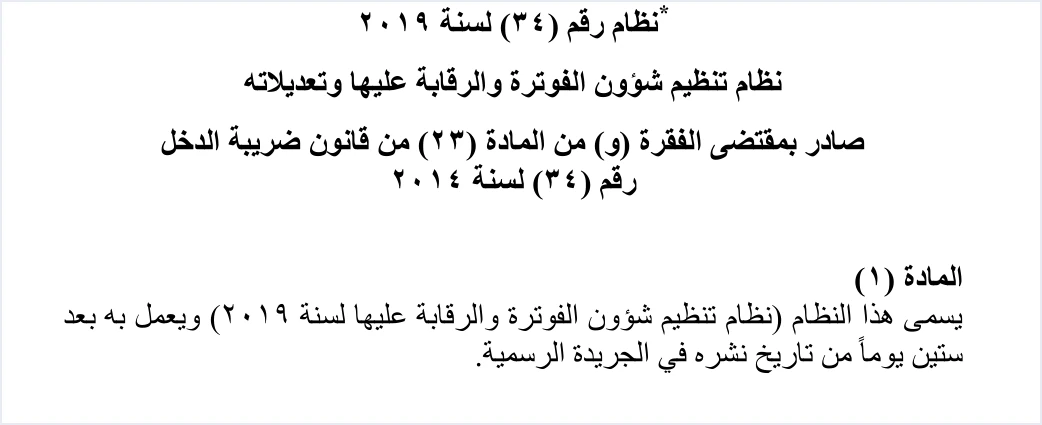
Regulation 34/2019 is secondary legislation, that is, a regulation issued under a law. Its heading states the law it was issued under, and here is the Arabic wording.
«صادر بمقتضى الفقرة (و) من المادة (23) من قانون ضريبة الدخل رقم (34) لسنة 2014»
In English, the heading says that the regulation was issued under paragraph (F) of Article 23 of Income Tax Law No. 34 of 2014. No official English translation of this regulation was found; the English here is our rendering, and the Arabic text is the authority.
For this reason, Regulation 34/2019 refers back to the Income Tax Law on everything it does not define or settle itself, and penalties are one example.
Watch the two similar numbers. No. 34 of 2019 is the number of the regulation. No. 34 of 2014 is the number of the law under which the regulation was issued. They are two different texts, and when Regulation 34/2019 refers to the law, it means the Income Tax Law.
Publication and amendment are given in the footnote on the first page of the consolidated text.
- Publication. The original regulation was published in the Official Gazette, issue 5572, dated 1 May 2019. Article 1 of Regulation 34/2019 provides that it takes effect sixty days after the date of its publication in the Official Gazette.
- Amendment. It was amended by amending Regulation No. 13 of 2023, published in the Official Gazette, issue 5851, dated 16 April 2023.

The consolidated text that ISTD publishes merges the amendment into the articles and does not mark which articles were amended. This article therefore explains the text in force as ISTD publishes it, and does not compare it with the original 2019 version.
Regulation 34/2019 has a companion implementing text, Instructions No. 1 of 2019 on Invoicing Affairs and Their Control, as amended (Instructions 1/2019). They were issued under paragraph (a) of Article 11 and Article 16 of Regulation 34/2019. For a wider view of the electronic system that applies these provisions, see the section on the legal basis in our article Jordan’s National E-Invoicing System.
A map of the sixteen articles
Before the detail, here is the subject of each article of Regulation 34/2019 in one line.
Articles 1 and 2: name and definitions
Article 1 of Regulation 34/2019 sets the name of the regulation and when it takes effect, as covered above. Article 2 of Regulation 34/2019 sets the meanings through which the other articles are read. The law is the Income Tax Law, the Minister is the Minister of Finance, the Department is ISTD, the Director is its Director General, and a person is a natural or legal person.
The other definitions in Article 2 of Regulation 34/2019 contain details worth noting.
- Goods. Any natural material or any animal, agricultural or industrial product, and the definition expressly includes electric power.
- Service. Any work a person does for consideration, or the provision of a benefit to others. It does not cover supplying goods, unless those goods are needed to provide the service.
- Sale of goods. This is not limited to transferring ownership for a price. It also covers a transfer without consideration, and the taxpayer’s use of the goods for their own purposes, or enabling others to use them.
- Sale of a service. Performing, providing or supplying the service from the seller to the buyer for consideration. A free service therefore falls outside this definition, unlike free goods.
- Invoice. A document issued by the seller that shows a description of the goods or service, the price and the quantity, and the amount of General Sales Tax (GST), the last item applying if the seller is registered for sales tax. A seller who is not registered issues an invoice that carries no tax amount.
Paragraph (b) of Article 2 of Regulation 34/2019 adds that the definitions in the law apply wherever the regulation uses those terms, unless the context indicates otherwise. These are definitions for this regulation. If you want to know how a given sale affects General Sales Tax, the reference is the General Sales Tax Law, not this article.
Article 3: the time and date of the sale
Article 3 of Regulation 34/2019 fixes the time and date of a sale of goods or a sale of a service. Here is the Arabic wording.
«يكون الوقت والتاريخ اللذان تقع فيهما عملية بيع السلعة أو بيع الخدمة وفق أحكام هذا النظام هما وقت وتاريخ تحقق واقعة بيع أي منهما»
In English, the time and date at which a sale of goods or a sale of a service takes place under the regulation are the time and date on which the sale of either actually occurs. No official English translation of this regulation was found; the English here is our rendering, and the Arabic text is the authority.
Article 3 of Regulation 34/2019 speaks of the sale, not of the invoice. The link to the invoice comes from paragraph (d) of Article 5 of Regulation 34/2019, which requires the seller to issue the invoice when the sale occurs. Read together, the two articles mean that the invoice date follows the date of the actual sale.
The rule, then, is that the invoice is issued with the sale. Sales are not collected and invoiced at the end of the week or the month, except in the special case governed by Article 7 of Regulation 34/2019, with the prior approval of the Director.
Article 4: the invoice the regulation recognizes
Article 4 of Regulation 34/2019 is the legal link between the regulation and the National Invoicing System. It has two paragraphs.
Paragraph (a). This paragraph names the two accepted sources of an electronic invoice. Here is the Arabic wording.
«تعتمد الفاتورة الالكترونية الصادرة عن برنامج الفوترة الوطني الالكتروني أو الصادرة عن برنامج تم ربطه ببرنامج الفوترة الوطني الالكتروني»
In English, Article 4(a) of Regulation No. 34 of 2019 provides that, for the purposes of the regulation, the electronic invoice that is recognized is the one issued by the National Invoicing System or by a program linked to it. No official English translation of this regulation was found; the English here is our rendering, and the Arabic text is the authority.
So there are two accepted routes, issuing directly from the National Invoicing System, or issuing from a program linked to it.
Paragraph (b). Under paragraph (b) of Article 4 of Regulation 34/2019, ISTD is responsible for issuing and organizing the invoice through the system, or through a direct link with the system according to the time plan prepared for that purpose.
The time plan in paragraph (b) of Article 4 of Regulation 34/2019 ties the direct link to a plan prepared for that purpose. The text gives neither the date of that plan nor its content, so no deadline can be drawn from this article.
If you issue your invoices from accounting software, the next question is whether linking accounting software to JoFotara is mandatory.
Article 5: invoice items and delivery
Article 5 of Regulation 34/2019 is the longest article of the regulation and the one with the most effect on day-to-day work. Paragraph (a) of Article 5 of Regulation 34/2019 requires the seller of any goods or service worth not less than one dinar to issue an invoice in at least two copies, and the invoice must carry five items.
- The invoice serial number.
- The seller’s full name and address.
- The seller’s tax number if registered for sales tax, or national number if not.
- The date on which the invoice was organized and issued.
- The type, quantity and value of the goods or service sold, and the invoice total.
The other paragraphs of Article 5 of Regulation 34/2019 add three rules.
- Buyer’s name. Article 5(b) of Regulation No. 34 of 2019 requires the buyer’s name to be stated clearly in a deferred sale, an installment sale or a sale paid in stages.
- Buyer’s copy. Under paragraph (c)(1) of Article 5 of Regulation 34/2019, a copy goes to the buyer in line with the method used to organize and issue the invoices, and the other copies stay with the seller. A seller who issues invoices electronically delivers the buyer’s copy in the same way.
- Proof of receipt. Under paragraph (c)(2) of Article 5 of Regulation 34/2019, when the value of an invoice exceeds JOD 10,000, the seller must prove that the buyer has received it. The rule starts above that amount, not at it.
Articles 6 and 7: the invoice register and the daily invoice
Article 6 of Regulation 34/2019 requires every person who must issue invoices to keep a paper or computerized register of sales invoices, headed with the seller’s name. The register carries four items, the register page number, the buyer’s name, the invoice number and the invoice total.
Article 7 of Regulation 34/2019 allows commercial markets, or any other party, to issue a total invoice for each day that covers all of its daily sales. This option has two conditions, a request from the party and the Director’s prior approval. The article also provides that this is organized under instructions the Minister issues for that purpose. The detailed procedure is therefore in those instructions, not in the regulation, so check it with ISTD before you base your way of working on it.
Articles 8 and 9: four years of retention and data transfer
Article 8 of Regulation 34/2019 requires an invoice to be kept for four years, counted from the latest of the following three dates.
- The end of the tax period in which the invoice was issued.
- The date the tax return was filed.
- The date of notification of the result of an administrative assessment.
If there is a dispute over the invoice, over the amount of tax due, or over any fines and amounts related to it, retention continues until the dispute is settled or a final court decision is issued. The text adds that, in all cases, the retention period must not be shorter than four years. Four years is therefore a minimum that a dispute does not shorten.
Paragraph (b) of Article 8 of Regulation 34/2019 provides that data in the National Invoicing System is accepted in place of keeping the invoice on paper. This does not cancel the duty to keep invoices, but it makes the data held in JoFotara an accepted substitute for a paper archive.
Article 9 of Regulation 34/2019 requires every seller to enable ISTD to transfer, electronically, all data and information relating to invoices and their contents, with the unit set up at ISTD taking on this responsibility. This is the unit that Article 14 of Regulation 34/2019 returns to.
Article 10: seller and buyer are responsible together
Article 10 of Regulation 34/2019 places responsibility for the invoice data matching what actually happened in the sale on the seller and the buyer alike. Each of them is responsible for invoices that do not match the facts.
The buyer is not a passive party who only receives the invoice. A buyer who receives an invoice that does not reflect what was actually bought, in quantity, value or type of goods, shares responsibility for it. That is why an accountant does well to review supplier invoices when they arrive, not when the return is being prepared.
Articles 11, 12 and 13: special cases
Article 11. Article 11 of Regulation 34/2019 exempts certain categories from issuing invoices. The exemption depends on the activity that is registered and actually carried on, together with an annual sales ceiling, and the article leaves room for other parties or categories to be set by instructions. Two rules are tied to the exemption.
- If there is sufficient evidence that the sales of a person who is not obliged exceed the limit, paragraph (b) of Article 11 of Regulation 34/2019 gives the Director the power to oblige that person to issue invoices, and the provisions of the regulation then apply. An exemption is therefore not a permanent status.
- Under paragraph (c) of Article 11 of Regulation 34/2019, an exempt party may ask ISTD in writing to issue invoices, and in that case the provisions of the regulation apply to it. A party that joins voluntarily is bound by the whole regulation.
The exempt categories and their ceilings are covered in our article on exemption from the National Invoicing System, and the full picture of who the system covers is in our article Who Must Use E-Invoicing in Jordan?
Article 12. Under Article 12 of Regulation 34/2019, the Director may, on the recommendation of a technical committee formed at ISTD and on a written request from the seller or from any party the regulation applies to, amend the items shown on invoices or issue invoice forms that suit the nature of the seller’s activity. This article serves activities that the five general invoice items do not fit.
Article 13. Article 13 of Regulation 34/2019 applies notwithstanding anything else in the regulation. It accepts lease contracts in place of invoices, provided that they contain the items set out in Article 5 of Regulation 34/2019. A contract that carries those items therefore stands in for the invoice under this article.
Articles 14, 15 and 16: oversight, penalties and instructions
Article 14. Under paragraph (a) of Article 14 of Regulation 34/2019, ISTD follows up on how invoicing affairs are applied and oversees the application of the regulation. Paragraph (b) of Article 14 of Regulation 34/2019 sets up at ISTD a unit responsible for invoicing affairs. Its tasks include linking invoicing systems between sellers and ISTD, and transferring data from the electronic systems used for invoices to a central system at ISTD. The text calls it a unit and gives it no other name.
Article 15. Article 15 of Regulation 34/2019 provides that anyone who fails to issue the invoice in line with the regulation is punished with the penalties set out in the law. Regulation 34/2019 therefore sets no amount for any fine and refers to Income Tax Law No. 34 of 2014. The articles that set the fines and how they are calculated are explained in our article on penalties for not complying with the National Invoicing System.
Article 16. Under Article 16 of Regulation 34/2019, the Minister of Finance issues, on the recommendation of the Director, the instructions needed to implement the regulation, and those instructions are to be published in the Official Gazette. Instructions No. 1 of 2019 on Invoicing Affairs and Their Control were issued under this article and paragraph (a) of Article 11 of Regulation 34/2019, and they set out the exempt categories in more detail.
How to apply Regulation 34/2019 in your daily work
Put the articles above together as a working list, and this is what Regulation 34/2019 asks of a seller who is obliged to issue invoices. It is a reading of the regulation alone. The wider set of requirements is in our article E-Invoicing Requirements in Jordan.
- Issue the invoice from a source that Article 4 of Regulation 34/2019 accepts. That is either the National Invoicing System directly, or accounting software linked to it.
- Issue it when the sale occurs. The invoice follows the date the sale actually occurs (Article 3 and Article 5(d) of Regulation 34/2019).
- Check the five items on every invoice, and add the buyer’s name in a deferred sale, an installment sale or a sale paid in stages.
- Deliver the buyer’s copy by the same method you issue invoices with, and keep proof of receipt when an invoice exceeds JOD 10,000.
- Keep invoices for at least four years from the latest of the three dates, and longer if a dispute arises.
- Review supplier invoices when they arrive, because responsibility for whether they match the facts is shared (Article 10 of Regulation 34/2019).
The first item shapes everything else. A business that issues its invoices from accounting software needs that software to be linked to the National Invoicing System. Qoyod is integrated with the National Invoicing System (JoFotara). To see the full integration, visit our National Invoicing System page.
E-invoicing and full accounting in one system
Qoyod is integrated with the National Invoicing System (JoFotara). You issue your invoice in Jordanian dinars from Qoyod, it is booked to your ledgers automatically and sent to the system, and once it is accepted it comes back with a QR code from the Income and Sales Tax Department.
Frequently asked questions
What is the legal basis of Regulation 34/2019?
Regulation 34/2019 was issued under paragraph (F) of Article 23 of Income Tax Law No. 34 of 2014. This is stated in the heading of the consolidated text that the Income and Sales Tax Department publishes.
When did Regulation 34/2019 take effect?
The original regulation was published in the Official Gazette, issue 5572, dated 1 May 2019. Article 1 of Regulation 34/2019 provides that it takes effect sixty days after the date of its publication.
Has Regulation 34/2019 been amended since it was issued?
It has been amended by amending Regulation No. 13 of 2023, published in the Official Gazette, issue 5851, dated 16 April 2023. The consolidated text that ISTD publishes merges the amendment and does not mark the amended articles, so the reference is the text in force.
Does Regulation 34/2019 set fine amounts?
Regulation 34/2019 sets no fine amounts. Article 15 of Regulation 34/2019 provides that anyone who fails to issue the invoice is punished with the penalties set out in the law, meaning the Income Tax Law, and the regulation itself states no amount.
How many years must invoices be kept?
Article 8 of Regulation 34/2019 requires at least four years from the latest of three dates, the end of the tax period in which the invoice was issued, the filing of the return, and notification of an administrative assessment. In a dispute, retention continues until the dispute is settled. Data in the National Invoicing System is accepted in place of keeping invoices on paper.
Can a lease contract replace an invoice?
A lease contract can replace an invoice under Article 13 of Regulation 34/2019. The condition is that the contract contains the items and information set out in Article 5 of Regulation 34/2019.
References
- Regulation No. 34 of 2019 on Organizing and Controlling Invoicing Affairs, as amended, consolidated text (in Arabic), Articles 1 to 16.
- Instructions No. 1 of 2019 on Invoicing Affairs and Their Control, as amended (in Arabic).
- Income Tax Law No. 34 of 2014, as amended (in Arabic).