E-invoicing for lawyers in Jordan rests on one text written for lawyers alone, Article 6 of Instructions No. 1 of 2019 on Invoicing Affairs and Their Control, as amended (Instructions 1/2019). In this area a lawyer is not treated like every other seller. Article 6 of Instructions 1/2019 sets up a separate mechanism, and its yardstick is the revenue a lawyer actually collects in a year.
In short, a receipt for amounts collected, or any receipt voucher, is accepted in place of an invoice for every lawyer whose collected revenue does not exceed JOD 50,000 a year. A lawyer whose revenue goes above that figure issues an invoice under Article 5 of Regulation No. 34 of 2019 on Organizing and Controlling Invoicing Affairs, as amended (Regulation 34/2019), within 45 days of the date the threshold is reached. For non-compliance, Article 6 of Instructions 1/2019 applies the fines set out in Article 64 of Income Tax Law No. 34 of 2014, as amended (the Income Tax Law).
This article walks through the four paragraphs of Article 6 of Instructions 1/2019 as they appear in the version published by the Income and Sales Tax Department (ISTD). It then sets out what Article 5 of Regulation 34/2019 requires of a lawyer’s invoice once the ceiling is passed, and what the text does not say in so many words.
E-invoicing for lawyers in Jordan: where the rule sits
The rule for lawyers is not in the invoicing regulation itself. It is in the instructions issued to implement it. Instructions 1/2019 were issued under paragraph (a) of Article 11 and under Article 16 of Regulation 34/2019, and they have been in force since July 1, 2019.
Article 6 of Instructions 1/2019 opens with the sentence below, and then sets out the mechanism in four paragraphs.
«تعتمد الآلية المحددة أدناه لتنظيم شؤون الفوترة على المحامين كما يلي»
In English, the mechanism set out below is adopted to govern invoicing for lawyers. No official English translation of this instruction was found; the English here is our rendering, and the Arabic text is the authority.
- Paragraph (a) sets what is accepted in place of the invoice, up to the JOD 50,000 ceiling.
- Paragraph (b) requires an invoice under Article 5 of Regulation 34/2019 from a lawyer whose revenue exceeds the ceiling.
- Paragraph (c) deals with revenue moving up or down during the year.
- Paragraph (d) refers non-compliance to the fines in Article 64 of the Income Tax Law.
In its own words, Article 6 of Instructions 1/2019 is reserved for lawyers. Its ceiling and its deadline are set for lawyers, not for other professions. Other professions are governed by the general rules of Regulation 34/2019, and who must issue invoices in general is covered in our article Who Must Use E-Invoicing in Jordan?
Paragraph (a): a receipt voucher instead of an invoice up to JOD 50,000
Paragraph (a) of Article 6 of Instructions 1/2019 reads as follows in the Arabic text.
«يعتمد إيصال المقبوضات أو أي سند قبض لغايات احتساب الضريبة بدلاً عن الفاتورة المنصوص عليها في أحكام المادة (5) من نظام تنظيم شؤون الفوترة والرقابة عليها لكل محامي لا تتجاوز إيراداته المقبوضة (50000) خمسين ألف دينار أردني سنوياً وذلك لغايات احتساب الضريبة»
In English, a receipt for amounts collected, or any receipt voucher, is accepted for the purpose of calculating the tax in place of the invoice provided for in Article 5 of Regulation 34/2019, for every lawyer whose collected revenue does not exceed JOD 50,000 a year. No official English translation of this instruction was found; the English here is our rendering, and the Arabic text is the authority.
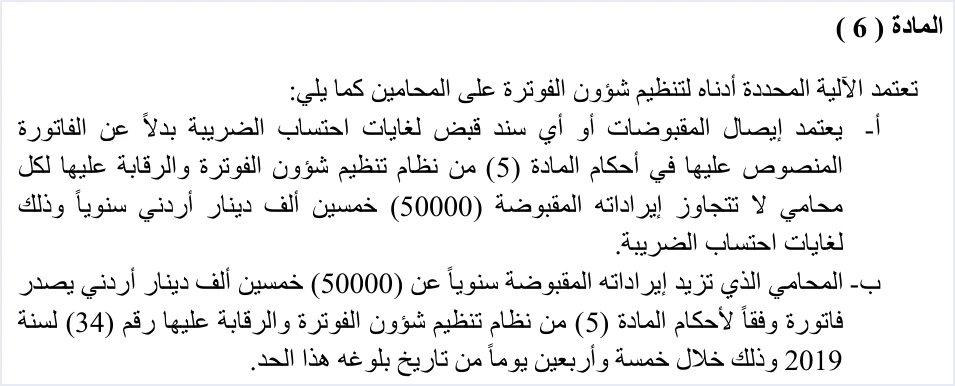
The sentence holds four elements that are worth reading one at a time.
- The substitute document. The text names a receipt for amounts collected or any receipt voucher. It does not limit the substitute to a particular form, and it does not name any details the voucher must contain.
- What it replaces. The voucher takes the place of the invoice provided for in Article 5 of Regulation 34/2019, the invoice with five required details that this article covers further down.
- The purpose. The phrase for the purpose of calculating the tax appears twice in paragraph (a) of Article 6 of Instructions 1/2019. The text ties acceptance of the voucher to a purpose it states openly.
- The ceiling. The words does not exceed mean, in our reading, that a lawyer whose collected revenue is exactly JOD 50,000 stays within paragraph (a), because reaching the figure is not exceeding it. Paragraph (b) of Article 6 of Instructions 1/2019 supports this reading, since it begins with the lawyer whose revenue exceeds the amount.
Paragraph (a) of Article 6 of Instructions 1/2019 does not say that the receipt voucher is issued through the National Invoicing System (JoFotara), and it does not say that it is issued outside it. The text stops at accepting the voucher in place of the invoice, and anything beyond that would need a text or later instructions from ISTD. How a receipt voucher compares with an invoice for sellers in general is set out in our article Receipt Voucher vs Invoice in Jordan.
Collected revenue: what the ceiling measures
The yardstick in Article 6 of Instructions 1/2019 is collected revenue, counted yearly. That differs from Article 4 of the same Instructions 1/2019, which measures licensed activities and bakeries by annual sales and crafts by annual revenue, without describing any of them as collected.
On the face of the wording, what counts is what the lawyer has actually received. It is not the fee agreed in the power of attorney with the client, and it is not an amount that has fallen due but has not yet been collected. This is a reading of the wording, and Instructions 1/2019 do not define collected revenue any further. One consequence is that two law offices with the same agreed fees may fall on different sides of the ceiling if they collected different amounts during the year.
Article 6 of Instructions 1/2019 also does not say when the year in which revenue is counted begins. The word yearly appears without a start or end date. For that reason a lawyer does well to keep a running record of amounts collected, dated by the day each amount was received, so that the position against the ceiling is known at any time.
Article 6 of Instructions 1/2019 in a table: what each paragraph says and what it leaves open
Scroll the table sideways to see the remaining columns
Paragraph (b): an invoice under Article 5 of Regulation 34/2019 within 45 days
Paragraph (b) of Article 6 of Instructions 1/2019 reads as follows.
«المحامي الذي تزيد إيراداته المقبوضة سنوياً عن (50000) خمسين ألف دينار أردني يصدر فاتورة وفقاً لأحكام المادة (5) من نظام تنظيم شؤون الفوترة والرقابة عليها رقم (34) لسنة 2019 وذلك خلال خمسة وأربعين يوماً من تاريخ بلوغه هذا الحد»
In English, a lawyer whose collected revenue exceeds JOD 50,000 a year issues an invoice under Article 5 of Regulation No. 34 of 2019, within 45 days of the date the lawyer reaches that threshold. No official English translation of this instruction was found; the English here is our rendering, and the Arabic text is the authority.
The paragraph carries two rules. The first moves the required document from the receipt voucher to the invoice provided for in Article 5 of Regulation 34/2019. The second gives a 45-day period for that move, counted from the date the lawyer reaches the threshold.
Three points about how the deadline is worded.
- The starting point in the text is the date the threshold is reached. It is not the start of the year, and it is not the date of any notice from ISTD.
- The text does not say how the days are counted, and it names no calendar date. For that reason we do not turn the deadline into a specific date here, and ISTD is the reference for counting it.
- Paragraph (b) of Article 6 of Instructions 1/2019 uses reaches for the deadline and exceeds for the condition. The text does not spell out how the two words relate, so the safer course is for a lawyer to watch revenue before it reaches the ceiling, not after.
What Article 5 of Regulation 34/2019 requires of a lawyer’s invoice
Once the ceiling is passed, Instructions 1/2019 do not create a special invoice for lawyers. They refer the lawyer to the provisions of Article 5 of Regulation 34/2019, the same provisions that apply to every seller. The referral is to the whole of that article, with no paragraph left out.
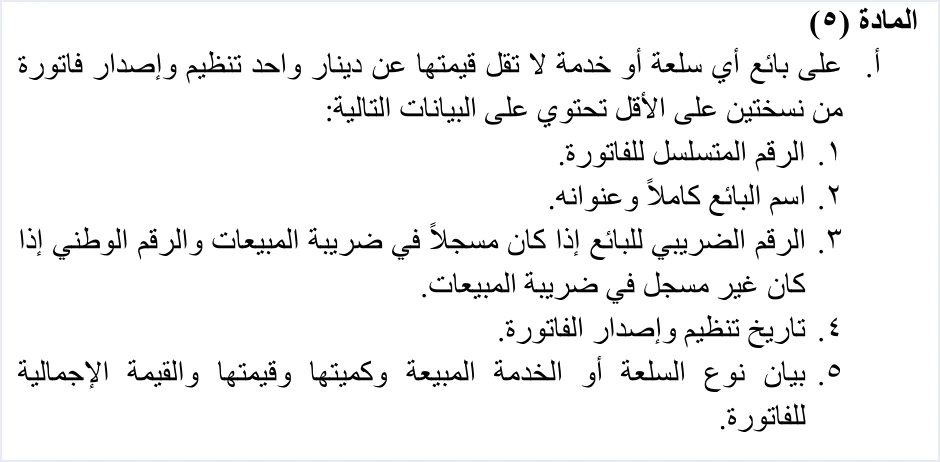
Paragraph (a) of Article 5 of Regulation 34/2019 opens with the sentence below and then lists five details.
«على بائع أي سلعة أو خدمة لا تقل قيمتها عن دينار واحد تنظيم وإصدار فاتورة من نسختين على الأقل تحتوي على البيانات التالية»
In English, the seller of any good or service worth not less than one dinar must prepare and issue an invoice in at least two copies containing the following details. No official English translation of this regulation was found; the English here is our rendering, and the Arabic text is the authority.
- The invoice serial number.
- The seller’s full name and address.
- The seller’s tax number if registered for sales tax, or national number if not.
- The date the invoice is prepared and issued.
- The type, quantity and value of the goods or service sold, and the invoice total.
The other paragraphs of Article 5 of Regulation 34/2019 add three rules that bear directly on a lawyer’s work.
- The buyer’s name. Article 5(b) of Regulation No. 34 of 2019 requires the buyer’s name to be stated clearly in a deferred sale, an installment sale or a sale paid in stages. A legal service whose fees are paid in installments falls within the plain wording of this rule.
- Handing over a copy. Article 5(c)(1) of Regulation 34/2019 requires a copy of the invoice to be given to the buyer in line with the method used to prepare and issue invoices, and the remaining copies are kept by the seller.
- Proof of receipt. Under Article 5(c)(2) of Regulation 34/2019, when the value of an invoice exceeds JOD 10,000, the seller must prove that the buyer has received it.
Article 5(d) of Regulation No. 34 of 2019 requires the seller to issue the invoice when the sale takes place. Article 3 of Regulation 34/2019 makes the time and date of a sale the time and date on which the sale takes place. Article 2 of Regulation 34/2019 defines the sale of a service as its performance, provision or supply by the seller to the buyer for consideration.
Where the invoice is issued once the ceiling is passed
The invoice a lawyer issues above the ceiling is an invoice under Regulation 34/2019, so Article 4(a) of Regulation 34/2019 applies to it.
«لغايات تنفيذ أحكام هذا النظام تعتمد الفاتورة الالكترونية الصادرة عن برنامج الفوترة الوطني الالكتروني أو الصادرة عن برنامج تم ربطه ببرنامج الفوترة الوطني الالكتروني»
In English, Article 4(a) of Regulation No. 34 of 2019 provides that, for the purposes of the regulation, the electronic invoice that is recognized is the one issued by the National Invoicing System or by a program linked to it. No official English translation of this regulation was found; the English here is our rendering, and the Arabic text is the authority.
So a lawyer has two routes, the portal that ISTD provides or accounting software linked to the system. The steps of the first route are in our article Issue an Invoice on the JoFotara Portal.
The choice between the two routes is governed by a criterion in the questions and answers guide that ISTD publishes, and it is explained in our article Is Linking Accounting Software to JoFotara Mandatory?
Paragraph (c): correcting the position on an increase, adjusting it on a decrease
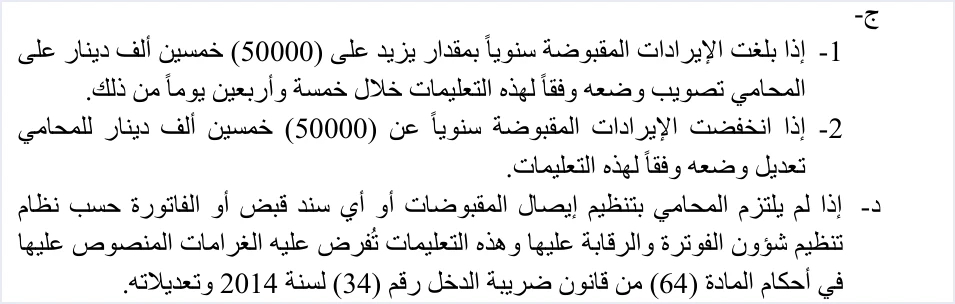
Paragraph (c) of Article 6 of Instructions 1/2019 deals with two opposite cases. The first item reads as follows.
«إذا بلغت الإيرادات المقبوضة سنوياً بمقدار يزيد على (50000) خمسين ألف دينار على المحامي تصويب وضعه وفقاً لهذه التعليمات خلال خمسة وأربعين يوماً من ذلك»
In English, if collected revenue reaches an amount above JOD 50,000 a year, the lawyer must correct the position in line with the instructions within 45 days of that. No official English translation of this instruction was found; the English here is our rendering, and the Arabic text is the authority.
The second item reads as follows.
«إذا انخفضت الإيرادات المقبوضة سنوياً عن (50000) خمسين ألف دينار للمحامي تعديل وضعه وفقاً لهذه التعليمات»
In English, if collected revenue falls below JOD 50,000 a year, the lawyer may adjust the position in line with the instructions. No official English translation of this instruction was found; the English here is our rendering, and the Arabic text is the authority.
The two items are worded differently, and the difference is clear. The first is phrased as a duty laid on the lawyer, and it comes with a 45-day period. The second is phrased as a permission given to the lawyer, and it sets no period. So the move to the invoice is a duty with a set time, while the return to the receipt voucher is an option open to the lawyer when revenue falls.
Neither item sets a particular procedure for correcting or adjusting the position, and neither names a form or a request to be filed with ISTD. The words in line with the instructions point back to the provisions of Article 6 of Instructions 1/2019 itself, meaning the document that fits where revenue stands against the ceiling.
Paragraph (d) and Article 64 of the Income Tax Law: the fine for non-compliance
Paragraph (d) of Article 6 of Instructions 1/2019 reads as follows.
«إذا لم يلتزم المحامي بتنظيم إيصال المقبوضات أو أي سند قبض أو الفاتورة حسب نظام تنظيم شؤون الفوترة والرقابة عليها وهذه التعليمات تُفرض عليه الغرامات المنصوص عليها في أحكام المادة (64) من قانون ضريبة الدخل رقم (34) لسنة 2014 وتعديلاته»
In English, if the lawyer does not comply with preparing a receipt for amounts collected, any receipt voucher or the invoice under the invoicing regulation and these instructions, the fines set out in Article 64 of Income Tax Law No. 34 of 2014, as amended, are imposed. No official English translation of this instruction was found; the English here is our rendering, and the Arabic text is the authority.
Note that paragraph (d) of Article 6 of Instructions 1/2019 covers both cases at once. A lawyer below the ceiling must prepare the receipt for amounts collected or the receipt voucher, a lawyer above it must issue the invoice, and a failure in either case falls under the same referral.
Article 64 of the Income Tax Law imposes an additional tax of no less than JOD 200 and no more than JOD 500, and paragraph (b) of Article 64 of the Income Tax Law provides that the amounts are doubled on repetition. In other words, the fine runs from JOD 200 to JOD 500 and doubles on repetition.
The Income Tax Law also has a second route, separate from this referral. Article 66 of the Income Tax Law counts among the acts of tax evasion a taxpayer who did not issue a proper invoice (فاتورة أصولية). ISTD’s English translation of the Income Tax Law, which ISTD labels an unofficial translation and under which the Arabic version prevails in case of conflict, reads: “Did not issue a proper invoice.” The penalty under Article 66 of the Income Tax Law is a compensatory fine equal to the tax difference, with imprisonment on repetition. Paragraph (d) of Article 6 of Instructions 1/2019 does not refer to Article 66 of the Income Tax Law, as it names Article 64 of the Income Tax Law alone. Article 69 of the Income Tax Law provides that imposing a penalty or a fine does not exempt anyone from paying the tax and the amounts due. Both routes are set out in our article JoFotara Penalties.
The limits of Article 6 of Instructions 1/2019: what the text does not say
Article 6 of Instructions 1/2019 is short, and a careful reading has to note what it leaves unsaid as much as what it says.
- No form for the receipt voucher. Article 6 of Instructions 1/2019 names no details that the receipt for amounts collected or the receipt voucher must contain.
- No issuing channel for the voucher. Article 6 of Instructions 1/2019 does not say that the voucher goes through the National Invoicing System, and it does not say that it does not.
- No retention period for the voucher. Article 6 of Instructions 1/2019 sets no period for keeping receipt vouchers.
- No definition of the year. Article 6 of Instructions 1/2019 does not say when the year in which collected revenue is counted begins.
- No reach beyond lawyers. Article 6 of Instructions 1/2019 opens by describing itself as a mechanism for invoicing for lawyers, and Instructions 1/2019 give this mechanism to no other profession.
We do not answer these questions here, because the texts we rely on do not answer them, and ISTD is the reference on each of them. If your case depends on this point, confirm it with ISTD before you rely on it.
Practical steps for a lawyer before and after reaching the ceiling
The list below is built on the text of Article 6 of Instructions 1/2019 and Article 5 of Regulation 34/2019, and it adds no obligation to either.
- Record amounts collected on a running basis. Log each amount you receive with its date, because the ceiling is measured by collected revenue, not by agreed fees.
- Note the date the threshold is reached. The 45-day period starts from that date, so recording it when it happens saves you from rebuilding it later.
- Set up your JoFotara account early. Registering in the system comes before issuing an invoice from it, and the step is explained in our article JoFotara Registration and the Registration Document.
- Choose how you will issue. The portal or accounting software linked to the system, under Article 4(a) of Regulation 34/2019.
- Check the five invoice details. Add the client’s name clearly when fees are paid in installments or on deferred terms.
- Watch for the opposite direction. If your collected revenue falls below the ceiling, paragraph (c)(2) of Article 6 of Instructions 1/2019 lets you adjust your position.
To compare the lawyers’ rule with the other ceilings in Instructions 1/2019, our article JoFotara Exemption sets out the three ceilings in Article 4 of Instructions 1/2019 and the conditions attached to them.
How Qoyod helps once the ceiling is passed
When issuing invoices under Article 5 of Regulation 34/2019 becomes a duty for a lawyer, the practical question is how to issue the invoice and record it in your books without entering it twice. Qoyod is integrated with the National Invoicing System (JoFotara), and it works as follows.
- Issuing and sending the invoice. You issue your invoice in Jordanian dinars from Qoyod. Qoyod builds the invoice file in UBL 2.1 format with its unique identifier (UUID) and sends it to the National Invoicing System without any manual intervention.
- A check before sending. Qoyod checks each invoice at field level as it is created, covering the tax number, the document type and payment method, the General Sales Tax rate and whether the lines are complete, and alerts you to any error before the invoice is sent, to reduce rejections. The pre-send check is an alert, not a guarantee.
- The status panel. ISTD returns the invoice status and any error message, and Qoyod shows them in its status panel. The status panel lists invoices that were not sent and need to be resent, and when you resend one it keeps the same UUID.
- The QR code. Once ISTD accepts the invoice it returns a QR code, and Qoyod shows that code on the invoice.
For a wider view of the system and how to connect your business to it, read our article Jordan’s National E-Invoicing System, or see how Qoyod works with JoFotara on our National Invoicing System page.
E-invoicing and full accounting in one system
Qoyod is integrated with the National Invoicing System (JoFotara). You issue your invoice in Jordanian dinars from Qoyod, it is booked to your ledgers automatically and sent to the system, and once it is accepted it comes back with a QR code from the Income and Sales Tax Department.
Frequently asked questions
Does a lawyer in Jordan have to issue electronic invoices?
It depends on collected revenue under Article 6 of Instructions No. 1 of 2019. A lawyer whose collected revenue does not exceed JOD 50,000 a year may use a receipt for amounts collected, or any receipt voucher, in place of the invoice. A lawyer whose revenue exceeds that figure issues an invoice under Article 5 of Regulation No. 34 of 2019.
When must a lawyer start issuing invoices?
Paragraph (b) of Article 6 of Instructions No. 1 of 2019 gives the lawyer 45 days from the date the JOD 50,000 threshold is reached. The text names no calendar date, so the period runs from the date each lawyer reaches the threshold.
Is the ceiling measured on agreed fees or on amounts received?
Article 6 of Instructions No. 1 of 2019 uses the words collected revenue, counted yearly. On the face of the wording, what counts is what the lawyer has actually received, not the agreed fee and not an amount that has fallen due but has not been collected.
What happens if a lawyer’s revenue falls below JOD 50,000?
Paragraph (c)(2) of Article 6 of Instructions No. 1 of 2019 provides that, if collected revenue falls below JOD 50,000 a year, the lawyer may adjust the position in line with the instructions. The wording grants a permission, and the text sets no period for it.
What is the fine if a lawyer does not comply?
Paragraph (d) of Article 6 of Instructions No. 1 of 2019 refers to the fines in Article 64 of Income Tax Law No. 34 of 2014, which run from JOD 200 to JOD 500 and double on repetition. Separately, Article 66 of Income Tax Law No. 34 of 2014 counts not issuing a proper invoice among the acts of tax evasion, which is a different route.
Does the JOD 50,000 rule apply to other professions?
No, it does not. Article 6 of Instructions No. 1 of 2019 is limited to lawyers in its own words, since it sets a mechanism for invoicing for lawyers. Instructions No. 1 of 2019 give this mechanism to no other profession, and the general rules of Regulation No. 34 of 2019 apply to them.
References
- Instructions No. 1 of 2019 on Invoicing Affairs and Their Control, as amended (in Arabic), Article 6.
- Regulation No. 34 of 2019 on Organizing and Controlling Invoicing Affairs, as amended, consolidated text (in Arabic), Articles 2, 3, 4 and 5.
- Income Tax Law No. 34 of 2014, as amended (in Arabic), Articles 64, 66 and 69.
- ISTD’s unofficial English translation of Law No. 34 of 2014 as amended by Law No. 38 of 2018, Article 66 (in case of conflict, the Arabic version prevails).