The phrase Article 4 Jordan invoicing regulation refers to Article 4 of Regulation No. 34 of 2019 on Organizing and Controlling Invoicing Affairs, as amended (Regulation 34/2019). That article answers one question that comes before every other question in Jordanian e-invoicing, namely, which invoice the regulation recognizes. Regulation 34/2019 was issued under paragraph (F) of Article 23 of Income Tax Law No. 34 of 2014. Article 4 of Regulation 34/2019 has only two short paragraphs, but the link between the legal text and the National Invoicing System (JoFotara) rests on them.
In short, paragraph (a) of Article 4 of Regulation 34/2019 recognizes, for the purposes of the regulation, the electronic invoice issued by the national electronic invoicing program or by a program linked to it, and paragraph (b) gives the Income and Sales Tax Department (ISTD) the task of issuing and organizing the invoice through the program or through a direct link with it, according to the timetable prepared for that purpose. The text gives no date for that timetable. This article reads the two paragraphs phrase by phrase, places Article 4 among the other articles of Regulation 34/2019, and then sets out what its text does not say.
One warning before we start. Instructions No. 1 of 2019 on Invoicing Affairs and Their Control, issued under the regulation, also have an Article 4, and its subject is entirely different, because it lists the exempt categories and their ceilings. Wherever this article mentions Article 4, it means Article 4 of Regulation 34/2019, not Article 4 of Instructions No. 1 of 2019.
Article 4 Jordan invoicing regulation: the text as published
Article 4 of Regulation 34/2019 sits on the second page of the consolidated text that ISTD publishes. It comes after Article 3 of Regulation 34/2019, which fixes the time and date of the sale, and before Article 5 of Regulation 34/2019, which sets out the items an invoice must carry. Here is the full Arabic wording.
«أ. لغايات تنفيذ أحكام هذا النظام تعتمد الفاتورة الالكترونية الصادرة عن برنامج الفوترة الوطني الالكتروني أو الصادرة عن برنامج تم ربطه ببرنامج الفوترة الوطني الالكتروني.
ب. تتولى الدائرة إصدار الفاتورة وتنظيمها بموجب أحكام هذا النظام من خلال برنامج الفوترة الوطني الالكتروني أو الربط المباشر مع البرنامج وفقاً للخطة الزمنية المعدة لهذه الغاية».
In English, Article 4(a) of Regulation No. 34 of 2019 provides that, for the purposes of the regulation, the electronic invoice that is recognized is the one issued by the National Invoicing System or by a program linked to it. Article 4(b) of Regulation No. 34 of 2019 gives ISTD the task of issuing and organizing the invoice under the regulation through the national electronic invoicing program, or through a direct link with the program, according to the timetable prepared for that purpose. No official English translation of this regulation was found; the English here is our rendering, and the Arabic text is the authority.
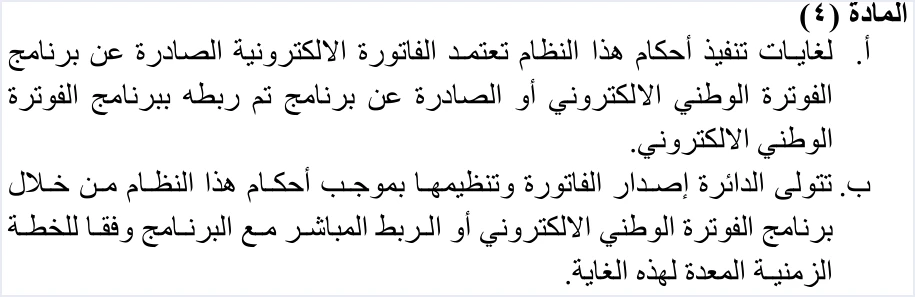
We reproduce the Arabic with the spelling of the source. In Article 4 of Regulation 34/2019, the Arabic word for electronic is written without the hamza on its first letter, while paragraph (b) of Article 8 of Regulation 34/2019 writes the same word with the hamza. The difference is one of spelling and has no effect on the meaning, but it helps if you want to check a quotation attributed to Article 4 of the regulation.
Article 4 is one of the sixteen articles of Regulation 34/2019. This page stays with Article 4 of the regulation alone and does not walk through the other fifteen.
Paragraph (a): which electronic invoice is recognized
Paragraph (a) is built from a scope phrase at the start, then a verb, then the object of the verb, and then two sources joined by the word or. We take each part in turn.
The opening scope phrase
The paragraph opens by setting its own scope. The recognition it provides is recognition for the purposes of implementing the provisions of the regulation. You may find the paragraph quoted from the verb onward, without this opening phrase. The phrase adds no condition on the invoice, but it shows that the paragraph speaks within the framework of the invoicing regulation itself. This is our reading of the text, not a statement by ISTD, because the article does not explain the phrase.
The verb of recognition
Regulation 34/2019 uses the same verb, which we render as recognize, in more than one place, and each time it names something the regulation accepts.
- Article 2(b) of Regulation 34/2019. The definitions in the law are recognized wherever the regulation uses those terms, unless the context indicates otherwise.
- Article 4(a) of Regulation 34/2019. For the purposes of the regulation, the electronic invoice issued by one of the two sources is recognized.
- Article 8(b) of Regulation 34/2019. The data of the national electronic invoicing program is recognized in place of keeping the invoice on paper, as that article otherwise requires.
- Article 13 of Regulation 34/2019. Lease contracts that contain the items and information set out in Article 5 of Regulation 34/2019 are recognized in place of invoices.
So the verb in Article 4 of Regulation 34/2019 is part of a wording the regulation repeats. In Article 8(b) and Article 13 of the same regulation, the verb comes with the words in place of. In paragraph (a) it comes without them.
The electronic invoice
Article 2 of Regulation 34/2019 defines the invoice as a document issued by the seller that shows a description of the goods or service supplied, the price, the quantity sold and the amount of General Sales Tax (GST) charged on the invoice if the seller is registered for sales tax, issued in line with the provisions and conditions set out in the regulation. Article 2 of the regulation gives no separate definition of the electronic invoice. Paragraph (a) describes the invoice as electronic and then names its source.
The first source, the national electronic invoicing program
The first source is the national electronic invoicing program itself. The text uses the word program, while the guides that ISTD publishes for 2026 use the name National Electronic Invoicing System. Article 2 of the regulation neither defines nor describes this program.
Issuing directly from the national program is what ISTD’s joining guide presents as a path of its own, issuing invoices through the National Electronic Invoicing System using the portal. On this path the main user adds a sub-user, and the sub-user then issues invoices from the Issue an invoice tile (تنظيم فاتورة).
The second source, a linked program
The second source is a program linked to the national electronic invoicing program. The wording is in the passive voice, so it does not say who carries out the linking. The paragraph does not name the type of program, does not mention accounting software by name, and sets no technical conditions for the link. The only condition the text carries is that the program is linked to the national invoicing program.
In ISTD’s guides, the matching path is the device linking path. The main user chooses the device linking option (ربط الأجهزة) on the home screen and then creates a Client ID and a Secret Key. The steps are in our article on the Client ID and Secret Key used for device linking. The technical specification of an invoice sent through the link belongs in the technical guide that ISTD publishes for the API, not in the text of Article 4 of Regulation 34/2019.
The word or between the two sources
The word or separates the two sources, so, for the purposes of the regulation, an invoice issued by either of them is recognized under the same paragraph. The paragraph does not rank one source above the other, and it does not give the invoice from one source greater legal weight than the invoice from the other.
Paragraph (b): ISTD’s role and the direct link
Paragraph (b) turns from the invoice to the authority. Its subject is the Department, which Article 2 of Regulation 34/2019 defines as the Income and Sales Tax Department.
ISTD issues and organizes the invoice
Paragraph (b) provides that ISTD is responsible for issuing and organizing the invoice under the provisions of the regulation. The same two verbs, issuing and organizing, appear in Article 5 of Regulation 34/2019 as a duty of the seller. Article 5(a) of Regulation 34/2019 requires the seller of any goods or service worth not less than one dinar to organize and issue an invoice. Article 4 of Regulation 34/2019 does not explain how the two roles relate, so we add no explanation of our own. It is enough to read each text for what it says. Article 5 of Regulation 34/2019 sets the seller’s duty, and paragraph (b) sets what ISTD is responsible for.
Two means, as in paragraph (a)
Paragraph (b) names two means, joined by the word or, namely the national electronic invoicing program and a direct link with the program. In their wording they match the two sources in paragraph (a), the national program itself and the program linked to it. The word direct is the only place in Article 4 of the regulation where the link is given a description, because paragraph (a) only speaks of a program that has been linked.
According to the timetable prepared for that purpose
Paragraph (b) ties the direct link to a timetable. Three points in that phrase deserve a closer look.
- A particular timetable. The text refers to one specific timetable, but it gives neither its date nor its content.
- No named author. The text says the timetable is prepared, but it does not name the body that prepares it and does not say where it is published.
- For that purpose. The timetable serves the purpose the paragraph names, with no further detail.
The text says timetable and nothing more. So you cannot report Article 4 of Regulation 34/2019 as saying that implementation is divided into stages, and you cannot attribute a linking deadline to it. We also did not find the date of this timetable in the ISTD 2026 guides we relied on, which are the joining procedures guide, the invoice issuing procedures guide and the questions and answers guide.
Article 4 among the articles of Regulation 34/2019
Article 4 of Regulation 34/2019 becomes clearer when it is placed beside the articles of the same regulation that connect to it. The table below lists those articles in order, with what each text says and how it relates to Article 4 of Regulation 34/2019.
Scroll the table sideways to see the remaining columns
The table shows a clear sequence. Article 3 of Regulation 34/2019 fixes the time of the sale, Article 4 of Regulation 34/2019 names the electronic invoice that is recognized for the purposes of the regulation, Article 5 of Regulation 34/2019 sets what the invoice must contain, and Article 8 of Regulation 34/2019 makes the national program’s data a substitute for keeping invoices on paper. The idea of linking returns in Article 14 of Regulation 34/2019, because the unit that paragraph (b) of Article 14 creates is responsible for linking invoicing systems between sellers of goods and services on one side and ISTD on the other. Finally, Article 15 of Regulation 34/2019 refers the penalty to the law.
What Article 4 of Regulation 34/2019 does not say
Because Article 4 of Regulation 34/2019 is short and deals with linking, it is easy to attribute rules to it that are not in its text. The points below are not stated in Article 4 of Regulation 34/2019, and we read its full text in the consolidated version.
- No date and no grace period. Article 4 of Regulation 34/2019 sets no deadline for linking and no start date for the obligation, and the word timetable comes with no date.
- No stages. The text does not divide implementation into stages. It only refers to a timetable.
- No list of who must link. Article 4 of Regulation 34/2019 names no category of seller that must use the direct link while others need not.
- No mention of accounting software. Paragraph (a) of Article 4 of Regulation 34/2019 speaks of a linked program in general terms. ISTD’s position on a business that has an accounting system is published in the questions and answers guide for the National Invoicing System, 2026, where ISTD says that a business that has an accounting system must link its system with the invoicing system. We set out that position and what follows from it in our article on whether linking accounting software to JoFotara is mandatory.
- No penalty of its own. Article 4 of Regulation 34/2019 states no sanction. Article 15 of Regulation 34/2019 provides that anyone who fails to issue the invoice in line with the regulation is punished with the penalties set out in the law, and the regulation itself states no amount. The articles that set the fines are explained in our article on the fines for not complying with the National Invoicing System.
- No technical specification. Article 4 of Regulation 34/2019 names no file format, no API and no verification code, and does not explain how the link works. Those points sit in ISTD’s technical guide, and our articles on how JoFotara approves an invoice once it is sent and on the QR code that ISTD returns cover two parts of that technical side.
- No statement of what the amending regulation changed. A footnote in the consolidated text says that the regulation was amended by amending Regulation No. 13 of 2023, but it does not identify the articles the amendment touched. So do not attribute any specific change in Article 4 of Regulation 34/2019 to that amendment.
- No exemption. Article 4 of Regulation 34/2019 does not deal with the parties exempt from organizing and issuing invoices. Exemption is governed by Article 11 of Regulation 34/2019 and by the instructions issued under it, and the detail is in our article on who is exempt from the National Invoicing System and at what threshold.
If a source tells you that Article 4 of Regulation 34/2019 sets a date, a fine or a category that must link, go back to its text on the second page of the consolidated version and check it yourself.
How to read Article 4 of Regulation 34/2019 in your work
Article 4 of Regulation 34/2019 does not lay out steps. It gives you a standard to measure how you issue your invoices against, and a text to check what you are told. These practical points are based on the official texts.
- Identify the source of your invoices. If you issue invoices on the portal through a sub-user, your invoice is issued by the national program. If you issue them from a program linked through the device linking option, your invoice is issued by a linked program. For the purposes of the regulation, paragraph (a) of Article 4 of Regulation 34/2019 recognizes both cases.
- Keep the text and ISTD’s position apart. Article 4 of Regulation 34/2019 is a legal text, and the note in the questions and answers guide is a published guidance position of ISTD. When you pass on a sentence, attribute it to its own source.
- Check which text is meant. Before relying on information attributed to Article 4, ask whether it means Article 4 of Regulation 34/2019 or Article 4 of Instructions No. 1 of 2019. The first is about the recognized invoice, the second about the exempt categories.
- Check the quotation. The full text of paragraph (a) of Article 4 of Regulation 34/2019 begins with the scope phrase about implementing the provisions of the regulation, and paragraph (b) ends with the timetable prepared for that purpose, with no date. Any date attached to a quotation of the article is not part of the text.
- Go back to the consolidated text. The consolidated text that ISTD publishes merges the amendments made by amending Regulation No. 13 of 2023, so read Article 4 of Regulation 34/2019 in the wording in force.
For a wider view of the system and how to connect your business to it, read our article Jordan’s National E-Invoicing System, or see how Qoyod works with JoFotara on our National Invoicing System page. If you have a question about how Article 4 of Regulation 34/2019 applies to your own business, ISTD is the body that can answer it.
E-invoicing and full accounting in one system
Qoyod is integrated with the National Invoicing System (JoFotara). You issue your invoice in Jordanian dinars from Qoyod, it is booked to your ledgers automatically and sent to the system, and once it is accepted it comes back with a QR code from the Income and Sales Tax Department.
Frequently asked questions
What does Article 4 of Regulation 34/2019 say?
Article 4(a) of Regulation No. 34 of 2019 provides that, for the purposes of the regulation, the electronic invoice that is recognized is the one issued by the National Invoicing System or by a program linked to it. Article 4(b) of Regulation No. 34 of 2019 gives ISTD the task of issuing and organizing the invoice through the national program or through a direct link with it, according to the timetable prepared for that purpose.
Is an invoice issued on the portal recognized in the same way as one from a linked program?
For the purposes of Regulation 34/2019, both invoices are recognized under the same paragraph. Paragraph (a) of Article 4 of the regulation names the invoice issued by the national program and the invoice issued by a program linked to it, and separates them with the word or without ranking one above the other.
Does Article 4 of Regulation 34/2019 set a deadline for the direct link?
Article 4 of Regulation 34/2019 sets no deadline. It ties the direct link to the timetable prepared for that purpose, and it gives neither the date of that timetable nor its content nor the body that prepares it. Nor can it be reported as dividing implementation into stages.
Does Article 4 of Regulation 34/2019 require me to link my accounting software?
Article 4 of Regulation 34/2019 speaks of a linked program in general terms and does not mention accounting software. ISTD’s position on a business that has an accounting system is published in the questions and answers guide for the National Invoicing System, 2026, and we set it out in our article on whether linking accounting software to JoFotara is mandatory.
What is the difference between Article 4 of Regulation 34/2019 and Article 4 of Instructions 1/2019?
The two are different texts on different subjects. Article 4 of Regulation 34/2019 names the electronic invoice the regulation recognizes and ISTD’s role in issuing it. Article 4 of Instructions No. 1 of 2019 on Invoicing Affairs and Their Control lists the categories exempt from organizing invoices and their ceilings.
What is the penalty for breaching Article 4 of Regulation 34/2019?
Article 4 of Regulation 34/2019 states no penalty. Article 15 of Regulation 34/2019 refers the penalty for anyone who fails to issue the invoice in line with the regulation to the penalties set out in the law, meaning the Income Tax Law, and the regulation itself states no amount.
References
- Regulation No. 34 of 2019 on Organizing and Controlling Invoicing Affairs, as amended, consolidated text (in Arabic), Articles 2, 3, 4, 5, 8, 9, 11, 13, 14 and 15.
- Instructions No. 1 of 2019 on Invoicing Affairs and Their Control, as amended (in Arabic), Article 4.
- Income and Sales Tax Department (ISTD), procedures guide for joining the Jordanian National Electronic Invoicing System, 2026 edition (in Arabic).
- Income and Sales Tax Department (ISTD), questions and answers guide for the National Invoicing System, 2026 (in Arabic), p. 6.