A doctor who runs a clinic, an independent consultant and anyone who sells a professional service in their own name all ask the same two questions about the National Invoicing System. Does it apply to me, and what invoice do I give my clients? This article on JoFotara freelancers collects what the official texts say about freelance professionals and the National Invoicing System (JoFotara). It explains when your invoice is an income invoice that carries no tax, when it is a general sales tax invoice, and which details it has to show.
In short, Regulation No. 34 of 2019 on Organizing and Controlling Invoicing Affairs, as amended, addresses the seller of any goods or service, and it defines a service as any work a person performs in return for consideration. If you are not registered for General Sales Tax (GST) and your activity is not exempt, the invoice you issue is an income invoice. It carries no tax, and it shows your national number in place of a tax number.
This article does not cover how income tax on professional income is calculated, and it is not tax advice. Its subject is the invoice alone, as described in the texts published by the Income and Sales Tax Department (ISTD) and in ISTD’s technical guide for the National Invoicing System.
JoFotara freelancers: what the text says
The answer starts with Article 5(a) of Regulation No. 34 of 2019, which sets the duty to issue an invoice.
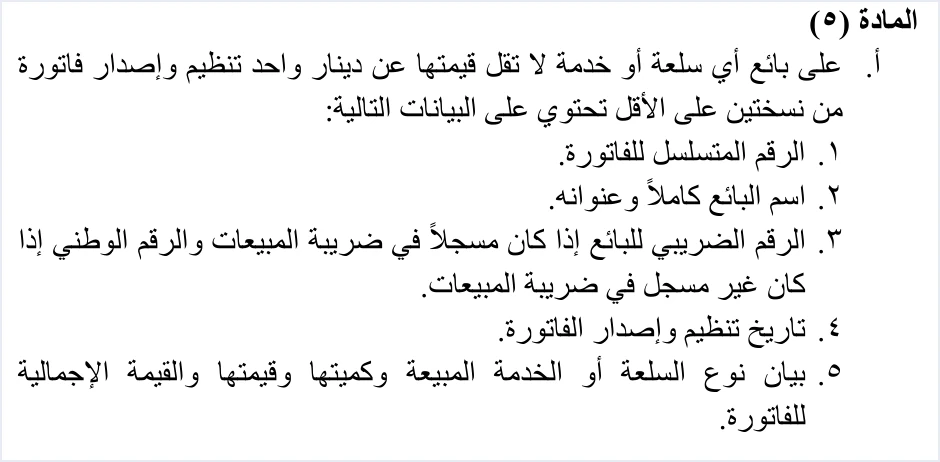
«على بائع أي سلعة أو خدمة لا تقل قيمتها عن دينار واحد تنظيم وإصدار فاتورة من نسختين على الأقل»
In English, Article 5(a) of Regulation No. 34 of 2019 requires the seller of any goods or service worth no less than one dinar to issue an invoice in at least two copies. No official English translation of this regulation was found; the English here is our rendering, and the Arabic text is the authority.
The text does not limit the duty to a trader who sells goods. It names the service expressly, next to the goods.
Article 2 of Regulation No. 34 of 2019 then defines the words this rule rests on. Three of its definitions concern a freelance professional directly. The first is the service.
«كل عمل يقوم به الشخص لقاء بدل أو تقديم منفعة إلى الغير ولا يشمل هذا العمل تزويد سلعة إلا إذا كانت هذه السلعة لازمة لتقديم الخدمة»
In English, Article 2 of Regulation No. 34 of 2019 defines a service as any work a person performs in return for consideration, or the provision of a benefit to others, and excludes the supply of goods unless the goods are needed to provide the service. No official English translation of this regulation was found; the English here is our rendering, and the Arabic text is the authority.
The other two definitions complete the picture.
- Sale of a service. Article 2 of Regulation No. 34 of 2019 defines it as the performance, provision or supply of the service by the seller to the buyer in return for consideration.
- Seller and person. In the same article, the seller is the seller of the goods or the service, and a person is a natural or legal person.
A medical examination a doctor charges for, and a consultation a consultant provides for a fee, are both a sale of a service in the sense of this regulation. The person who provides them is a seller, whether they work in their own name or through a company. Keep in mind that these are the regulation’s own definitions. They decide who issues the invoice. They do not decide on their own whether a service is subject to General Sales Tax, because a different law governs that.
The scope of the regulation is therefore wider than the businesses registered for sales tax. It covers sellers of goods and providers of services, including professionals such as doctors, lawyers and consultants, and those of them who are not registered issue an income invoice. The belief that e-invoicing concerns only businesses registered for sales tax has no support in the text. Some activities are exempted from the invoicing obligation by Regulation No. 34 of 2019 on Organizing and Controlling Invoicing Affairs, as amended, and by Instructions No. 1 of 2019 issued under it. That exemption depends on the activity, the list is not closed, and it is not permanent. The section on exempt crafts below explains why it does not cover the professions as such.
For the wider question of which businesses fall under the obligation, read our article Who Must Use E-Invoicing in Jordan? A separate article in this series walks through the regulation article by article.
Income invoice or general sales tax invoice?
A professional does not choose the type of invoice by profession. The choice follows their registration status for General Sales Tax. This shows in the definition of the invoice itself in Article 2 of Regulation No. 34 of 2019.
«وثيقة صادرة عن البائع تبين وصفاً للسلعة أو الخدمة المقدمة والسعر والكمية المبيعة ومقدار الضريبة العامة على المبيعات المحتسبة على الفاتورة في حال كان من المكلفين المسجلين في ضريبة المبيعات»
In English, Article 2 of Regulation No. 34 of 2019 defines the invoice as a document issued by the seller that shows a description of the goods or service supplied, the price and the quantity sold, and the amount of General Sales Tax charged on the invoice if the seller is registered for sales tax. No official English translation of this regulation was found; the English here is our rendering, and the Arabic text is the authority.
The tax amount is part of the invoice only for a registered seller. The National Invoicing System turns this difference into three families of invoice, and two of them matter here.
Scroll the table sideways to see the remaining columns
The third family is the special tax invoice. It covers specific goods that carry Special Sales Tax (SST) on top of the general tax, so it does not concern a professional who sells a service. The differences between all the types are explained in our article Invoice Types in the National Invoicing System, and the income invoice itself in our article Income Invoice in JoFotara.
The practical result is clear. A doctor or consultant who is not registered for General Sales Tax issues an income invoice. It shows the description of the service, its quantity, its price and any discount, and it adds no tax rate. If the same professional later registers for General Sales Tax, their invoices move to the general sales tax family.
The sales tax registration threshold for service providers
So what moves a professional from the first family to the second? The answer sits in the General Sales Tax Law No. 6 of 1994, as amended, not in the invoicing regulation. According to summaries of that law published by international advisory firms, Article 13 of the General Sales Tax Law sets registration thresholds by annual taxable sales, including these two.
- JOD 30,000 for service providers.
- JOD 75,000 for sellers of goods, other than goods subject to Special Sales Tax.
The same summaries add that a person with more than one activity is held to the lowest of the thresholds for their activities.
According to the same sources, Article 14 of the General Sales Tax Law allows voluntary registration. A professional may therefore be registered for General Sales Tax before reaching the threshold. In that case the invoice follows the actual registration, not the size of the income.
Three points help you avoid confusion here.
- Your registration status with ISTD is what counts, not your own estimate of your sales. The invoice type the system accepts is tied to your tax number and your income-source sequence as they are registered with ISTD.
- This article does not set a registration date or a filing frequency for General Sales Tax. Those questions have texts of their own, so take them to ISTD or to your tax adviser.
- The figure of JOD 30,000 appears in two different texts. Once as the sales tax registration threshold for service providers, and once as the ceiling for the invoicing exemption of licensed crafts. Each has its own rule, explained below.
Income invoice details under Article 5
The mandatory details on an income invoice differ from those on other invoices only in the seller’s number. Article 5(a) of Regulation No. 34 of 2019 requires five items on every invoice.
- The invoice serial number.
- The seller’s full name and address.
- The seller’s tax number if registered for sales tax, or national number if not.
- The date the invoice is organized and issued.
- The type, quantity and value of the goods or service, and the invoice total.
The third item is the one that matters to an unregistered professional. Article 3 of Instructions No. 1 of 2019 on Invoicing Affairs and Their Control, as amended, details it for the cash sales invoice. It names the national number for a Jordanian person, and the number approved by the competent authority for a non-Jordanian person, where either of them is not registered for sales tax.
The buyer’s name, meaning the patient or the client, is a separate matter. Article 5(b) of Regulation No. 34 of 2019 requires the buyer’s name to be stated clearly in a deferred sale, an installment sale or a sale paid in stages. The technical guide applies the same rule to the submitted file. The buyer’s name is always required on a receivable invoice, and on a cash invoice worth more than JOD 10,000 or its equivalent in foreign currency. The buyer fields and their identifier types are covered in our article JoFotara Buyer Identification.
Income invoice codes in the submitted file
If you issue your invoices from software linked to the National Invoicing System, the software declares the invoice type in the submitted file with a three-digit code. Version 1.5 of ISTD’s technical guide for integrating with the National Invoicing System through the API sets out what each digit means. The first digit is the trade type, the second is the payment method (1 for cash, 2 for receivable), and the third is the tax family. A third digit of 1 means an income invoice, 2 a general sales tax invoice and 3 a special tax invoice.
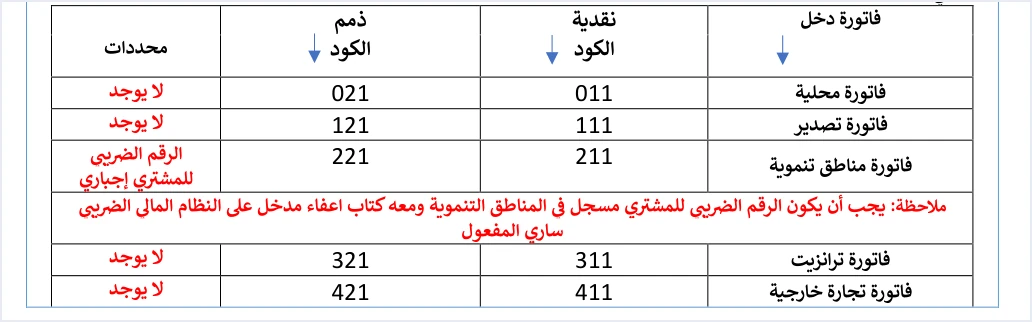
Code 011 is a local cash income invoice, and 021 is a local receivable income invoice. A service that an unregistered professional provides inside the Kingdom is declared with one of these two codes, depending on how it is paid. The table also carries income invoice codes for export, development zones, transit, foreign trade and assignment within free zones. For a development zones invoice, the guide makes the buyer’s tax number mandatory and requires it to be registered in the development zones, with a valid exemption letter entered on the financial tax system.
The income invoice file differs from the general sales tax invoice file in one essential point. It carries no tax section at all, at line level or at invoice level. The lines of an income invoice are limited to the quantity, the price, the discount and the item name. The technical guide gives an example of an income invoice with two lines.
There is no tax row in this example, because the amount payable is the total after discount. The line fields and their constraints are covered in our article JoFotara InvoiceLine.
If you need a return against an income invoice, the return invoice reuses the code of the original invoice, and only the document type changes to a return. The value of the invoice type element itself shows whether the invoice is new or a return, 388 for a new invoice and 381 for a return. So name="011" with the value 381 means a local cash return on an income invoice.
When the invoice type does not match your registration
Declaring an income invoice in the file is not enough for the system to accept it. The file declares the type, and ISTD checks it against your registration. If a professional registered for General Sales Tax sends an income invoice, or an unregistered one sends a general sales tax invoice, the invoice is rejected with the message This user is not authorized to submit this type of invoice.

«يقوم بارسال نوع فاتورة لا يتناسب مع رقمه الضريبي او تسلسل مصدر الدخل الخاص به»
In English, the technical guide explains that the message appears when the taxpayer sends an invoice type that does not match their tax number or their income-source sequence. ISTD publishes this guide in Arabic only; the English here is our rendering, and the Arabic text is the authority.
That is why it helps to check the JoFotara income-source sequence when this message appears, because the error may lie in the sequence rather than in the invoice type. The steps to diagnose and fix the message are in our article Not authorized to submit this type of invoice.
The same situation arises when a registration changes. A professional who has just registered for General Sales Tax and whose software keeps sending income invoices meets this rejection until the invoice type in the software is changed to match the new registration.
Lawyers have a rule of their own
A lawyer is a freelance professional, but Article 6 of Instructions No. 1 of 2019 on Invoicing Affairs and Their Control gives lawyers alone a mechanism of their own. A receipt voucher, or any other receipt, is accepted in place of an invoice for a lawyer whose collected revenue does not exceed JOD 50,000 a year. A lawyer whose collected revenue exceeds that limit issues an invoice under Article 5 of Regulation No. 34 of 2019, within forty-five days of the date the limit is reached.
Article 6 of Instructions No. 1 of 2019 names lawyers only. Its text does not extend the mechanism to doctors, engineers or consultants, so the text gives them no basis to rely on it. The difference between the two documents is explained in our article Receipt Voucher vs Invoice in Jordan, and a separate article in this series covers e-invoicing for lawyers in Jordan.
Freelance professions are not the exempt crafts
It is easy to confuse the freelance professions with the crafts, because the two words sound close in Arabic and because the figure of JOD 30,000 appears in both contexts. The difference matters, because one of them concerns the exemption from invoicing.
«أصحاب الحرف الذين تقل مبيعات أو إيرادات كل منهم من الحرفة عن (30000) دينار في السنة»
In English, Article 11(a) of Regulation No. 34 of 2019 exempts craftspeople whose sales or revenue from the craft are each below JOD 30,000 a year. No official English translation of this regulation was found; the English here is our rendering, and the Arabic text is the authority.
Article 4(b) of Instructions No. 1 of 2019 restates the same exemption for licensed crafts in any of the Kingdom’s governorates whose annual revenue is below JOD 30,000.
This exemption speaks of crafts in its own wording. Neither Article 11(a) of Regulation No. 34 of 2019 nor Article 4 of Instructions No. 1 of 2019, in the text ISTD publishes and we cite here, names doctors, consultants or other freelance professionals. The list of exempt bodies was amended later, so the reference for any specific activity is the text in force. The exemption is not permanent either. Article 11(b) of Regulation No. 34 of 2019 allows the Director to impose the obligation on a person when there is sufficient evidence that the person’s sales exceed the limit. The exemptions and their ceilings are set out in our article JoFotara Exemption: Who Is Exempt and at What Threshold.
The income invoice and income tax
The name “income invoice” suggests a link to income tax. In the National Invoicing System, though, it describes the family of invoices that carry no sales tax. Income tax on what a professional earns has its own law and its own return. The Income Tax Law treats a resident’s income from a freelance profession as income from a business activity. Brackets, exemptions and withholding are covered in our article Income Tax in Jordan.
Checklist before your first invoice
Before a freelance professional issues a first invoice through the National Invoicing System, it helps to go through these points.
- Confirm your General Sales Tax registration status as ISTD holds it, because it decides the family of your invoice.
- If you are not registered, your invoice is an income invoice with no tax rate, and your national number is what appears in the seller details.
- If you are registered, your invoice is a general sales tax invoice, and it carries your tax number and the tax rate on each line.
- Check the five items of Article 5(a) of Regulation No. 34 of 2019 on every invoice.
- Write the buyer’s name on every receivable invoice, and on a cash invoice above the limit stated in the technical guide.
- If you are a lawyer, apply the mechanism in Article 6 of Instructions No. 1 of 2019, under which a receipt is accepted in place of an invoice as long as your collected revenue does not exceed JOD 50,000 a year.
- If your registration changes, change the invoice type in your issuing tool before the first invoice after the change.
Two ways to issue the invoice
Article 4(a) of Regulation No. 34 of 2019 provides that, for the purposes of the regulation, the electronic invoice that is recognized is the one issued by the National Invoicing System or by a program linked to it. If you issue a small number of invoices without accounting software, the steps for issuing an invoice on the portal are in our article Issue an Invoice on the JoFotara Portal.
If you keep the books of your clinic or office in accounting software, it is more practical for the software to issue the invoice and send it to the system directly. Qoyod is integrated with the National Invoicing System (JoFotara). Qoyod builds the invoice file in UBL 2.1 format with its unique identifier (UUID) and sends it to the National Invoicing System without any manual intervention. For a wider view of the system and how to connect your business to it, read our article Jordan’s National E-Invoicing System, or see how Qoyod works with JoFotara on our National Invoicing System page.
E-invoicing and full accounting in one system
Qoyod is integrated with the National Invoicing System (JoFotara). You issue your invoice in Jordanian dinars from Qoyod, it is booked to your ledgers automatically and sent to the system, and once it is accepted it comes back with a QR code from the Income and Sales Tax Department.
Frequently asked questions
Does the National Invoicing System cover doctors and consultants?
Article 5(a) of Regulation No. 34 of 2019 addresses the seller of any goods or service worth no less than one dinar, and the regulation defines a service as any work a person performs in return for consideration. A doctor or consultant who charges for their services is therefore a seller of a service in the sense of the regulation. Some activities are exempted from the invoicing obligation by the regulation and by Instructions No. 1 of 2019, so check the text in force for your activity.
What is an income invoice?
An income invoice is the invoice issued by a seller who is not registered for General Sales Tax, and it carries no tax. Its code in the submitted file ends in 1, such as 011 for a local cash invoice and 021 for a local receivable invoice.
Do I put my tax number or my national number on the invoice?
Article 5(a) of Regulation No. 34 of 2019 requires the seller’s tax number if the seller is registered for sales tax, and the national number if not. Article 3 of Instructions No. 1 of 2019 adds the number approved by the competent authority for a non-Jordanian person.
When do I move from the income invoice to the general sales tax invoice?
A professional moves to the general sales tax invoice once registered for General Sales Tax. According to summaries of the law, Article 13 of the General Sales Tax Law sets the registration threshold for service providers at JOD 30,000 of annual taxable sales, and Article 14 allows voluntary registration before it.
Why was my income invoice rejected with This user is not authorized to submit this type of invoice?
The system rejects an invoice with this message when its type does not match the taxpayer’s tax number or income-source sequence, for example when a seller registered for General Sales Tax sends an income invoice. The fix is to make the invoice type match the actual registration.
Do the JOD 50,000 limit and the receipt voucher apply to every freelance professional?
Article 6 of Instructions No. 1 of 2019 limits this mechanism to lawyers. Other freelance professionals issue an invoice for every service worth no less than one dinar under Article 5 of Regulation No. 34 of 2019.
References
- Regulation No. 34 of 2019 on Organizing and Controlling Invoicing Affairs, as amended, consolidated text (in Arabic), Articles 2, 4, 5 and 11.
- Instructions No. 1 of 2019 on Invoicing Affairs and Their Control, as amended (in Arabic), Articles 3, 4 and 6.
- Income and Sales Tax Department (ISTD), technical guide for integrating with the National Invoicing System through the API, version 1.5 (in Arabic), pp. 12 and 101.
- General Sales Tax Law No. 6 of 1994, as amended, Articles 13 and 14, according to summaries by international advisory firms.
- ISTD’s National Invoicing System guides (in Arabic)