The income invoice in JoFotara is the invoice that a seller not registered for General Sales Tax (GST) with the Income and Sales Tax Department (ISTD) issues through the National Invoicing System (JoFotara). It carries the details that Article 5(a) of Regulation No. 34 of 2019 on Organizing and Controlling Invoicing Affairs requires, and it carries no tax at all. Its lines have no tax rate, its header has no tax total, and a 1 in the third digit of its type code marks it. It is issued on the JoFotara portal or from accounting software linked to the system.
This article brings the rules for this invoice together in one place. It covers who issues it and when, how each Article 5(a) item of Regulation No. 34 of 2019 appears on the portal form and in the submitted file, the twelve codes of its family, and what ISTD’s guides leave undocumented. The comparison of the six trade types is in our article Invoice Types in the National Invoicing System. The income invoice is a document, not the income tax itself, which is covered in our article Income Tax in Jordan.
What is an income invoice in JoFotara
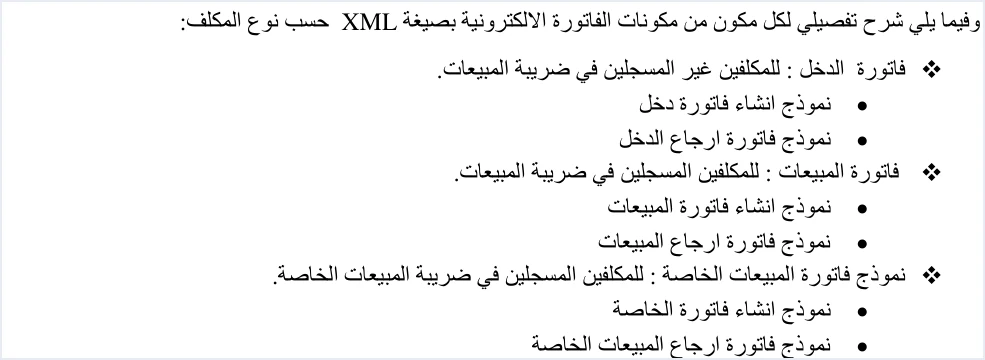
Version 1.5 of ISTD’s technical guide for integrating with the National Invoicing System through the API sorts invoice models into three families by type of taxpayer. The first is the income invoice for taxpayers not registered for sales tax. It has two models, one to create an income invoice and one to return income. The other two families are the sales invoice for taxpayers registered for General Sales Tax and the special sales invoice for taxpayers registered for Special Sales Tax (SST).
The split goes back to how the invoice itself is defined. Article 2 of Regulation No. 34 of 2019 on Organizing and Controlling Invoicing Affairs gives this definition.
«وثيقة صادرة عن البائع تبين وصفاً للسلعة أو الخدمة المقدمة والسعر والكمية المبيعة ومقدار الضريبة العامة على المبيعات المحتسبة على الفاتورة في حال كان من المكلفين المسجلين في ضريبة المبيعات»
In English, Article 2 of Regulation No. 34 of 2019 defines the invoice as a document issued by the seller that shows a description of the goods or service supplied, the price and the quantity sold, and the amount of General Sales Tax charged on the invoice if the seller is registered for sales tax. No official English translation of this regulation was found; the English here is our rendering, and the Arabic text is the authority.
Description, price and quantity belong on every invoice. The tax amount belongs only on the invoice of a registered seller. The income invoice is the form an invoice takes when that element is absent.
Having no tax does not make it a second-class invoice. It is an electronic invoice that passes through JoFotara like any other, and Article 4(a) of Regulation No. 34 of 2019 covers it, recognizing the invoice issued in these terms.
«الصادرة عن برنامج الفوترة الوطني الالكتروني أو الصادرة عن برنامج تم ربطه ببرنامج الفوترة الوطني الالكتروني»
In English, Article 4(a) of Regulation No. 34 of 2019 provides that, for the purposes of the regulation, the electronic invoice that is recognized is the one issued by the National Invoicing System or by a program linked to it. No official English translation of this regulation was found; the English here is our rendering, and the Arabic text is the authority.
Who issues the income invoice: a seller not registered for General Sales Tax
It is issued by a seller not registered for General Sales Tax with ISTD. Article 5(a) of Regulation No. 34 of 2019 addresses the seller of any goods or service worth at least one dinar, and it does not limit the invoice to sellers registered for sales tax. An unregistered seller therefore also issues its invoice through the system, and that invoice is the income invoice.
What counts here is registration status at ISTD, not the nature of the activity and not the seller’s preference. The system reads the invoice type from two elements of the file, and what those elements may say is decided by the taxpayer’s registration and the reality of the sale. If an unregistered seller sends an invoice from the General Sales Tax family, or a registered seller sends an income invoice, the system rejects it with the message This user is not authorized to submit this type of invoice. The technical guide explains the cause in these words.
«يقوم بارسال نوع فاتورة لا يتناسب مع رقمه الضريبي او تسلسل مصدر الدخل الخاص به»
In English, the guide gives the cause as the taxpayer sending an invoice type that does not match their tax number or their income-source sequence.
When General Sales Tax registration becomes mandatory is a question of annual sales thresholds, which differ between goods and services, and voluntary registration is also allowed. These thresholds are explained in our article General Sales Tax in Jordan. A seller may be registered before it reaches any threshold. Its invoice then follows its actual registration, not its sales volume, so it does not issue an income invoice.
Once a seller registers, its invoice family changes. That moment of transition, including the digit that changes in the code and what happens to invoices issued before registration, is the subject of a separate article in this series on switching from the income invoice to the general sales tax invoice. The registered seller’s invoice itself has its own article in the series, on the general sales tax invoice.
One distinction still matters. Not being registered for General Sales Tax is one thing, and being exempt from invoicing is another. Article 11 of Regulation No. 34 of 2019 and Article 4 of Instructions No. 1 of 2019 on Invoicing Affairs and Their Control exempt specific activities under their own conditions. That rule is separate from sales tax registration, and later amendments have added sectors to it. So the income invoice question comes only after you confirm that the activity is not exempt under the text in force.
When the income invoice is issued
An income invoice is issued at the same moment as any other invoice. Article 3 of Regulation No. 34 of 2019 sets the time and date of a sale of goods or services as the time and date on which the sale takes place, and Article 5(d) of the same regulation requires the invoice to be issued when the sale takes place.
All of Article 5 of Regulation No. 34 of 2019 applies to the income invoice exactly as it applies to other invoices. These are its main provisions.
- An invoice is issued for every sale of goods or a service worth at least one dinar, unless the activity is exempt.
- It is made out in at least two copies. One copy goes to the buyer according to the method used to prepare and issue invoices, and the seller keeps the other copies.
- Article 5(b) of Regulation No. 34 of 2019 requires the buyer’s name to be stated clearly in a deferred sale, an instalment sale or a sale paid in stages.
- If the invoice is worth more than JOD 10,000, the seller must prove that the buyer received it.
ISTD’s guides set no deadline, in hours or in days, for sending the invoice to the system after the sale. What the technical guide does document is the sequence. The invoice is sent to the system, the response returns its status, and a QR code comes back only once the invoice is accepted.
What the income invoice carries under Article 5(a) of Regulation No. 34 of 2019
Article 5(a) of Regulation No. 34 of 2019 requires five items on every invoice, and the income invoice is no exception. The table below shows each item, its counterpart on the portal invoice form as shown in the 2026 invoice issuing guide, and its counterpart in the file that linked software sends, according to the technical guide.
Scroll the table sideways to see the remaining columns
The third item deserves a closer look, because the regulation and the technical guide do not line up on it.
«الرقم الضريبي للبائع إذا كان مسجلاً في ضريبة المبيعات والرقم الوطني إذا كان غير مسجل في ضريبة المبيعات»
In English, Article 5(a) of Regulation No. 34 of 2019 asks for the seller’s tax number if the seller is registered for sales tax, and the national number if the seller is not registered. No official English translation of this regulation was found; the English here is our rendering, and the Arabic text is the authority.
The seller on an income invoice is not registered. The technical guide, however, puts the tax number in the seller element, and the portal shows the tax number in the seller details. ISTD’s guides do not explain how the two texts fit together on an income invoice.
On the buyer side, the income invoice follows the same buyer-name rule as other invoices. The buyer’s name is always required on a receivable invoice, and on a cash invoice worth more than JOD 10,000 or its equivalent in foreign currency. That wording comes from the error message table in the technical guide. The buyer is identified by national number, by personal number for a non-Jordanian, or by tax number.
What the income invoice does not carry: no TaxTotal block and no tax rate
This is the difference that sets the income invoice apart from the other two families. The income invoice template in the technical guide has no cac:TaxTotal tax block, either at line level or at invoice level. Several things follow from that.
- A line carries only the quantity, the unit price, the discount and the name of the goods or service, with no tax amount and no tax-inclusive amount.
- No tax category
S,ZorOappears on the line, and no General Sales Tax rate. - The invoice header carries no tax total, and the totals go straight from the discount block to
cac:LegalMonetaryTotal. - The list of rates that the rate field accepts does not apply to the income invoice, and neither does the 0% rate condition on non-local trade types, because both are constraints on tax lines that do not exist here.
- The consumer price feature is not available, because the guide limits it to taxpayers registered for General Sales Tax or Special Sales Tax.
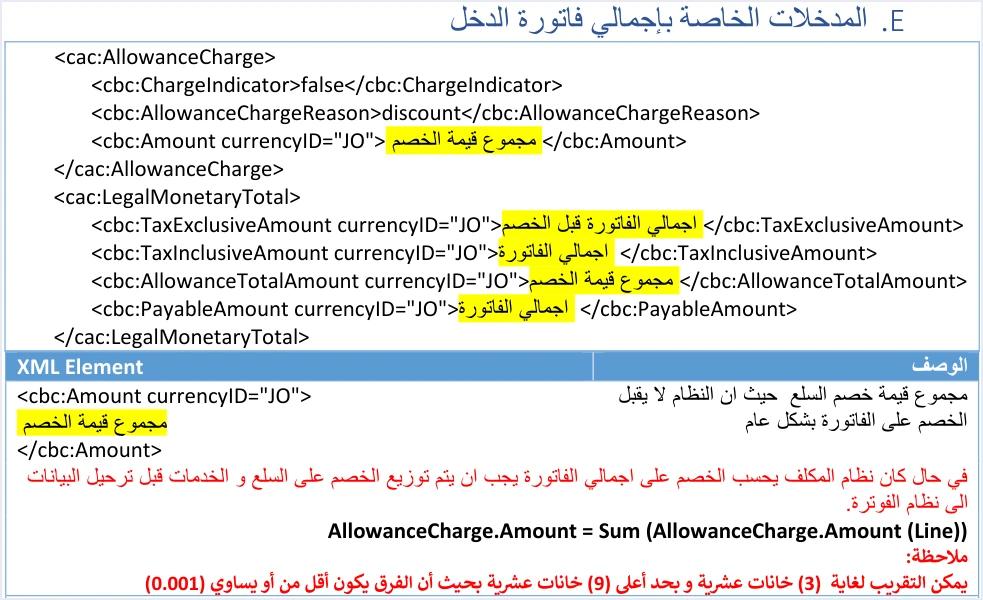
The guide’s income invoice example puts numbers on these rules. Its first line is 33 × 2 with a discount of 2, worth 64, and its second line is 10 × 5 with a discount of 5, worth 45. The total before discount is 116.000, the total discount is 7.000, and the amount payable is 109.000. On an income invoice, the amount payable is the total after discount, with no tax line between the two.
The general totals rules in the guide still apply to income invoice totals. The system does not accept a separate invoice-level discount. The discount in the header is the sum of the line discounts, so a seller who discounts the invoice total spreads that discount across the lines before sending. The guide also allows rounding to 3 decimal places and up to 9, provided the difference is no more than 0.001.
Version 1.5 of ISTD’s technical guide does not state how the system handles an income invoice file that carries a tax block with zero values, because the income template does not include that block in the first place.
The income invoice code: a third digit of 1 in the type code
The technical guide codes each invoice type as a three-digit number placed in the name attribute of the invoice type element. The first digit is the trade type, the second is the payment method (1 for cash, 2 for receivable), and the third is the tax family. On an income invoice the third digit is 1, against 2 for the General Sales Tax family and 3 for the Special Sales Tax family. These are the full income family codes.
Scroll the table sideways to see the remaining columns
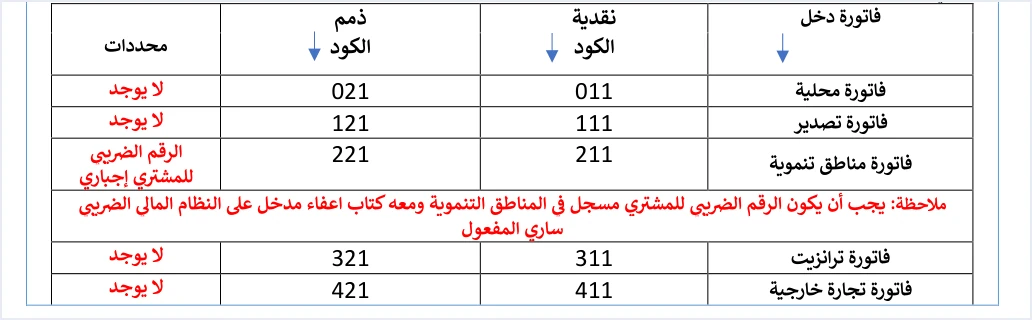
Every code that ends in 1 is an income invoice code. Codes 012 and 022 are not, because they belong to the General Sales Tax family. The income table also differs from the General Sales Tax table in its conditions column. In the General Sales Tax family, the non-local types require a 0% tax rate. In the income family, the condition reads None (لا يوجد) for every type except development zones, because the income invoice carries no tax lines at all.
The second digit declares the payment method at the moment of issue. Still, the file only declares the type. What settles it is the taxpayer’s registration with ISTD and the reality of the sale.
The value of the invoice type element itself shows whether the invoice is new or a return, 388 for a new invoice and 381 for a return. Version 1.5 of the technical guide defines no third value. A return invoice reuses the code of the original invoice, so the value 381 with the code 011 means a local cash return on an income invoice. A return is on quantities only and carries the same buyer details, and the income return invoice keeps the notes field as an optional field.
The income invoice on the portal or through linking
ISTD’s joining guide sets out two paths after the account is created, issuing invoices on the portal for a business with no accounting software, and device linking for a business that has it. An income invoice can be issued from either path.
On the portal
The taxpayer signs in as the sub-user, because the main user does not see the Issue an invoice tile (تنظيم فاتورة). Then they choose cash (نقدي) or receivable (ذمم), fill in the invoice and buyer details, add each item with the Add button (إضافة), and press Issue (إصدار). The steps are in our article Issue an Invoice on the JoFotara Portal.
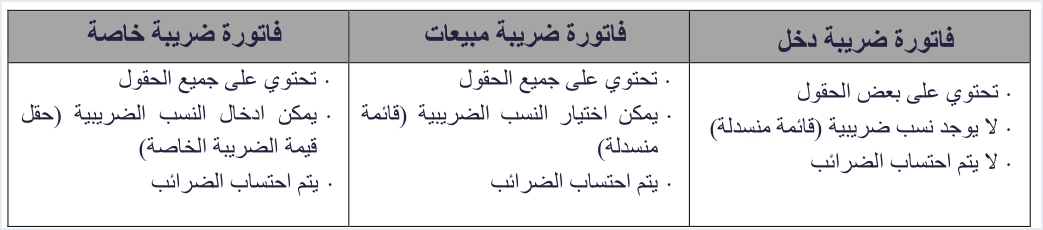
There is a catch. The form shown in the 2026 guide is a sub-user form for a taxpayer registered for General Sales Tax, and it has a mandatory field called General Sales Tax rate (نسبة الضريبة العامة). The fields of the income invoice form are described only in the 2024 user guide for the platform, which is not an ISTD guide. According to that guide, the General Sales Tax rate field is hidden on the income invoice, and the guide’s table describes the income invoice as having some of the fields, with no tax rates and no tax calculated. The current interface may differ from this.
Through linking
The main user chooses the device linking option (ربط الأجهزة), enters a username and selects the income-source sequence, and the system generates the Client ID and the Secret Key. The taxpayer then completes the technical requirements with the developer of its system or its technology provider. The software then sends the invoice to the system as an XML file in the UBL 2.1 standard, Base64-encoded inside a request. The invoice code must match the taxpayer’s tax number and income-source sequence, so software that serves an unregistered seller sends codes that end in 1.
The response returns the invoice status, and if the invoice is accepted a QR code comes back with it, which the guide requires to be shown on the seller’s invoice.
What the choice of path changes
ISTD’s questions and answers guide states that the sub-user loses the Issue an invoice tile (تنظيم فاتورة) once the device linking option is clicked. Undoing the link is not a setting you change yourself. It is an invoicing-system support request (طلب دعم فني لنظام الفوترة) that you submit to ISTD, and it is meant for a business that has no accounting system and linked by mistake. The same guide states that the platform lets you return invoices sent through it in all cases, whether or not the business has linked a system.
What ISTD’s guides do not document about the income invoice
ISTD’s guides answer the basic rules of the income invoice but stay silent on several related questions. None of the points below is stated in the official guides, so do not base a decision on any of them before checking with ISTD.
- How the national number that Article 5(a) of Regulation No. 34 of 2019 requires for an unregistered seller relates to the tax number that the seller element carries in the file.
- The fields of the income invoice form on the current portal, since the 2026 guide shows the form of a user registered for General Sales Tax.
- How the system handles an income invoice file that carries a tax block with zero values.
- A full example of a receivable income invoice or of a non-local income invoice, since the guide gives only an example of a local cash invoice and one-line examples for the codes.
- Whether an invoice that is partly paid at issue counts as cash or receivable.
- Correcting the type code alone after sending when the quantities are right, since the available correction is a return invoice on quantities only.
Checklist before issuing an income invoice
The checklist below turns the rules above into questions for the accountant or the business owner to answer before the invoice leaves the portal or their software.
- Is the business unregistered for General Sales Tax? If the business is registered, the correct invoice is the general sales tax invoice, and the system rejects a type that does not match the registration.
- Does the code end in 1? The code is 011 for a local cash invoice and 021 for a local receivable invoice, and the other types have their codes in the table above.
- Is the file free of tax blocks? The lines carry no tax category, rate or amount, and the header carries no tax total.
- Is the discount spread across the lines? The system does not accept a separate invoice-level discount.
- Is the buyer’s name required? The buyer’s name is always required on a receivable invoice, and on a cash invoice worth more than JOD 10,000 or its equivalent in foreign currency.
- Is the trade type development zones? Then the buyer’s tax number becomes mandatory, and the guide requires that number to be registered in the development zones, with a valid exemption letter entered on the financial tax system.
- Have you chosen the right path? Device linking takes the Issue an invoice tile (تنظيم فاتورة) away from the sub-user on the portal.
For the full picture of the system and how to connect your business to it, read our article Jordan’s National E-Invoicing System, or see how Qoyod works with JoFotara on Qoyod’s National Invoicing System page.
E-invoicing and full accounting in one system
Qoyod is integrated with the National Invoicing System (JoFotara). You issue your invoice in Jordanian dinars from Qoyod, it is booked to your ledgers automatically and sent to the system, and once it is accepted it comes back with a QR code from the Income and Sales Tax Department.
Frequently asked questions
Who issues the income invoice in JoFotara?
It is issued by a seller not registered for General Sales Tax with ISTD. The invoice type is set by the taxpayer’s registration with ISTD, not by the nature of its activity or by its own choice.
Is tax charged on an income invoice?
An income invoice carries no tax at all. Its lines have no tax category, rate or tax amount, and its header has no tax total. The amount payable on it is the total after discount.
What is the code for a local income invoice?
The code is 011 for a local cash invoice and 021 for a local receivable invoice. A third digit of 1 marks the income family in every trade type, from 011 and 021 to 511 and 521.
Can I issue an income invoice on the portal without accounting software?
ISTD’s joining guide provides a path for issuing invoices on the portal for a business with no accounting software. You issue the invoice as the sub-user from the Issue an invoice tile (تنظيم فاتورة), and the sub-user loses that tile if the device linking option is clicked.
How do I correct an income invoice issued in error?
You correct it with a return invoice that has the value 381 and the same code as the original invoice. For a local cash income invoice, that code is 011. A return is on quantities only, carries the same buyer details, and cannot exceed the quantity sold on the original invoice.
What happens to the income invoice after registering for General Sales Tax?
Your new invoices belong to the General Sales Tax family, and their codes end in 2. If a registered taxpayer sends an income invoice, the system rejects it with the message This user is not authorized to submit this type of invoice.
References
- Income and Sales Tax Department (ISTD), technical guide for integrating with the National Invoicing System through the API, version 1.5 (in Arabic), pp. 10, 12 and 18.
- Income and Sales Tax Department (ISTD), procedures guide for joining the Jordanian National Electronic Invoicing System, 2026 edition (in Arabic).
- Income and Sales Tax Department (ISTD), procedures guide for issuing an invoice in the Jordanian National Electronic Invoicing System, 2026 edition (in Arabic).
- Income and Sales Tax Department (ISTD), questions and answers guide for the National Invoicing System, 2026 (in Arabic).
- Regulation No. 34 of 2019 on Organizing and Controlling Invoicing Affairs, as amended, consolidated text (in Arabic), Articles 2, 3, 4, 5 and 11.
- Instructions No. 1 of 2019 on Invoicing Affairs and Their Control, as amended (in Arabic), Article 4.
- User guide for the National Invoicing System platform, 2024, prepared by a software vendor, not ISTD (secondary source; the current interface may differ from it) (in Arabic). Cited here for the income invoice interface only.
- ISTD’s National Invoicing System guides (in Arabic)