Wholesale distribution in the National Invoicing System (JoFotara) runs on the same rules that apply to every seller in Jordan. What sets a wholesaler apart is that one trading cycle brings several of those rules together. A credit sale to a retail shop, a high-value invoice, a partial return from an earlier shipment and a discount on a line item each correspond to a specific rule in the official texts issued by the Income and Sales Tax Department (ISTD). Together, those rules are what this article calls the wholesale distribution JoFotara rules.
This article follows those operations in the order they occur in a wholesale cycle, from issuing and delivering the invoice, through returns, to the sales invoice register. For each one it gives the rule, its wording and its source, and points to a fuller explanation where we have one in English. It is a map of the wholesale distribution JoFotara rules, not a second explanation of each.
The rules here rest on three official sources. They are Regulation No. 34 of 2019 on Organizing and Controlling Invoicing Affairs, as amended (Regulation 34/2019), the technical guide for integrating with the National Invoicing System through the API, version 1.5, and the portal guides published on the ISTD website. For a wider view of the system and how to connect your business to it, read our article Jordan’s National E-Invoicing System.
Wholesale distribution JoFotara rules at a glance
The table below lists the operations this article covers, the rule that governs each one, and the text the rule comes from.
Before the detail, three general rules govern everything that follows.
- When the invoice is issued. Article 5(d) of Regulation 34/2019 requires the seller to issue the invoice when the sale takes place.
- The invoice type. A sale inside the Kingdom is issued as a local invoice (فاتورة محلية). A sale to the free zones or to the Aqaba economic zone counts as an export under the invoice-type table in the portal guide. For the six types and when each one applies, see our article Invoice Types in the National Invoicing System.
- Shared responsibility. Article 10 of Regulation 34/2019 places the responsibility for making the invoice data match what actually happened in the sale of the goods or the supply of the service on the seller and the buyer alike. The retailer who buys from you therefore shares responsibility for the accuracy of the invoice you issue to them.
The buyer’s name on credit sales and large cash sales
This is the first rule a wholesaler meets on every invoice. Article 5(b) of Regulation 34/2019 requires the invoice to state the buyer’s name clearly when goods or services are sold on credit, and the same paragraph then names two further cases.
The technical guide spells the rule out in a note on the buyer block of the invoice file, and makes the buyer’s name mandatory in two cases.
- Receivable invoice. The buyer’s name is always mandatory, whatever the invoice value.
- Cash invoice. The buyer’s name is mandatory if the invoice is worth more than JOD 10,000 or its equivalent in foreign currencies, as the guide words it in its error table.

The procedures guide for issuing an invoice on the portal sets out the same rule. The Name field (الاسم) in the Buyer details section (بيانات المشتري) is always required on a receivable invoice, and it is required on a cash invoice whose value exceeds JOD 10,000.
In practice, every customer you sell to on credit needs complete details before the first invoice. In these cases, an invoice sent without the buyer’s name is rejected by the API with an error message.
Invoices over JOD 10,000 and proof of receipt
The second rule concerns large invoices, and it comes from the text of the regulation itself. Item 2 of Article 5(c) of Regulation 34/2019 reads as follows in Arabic.
«إذا زادت قيمة الفاتورة على (10000) دينار يثبت البائع استلامها من قبل المشتري»
In English, Article 5(c)(2) of Regulation No. 34 of 2019 requires the seller, when an invoice is worth more than JOD 10,000, to prove that the buyer received it. No official English translation of this regulation was found; the English here is our rendering, and the Arabic text is the authority.
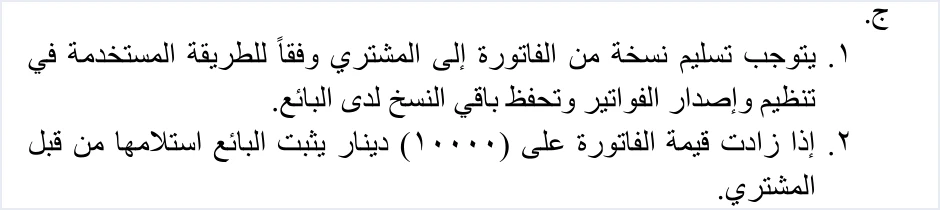
The same paragraph opens with the general delivery rule. Article 5(c)(1) of Regulation 34/2019 requires a copy of the invoice to be handed to the buyer in line with the method used to prepare and issue invoices, with the remaining copies kept by the seller. Delivery is therefore required for every invoice, and proof of receipt is an extra duty for an invoice whose value exceeds the threshold.
Three points keep the reading of this paragraph accurate.
- The wording exceeds. An invoice worth exactly JOD 10,000 does not exceed the threshold, so Article 5(c)(2) of Regulation 34/2019 does not cover it.
- The means of proof. The paragraph names no particular way to prove receipt. It places the duty on the seller and leaves the method open.
- The same figure from two different sources. The proof-of-receipt threshold is in the regulation, and the buyer-name threshold for cash invoices is in the technical guide. Both are ten thousand dinars, but the first is a duty to prove receipt and the second is a duty to fill in a field on the invoice.
The table below applies both rules to four cases a wholesale invoice can fall into.
Returning part of a shipment in several batches
When a customer sends back part of the goods from an earlier invoice, the correction is made with a return invoice (credit note). The technical guide defines the return invoice as a credit note and sets three rules for it in a single note.
- The system allows returns on quantities only.
- The system does not allow a return of more than the quantity sold on the original invoice.
- The system allows a return invoice to be sent once or more, until all the quantities of the items sold on the original invoice are used up.
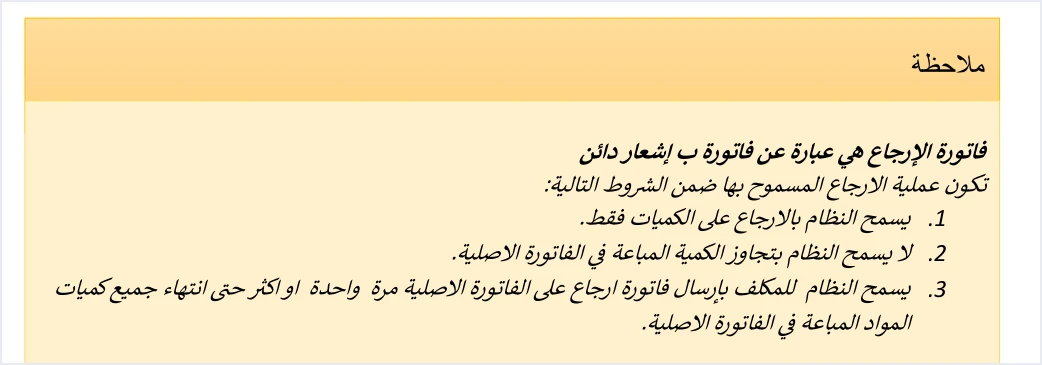
The third rule is the one a distributor needs when returns against the same invoice arrive in batches. Each batch is a separate return invoice linked to the original invoice, and the total returned on each line stays within the quantity sold on that line. The guide also requires two more things on every return invoice.
- Reference to the original. The return invoice carries the original invoice’s number, its unique identifier (UUID) and its total.
- The return reason. Stating the reason is mandatory on every return invoice.
The guide keeps the line number, the item name and the unit price on a return line as they appear on the original invoice. It accepts a returned quantity that is a whole number or a decimal greater than zero.
An issued invoice cannot be edited after it is sent, and the correction goes through a return invoice on quantities. Version 1.5 of the technical guide defines only two document types, the new invoice (388) and the return invoice (381), so it has no place for a debit note. The options open to you when you find an error in an invoice you have already sent are covered in our article Editing an Issued Invoice in Jordan’s National Invoicing System.
If you issued invoices on the portal before linking your accounting software, ISTD’s questions and answers guide states that the platform lets you return invoices sent through it in all cases, whether or not the business has linked a system. The steps for a return on the portal are in our article Return an Invoice on the JoFotara Portal.
Buyer details on the return invoice
The technical guide states this rule in a single sentence.
«يجب أن تتوافق بيانات المشتري في فاتورة الإرجاع مع بياناته في فاتورة البيع الأصلية المرتبطة بها»
In English, the guide requires the buyer details on the return invoice to match those on the original sales invoice it is linked to. The same sentence appears in three places in the guide, on pp. 26, 49 and 76.
Applied to wholesale, the rule is direct. The return is recorded against the original invoice on which the goods were sold, and the buyer details on it are the buyer details on that invoice, exactly as they stand. If the original sales invoice carries the buyer’s name, ID type and ID number, those details move to the return invoice unchanged.
A correct return therefore starts with a correct sales invoice. The customer details you enter on a credit sale are the same details that every later return invoice against that invoice will carry. The buyer fields in the invoice file include three ID types, the national number, the personal number for non-Jordanians and the tax number.
Discounts on a partial return
If you gave a customer a discount on a line and they then return part of its quantity, the technical guide sets what the return invoice shows for the discount.
«اذا كان الارجاع لكامل كمية السلعة او الخدمة فيجب وضع الخصم (إن وجد) كاملا، أما اذا كان الارجاع لجزء من الكمية فيجب ان يكون الخصم (إن وجد) جزء من الخصم الكلي للسلعة او الخدمة حسب الكمية المرجعة»
In English, the guide says that if the whole quantity of the good or service is returned, the discount (if any) must be entered in full, and if only part of the quantity is returned, the discount (if any) must be a part of the total discount on that good or service according to the quantity returned.
The plain reading of according to the quantity returned is that the discount is split in proportion to the returned quantity over the quantity sold. The guide gives no formula for this, so any worked example you see for this rule is an illustration, not official text.
The sales invoice register under Article 6
The last rule in the cycle does not concern a single invoice but all of them together. Article 6 of Regulation 34/2019 opens as follows in Arabic.
«يتوجب على كل شخص ملزم بتنظيم وإصدار الفاتورة أن يعد سجلاً ورقياً أو محوسباً لفواتير بيع السلع و/أو الخدمات مروساً باسم البائع»
In English, Article 6 of Regulation No. 34 of 2019 requires every person obliged to prepare and issue invoices to keep a paper or computerized register of sales invoices for goods or services, headed with the seller’s name. No official English translation of this regulation was found; the English here is our rendering, and the Arabic text is the authority.
The register contains four details.
- The register page number.
- The buyer’s name.
- The invoice number.
- The invoice total.
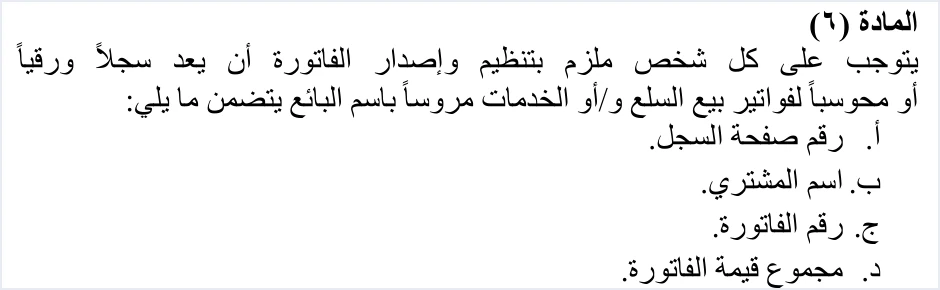
The text lets the seller choose between a paper register and a computerized one, and it requires the register to be headed with the seller’s name. The register carries the buyer’s name on every line, and that is the detail that ties each invoice to the customer it was issued to.
Wholesale cycle checklist
These questions follow the order of the cycle, and each one points to the text it rests on.
- Did you issue the invoice when the sale took place? (Article 5(d) of Regulation 34/2019).
- Is the invoice type right? A local invoice for a sale inside the Kingdom, and an export invoice for a sale to the free zones or the Aqaba economic zone (the invoice-type table in the portal guide).
- Is it a receivable invoice? The buyer’s name is always mandatory (Article 5(b) of Regulation 34/2019, and the technical guide).
- Is it a cash invoice worth more than JOD 10,000 or its equivalent? The buyer’s name is mandatory (the technical guide).
- Does the invoice value exceed JOD 10,000? Prove that the buyer received it (Article 5(c)(2) of Regulation 34/2019).
- Did the customer return part of the goods? Issue a return invoice on quantities, linked to the original invoice, with the return reason, and within what remains of each line (the technical guide).
- Are the buyer details on the return invoice the ones on the original invoice? They must match (the technical guide).
- Is there a discount on the returned line? Enter the full discount if the whole quantity is returned, and the part that matches the returned quantity if the return is partial (the technical guide).
- Did you record the invoice in the sales invoice register? The page number, the buyer’s name, the invoice number and the invoice total (Article 6 of Regulation 34/2019).
How Qoyod helps
The rules above are the same whether you issue invoices on the portal or from accounting software linked to the system, because Article 4(a) of Regulation 34/2019 recognizes the invoice issued by either route. ISTD’s questions and answers guide, however, states that a business that has an accounting system must link it to the National Invoicing System. For a comparison of issuing on the portal and issuing from accounting software, see our article National Invoicing Portal in Jordan: When It Is Enough and When You Need an Accounting System.
Qoyod is integrated with the National Invoicing System (JoFotara). This is what it does when you send your invoices.
- Field check before sending. Qoyod checks each invoice at field level as it is created, covering the tax number, the document type and payment method, the General Sales Tax rate and whether the lines are complete, and alerts you to any error before the invoice is sent, to reduce rejections.
- Status panel. ISTD returns the invoice status and any error message, and Qoyod shows them in its status panel. The status panel lists invoices that were not sent and need to be resent, and when you resend one it keeps the same UUID.
See the details on our page Qoyod’s integration with the National Invoicing System.
E-invoicing and full accounting in one system
Qoyod is integrated with the National Invoicing System (JoFotara). You issue your invoice in Jordanian dinars from Qoyod, it is booked to your ledgers automatically and sent to the system, and once it is accepted it comes back with a QR code from the Income and Sales Tax Department.
Frequently asked questions
Is the buyer’s name required on every invoice a wholesaler issues?
The buyer’s name is always required on a receivable invoice, and on a cash invoice worth more than JOD 10,000 or its equivalent in foreign currencies, as the technical guide states. Article 5(b) of Regulation 34/2019 also requires the buyer’s name to be stated clearly in a credit sale.
When must the seller prove that the buyer received the invoice?
Proof is required when the invoice value exceeds JOD 10,000, under Article 5(c)(2) of Regulation 34/2019. An invoice worth exactly JOD 10,000 does not exceed the threshold, and the paragraph does not say how receipt is to be proved.
Can goods from one invoice be returned more than once?
The technical guide allows a return invoice to be sent once or more until all the quantities of the items sold on the original invoice are used up. Returns are on quantities only and cannot exceed the quantity sold.
Can a return invoice carry another buyer’s details?
A return invoice cannot carry another buyer’s details, because the technical guide requires the buyer details on the return invoice to match those on the original sales invoice it is linked to.
How is the discount entered when a customer returns part of the quantity?
The discount is entered as a part of the total discount on the good or service, according to the quantity returned, as the technical guide says. If the whole quantity is returned, the discount is entered in full.
What details does the sales invoice register contain?
Article 6 of Regulation 34/2019 sets four details, the register page number, the buyer’s name, the invoice number and the invoice total. The register may be on paper or computerized, and it is headed with the seller’s name.
References
- Regulation No. 34 of 2019 on Organizing and Controlling Invoicing Affairs, as amended, consolidated text (in Arabic), Articles 4, 5, 6 and 10.
- Income and Sales Tax Department (ISTD), technical guide for integrating with the National Invoicing System through the API, version 1.5 (in Arabic), pp. 16, 23, 26, 49, 76 and 101.
- Income and Sales Tax Department (ISTD), procedures guide for issuing an invoice in the Jordanian National Electronic Invoicing System (in Arabic).
- Income and Sales Tax Department (ISTD), questions and answers guide for the National Invoicing System (in Arabic).