Articles and presentations about e-invoicing in Jordan pass around many dates. Some come from an official text, and some have no known source. This article puts the JoFotara timeline from 2019 to 2025 in one place and grades the source of each date, so you can tell what you are reading in a text published by the Income and Sales Tax Department (ISTD) and what is only repeated in coverage of the National Invoicing System (JoFotara).
In short, Regulation No. 34 of 2019 on Organizing and Controlling Invoicing Affairs was published in the Official Gazette on 1 May 2019, its instructions have applied since 1 July 2019, and it was amended by amending Regulation No. 13 of 2023, published on 16 April 2023. These three dates come from the two official texts. The platform launch in December 2022 and mandatory application from 1 April 2025 are reported dates, and neither appears in the consolidated text of the regulation or in the text of the instructions.
This article does not explain the articles of the regulation or of the instructions, since each has its own article in this series. It covers only the dates, what each text says about its own date, and what it leaves unsaid.
The JoFotara timeline in one table
The table below lists each date with the event tied to it and the grade of its source. We use three grades. Official means the date appears in a text that ISTD publishes. Reported means the date circulates in coverage of the system, and we have not matched it to a specific official text. Secondary means the date comes from a single unofficial party and does not appear in the consolidated text that ISTD publishes.
Scroll the table sideways to see the remaining columns
The table shows that every official date concerns the texts themselves, meaning their publication, their entry into force, their amendment and the versions of the technical guide. None of the dates about practical application, from the platform launch to the mandate, appears in the two official texts. That difference has a practical consequence, which we return to at the end of the article.
2019: the regulation and its instructions are issued
The legal framework for invoicing began with two texts issued in the same year. The first is a regulation issued under a law. The second is a set of instructions issued to implement the regulation.
Publication of the regulation in Official Gazette issue 5572
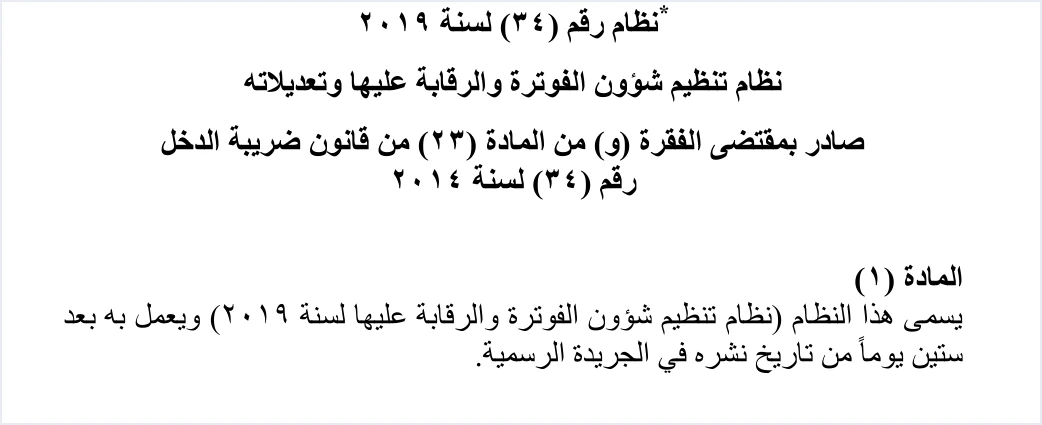
The heading of the consolidated text names the law under which Regulation No. 34 of 2019 on Organizing and Controlling Invoicing Affairs was issued. Here is the Arabic wording.
«صادر بمقتضى الفقرة (و) من المادة (23) من قانون ضريبة الدخل رقم (34) لسنة 2014»
In English, the heading says that the regulation was issued under paragraph (F) of Article 23 of Income Tax Law No. 34 of 2014. No official English translation of this regulation was found; the English here is our rendering, and the Arabic text is the authority.
The footnote on the first page adds that the regulation was published in the Official Gazette, issue 5572, dated 1 May 2019.

Watch the two similar numbers. No. 34 of 2019 is the number of the regulation. No. 34 of 2014 is the number of the law under which the regulation was issued. They are two different texts, and neither should be shortened to the name of the other.
In force sixty days after publication
Regulation 34/2019 gives no calendar date for when it takes effect. Article 1 of Regulation 34/2019 ties its entry into force to publication, and here is the Arabic wording.
«يعمل به بعد ستين يوماً من تاريخ نشره في الجريدة الرسمية»
In English, Article 1 of Regulation 34/2019 provides that the regulation takes effect sixty days after the date of its publication in the Official Gazette. No official English translation of this regulation was found; the English here is our rendering, and the Arabic text is the authority.
The text links entry into force to a period counted from the date of publication and does not name a specific day. This article therefore gives no computed start date, because ISTD has not published such a date in the text.
Instructions No. 1 of 2019 from 1 July 2019
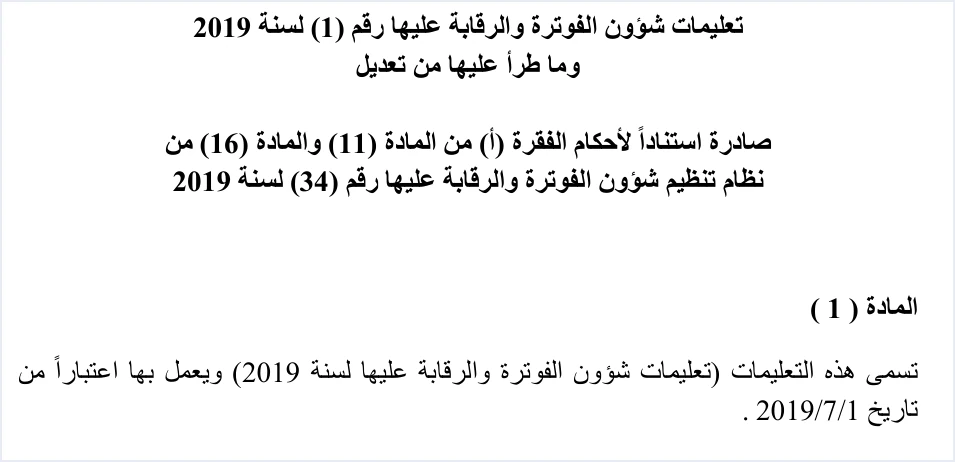
Instructions No. 1 of 2019 on Invoicing Affairs and Their Control were issued under paragraph (a) of Article 11 and Article 16 of Regulation 34/2019. Article 16 of Regulation 34/2019 is the one that empowers the Minister of Finance to issue the instructions needed to implement the regulation, on the recommendation of the Director. Unlike the regulation, the instructions state their own effective date, and they apply from 1 July 2019.
With these two texts, the legal framework for invoicing was complete in 2019. Regulation 34/2019 sets the invoice items, how invoices are kept and when an invoice is issued, which paragraph (d) of Article 5 of Regulation 34/2019 ties to the sale itself. Instructions 1/2019 set out the exempt categories and the arrangement for lawyers. The platform date comes later in the timeline.
2022 and 2023: the platform launch and amending Regulation No. 13
The platform launch in December 2022
Coverage of the system states that the National Invoicing System platform was launched in December 2022 and that joining it was voluntary at first. This date is reported, and we have not matched it to a specific official announcement by ISTD. The same coverage states that January and February 2023 saw mandatory registration for selected groups of taxpayers, with integration testing. This too is reported.
Amending Regulation No. 13 of 2023
This date is official. The footnote of the consolidated text states that Regulation 34/2019 was amended by amending Regulation No. 13 of 2023, published in the Official Gazette, issue 5851, dated 16 April 2023.
We do not set out what the amendment changed. The consolidated text that ISTD publishes merges the amendment into the articles and does not mark which articles were amended, and the text of the amending regulation itself is not among the official sources we relied on. Any specific change attributed to this amendment comes from news reports, not from the text. In practice, read the regulation in force as ISTD publishes it, rather than comparing it with the original 2019 version.
Versions 1.3 and 1.4 of the technical guide
Two versions of the technical guide for integrating with the National Invoicing System through the API were also approved in 2023. The version table in the guide shows that versions 1.1 and 1.2 were drafts in January 2023, that version 1.3 was approved on 23 January 2023, and that version 1.4 was approved on 1 December 2023. We return to this table in its own section below.
2024 and 2025: from the registration window to the mandate
Every date in these two years is reported or secondary, and none of them appears in the consolidated text of the regulation or in the text of the instructions.
- 31 May 2024. Coverage of the system states that this date was the announced end of a registration window for the National Invoicing System.
- October 2024. The same coverage states that ISTD sent compliance notices to businesses that had not registered.
- 2025. A single law firm reports the issue of an amending Regulation No. 2 of 2025. This source is secondary. The consolidated text that ISTD publishes does not mention this amending regulation in its footnote, which stops at the 2023 amendment. For that reason this article does not treat it as a settled text in force.
- 1 April 2025. Mandatory application. Coverage of the system states that from this date all invoices, between businesses, to individuals and to government bodies, must be issued through the National Invoicing System or through software linked to it. Who the obligation covers is set out in our article Who Must Use E-Invoicing in Jordan?
The legal basis for applying the link according to a time plan is paragraph (b) of Article 4 of Regulation 34/2019. Here is the Arabic wording.
«تتولى الدائرة إصدار الفاتورة وتنظيمها بموجب أحكام هذا النظام من خلال برنامج الفوترة الوطني الالكتروني أو الربط المباشر مع البرنامج وفقاً للخطة الزمنية المعدة لهذه الغاية»
In English, paragraph (b) of Article 4 of Regulation 34/2019 makes ISTD responsible for issuing and organizing the invoice under the regulation through the National Invoicing System, or through a direct link with the system according to the time plan prepared for that purpose. No official English translation of this regulation was found; the English here is our rendering, and the Arabic text is the authority.
The text mentions the time plan but gives it no date. The date itself comes from outside the text, which is why we grade it as reported. Our article Is Linking Accounting Software to JoFotara Mandatory? explains what Article 4 of Regulation 34/2019 says about linking.
The technical guide from version 1.3 to 1.5
The technical guide for integrating with the National Invoicing System is the document that the Invoicing Affairs Directorate at ISTD issues for anyone who links accounting software to the system. Its dates are official, because they appear in the version table on the second page of the guide itself.
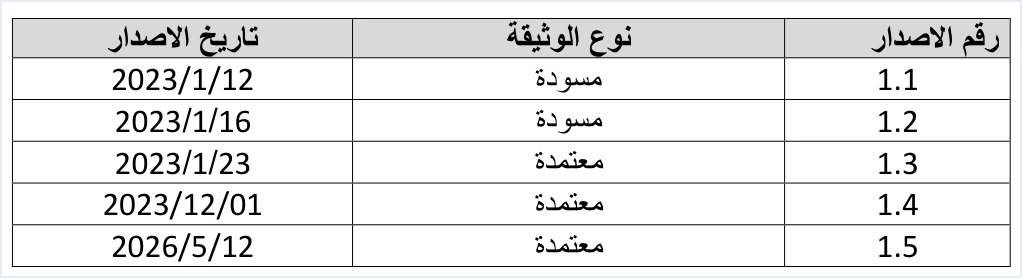
- January 2023. Versions 1.1 and 1.2 are drafts.
- 23 January 2023. Version 1.3 is approved.
- 1 December 2023. Version 1.4 is approved.
- 12 May 2026. Version 1.5 is issued, and the director of the Invoicing Affairs Directorate and the Director General approved it on 14 May 2026.
Version 1.5 is the current version, and it replaced version 1.4. The text of version 1.4 is not among the sources we relied on, so this article does not compare the two versions. Our article JoFotara UBL 2.1 explains what the guide requires of the invoice file.
Note that the approval of version 1.5 is a technical event that concerns integration. It is not a new obligation on taxpayers, and it is the only 2026 date in this timeline.
How to read the source grade of each date
The source grade is not a formality. It decides how you can use a date in a decision, in correspondence or in a reply to an auditor.
- An official date can be referred back to the text itself, by the Official Gazette issue number, the article number or the version table. Examples are the publication of the regulation in issue 5572 and the entry into force of the instructions on 1 July 2019.
- A reported date helps you understand the context, but do not build a legal argument on it until you find an official announcement from ISTD. An example is the platform launch in December 2022.
- A secondary date remains information that needs checking, and it is not presented as a text in force. An example is amending Regulation No. 2 of 2025.
The same rule applies to anything you read about the National Invoicing System. If you find a date that does not name its source, first ask which text it appears in, and then in which issue of the Official Gazette that text was published.
What does not appear in the JoFotara timeline
Some of what circulates about invoicing in Jordan has no place in a timeline built on sources. Three points stand out.
No new dated mandate in 2026
We found no new dated obligation for 2026 in the official sources that can be verified. The accurate wording is mandatory application since 1 April 2025, with oversight that keeps tightening, where 1 April 2025 is a reported date. If you read about a new mandate date in 2026, ask for the official text that sets it before you build a plan on it.
The legal basis is in the heading, not in secondary accounts
The legal basis of Regulation 34/2019 is what the heading of the consolidated text states, paragraph (F) of Article 23 of Income Tax Law No. 34 of 2014. If another source says the regulation was issued under a different law, the reference is the heading that ISTD publishes.
Fines are not a date in this timeline
Regulation 34/2019 sets no fine amounts, because Article 15 of Regulation 34/2019 refers penalties to the Income Tax Law. Under Article 64 of Income Tax Law No. 34 of 2014, the penalty is an additional tax of JOD 200 to JOD 500, which doubles on repetition. Our article JoFotara Penalties explains Articles 64 and 66 of the Income Tax Law in detail.
How to use the timeline in your business
The timeline is more than history. It tells you which text to read and which document to work from. These practical steps follow from it.
- Read the regulation in its consolidated form. The text that ISTD publishes merges the 2023 amendment, so do not rely on the original 2019 version or on an earlier summary of the amendment.
- Read the instructions together with the regulation. Regulation 34/2019 sets the general rules, and Instructions 1/2019, in force since 1 July 2019, set out the exempt categories and the arrangement for lawyers.
- Work from version 1.5 of the technical guide if you or your software provider link accounting software to the National Invoicing System, because it is the current version, approved on 14 May 2026.
- Take 1 April 2025 as your reference date. It is the reported date of mandatory application, and we found no later dated mandate in the official sources that can be verified.
- Check that your suppliers are registered. ISTD offers a service for checking registration in the National Invoicing System by entering the tax number. Article 10 of Regulation 34/2019 places responsibility for the invoice matching the facts on the seller and the buyer alike.
Qoyod is integrated with the National Invoicing System (JoFotara). For a wider view of the system and how to connect your business to it, read our article Jordan’s National E-Invoicing System, or see how Qoyod works with JoFotara on our National Invoicing System page.
E-invoicing and full accounting in one system
Qoyod is integrated with the National Invoicing System (JoFotara). You issue your invoice in Jordanian dinars from Qoyod, it is booked to your ledgers automatically and sent to the system, and once it is accepted it comes back with a QR code from the Income and Sales Tax Department.
Frequently asked questions
When was the invoicing regulation issued in Jordan?
Regulation No. 34 of 2019 on Organizing and Controlling Invoicing Affairs was published in the Official Gazette, issue 5572, dated 1 May 2019. Article 1 of Regulation 34/2019 provides that it takes effect sixty days after the date of its publication, without giving a calendar date.
When did the invoicing instructions take effect?
Instructions No. 1 of 2019 on Invoicing Affairs and Their Control apply from 1 July 2019, as the instructions themselves state. They were issued under paragraph (a) of Article 11 and Article 16 of Regulation 34/2019.
What did amending Regulation No. 13 of 2023 change?
The consolidated text that ISTD publishes merges this amendment into the articles without marking the amended articles, so this article does not set out what it changed. What the footnote does establish is that it was published in the Official Gazette, issue 5851, dated 16 April 2023. In practice, the reference is the regulation in force.
Is there a new National Invoicing System mandate in 2026?
We found no new dated obligation for 2026 in the official sources that can be verified. Mandatory application has been in place since 1 April 2025 (a reported date), with oversight that keeps tightening. The only 2026 date in this timeline is the approval of version 1.5 of the technical guide, which is a technical event, not a new obligation.
What is the latest version of the technical guide for integrating with the National Invoicing System?
Version 1.5 is the latest version. It was issued on 12 May 2026, and the director of the Invoicing Affairs Directorate and the Director General approved it on 14 May 2026. It replaced version 1.4, which was approved on 1 December 2023.
References
- Regulation No. 34 of 2019 on Organizing and Controlling Invoicing Affairs, as amended, consolidated text (in Arabic, 5 pages), heading, footnote and Article 1.
- Instructions No. 1 of 2019 on Invoicing Affairs and Their Control, as amended (in Arabic).
- Income and Sales Tax Department (ISTD), Invoicing Affairs Directorate, technical guide for integrating with the National Invoicing System through the API, version 1.5 (in Arabic), version table, p. 2.