The Jordan invoicing instructions No. 1 of 2019 set out the implementing detail that the invoicing regulation left to the Minister of Finance. Their full name is Instructions No. 1 of 2019 on Invoicing Affairs and Their Control, as amended (Instructions 1/2019). They contain the value at which an invoice becomes mandatory, the items a cash sales invoice must carry, the list of activities the text exempts from issuing an invoice within set ceilings, the rule for goods placed on consignment, and a separate mechanism for lawyers.
In short, Instructions 1/2019 were issued under paragraph (a) of Article 11 and Article 16 of Regulation No. 34 of 2019 on Organizing and Controlling Invoicing Affairs, and they apply from 1 July 2019. The text is short, but each of its articles settles a practical question a seller faces when issuing an invoice.
This article explains Articles 1 to 6 of Instructions 1/2019 in the order of the version that the Income and Sales Tax Department (ISTD) publishes, and gives the Arabic wording where the exact words carry the point. It does not replace the official text, and it is not legal advice.
What are the Jordan invoicing instructions No. 1 of 2019?
Instructions are an implementing text issued under a regulation. Article 16 of Regulation No. 34 of 2019 (Regulation 34/2019) is the article that provides for them.
«يصدر الوزير بناء على تنسيب المدير التعليمات اللازمة لتنفيذ أحكام هذا النظام على أن يتم نشرها في الجريدة الرسمية»
In English, Article 16 of Regulation 34/2019 provides that the Minister, acting on a proposal from the Director, issues the instructions needed to implement the regulation, and that they are published in the Official Gazette. No official English translation of this regulation was found; the English here is our rendering, and the Arabic text is the authority.
Paragraph (a) of Article 11 of Regulation 34/2019 adds a second hook. After the categories that the regulation exempts by name, it covers any other bodies or categories that are set by instructions the Minister issues for that purpose.
Instructions 1/2019 rely on these two articles expressly. Their heading states that they were issued under paragraph (a) of Article 11 and Article 16 of Regulation 34/2019. Article 1 of Instructions 1/2019 gives the text its name, the Invoicing Affairs and Their Control Instructions of 2019, and provides that they apply from 1 July 2019.
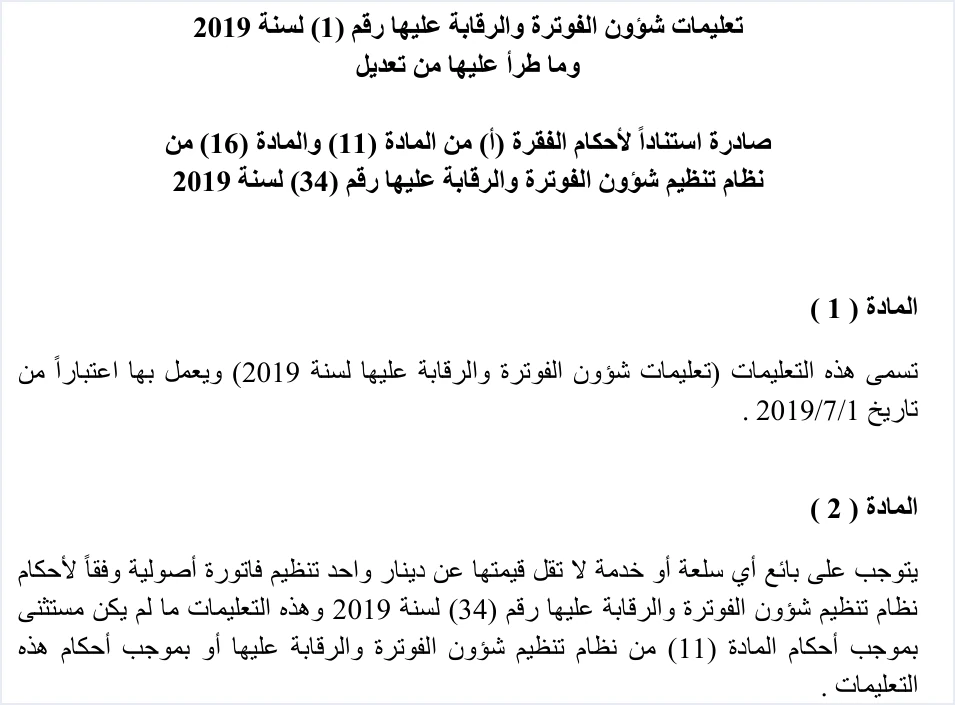
The title of the published version says that it includes later amendments, but that version does not contain every later amendment, as the section on Article 4 shows. Because Instructions 1/2019 detail what Regulation 34/2019 referred to them, Article 2 of Instructions 1/2019 refers to the regulation and the instructions together, and Article 6 of Instructions 1/2019 refers to Income Tax Law No. 34 of 2014 for fines.
The six articles in one line each
Before the detail, here is the subject of each article of Instructions 1/2019 that this article explains.
Article 2: the one-dinar rule
Article 2 of Instructions 1/2019 is the general obligation. Here is its Arabic wording.
«يتوجب على بائع أي سلعة أو خدمة لا تقل قيمتها عن دينار واحد تنظيم فاتورة أصولية وفقاً لأحكام نظام تنظيم شؤون الفوترة والرقابة عليها رقم (34) لسنة 2019 وهذه التعليمات ما لم يكن مستثنى بموجب أحكام المادة (11) من نظام تنظيم شؤون الفوترة والرقابة عليها أو بموجب أحكام هذه التعليمات»
In English, Article 2 of Instructions 1/2019 requires the seller of any good or service worth not less than one dinar to prepare a proper invoice in line with Regulation 34/2019 and these instructions, unless the seller is exempt under Article 11 of the regulation or under the instructions. No official English translation of this instruction was found; the English here is our rendering, and the Arabic text is the authority.
The text has three parts worth separating.
- Who is bound. The seller of any good or service. The text puts sellers of goods and providers of services under one rule.
- When the obligation starts. At a good or service worth not less than one dinar. This is the same threshold that paragraph (a) of Article 5 of Regulation 34/2019 sets.
- Who is exempt. Anyone exempted by Article 11 of Regulation 34/2019, or by Article 4 of Instructions 1/2019 itself.
Article 2 of Instructions 1/2019 requires the invoice to be a proper invoice (فاتورة أصولية) in line with the provisions of the regulation and the instructions, so the test is that the invoice meets both texts together. One of those provisions in the regulation as it now stands is paragraph (a) of Article 4 of Regulation 34/2019.
«تعتمد الفاتورة الالكترونية الصادرة عن برنامج الفوترة الوطني الالكتروني أو الصادرة عن برنامج تم ربطه ببرنامج الفوترة الوطني الالكتروني»
In English, Article 4(a) of Regulation No. 34 of 2019 provides that, for the purposes of the regulation, the electronic invoice that is recognized is the one issued by the National Invoicing System or by a program linked to it. No official English translation of this regulation was found; the English here is our rendering, and the Arabic text is the authority.
The regulation’s own version of the one-dinar rule also requires at least two copies of the invoice. Both rules are explained in our article Minimum Invoice Value in Jordan: One Dinar, Two Copies.
Article 3: items of a cash sales invoice
Article 3 of Instructions 1/2019 sets out what a cash sales invoice for goods or for the provision of services must contain. There are five items.
- The invoice serial number.
- The seller’s name and address.
- The seller’s tax number if the seller is registered for sales tax. If not registered, the national number for a Jordanian person, and the number approved by the competent authority for a non-Jordanian person.
- The date the invoice is prepared and issued.
- The type, quantity and value of the goods or service sold, and the invoice total.
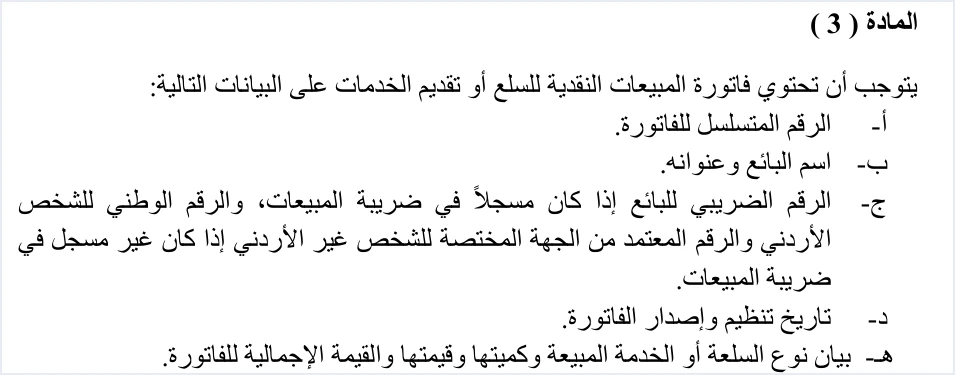
This list matches the five items in paragraph (a) of Article 5 of Regulation 34/2019. What Article 3 of Instructions 1/2019 adds is detail on the third item for a seller who is not registered for sales tax. It separates a Jordanian, who gives a national number, from a non-Jordanian, who gives the number approved by the competent authority.
Article 3 of Instructions 1/2019 deals with the cash invoice. For a deferred sale, an installment sale or a sale paid in stages, Article 5(b) of Regulation No. 34 of 2019 requires the buyer’s name to be stated clearly. For the steps to enter these items on the portal, see our article Issue an Invoice on the JoFotara Portal: The Steps.
Article 4: the ceilings as the text states them
Article 4 of Instructions 1/2019 opens by exempting the following categories from preparing and issuing an invoice under Regulation 34/2019 and the instructions issued under it. It then lists three paragraphs, each with an annual ceiling.
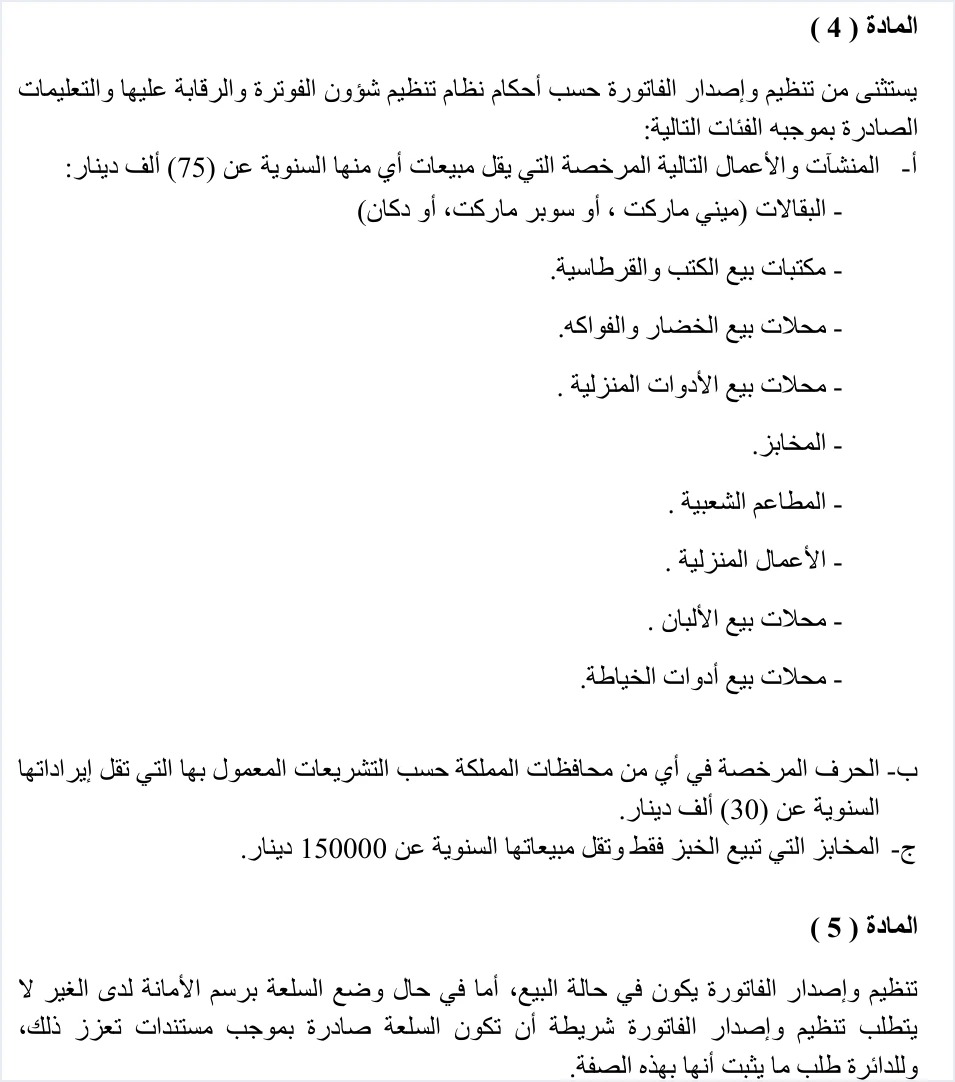
Bakeries appear twice in Article 4 of Instructions 1/2019. Paragraph (a) lists them with a ceiling of JOD 75,000, and paragraph (c) lists them with a ceiling of JOD 150,000, on condition that they sell bread only. To read these ceilings correctly, keep three points in mind.
- The list is not closed. Other sectors were added by later amendments that do not appear in the version this article explains, so check the current text for your activity.
- The activity and the ceiling count together. For a grocery store, mini market, supermarket or small shop, paragraph (a) of Article 11 of Regulation 34/2019 requires that the business actually carries on that activity, so a license for the activity is not enough on its own. Here is the Arabic wording of that condition.
«وتمارس فعلياً هذا النشاط»
In English, Article 11(a) of Regulation No. 34 of 2019 makes the exemption apply only to a business that actually carries on the named activity. No official English translation of this regulation was found; the English here is our rendering, and the Arabic text is the authority.
- The exemption is not permanent. Paragraph (b) of Article 11 of Regulation 34/2019 allows the Director to bind a person to the regulation when there is sufficient evidence that the person’s sales exceed the threshold.
These ceilings, and what to do as you approach one, are explained in detail in our article JoFotara Exemption: Who Is Exempt and at What Threshold. For the wider picture of who must use e-invoicing in Jordan, there is a separate article.
Article 5: the invoice on a sale, and goods on consignment
Article 5 of Instructions 1/2019 is short. Here is its Arabic wording.
«تنظيم وإصدار الفاتورة يكون في حالة البيع، أما في حال وضع السلعة برسم الأمانة لدى الغير لا يتطلب تنظيم وإصدار الفاتورة شريطة أن تكون السلعة صادرة بموجب مستندات تعزز ذلك، وللدائرة طلب ما يثبت أنها بهذه الصفة»
In English, Article 5 of Instructions 1/2019 provides that an invoice is prepared and issued in the case of a sale, and that placing goods on consignment with others does not require an invoice, provided the goods leave under documents that support this, and that ISTD may ask for proof that the goods were placed on that basis. No official English translation of this instruction was found; the English here is our rendering, and the Arabic text is the authority.
Article 5 of Instructions 1/2019 combines a rule, a condition and a power.
- The rule. The invoice is prepared and issued on a sale, and placing goods on consignment with others does not require an invoice.
- The condition. The goods must leave under documents that support this.
- The power. ISTD may ask for proof that the goods were placed on that basis.
Article 5 of Instructions 1/2019 does not name the document required or set its form, and it allows ISTD to ask for proof of the consignment basis. So keep the document under which the goods left on consignment. The general rule in Regulation 34/2019 still applies. Article 3 of Regulation 34/2019 fixes the time and date of a sale as the time and date the sale takes place, and Article 5(d) of Regulation 34/2019 requires the seller to issue the invoice when the sale takes place.
Article 6: a separate mechanism for lawyers
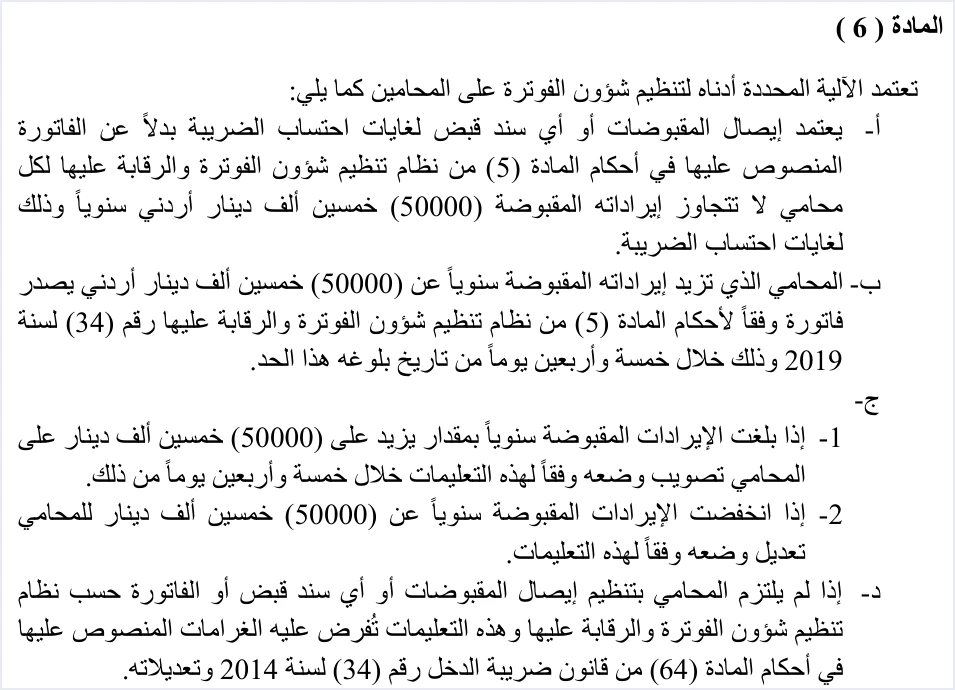
Article 6 of Instructions 1/2019 opens by adopting the mechanism set out below for the invoicing affairs of lawyers. It comes down to four points.
- Up to JOD 50,000. For every lawyer whose collected revenue does not exceed JOD 50,000 a year, a receipt voucher or any other receipt document is accepted in place of the invoice for the purpose of calculating tax (paragraph (a)).
- Above JOD 50,000. The lawyer issues an invoice under Article 5 of Regulation 34/2019 within forty-five days from the date the lawyer reaches that threshold (paragraph (b)).
- When revenue changes. If collected revenue rises above JOD 50,000, the lawyer must correct their position within 45 days. If it falls below that figure, the lawyer may adjust their position in line with the instructions (paragraph (c)).
- Non-compliance. The lawyer is subject to the fines set out in Article 64 of Income Tax Law No. 34 of 2014, as amended (paragraph (d)).
Here is the Arabic wording of paragraph (a), the core of the mechanism.
«إيصال المقبوضات أو أي سند قبض لغايات احتساب الضريبة بدلاً عن الفاتورة»
In English, paragraph (a) of Article 6 of Instructions 1/2019 accepts a receipt voucher or any other receipt document, for the purpose of calculating tax, in place of the invoice. No official English translation of this instruction was found; the English here is our rendering, and the Arabic text is the authority.
The measure in Article 6 of Instructions 1/2019 is collected revenue per year. Article 4 of Instructions 1/2019 measures by annual sales instead, or by annual revenue in the case of crafts. The fine amounts that paragraph (d) refers to are explained in our article JoFotara Penalties: Articles 64 and 66 Explained.
How to read the instructions with the regulation
Instructions 1/2019 cannot be read fully without Regulation 34/2019, because each of their articles details a rule found in the regulation. Here is where each topic sits in the two texts.
Put together as a practical list, this is what the two texts mean for a seller.
- Every good or service worth not less than one dinar needs a proper invoice, unless your activity is exempt under Regulation 34/2019 or Instructions 1/2019.
- A cash invoice carries the five items, with the tax number, the national number or the approved number, depending on your case.
- If your activity is listed in Article 4 of Instructions 1/2019, watch your annual sales against its ceiling, because paragraph (b) of Article 11 of Regulation 34/2019 allows the Director to bind you when there is sufficient evidence that you have exceeded the threshold.
- Goods delivered on consignment need a document that proves that basis.
- A lawyer tracks collected revenue against the JOD 50,000 threshold and the forty-five-day period.
Issuing the invoice from a program linked to the National Invoicing System
Paragraph (a) of Article 4 of Regulation 34/2019 recognizes the invoice issued by the National Invoicing System (JoFotara) or by a program linked to it. ISTD’s questions and answers guide states its position on businesses that use an accounting system.
«من يمتلك نظام محاسبي يلزمه ربط نظامه مع نظام الفوترة»
In English, ISTD’s questions and answers guide says that a business that has an accounting system must link that system to the National Invoicing System. ISTD publishes this guide in Arabic only; the English here is our rendering, and the Arabic text is the authority.
So if you issue your invoices from accounting software, that software needs to be linked to JoFotara. The technical side of that link carries its own operational rules from ISTD, explained in our article JoFotara Guidelines for Linked Systems: All Ten Explained, and the wider list of obligations is in our article E-Invoicing Requirements in Jordan.
Qoyod is integrated with the National Invoicing System (JoFotara). For a wider view of the system and how to connect your business to it, read our article Jordan’s National E-Invoicing System, or see how Qoyod works with JoFotara on our National Invoicing System page.
E-invoicing and full accounting in one system
Qoyod is integrated with the National Invoicing System (JoFotara). You issue your invoice in Jordanian dinars from Qoyod, it is booked to your ledgers automatically and sent to the system, and once it is accepted it comes back with a QR code from the Income and Sales Tax Department.
Frequently asked questions
What are Instructions No. 1 of 2019 on Invoicing Affairs and Their Control?
They are the implementing instructions issued under paragraph (a) of Article 11 and Article 16 of Regulation No. 34 of 2019 on Organizing and Controlling Invoicing Affairs. They detail its rules on the invoice value, the invoice items, the activities exempt from issuing an invoice and their ceilings, goods placed on consignment, and the mechanism for lawyers.
When did the instructions take effect?
Article 1 of Instructions 1/2019 provides that they apply from 1 July 2019.
What is the lowest value that requires an invoice?
Article 2 of Instructions 1/2019 requires the seller of any good or service worth not less than one dinar to prepare a proper invoice. The exception is a seller exempt under Article 11 of Regulation 34/2019 or under the instructions.
What items must a cash sales invoice carry?
Article 3 of Instructions 1/2019 requires five items. They are the serial number, the seller’s name and address, the tax number or national number (or the approved number for a non-Jordanian), the date of preparation and issue, and the type, quantity and value of the goods or service with the invoice total.
Do goods placed on consignment need an invoice?
Article 5 of Instructions 1/2019 does not require an invoice when goods are placed on consignment with others, provided the goods leave under documents that support this. ISTD may ask for proof of that basis.
Does a lawyer issue an invoice or a receipt voucher?
A lawyer whose collected revenue does not exceed JOD 50,000 a year uses a receipt voucher or any other receipt document in place of the invoice, under Article 6 of Instructions 1/2019. Above that figure, the lawyer issues an invoice under Article 5 of Regulation 34/2019 within forty-five days from the date of reaching the threshold.
References
- Instructions No. 1 of 2019 on Invoicing Affairs and Their Control, as amended (in Arabic), Articles 1 to 6.
- Regulation No. 34 of 2019 on Organizing and Controlling Invoicing Affairs, as amended, consolidated text (in Arabic), Articles 3, 4, 5, 11, 15 and 16.
- Income and Sales Tax Department (ISTD), questions and answers guide for the National Invoicing System, 2026 (in Arabic).
- Income Tax Law No. 34 of 2014, as amended (in Arabic).