The phrase proper invoice in Jordan keeps coming back in the invoicing and tax texts. The Income Tax Law requires a person to issue one, the invoicing instructions place the same duty on the seller, and the Income Tax Law itself lists failing to issue one among the acts of tax evasion. Yet a reader looking for a ready definition will not find one in the definitions article. This article gathers the places where the phrase appears, then sets out the conditions that the texts themselves point to.
In short, the definitions article of Regulation 34/2019 does not define the proper invoice, but Article 2 of Instructions 1/2019 ties the description to compliance with the provisions of the regulation and the instructions. Our reading is that a proper invoice is one that meets the provisions of both texts, led by the source of the invoice in paragraph (a) of Article 4 of Regulation 34/2019, and its items and two copies in paragraph (a) of Article 5 of Regulation 34/2019. This is our reading of the text, not a definition issued by the Income and Sales Tax Department (ISTD).
Here, Regulation 34/2019 means Regulation No. 34 of 2019 on Organizing and Controlling Invoicing Affairs, as amended, issued under paragraph (F) of Article 23 of Income Tax Law No. 34 of 2014. Instructions 1/2019 means Instructions No. 1 of 2019 on Invoicing Affairs and Their Control, as amended, in force from 1 July 2019.
Where the proper invoice appears in Jordan’s legal texts
The phrase appears in three places across two texts, the Income Tax Law and Instructions 1/2019, and each place does a different job. The table also shows where Regulation 34/2019 defines the invoice, because that definition is the closest text to the phrase even though it does not use it.
Scroll the table sideways to see the remaining columns
The table shows that the phrase is the same in all three places, but each text uses it differently. Article 23 of Income Tax Law No. 34 of 2014 uses it to set the duty and leaves its organization to a regulation. Article 2 of Instructions 1/2019 uses it to state what the seller must do. Article 66 of Income Tax Law No. 34 of 2014 uses it to name an act that is treated as evasion. Regulation 34/2019, the text that sets the detailed conditions, does not use the phrase in any of its sixteen articles as published in the consolidated text.
Does any text define the proper invoice in Jordan?
The answer starts with the definitions article of Regulation 34/2019. Paragraph (a) of Article 2 of Regulation 34/2019 defines eleven terms. The invoice is one of them, but the word proper is not. The definition of the invoice reads as follows in the Arabic text.
«الفاتورة: وثيقة صادرة عن البائع تبين وصفاً للسلعة أو الخدمة المقدمة والسعر والكمية المبيعة ومقدار الضريبة العامة على المبيعات المحتسبة على الفاتورة في حال كان من المكلفين المسجلين في ضريبة المبيعات الصادرة وفق الأحكام والشروط المحددة في هذا النظام».
In English, Article 2 of Regulation No. 34 of 2019 defines the invoice as a document issued by the seller that shows a description of the goods or service supplied, the price and the quantity sold, and the amount of General Sales Tax charged on the invoice if the seller is registered for sales tax, issued in line with the provisions and conditions set out in this regulation. No official English translation of this regulation was found; the English here is our rendering, and the Arabic text is the authority.
The end of the definition is what matters here. Under Article 2 of Regulation 34/2019, the invoice is a document issued in line with the provisions and conditions set out in the regulation. So the regulation does not stop at describing what the document contains. It ties the document’s status to the provisions that follow.
Article 2 of Instructions 1/2019 sets no separate definition for the phrase it uses. Nor does Income Tax Law No. 34 of 2014 explain it in either of the two places where the phrase appears. Paragraph (F) of Article 23 of Income Tax Law No. 34 of 2014 sets the duty and leaves invoicing affairs to a regulation issued for that purpose, and Article 66 of Income Tax Law No. 34 of 2014 names the phrase within a list of acts. ISTD’s English translation of the Income Tax Law, which ISTD labels an unofficial translation and under which the Arabic version prevails in case of conflict, reads: “The person shall comply with issuing a proper invoice for the provision of any service or sale of any goods in the Kingdom. All matters pertaining to the invoice systems, its issuance, monitoring, and the excluded categories shall be regulated in accordance with a regulation issued for this purpose.”
That translation is where the English term proper invoice comes from, and this article uses the same term for all three places. If you come across a specific definition attributed to a Jordanian text, ask for the article it appears in before you rely on it.
Article 2 of Instructions 1/2019: in accordance with the provisions
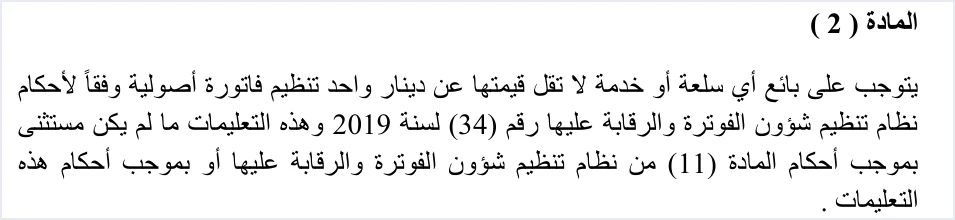
The image below shows the text of Article 2 of Instructions 1/2019 as ISTD publishes it. It shows that the word proper does not stand alone. It is followed at once by words that set its reference point.
The full text of the article in Arabic reads as follows.
«يتوجب على بائع أي سلعة أو خدمة لا تقل قيمتها عن دينار واحد تنظيم فاتورة أصولية وفقاً لأحكام نظام تنظيم شؤون الفوترة والرقابة عليها رقم (34) لسنة 2019 وهذه التعليمات ما لم يكن مستثنى بموجب أحكام المادة (11) من نظام تنظيم شؤون الفوترة والرقابة عليها أو بموجب أحكام هذه التعليمات».
In English, Article 2 of Instructions 1/2019 requires the seller of any goods or service worth not less than one dinar to organize a proper invoice in accordance with the provisions of Regulation No. 34 of 2019 and of the instructions themselves, unless the seller is exempt under Article 11 of Regulation No. 34 of 2019 or under the instructions. No official English translation of this instruction was found; the English here is our rendering, and the Arabic text is the authority.
Three parts of Article 2 of Instructions 1/2019 bear directly on the phrase.
- The description. A proper invoice, which is the description whose meaning the reader is looking for.
- The reference point. In accordance with the provisions of Regulation 34/2019 and of the instructions themselves. Article 2 of Instructions 1/2019 points to both texts together and to no specific article in either.
- The limit. Unless the seller is exempt under Article 11 of Regulation 34/2019 or under Instructions 1/2019. A seller who is exempt does not carry this duty for as long as the exemption stands.
The threshold at which the duty starts, one dinar, is not repeated here. The one-dinar rule and the two-copy rule are explained in our article Minimum Invoice Value in Jordan: One Dinar, Two Copies.
Our reading builds on the first two parts. If an invoice is proper when it is in accordance with the provisions of Regulation 34/2019 and Instructions 1/2019, the reasonable test is whether it meets those provisions. This is our reading of how Article 2 of Instructions 1/2019 is worded, since the article does not state in so many words what a proper invoice is.
The first condition for a proper invoice in Jordan: its source
The first thing the provisions of Regulation 34/2019 point to is the source of the invoice. Paragraph (a) of Article 4 of Regulation 34/2019 sets out which electronic invoice is recognized for the purposes of the regulation.
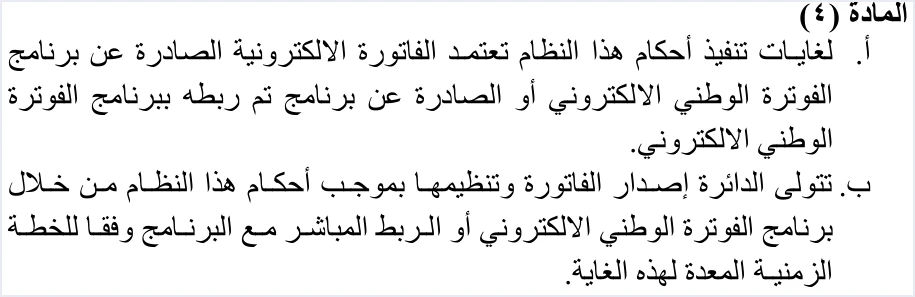
«أ. لغايات تنفيذ أحكام هذا النظام تعتمد الفاتورة الالكترونية الصادرة عن برنامج الفوترة الوطني الالكتروني أو الصادرة عن برنامج تم ربطه ببرنامج الفوترة الوطني الالكتروني».
In English, Article 4(a) of Regulation No. 34 of 2019 provides that, for the purposes of the regulation, the electronic invoice that is recognized is the one issued by the National Invoicing System or by a program linked to it. No official English translation of this regulation was found; the English here is our rendering, and the Arabic text is the authority.
Paragraph (a) of Article 4 of Regulation 34/2019 names two sources joined by the word or. One is the National Invoicing System (JoFotara) itself, and the other is a program linked to it. We do not go into the rest of the article’s wording or its second paragraph here.
What matters for this topic is the link between the two articles. Article 2 of Instructions 1/2019 requires a proper invoice in accordance with the provisions of Regulation 34/2019, and Article 4(a) of Regulation 34/2019 provides that, for the purposes of the regulation, the electronic invoice that is recognized is the one issued by the National Invoicing System or by a program linked to it. Our reading is that an invoice that does not come from one of the two sources does not meet this provision of Regulation 34/2019. Article 4 of Regulation 34/2019 does not use the phrase itself, so the link between the two articles is our reading of the two texts together.
The second condition: five items and two copies in Article 5(a) of Regulation 34/2019
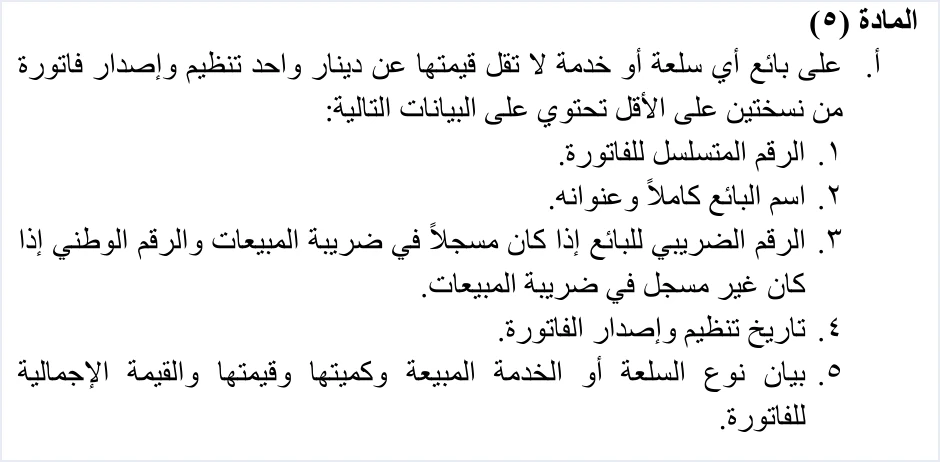
After the source comes the content of the invoice. Paragraph (a) of Article 5 of Regulation 34/2019 requires the seller to organize and issue the invoice in at least two copies, and it sets out five items that the invoice must contain.
The five items as they appear in the Arabic text of the paragraph are these.
«الرقم المتسلسل للفاتورة» · «اسم البائع كاملاً وعنوانه» · «الرقم الضريبي للبائع إذا كان مسجلاً في ضريبة المبيعات والرقم الوطني إذا كان غير مسجل في ضريبة المبيعات» · «تاريخ تنظيم وإصدار الفاتورة» · «بيان نوع السلعة أو الخدمة المبيعة وكميتها وقيمتها والقيمة الإجمالية للفاتورة».
In English, the five items of Article 5(a) of Regulation No. 34 of 2019 are the following.
- The invoice serial number.
- The seller’s full name and address.
- The seller’s tax number if registered for sales tax, or national number if not.
- The date on which the invoice is organized and issued.
- The type, quantity and value of the goods or service sold, and the invoice total.
No official English translation of this regulation was found; the English here is our rendering, and the Arabic text is the authority.
These items are the minimum that Regulation 34/2019 sets for every invoice it covers. Article 3 of Instructions 1/2019 sets out the items of a cash sales invoice on the same pattern. It names the national number for a Jordanian person and the number approved by the competent authority for a non-Jordanian person, where the seller is not registered for sales tax. For where the seller’s details sit in the electronic invoice file, see our article on seller details in JoFotara, and for the fields the technical guide marks as mandatory, see our article on mandatory fields in JoFotara. Whether an invoice also needs a stamp or a signature is a separate question, covered in our article E-Invoice Stamp in Jordan.
Other provisions of Regulation 34/2019 that concern the invoice itself
The provisions of Regulation 34/2019 do not stop at Article 4 and Article 5(a). Because Article 2 of Instructions 1/2019 points to the provisions of Regulation 34/2019 without naming them, it helps to know the other provisions that concern the invoice itself. We do not say that each of them is part of what makes an invoice proper, because the text does not say so.
- Timing. Article 3 of Regulation 34/2019 fixes the time and date of a sale of goods or of a service as the time and date on which that sale actually takes place. Paragraph (d) of Article 5 of Regulation 34/2019 then requires the seller to issue the invoice when the sale takes place.
- The buyer’s name. Article 5(b) of Regulation No. 34 of 2019 requires the buyer’s name to be stated clearly in a deferred sale, an installment sale or a sale paid in stages. For where it sits in the invoice file, see our article on buyer identification in JoFotara.
- Delivering the copy. Paragraph (c)(1) of Article 5 of Regulation 34/2019 requires a copy of the invoice to be delivered to the buyer in line with the method used to organize and issue the invoices. Paragraph (c)(2) of Article 5 of Regulation 34/2019 requires the seller to prove that the buyer received the invoice when its value exceeds JOD 10,000.
- Matching the facts. Article 10 of Regulation 34/2019 places responsibility for the invoice data matching what actually happened in the sale on the seller and the buyer alike.
This list shows that the provisions of Regulation 34/2019 reach from the source of the invoice to its timing and delivery. All the articles of the regulation are explained in our article Jordan Invoicing Regulation No. 34 of 2019 Explained.
Did not issue a proper invoice: the phrase in Article 66 of the Income Tax Law
The third place where the phrase appears moves from duty to violation. Article 66 of Income Tax Law No. 34 of 2014, as amended, lists acts that it treats as tax evasion, and item (7) of Article 66 of that law covers a taxpayer who did not issue a proper invoice. ISTD’s English translation of the Income Tax Law, which ISTD labels an unofficial translation and under which the Arabic version prevails in case of conflict, reads: “Did not issue a proper invoice.”
Two close items in Income Tax Law No. 34 of 2014 are worth telling apart.
- Article 66, item (7), of Income Tax Law No. 34 of 2014. Not issuing a proper invoice, listed among the acts of tax evasion.
- Article 64, item (7), of Income Tax Law No. 34 of 2014. Refusing to issue an invoice or document when the recipient asks for it, listed among the cases of the failure fine. The act here depends on a request from the recipient.
The first item uses the word proper and the second does not. We do not set out the penalty on each route here, since it is explained in our article on penalties for not complying with the National Invoicing System. It is enough to know that Regulation 34/2019 sets no amounts. Article 15 of Regulation 34/2019 reads as follows in Arabic.
«يعاقب كل من لم يلتزم بإصدار الفاتورة وفق أحكام هذا النظام بالعقوبات المنصوص عليها في القانون».
In English, Article 15 of Regulation No. 34 of 2019 provides that anyone who fails to issue the invoice in line with the provisions of the regulation is punished with the penalties set out in the law. No official English translation of this regulation was found; the English here is our rendering, and the Arabic text is the authority.
Note that Article 15 of Regulation 34/2019 ties the duty to issue to the provisions of the regulation, in wording close to the reference to the provisions in Article 2 of Instructions 1/2019. This closeness in wording supports our reading, but it does not make that reading part of the text.
What Regulation 34/2019 and Instructions 1/2019 accept in place of an invoice
Regulation 34/2019 and Instructions 1/2019 set out cases where another document is accepted, or where the duty does not arise at all. Knowing these cases keeps you from applying the duty to someone who does not carry it.
- Lease contracts. Article 13 of Regulation 34/2019 accepts lease contracts that contain the items and information set out in Article 5 of Regulation 34/2019 in place of invoices. The condition here, too, is the items of Article 5 of Regulation 34/2019.
- Lawyers. Article 6 of Instructions 1/2019 accepts a receipt voucher in place of the invoice for a lawyer, within a set ceiling.
- Exempt parties. Article 2 of Instructions 1/2019 limits the duty to sellers who are not exempt under Article 11 of Regulation 34/2019 or under the instructions. The exemption is not permanent, because paragraph (b) of Article 11 of Regulation 34/2019 allows the Director to oblige a person whose sales exceed the limit when there is sufficient evidence of it.
- Voluntary joiners. Paragraph (c) of Article 11 of Regulation 34/2019 allows an exempt party to submit a written request to issue invoices, and in that case the provisions of the regulation apply to it.
The last case brings us back to the starting point. An exempt party that asks to issue invoices becomes subject to all the provisions of Regulation 34/2019, including the source and the items set out above.
Questions to ask about your invoice before you issue it
If you want to apply this reading to your own business, here are questions drawn from the texts above, each with its article.
- Am I obliged at all? Check the unless-exempt proviso in Article 2 of Instructions 1/2019, Article 11 of Regulation 34/2019 and Article 4 of Instructions 1/2019, then check the text in force for your activity.
- Does the invoice come from a source recognized by Article 4(a) of Regulation 34/2019? For the purposes of the regulation, that means the National Invoicing System, or a program linked to it.
- Does the invoice carry the five items of Article 5(a) of Regulation 34/2019? The serial number, the seller’s name and address, the tax or national number, the date of organizing and issuing, and the type, quantity and value of the goods or service with the invoice total.
- Is the sale deferred, by installments or in stages? If so, the buyer’s name must appear clearly under Article 5(b) of Regulation 34/2019.
- Was the invoice issued when the sale took place? Article 3 and paragraph (d) of Article 5 of Regulation 34/2019 govern this.
- Is it worth more than JOD 10,000? If so, you must prove that the buyer received it under Article 5(c)(2) of Regulation 34/2019.
- Do its details match what actually happened? Responsibility for this is shared between you and the buyer under Article 10 of Regulation 34/2019.
These questions do not replace the text, but they gather what is spread across its articles. If you have a question about your own business, the authority to answer it is ISTD. For the requirements of the National Invoicing System as a whole, see our article E-Invoicing Requirements in Jordan. For a wider view of the system and how to connect your business to it, read our article Jordan’s National E-Invoicing System, or see how Qoyod works with JoFotara on our National Invoicing System page.
E-invoicing and full accounting in one system
Qoyod is integrated with the National Invoicing System (JoFotara). You issue your invoice in Jordanian dinars from Qoyod, it is booked to your ledgers automatically and sent to the system, and once it is accepted it comes back with a QR code from the Income and Sales Tax Department.
Frequently asked questions
What is a proper invoice in Jordan?
Article 2 of Instructions No. 1 of 2019 requires a proper invoice to be organized in accordance with the provisions of Regulation No. 34 of 2019 and of the instructions, and the definitions article of Regulation No. 34 of 2019 does not define the word proper. Our reading is that a proper invoice is one that meets the provisions of both texts, including the source in Article 4(a) of Regulation No. 34 of 2019 and the items and two copies in Article 5(a) of Regulation No. 34 of 2019.
Where does the phrase proper invoice appear in the texts?
It appears in paragraph (F) of Article 23 of Income Tax Law No. 34 of 2014, as a general duty whose organization the law leaves to a regulation. It appears in Article 2 of Instructions No. 1 of 2019 as a duty on the seller. It appears in item (7) of Article 66 of Income Tax Law No. 34 of 2014, among the acts of tax evasion, as not having issued a proper invoice. It does not appear in the sixteen articles of Regulation No. 34 of 2019 as published in the consolidated text.
Is every invoice issued through the National Invoicing System a proper invoice?
For the purposes of the regulation, an invoice issued by the National Invoicing System meets the source condition in Article 4(a) of Regulation No. 34 of 2019. Article 2 of Instructions No. 1 of 2019, however, points to all the provisions of the regulation and the instructions, including the five items in Article 5(a) of Regulation No. 34 of 2019 and the buyer’s name in a deferred sale under Article 5(b) of that regulation. So we read the source as a first condition, not the only one.
Is not issuing a proper invoice tax evasion?
Article 66 of Income Tax Law No. 34 of 2014, as amended, lists a taxpayer who did not issue a proper invoice among the acts it treats as tax evasion. This differs from item (7) of Article 64 of Income Tax Law No. 34 of 2014, which covers refusing to issue an invoice when the recipient asks for it. The penalty on each route is explained in our separate article on penalties for not complying with the National Invoicing System.
Is a lease contract a proper invoice?
Article 13 of Regulation No. 34 of 2019 accepts lease contracts in place of invoices when they contain the items and information set out in Article 5 of that regulation. The text accepts the contract in place of the invoice on condition of its items, and it does not call it a proper invoice.
If I am exempt and ask to issue invoices, do the same conditions apply to me?
Paragraph (c) of Article 11 of Regulation No. 34 of 2019 provides that an exempt party that submits a written request to issue invoices becomes subject, in that case, to the provisions of the regulation. All the provisions of Regulation No. 34 of 2019 then bind you, including the source and the items.
References
- Instructions No. 1 of 2019 on Invoicing Affairs and Their Control, as amended (in Arabic), Articles 2, 3, 4 and 6.
- Regulation No. 34 of 2019 on Organizing and Controlling Invoicing Affairs, as amended, consolidated text (in Arabic), Articles 2, 3, 4, 5, 10, 11, 13 and 15.
- Income Tax Law No. 34 of 2014, as amended (in Arabic), Articles 23, 64 and 66.
- ISTD’s unofficial English translation of Law No. 34 of 2014 as amended by Law No. 38 of 2018, Articles 23(F) and 66(7).