Export invoices in the National Invoicing System (JoFotara) are the invoices a seller registered with the Income and Sales Tax Department (ISTD) issues when selling from inside Jordan to outside the country. ISTD’s technical guide sets three export invoice JoFotara rules. The first is a three-digit code that starts with 1 and declares the trade type, the payment method and the tax family. The second is a tax rate of 0% on General Sales Tax (GST) and Special Sales Tax (SST) invoices. The third is the value O in the tax category of every item on GST and SST invoices.
This article collects the export invoice JoFotara rules from two official documents. The procedures guide for issuing an invoice in the Jordanian National Electronic Invoicing System, 2026 edition, defines what counts as export. The technical guide for integrating with the National Invoicing System through the API, version 1.5, sets the codes and the line conditions. The article also says plainly what the two documents leave out, so that no tax decision rests on an inference.
If you are looking for the differences between all six invoice types, start with our article Invoice Types in the National Invoicing System, then come back here for the details of the export invoice alone.
What an export invoice is in JoFotara
The invoice issuing procedures guide includes a table of invoice types and the use case for each. According to that table, the export invoice is used for a sale from inside Jordan to outside the country, and a sale to the free zones or to the Aqaba economic zone also counts as export.

So the definition is not limited to goods that cross the border. A seller inside Jordan who sells to a business in a free zone, or into the Aqaba economic zone, falls in the export category under the same table. This article covers only what that means for the invoice type. It does not deal with the tax rates that apply in any zone.
Export and the types closest to it
The same table lists four other non-local types, each with a different use case. Three of them are close to export and differ from it in where the seller is or in the path the goods take.
Every description in the table rests on where the sale takes place and how the goods move. If your case does not clearly match one of these descriptions, check it with your accountant or with ISTD before you issue the invoice, because an invoice cannot be edited once it has been accepted.
The export invoice code in JoFotara
The accounting software sends the invoice type in the cbc:InvoiceTypeCode element. The value of that element separates a new invoice (388) from a return invoice (381). The name attribute carries a three-digit code, and each digit declares one aspect of the invoice.
- The first digit is the trade type. On an export invoice it is 1.
- The second digit is the payment method, 1 for cash and 2 for receivable.
- The third digit is the tax family, 1 for an income invoice, 2 for General Sales Tax and 3 for Special Sales Tax.
Combining the three digits gives six codes for the export invoice. The table below shows them, with the condition the technical guide attaches to each.
Scroll the table sideways to see the remaining columns
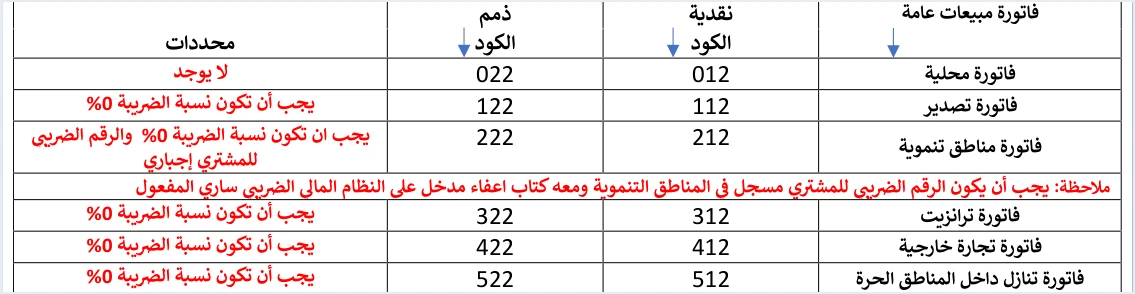
A new invoice for a cash export sale subject to General Sales Tax therefore declares its type in the file as <cbc:InvoiceTypeCode name="112">388</cbc:InvoiceTypeCode>. If the sale is on a receivable basis, the attribute becomes 122 and the value stays 388.
The file declares the type but does not decide it alone
The system reads the invoice type from these two elements of the file, but what they may say depends on two things outside the file. The first is the taxpayer’s registration status with ISTD, since the third digit must match the tax family the taxpayer is registered under. The second is the reality of the transaction itself, since the export code is used only for a sale that meets the definition of export.
If the taxpayer sends an invoice type that does not match their tax number or their income-source sequence, the system rejects it with the message This user is not authorized to submit this type of invoice.
0% and category O on export invoices in JoFotara
Each line of a general sales tax invoice carries two linked fields. One is the tax rate, in the cbc:Percent element. The other is the tax category, in the cbc:ID element with the attribute schemeID="UN/ECE 5305". Under the rate field in the invoice lines table, the technical guide places a note specific to the non-local types. It reads as follows.
«في حال كان نوع الفاتورة تصدير أو مناطق تنموية أو ترانزيت أو تجارة خارجية أو تنازل داخل المنطقة الحرة يشترط أن تكون نسبة الضريبة 0% وتعبأ القيمة O لجميع السلع».
In English, the note says that if the invoice type is export, development zones, transit, foreign trade or assignment inside the free zone, the tax rate must be 0% and the value O must be entered for all goods. ISTD publishes this guide in Arabic only; the English here is our rendering, and the Arabic text is the authority.

Each line on an export invoice subject to General Sales Tax therefore has two conditions at once, the 0% rate and the category O. The table on the same page describes O as the category for goods or services subject to the zero rate. The words “for all goods” mean the condition applies to every line, not to some lines only. The text makes no exception for any item, even one that would be sent with category Z on a local invoice.
Why the 0% rate alone is not enough
The table on page 42 accepts two categories at a 0% rate, Z for exempt goods or services and O for those subject to the zero rate. It reserves S for rates other than 0%. The choice between Z and O by the nature of the item belongs to the local invoice. On an export invoice, the note above specifies O for all goods. The guide does not say what the system does if an export line arrives with category Z, so following the note as written is the safe course.
If a line with a 0% rate is sent with category S, the invoice comes back with code 400 and the message General tax percentage must be zero.
How the condition affects line and invoice totals
The guide calculates the tax on a General Sales Tax line by multiplying its value after discount by the tax rate. On an export invoice subject to General Sales Tax (codes 112 and 122), every line takes the 0% rate with category O, not Z, so the line tax is zero, and the line total in the RoundingAmount element equals the line value after discount. The invoice’s total tax is the sum of the tax on its lines, so it is zero on an export invoice subject to General Sales Tax.
The income invoice and Special Sales Tax
An income invoice carries no tax lines at all. That is why the technical guide writes “None” in the conditions column for codes 111 and 121. The 0% condition therefore applies only to General Sales Tax and Special Sales Tax invoices.
On Special Sales Tax invoices, the guide sets the 0% condition on codes 113 and 123. The same “O for all goods” note appears again under the general tax rate field in the Special Sales Tax lines table (p. 69), so the 0% rate and category O apply together to those lines as well. The guide also does not explain how the 0% condition applies to the special tax amount itself, which it describes as an amount entered without calculation.
The export invoice on the JoFotara portal
If you issue your invoices on the portal rather than from accounting software, the New invoice form (فاتورة جديدة) in the invoice issuing procedures guide opens with the Invoice details section (بيانات الفاتورة). It contains a dropdown named invoice type (نوع الفاتورة) whose default value is local invoice (فاتورة محلية), and the guide states that the invoice type and the currency can be selected.
The guide does not show the full list of values in that dropdown, and it does not describe what changes on the form when a non-local type is selected. It does not say that the portal sets the tax rate to 0% by itself, and it does not say the opposite. The image of the form published in the guide shows 16% in the General Sales Tax rate field (نسبة الضريبة العامة), with no explanation for a non-local type. Each field of the form is covered in our article JoFotara Invoice Form Fields Explained.
Before you press Issue (إصدار), check two things yourself. First, that the invoice type field has not stayed on its default value. Second, that the General Sales Tax rate field on every item you added meets the technical guide’s condition for an export invoice. The full steps for issuing an invoice on the portal are in our article Issue an Invoice on the JoFotara Portal: The Steps.
Other details on an export invoice
The technical guide sets no export-specific rules beyond those above. Three general fields still deserve attention when the buyer is outside Jordan or deals in another currency.
- Invoice currency. The default value of the
cbc:DocumentCurrencyCodeandcbc:TaxCurrencyCodeelements isJOD, and it can be changed. The guide requires a currency change to apply to the whole invoice only, so the lines of one invoice cannot be written in different currencies. The guide contains no element for an exchange rate and no rule for converting amounts to dinars. - Buyer name. It is always mandatory on a receivable invoice, and on a cash invoice worth more than JOD 10,000 or its equivalent in foreign currency. A receivable export code (
122, for example) therefore needs the buyer’s name in every case. When the name is missing, the guide lists the messageBayer name is missing, spelled that way in the guide. - Buyer identifier and address. The guide sets three types of buyer identifier,
NINfor the national number,PNfor the personal number of a non-Jordanian andTNfor the tax number. It makes the identifier value, the postal code and the governorate code optional fields, according to the field shading in version 1.5 of the technical guide. The guide does not say how to identify a buyer who lives outside Jordan.
Returning an export invoice
An invoice cannot be edited after it is issued. The correction is a return invoice with the value 381, which is legally a credit note. The return invoice carries the same name attribute code as the original invoice, and the same currency. A return on a cash export invoice under General Sales Tax is therefore written <cbc:InvoiceTypeCode name="112">381</cbc:InvoiceTypeCode>. The guide’s examples of return codes include 112 and 122 on General Sales Tax invoices and 111 and 121 on income invoices.
A return is on quantities only, cannot exceed the quantity sold, and states the reason for the return. The guide does not cover an accepted invoice that carries the wrong type code, such as an export invoice sent with the local code. No path is documented for that case, so the safer course is to set the type correctly before sending.
Export invoice JoFotara checklist before submission
- Confirm that the sale is an export. Match the transaction against the definition of export in the invoice issuing procedures guide, and tell it apart from assignment inside the free zone, foreign trade and transit.
- Choose the right code. The first digit is 1, the second follows the payment method, and the third follows the tax family you are registered under with ISTD. The element value for a new invoice is
388. - Set every line. On a General Sales Tax or Special Sales Tax invoice, set the general tax rate to 0% and the category to
Oon all lines, without exception. - Recalculate the totals. On a General Sales Tax invoice, the tax on each line is zero, the invoice’s total tax is zero, and each line total equals its value after discount.
- Check the currency and the buyer name. One currency for the whole invoice, and the buyer name is mandatory on a receivable invoice and on a cash invoice above JOD 10,000 or its equivalent.
- Judge the result by the invoice status. The status
SUBMITTEDmeans the invoice was accepted, and a QR code comes back with it. If the invoice is rejected, fix it and resend it with the same invoice number and the same unique identifier (UUID).
What the guide does not say about export invoices
The two official documents answer what the invoice type is, what its code is and what conditions apply to its lines. Some practical questions remain that they do not answer, and this article does not supply answers of its own.
- Proof of export. Neither document mentions customs documents or any proof that accompanies the export invoice.
- Exchange rate. The technical guide does not set an exchange rate or a method for converting a foreign-currency invoice to dinars.
- Portal behavior. The invoice issuing procedures guide does not describe what the form shows when the export type is selected, and it mentions no automatic setting of the rate.
- Category
Zon an export line. The guide does not say how the system handles it. It only specifiesOfor all goods. - A complete example. The technical guide includes no complete XML file for an export invoice, only the code line.
On these points, go to ISTD or to your accountant before adopting any practice.
How Qoyod helps
When you issue your invoice from accounting software, you do not write the XML file by hand. That is the job of Qoyod’s integration with the National Invoicing System. Qoyod builds the invoice file in UBL 2.1 format with its unique identifier (UUID) and sends it to the National Invoicing System without any manual intervention. The integration also covers this layer.
- A check before sending. Qoyod checks each invoice at field level as it is created, covering the tax number, the document type and payment method, the General Sales Tax rate and whether the lines are complete, and alerts you to any error before the invoice is sent, to reduce rejections.
- The status of each invoice in view. ISTD returns the invoice status and any error message, and Qoyod shows them in its status panel.
- Resending with the same identifier. The status panel lists invoices that were not sent and need to be resent, and when you resend one it keeps the same UUID.
The pre-send check is an alert, not a guarantee. It covers the four fields listed above. Accepting the invoice remains with JoFotara alone, and deciding the type of transaction remains with the taxpayer.
Where to go next
- The full picture of the system. For a wider view of the system and how to connect your business to it, read our article Jordan’s National E-Invoicing System.
- Qoyod’s invoicing solutions in Jordan. See our National Invoicing System (JoFotara) page.
E-invoicing and full accounting in one system
Qoyod is integrated with the National Invoicing System (JoFotara). You issue your invoice in Jordanian dinars from Qoyod, it is booked to your ledgers automatically and sent to the system, and once it is accepted it comes back with a QR code from the Income and Sales Tax Department.
Frequently asked questions
What is the export invoice code in JoFotara?
The export invoice code has 1 as the first digit of the name attribute. It is 111 or 121 for an income invoice, 112 or 122 for General Sales Tax, and 113 or 123 for Special Sales Tax, where the middle digit is 1 for cash and 2 for receivable. The value of the element itself is 388 for a new invoice and 381 for a return.
Is a sale to a free zone or to the Aqaba economic zone an export?
The invoice issuing procedures guide treats it as an export. Its table describes the export invoice as a sale from inside Jordan to outside the country, and adds that a sale to the free zones or to the Aqaba economic zone also counts as export. A sale that takes place inside the free zones themselves has a different type, assignment inside the free zone.
What tax category do export invoice lines use?
The technical guide requires the value O for all goods, with a 0% tax rate, on an export invoice subject to General Sales Tax or Special Sales Tax. The rule appears in a note under the invoice lines table on page 42 and again in the Special Sales Tax lines table on page 69. The same note also covers development zones, transit, foreign trade and assignment inside the free zone.
Does the portal set the 0% rate automatically when an export invoice is selected?
The invoice issuing procedures guide does not say so. It describes the invoice type dropdown and its default value, local invoice, but not what changes on the form when another type is chosen. Check the General Sales Tax rate field on every item before you press Issue.
Can an export invoice be issued in US dollars?
The technical guide allows the invoice currency to be changed at the level of the whole invoice, and it lists the US dollar among the supported currencies. It does not set an exchange rate or a method for converting the amounts to dinars, so check this point with your accountant or with ISTD.
How do I correct an export invoice that has been accepted?
You issue a return invoice with the value 381 and the same name attribute code as the original invoice. A return is on quantities only and cannot exceed the quantity sold. For a wrong type code on its own, the guide documents no correction path.
References
- Income and Sales Tax Department (ISTD), technical guide for integrating with the National Invoicing System through the API, version 1.5 (in Arabic), pp. 33, 42 and 69.
- Income and Sales Tax Department (ISTD), procedures guide for issuing an invoice in the Jordanian National Electronic Invoicing System, 2026 edition (in Arabic), p. 7.
- ISTD’s National Invoicing System guides (in Arabic)