The minimum invoice value in Jordan is one dinar. Article 5(a) of Regulation No. 34 of 2019 on Organizing and Controlling Invoicing Affairs, as amended (Regulation 34/2019), requires the seller of any good or service worth not less than one dinar to prepare and issue an invoice of at least two copies. The same paragraph then lists, item by item, five details the invoice must carry.
In short, the rule rests on three numbers. One dinar is where the obligation starts, at least two copies are required of every invoice, and five details must appear on it. Article 2 of the implementing Instructions No. 1 of 2019 on Invoicing Affairs and Their Control, as amended (Instructions 1/2019), repeats the same threshold and attaches an exemption condition to it.
This article takes each of the three numbers as the text states it, then shows where it sits within the National Invoicing System (JoFotara), the system through which invoices are issued today. Where the text says nothing, the article says so plainly rather than filling the gap.
What is the minimum invoice value in Jordan?
Article 5(a) of Regulation 34/2019 sets the rule in a single sentence, then lists five details. Because the threshold and the copy count turn on its exact wording, here is the Arabic text.
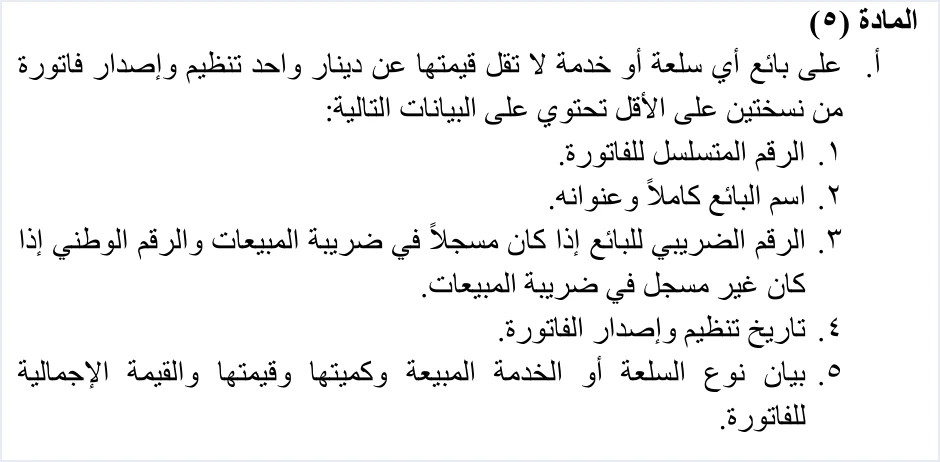
«على بائع أي سلعة أو خدمة لا تقل قيمتها عن دينار واحد تنظيم وإصدار فاتورة من نسختين على الأقل تحتوي على البيانات التالية:
1. الرقم المتسلسل للفاتورة.
2. اسم البائع كاملاً وعنوانه.
3. الرقم الضريبي للبائع إذا كان مسجلاً في ضريبة المبيعات والرقم الوطني إذا كان غير مسجل في ضريبة المبيعات.
4. تاريخ تنظيم وإصدار الفاتورة.
5. بيان نوع السلعة أو الخدمة المبيعة وكميتها وقيمتها والقيمة الإجمالية للفاتورة.»
In English, the seller of any good or service worth not less than one dinar must prepare and issue an invoice of at least two copies that contains the five details listed below. No official English translation of this regulation was found; the English here is our rendering, and the Arabic text is the authority.
- The serial number of the invoice.
- The seller’s full name and address.
- The seller’s tax number if the seller is registered for sales tax, and the national number if the seller is not registered for sales tax.
- The date the invoice is prepared and issued.
- A statement of the type of good or service sold, its quantity and value, and the total value of the invoice.
That one sentence holds three separate rules, and it helps to pull them apart before going into detail.
- The threshold. The obligation starts with a good or service worth not less than one dinar.
- The number of copies. The invoice is prepared in at least two copies.
- The content. The invoice carries the five details listed in the same paragraph.
The rule is addressed to the seller of any good or service. Article 2 of Regulation 34/2019 defines the seller as the person who sells the good or the service, and defines a person as a natural or legal person. By those definitions, the rule covers individuals and companies alike, and it puts sellers of goods and providers of services under one rule.
Reading the one-dinar threshold
Because Article 5(a) of Regulation 34/2019 phrases the threshold as not less than one dinar, the dinar itself falls inside the rule. A good or service worth exactly one dinar is covered, since its value is not below the threshold. Article 5(c)(2) of Regulation 34/2019 uses different wording, if the value exceeds, and that wording leaves out the amount that follows it. The difference between the two phrasings is worth watching whenever you read a figure in the regulation.
The Jordanian dinar (JOD) is divided into 1,000 fils, and amounts are written to three decimal places. On that basis, here is how the examples below read under Article 5(a) of Regulation 34/2019 alone.
Three points keep this reading accurate.
- The regulation states no rule for amounts under one dinar. Article 5(a) of Regulation 34/2019 ties the obligation to values of not less than one dinar, and it does not expressly deal with anything worth less.
- The text does not say how the value is measured. Article 5(a) of Regulation 34/2019 attaches the value to any good or service, and no article of the regulation says whether the threshold is measured per item or on the total of the sale. If this is unclear for your business, check with the Income and Sales Tax Department (ISTD).
- The threshold does not work alone. Reaching one dinar is a condition of the obligation, but it is not enough if the seller belongs to an exempt category, as the section on Article 2 of Instructions 1/2019 below explains.
At least two copies: what the regulation says about invoice copies
The words at least two copies set a minimum number of copies, not a maximum. Two copies are the least the text asks for, and nothing in it prevents more.
What happens to those copies is settled by Article 5(c)(1) of Regulation 34/2019.
«يتوجب تسليم نسخة من الفاتورة إلى المشتري وفقاً للطريقة المستخدمة في تنظيم وإصدار الفواتير وتحفظ باقي النسخ لدى البائع.»
In English, a copy of the invoice must be handed to the buyer in line with the method used to prepare and issue invoices, and the remaining copies are kept by the seller. No official English translation of this regulation was found; the English here is our rendering, and the Arabic text is the authority.
Two rules follow from this text.
- One copy for the buyer. It is delivered by the method used to prepare and issue invoices. The text ties the delivery method to the issuing method and does not name any particular channel.
- The other copies for the seller. They stay with the seller, and the duty to keep them, with its duration, is in Article 8 of Regulation 34/2019.
What the text does not say matters just as much. Regulation 34/2019 does not say that the National Invoicing System creates two copies of each invoice, and it does not say that the two-copy requirement fell away with electronic issuing. It says two things. The buyer’s copy is delivered by the method used for issuing (Article 5(c)(1) of Regulation 34/2019), and the data of the national electronic invoicing program is relied on instead of keeping invoices on paper (Article 8(b) of Regulation 34/2019), as explained below.
The same article also has a rule for large invoices. Under Article 5(c)(2) of Regulation 34/2019, if the value of an invoice exceeds JOD 10,000, the seller must establish that the buyer received it.
The five details on a one-dinar invoice
An invoice that reaches the threshold carries the same five details however small its value. On these details, the text draws no line between an invoice for one dinar and an invoice for thousands of dinars. Two other texts add detail to some of them.
On top of the five details, Article 5(b) of Regulation 34/2019 requires the invoice to show the buyer’s name clearly when the sale is on credit, in installments or in payments. The definition of an invoice in Article 2 of Regulation 34/2019 also covers the amount of General Sales Tax (GST) charged on it, where the seller is a taxpayer registered for sales tax. For the full picture of what an electronic invoice carries, see our article E-Invoicing Requirements in Jordan.
On the JoFotara portal, the invoice form shown in ISTD’s procedures guide for issuing an invoice in the Jordanian National Electronic Invoicing System, 2026 edition, displays the Seller details block (بيانات البائع) already filled in. It holds the name, the income-source sequence, the tax number, the country, the postal code and the phone number. The form also shows the invoice issue date field (تاريخ إصدار الفاتورة) and, for each line, the description of the good or service (وصف السلعة او الخدمة), the quantity (الكمية) and the unit price (سعر الوحدة). The form in the guide is a sub-user form for a taxpayer registered for General Sales Tax. The steps for filling it in, up to the Issue button (إصدار), are in our article on issuing an invoice on the JoFotara portal. For how the invoice types differ, see our article Invoice Types in the National Invoicing System.
Article 2 of Instructions 1/2019: the same threshold and the exemption condition
Article 2 of Instructions No. 1 of 2019 on Invoicing Affairs and Their Control, as amended, restates the one-dinar rule in nearly the same wording. It requires the seller of any good or service worth not less than one dinar to prepare a proper invoice (فاتورة أصولية), unless the seller is exempt under Article 11 of Regulation 34/2019 or under the Instructions themselves.
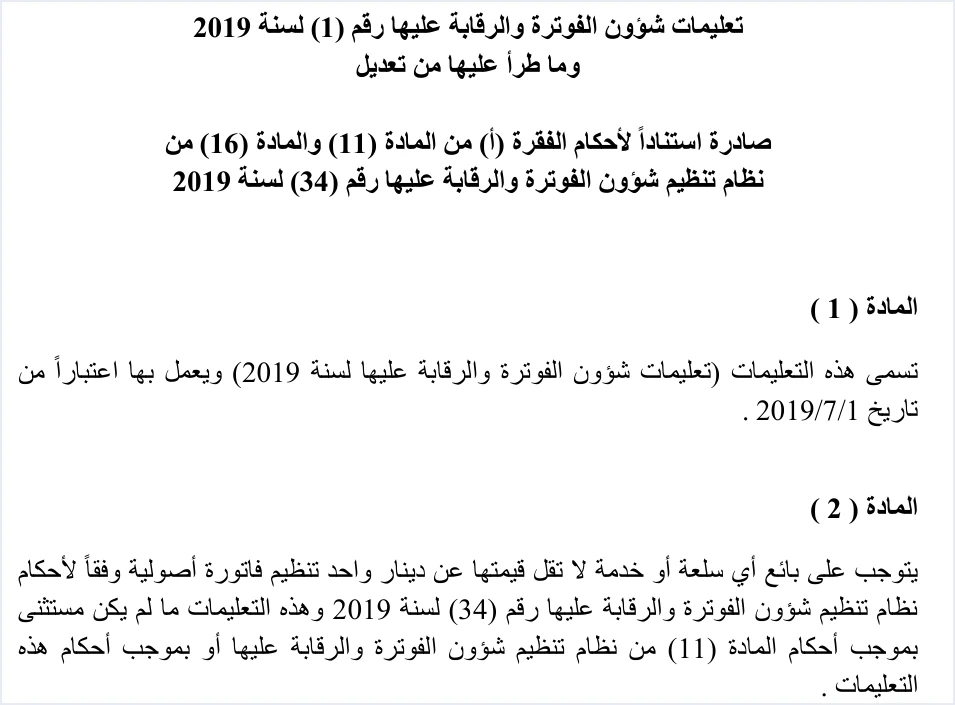
The threshold in Instructions 1/2019 is the threshold in Regulation 34/2019, one dinar. Article 2 of Instructions 1/2019 adds two things. It describes the invoice as a proper invoice, and it makes the obligation conditional on the seller not being exempt. In practice, the question of the minimum value is not settled without two more questions. Is the seller in an exempt category, and is the transaction a sale at all? Nearby texts answer both.
- The exemption depends on the activity and the ceiling together. Article 11(a) of Regulation 34/2019 exempts specific businesses whose sales fall below a yearly ceiling, and for grocery stores, minimarkets, supermarkets and small shops it requires that the business actually carries on that activity. Article 4 of Instructions 1/2019 names further activities, each with its ceiling.
- The exemption is not permanent. If there is enough evidence that the sales of a person who is not bound exceed the threshold, Article 11(b) of Regulation 34/2019 allows the Director to require that person to prepare and issue invoices. Under Article 11(c) of Regulation 34/2019, an exempt party may apply in writing to issue invoices, and the provisions of the regulation then apply to it.
- The invoice follows the sale. Article 5 of Instructions 1/2019 states that an invoice is prepared and issued in the case of a sale, and that goods placed on consignment with a third party do not require an invoice, provided supporting documents back that arrangement. ISTD may ask for proof of it.
- Lawyers have their own mechanism. Article 6 of Instructions 1/2019 accepts a receipt voucher, or any receipt document, in place of an invoice for a lawyer within a ceiling that the article sets.
Regulation 34/2019 also has two rules that bear on small, repeated invoices. Article 7 of Regulation 34/2019 allows commercial markets or any other party to prepare one aggregate invoice per day covering all of its daily sales, with the Director’s prior approval and at its own request, and this is to be organized by instructions issued by the Minister. The procedures under those instructions do not appear in the texts this article explains. Article 13 of Regulation 34/2019 accepts lease contracts that contain the details required by Article 5 of the same regulation in place of invoices.
Minimum invoice value in Jordan and the National Invoicing System
Article 5 of Regulation 34/2019 deals with the invoice and its copies without naming how the invoice is issued. The invoice the regulation accepts is set by Article 4(a) of Regulation 34/2019.
«لغايات تنفيذ أحكام هذا النظام تعتمد الفاتورة الالكترونية الصادرة عن برنامج الفوترة الوطني الالكتروني أو الصادرة عن برنامج تم ربطه ببرنامج الفوترة الوطني الالكتروني.»
In English, for the purposes of the regulation, the accepted invoice is the electronic invoice issued by the national electronic invoicing program or by a program that has been linked to it. No official English translation of this regulation was found; the English here is our rendering, and the Arabic text is the authority.
Read together, Articles 4(a) and 5 of Regulation 34/2019 mean that an invoice required once the one-dinar threshold is reached is issued through one of these two routes.
In its questions and answers guide for the National Invoicing System, ISTD states that a business that has an accounting system must link it to the National Invoicing System. For the difference between issuing on the portal and issuing from a linked program, see our article Jordan’s National E-Invoicing System.
The remaining rules of Article 5 of Regulation 34/2019 read on that basis, and each one rests on its own text.
- When to issue. Article 5(d) of Regulation 34/2019 requires the seller to issue and prepare the invoice when the sale takes place, and Article 3 of Regulation 34/2019 sets the time and date of a sale as the time and date on which the sale takes place.
- Delivering the buyer’s copy. Under Article 5(c)(1) of Regulation 34/2019, the copy is delivered in line with the method used to prepare and issue invoices. Where the issuing method is electronic, the text refers delivery to that method, without naming a specific channel.
- Keeping the invoice. Article 8(b) of Regulation 34/2019 puts the data of the national electronic invoicing program in place of keeping the invoice on paper, in the words quoted below.
«تعتمد بيانات برنامج الفوترة الوطني الإلكتروني بدلاً من الاحتفاظ بالفاتورة ورقياً المنصوص عليه في هذه المادة.»
In English, the data of the national electronic invoicing program is relied on instead of the paper retention of the invoice that this article provides for. No official English translation of this regulation was found; the English here is our rendering, and the Arabic text is the authority.

Article 8(b) of Regulation 34/2019 concerns keeping the invoice, which Article 8 governs. It does not deal with the number of copies in Article 5 of the same regulation.
For anyone who does not issue invoices as the regulation requires, Article 15 of Regulation 34/2019 refers to the penalties set out in the Law, meaning Income Tax Law No. 34 of 2014, as amended.
Checklist before issuing an invoice of one dinar or more
These questions follow the order in which the texts read, and each one points to the article it rests on.
- Is the transaction a sale? An invoice is required in the case of a sale, and goods placed on consignment, backed by supporting documents, do not need one (Article 5 of Instructions 1/2019).
- Is the value not less than one dinar? The dinar itself is inside the rule (Article 5(a) of Regulation 34/2019 and Article 2 of Instructions 1/2019).
- Are you in an exempt category? Check the activity and the ceiling together, and remember that for grocery stores, minimarkets, supermarkets and small shops the regulation requires the activity to be actually carried on (Article 11 of Regulation 34/2019 and Article 4 of Instructions 1/2019).
- Does the invoice carry the five details? The serial number, the seller’s name and address, the tax or national number, the date, and the description of the good or service with the invoice total (Article 5(a) of Regulation 34/2019).
- Is the sale on credit, in installments or in payments? Add the buyer’s name clearly (Article 5(b) of Regulation 34/2019).
- Did you issue it when the sale took place? Article 5(d) and Article 3 of Regulation 34/2019 set that timing.
- Did you deliver the buyer’s copy? Use the method used for issuing (Article 5(c)(1) of Regulation 34/2019).
If you issue invoices from accounting software, ISTD’s questions and answers guide says that the software needs to be linked to the National Invoicing System. Qoyod is integrated with the National Invoicing System (JoFotara).
E-invoicing and full accounting in one system
Qoyod is integrated with the National Invoicing System (JoFotara). You issue your invoice in Jordanian dinars from Qoyod, it is booked to your ledgers automatically and sent to the system, and once it is accepted it comes back with a QR code from the Income and Sales Tax Department.
Frequently asked questions
What is the minimum invoice value in Jordan?
Article 5(a) of Regulation No. 34 of 2019 on Organizing and Controlling Invoicing Affairs sets the threshold at one dinar. The seller of any good or service worth not less than one dinar must prepare and issue an invoice of at least two copies, and Article 2 of Instructions 1/2019 repeats the same threshold.
Does the one-dinar rule cover service providers?
It does, by the wording of Article 5(a) of Regulation 34/2019, which addresses the seller of any good or service. Article 2 of Regulation 34/2019 defines the seller as the person who sells the good or the service, and a person as natural or legal.
Is an invoice required if the value is exactly one dinar?
It is. Article 5(a) of Regulation 34/2019 covers values of not less than one dinar, so one dinar itself falls inside the rule.
How many copies of an invoice does the regulation require?
Regulation 34/2019 requires at least two copies. Article 5(c)(1) of Regulation 34/2019 requires one copy to be handed to the buyer in line with the method used to prepare and issue invoices, and the remaining copies to be kept by the seller.
Is anyone exempt from the one-dinar rule?
Article 2 of Instructions 1/2019 excludes anyone exempt under Article 11 of Regulation 34/2019 or under the Instructions themselves. The exemption depends on both the activity and the yearly ceiling, and the Director may require a person to issue invoices if there is enough evidence that the person’s sales exceed the threshold.
Is National Invoicing System data enough instead of keeping invoices on paper?
Article 8(b) of Regulation 34/2019 provides that the data of the national electronic invoicing program is relied on instead of keeping the invoice on paper. That paragraph concerns keeping the invoice, not the number of copies.
References
- Regulation No. 34 of 2019 on Organizing and Controlling Invoicing Affairs, as amended, consolidated text (in Arabic), Articles 2, 3, 4, 5, 7, 8, 11, 13 and 15.
- Instructions No. 1 of 2019 on Invoicing Affairs and Their Control, as amended (in Arabic), Articles 2, 3, 4, 5 and 6.
- Income and Sales Tax Department (ISTD), procedures guide for issuing an invoice in the Jordanian National Electronic Invoicing System, 2026 edition (in Arabic).
- Income and Sales Tax Department (ISTD), questions and answers guide for the National Invoicing System, 2026 (in Arabic).