JoFotara voluntary registration is the common name for a route that Article 11(c) of Regulation No. 34 of 2019 on Organizing and Controlling Invoicing Affairs opens to a business that is exempt from issuing invoices. The business asks the Income and Sales Tax Department (ISTD) in writing to issue invoices. The regulation does not describe a registration form or a separate registration step for this. Registration is the common label for this case, not the regulation’s term. The request is to issue invoices, and the link to the National Invoicing System (JoFotara) comes from Article 4(a) of the same regulation. A second route sits next to the written request and does not start with the business. Article 11(b) of the same regulation allows the Director to require a seller who is not obliged to issue invoices to do so, where there is sufficient evidence that the seller’s sales exceed the limit.
In short, the exemption in Jordan is not a door closed from both sides. You can ask to come in on your own initiative, and you can be required to come in by a decision of the Director. In both cases the text gives the same result, which is that the provisions of the regulation apply to you.
This article reads paragraphs (b) and (c) of Article 11 of Regulation No. 34 of 2019 phrase by phrase. It explains what it means in practice that the provisions apply to you, and what Article 11 of Regulation No. 34 of 2019 does not say about either route. Who is exempt in the first place, and under which ceiling, is covered in our article JoFotara Exemption: Who Is Exempt and at What Threshold, so we do not repeat the ceilings here. For the wider question of which businesses fall under the obligation, read our article Who Must Use E-Invoicing in Jordan?
Paragraphs (b) and (c) of Article 11 as published
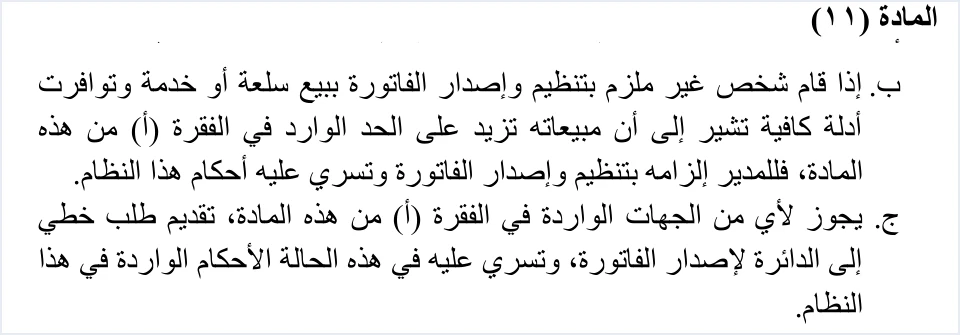
Article 11 of Regulation No. 34 of 2019 has three paragraphs. Paragraph (a) names what is exempt from preparing and issuing invoices and sets its ceilings. Paragraphs (b) and (c) set out how a seller moves between the exemption and the obligation. In the consolidated text that ISTD publishes, the two paragraphs read as follows.
«ب. إذا قام شخص غير ملزم بتنظيم وإصدار الفاتورة ببيع سلعة أو خدمة وتوافرت أدلة كافية تشير إلى أن مبيعاته تزيد على الحد الوارد في الفقرة (أ) من هذه المادة، فللمدير إلزامه بتنظيم وإصدار الفاتورة وتسري عليه أحكام هذا النظام.
ج. يجوز لأي من الجهات الواردة في الفقرة (أ) من هذه المادة، تقديم طلب خطي إلى الدائرة لإصدار الفاتورة، وتسري عليه في هذه الحالة الأحكام الواردة في هذا النظام.»
In English, Article 11(b) of Regulation No. 34 of 2019 allows the Director to require a person who is not obliged to prepare and issue invoices, and who sells goods or a service, to prepare and issue them where there is sufficient evidence that the person’s sales exceed the limit in paragraph (a), and the provisions of the regulation then apply to that person. Article 11(c) allows any of the bodies listed in paragraph (a) to submit a written request to ISTD to issue invoices, and in that case the provisions of the regulation apply to it. No official English translation of this regulation was found; the English here is our rendering, and the Arabic text is the authority.
Note that paragraph (a) itself opens by making the exemption subject to paragraph (b).
«مع مراعاة ما ورد في الفقرة (ب) من هذه المادة»
In English, Article 11(a) of Regulation No. 34 of 2019 opens with the words subject to what is set out in paragraph (b) of this article. No official English translation of this regulation was found; the English here is our rendering, and the Arabic text is the authority.
The exemption is written from its first words as limited by the Director’s power to impose the obligation. It is not a standalone rule to which that power is added later.
JoFotara voluntary registration by written request
Paragraph (c) is short, but each phrase in it settles a point. Here it is, read in the order of its words.
A permission, not a duty
The paragraph is worded as a permission, not as an obligation. An exempt business is not required to submit the request, and staying exempt does not breach the text as long as the conditions of the exemption are still met. The decision to apply belongs to the business.
Who may apply: the bodies listed in paragraph (a)
The request is open to those listed in paragraph (a), meaning the businesses the text exempts. Paragraph (a) names groceries, mini markets, supermarkets, small shops and craftspeople, and then adds any other bodies or categories specified under the instructions that the Minister issues for this purpose. In our reading, the categories that Instructions No. 1 of 2019 added under this delegation fall within the phrase, because they are bodies specified under the instructions. This is our reading of the text, not a statement by ISTD. A seller who is not exempt does not need this request at all, because that seller is obliged from the start.
A written request to ISTD
The text requires the request to be in writing and addressed to the Income and Sales Tax Department. It names no specific form, no submission channel and no documents to go with the request. If you want to submit one, ask ISTD which format it accepts, and do not build on a description of a procedure that is not in the text.
The request is to issue invoices
The subject of the request is issuing invoices. Joining the National Invoicing System is a common way to describe this case, and it is not the wording of the article. The link between the two comes from another article of the same regulation.
«تعتمد الفاتورة الالكترونية الصادرة عن برنامج الفوترة الوطني الالكتروني أو الصادرة عن برنامج تم ربطه ببرنامج الفوترة الوطني الالكتروني»
In English, Article 4(a) of Regulation No. 34 of 2019 provides that, for the purposes of the regulation, the electronic invoice that is recognized is the one issued by the National Invoicing System or by a program linked to it. No official English translation of this regulation was found; the English here is our rendering, and the Arabic text is the authority.
So a business that starts issuing invoices under the regulation issues them from one of these two sources.
The provisions of the regulation then apply
This phrase is the effect of the request. The text says the provisions, without excluding any of them. A business that joins voluntarily is bound by the whole regulation, in the same way as a seller who was obliged from the start. Paragraph (c) contains no lighter or partial obligation for those who come in by choice.
What it means in practice that the provisions apply
The same phrase appears in paragraphs (b) and (c), so what applies to a voluntary joiner also applies to a seller the Director has required to comply. These are the main provisions that pass to you under the text of the articles, in the order they appear in Regulation No. 34 of 2019.
This list summarizes what falls on the seller. It does not replace reading the articles themselves.
Where the exemption sits against the general obligation
To understand the effect of the written request, it helps to start from the rule rather than the exception. Article 2 of Instructions No. 1 of 2019 on Invoicing Affairs and Their Control requires the seller of any goods or service worth not less than one dinar to prepare a proper invoice, unless the seller is exempt under Article 11 of Regulation No. 34 of 2019 or under the instructions.
«ما لم يكن مستثنى»
In English, Article 2 of Instructions No. 1 of 2019 makes the duty apply unless the seller is exempt. No official English translation of this instruction was found; the English here is our rendering, and the Arabic text is the authority.
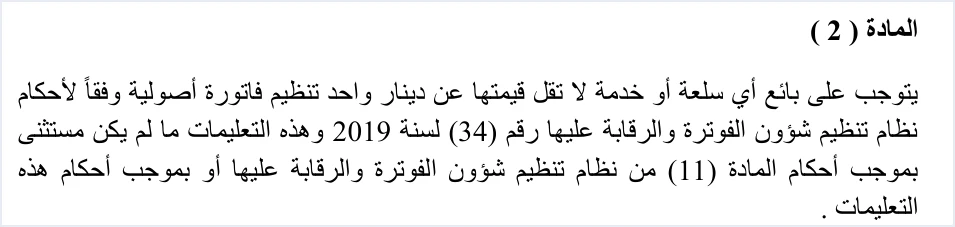
The obligation is the rule, and the exemption is a limit on it. Paragraphs (b) and (c) of Article 11 of Regulation No. 34 of 2019 return an exempt seller to the rule, the first by a decision of the Director and the second at the seller’s own request. Within the instructions, Article 4 of Instructions No. 1 of 2019 is the article that names the exempt activities.
The Director’s obligation to issue invoices under paragraph (b)
The second route does not start with the business. Reading paragraph (b) of Article 11 of Regulation No. 34 of 2019 phrase by phrase shows when it opens and who holds it.
A person who is not obliged
The paragraph addresses someone the obligation does not reach in the first place, meaning a seller exempt under paragraph (a). In the definitions of Regulation No. 34 of 2019, a person is a natural or legal person, so the rule covers individuals and companies alike.
Who sells goods or a service
The rule is tied to actually selling. This is consistent with the condition in paragraph (a) that the exempt business actually carries on the activity.
Sufficient evidence that sales exceed the limit
The condition is sufficient evidence that the limit has been exceeded, and the limit meant is the one set in paragraph (a). The text does not define sufficient evidence or list its types. The paragraph also does not say how this limit is read for the categories that the instructions added with ceilings of their own, so the reference on that point is ISTD.
The Director may require compliance
In the definitions of Regulation No. 34 of 2019, the Director is the Director General of ISTD. The phrase gives the Director a power to use. It does not say that the obligation applies automatically once the limit is exceeded. That does not make the exemption a fixed status, though. Because exceeding the limit opens this power, the exemption stays tied to your actual sales from one year to the next.
The same effect as paragraph (c)
The effect is the same as in paragraph (c). A seller whom the Director has required to comply carries all the obligations in the table above, including Article 15 of Regulation No. 34 of 2019, which refers to Income Tax Law No. 34 of 2014 for penalties.
The written request and the Director’s decision side by side
Both routes end with the same result, but they differ in who starts them and in the condition. This comparison is drawn from the wording of the two paragraphs alone.
What Article 11 does not say about either route
Article 11 of Regulation No. 34 of 2019 is short and we read it in full, so what it leaves out can be identified precisely. These are questions that paragraphs (b) and (c) do not answer.
- The procedure for the written request. Paragraph (c) names no form, no submission channel and no documents to go with the request.
- The decision on the request. Paragraph (c) does not say that the request needs approval, and it sets no time limit for a reply.
- The date the obligation starts. Neither paragraph says when the provisions start to apply after the request or after the Director’s decision.
- Going back on the request. Paragraph (c) sets out no route back to the exemption after the request is submitted.
- What sufficient evidence means. Paragraph (b) does not define this evidence or name its source.
- The procedure for imposing the obligation. Paragraph (b) does not say how the seller is notified of the Director’s decision, or how long the seller has to start complying.
On each of these questions, the reference is ISTD. The 45-day period you may come across in invoicing discussions is in Article 6 of Instructions No. 1 of 2019, and by its wording it applies to lawyers only. It cannot be carried over to paragraphs (b) and (c) of Article 11 of Regulation No. 34 of 2019.
What your business does before the written request or after the Director’s decision
Whether you come in at your own request or by the Director’s decision, the work that follows is the same. These are the steps in order, and each rests on a text.
- Check your current status. Review your activity’s description and ceiling in Article 11(a) of Regulation No. 34 of 2019 and in Instructions No. 1 of 2019. The written request is open to those listed there, and the Director’s decision rests on exceeding its limit.
- Read the provisions that will apply to you. These are the five items, the two copies, the time of issuing, the register and record keeping, as in the table above.
- Identify your invoice type. If you are registered for General Sales Tax (GST), your invoice carries your tax number. If you are not registered, it carries your national number under Article 5(a) of Regulation No. 34 of 2019, and you then issue an income invoice with no tax.
- Prepare where you will issue from. For the purposes of the regulation, the recognized invoice is issued from the National Invoicing System or from a program linked to it. The steps for opening an account are in our article JoFotara Registration and the Registration Document.
- Ask ISTD about what the text does not say. The format of the written request and the date the obligation starts are two questions for ISTD to answer.
If you issue your invoices from accounting software, ISTD’s questions and answers guide addresses your case directly.
«من يمتلك نظام محاسبي يلزمه ربط نظامه مع نظام الفوترة»
In English, ISTD’s questions and answers guide says that a business that has an accounting system is required to link it to the National Invoicing System. ISTD publishes this guide in Arabic only; the English here is our rendering, and the Arabic text is the authority.
Qoyod is integrated with the National Invoicing System (JoFotara). Qoyod checks each invoice at field level as it is created, covering the tax number, the document type and payment method, the General Sales Tax rate and whether the lines are complete, and alerts you to any error before the invoice is sent, to reduce rejections. The pre-send check is an alert, not a guarantee. For a wider view of the system and how to connect your business to it, read our article Jordan’s National E-Invoicing System, or see how Qoyod works with JoFotara on our National Invoicing System page.
E-invoicing and full accounting in one system
Qoyod is integrated with the National Invoicing System (JoFotara). You issue your invoice in Jordanian dinars from Qoyod, it is booked to your ledgers automatically and sent to the system, and once it is accepted it comes back with a QR code from the Income and Sales Tax Department.
Frequently asked questions
What is JoFotara voluntary registration?
It is the case where a business that is exempt from issuing invoices submits a written request to ISTD to issue invoices, under Article 11(c) of Regulation No. 34 of 2019. The regulation describes no separate registration form for it. The provisions of the regulation then apply to the business.
Who can submit the written request?
Article 11(c) of Regulation No. 34 of 2019 opens the request to any of the bodies listed in paragraph (a) of that article, meaning those the text exempts from issuing invoices. A seller who is not exempt is obliged from the start and needs no request.
Is a voluntary joiner bound by all the provisions of the regulation?
A voluntary joiner is bound by all of them. Article 11(c) of Regulation No. 34 of 2019 says that the provisions of the regulation apply in this case, with no exception. That covers the five items, the two invoice copies, the time of issuing, the register and the retention period, and the penalties the regulation refers to also apply.
When can the Director require a seller who is not obliged to issue invoices?
Article 11(b) of Regulation No. 34 of 2019 allows this when a person who is not obliged sells goods or a service and there is sufficient evidence that the person’s sales exceed the limit in paragraph (a). The provisions of the regulation then apply to that person.
Does the regulation set a form or a deadline for the written request?
Article 11(c) of Regulation No. 34 of 2019 names no form, no submission channel and no time limit for a reply. It only requires the request to be in writing and addressed to ISTD, so ask ISTD which format it accepts.
Can a business return to the exemption after joining voluntarily?
Article 11 of Regulation No. 34 of 2019 sets out no route back to the exemption after a written request. The reference on this question is ISTD, not a conclusion drawn from the silence of the text.
References
- Regulation No. 34 of 2019 on Organizing and Controlling Invoicing Affairs, as amended, consolidated text (in Arabic).
- Instructions No. 1 of 2019 on Invoicing Affairs and Their Control, as amended (in Arabic).
- Income and Sales Tax Department (ISTD), questions and answers guide for the National Invoicing System (in Arabic).
- Income Tax Law No. 34 of 2014, as amended (in Arabic).