The Jordan invoicing regulation definitions are the meanings that Article 2 of Regulation No. 34 of 2019 on Organizing and Controlling Invoicing Affairs, as amended (Regulation 34/2019), gives to eleven words and phrases. The rest of the regulation is read through them. When a later article of Regulation 34/2019 uses the word goods, service, seller or invoice, it carries the meaning Article 2 gives it, unless the context indicates otherwise.
In short, Article 2(a) of Regulation 34/2019 defines the Law, the Minister, the Department, the Director, the person, goods, the service, the seller, the invoice, the sale of goods and the sale of a service. Article 2(b) of Regulation 34/2019 adds that the definitions in the Income Tax Law apply wherever the regulation uses the terms they define. Three rules in these definitions stand out. Goods include electrical energy, a sale of goods can happen without consideration, and a sale of a service happens only for consideration.
This article sets out each definition as it appears in the consolidated text that the Income and Sales Tax Department (ISTD) publishes. Where the exact wording matters, it gives the Arabic text, then shows where each term appears in the other articles of Regulation 34/2019 and what the text does not say. It covers Article 2 only, not the regulation article by article.
What are the Jordan invoicing regulation definitions?
Regulation 34/2019 is a legislative text issued under paragraph (F) of Article 23 of Income Tax Law No. 34 of 2014. The original text was published in the Official Gazette, issue 5572, on 1 May 2019. It was later amended by amending Regulation No. 13 of 2023, published in the Official Gazette, issue 5851, on 16 April 2023.
Article 2 of Regulation 34/2019 opens its list of definitions with the following sentence.
«يكون للكلمات والعبارات التالية حيثما وردت في هذا النظام المعاني المخصصة لها أدناه، ما لم تدل القرينة على غير ذلك»
In English, the words and phrases that follow have the meanings assigned to them below wherever they appear in this regulation, unless the context indicates otherwise. No official English translation of this regulation was found; the English here is our rendering, and the Arabic text is the authority.
That sentence places two limits on every definition that comes after it.
- Wherever they appear in this regulation. A definition applies to the term in every article of Regulation 34/2019, not in Article 2 alone. The word goods in Article 5 of Regulation 34/2019 carries the meaning set in Article 2.
- Unless the context indicates otherwise. In a particular place, the context may move a term away from its defined meaning. The text gives no examples of such context.
The naming also deserves a note. In this article, the invoicing regulation means the legal text, Regulation No. 34 of 2019. The electronic platform that sellers know as the National Invoicing System (JoFotara) is called, in the regulation’s own text, the national electronic invoicing program (our rendering), as in Article 4(a) and Article 8(b) of Regulation 34/2019. That program is not one of the eleven definitions.
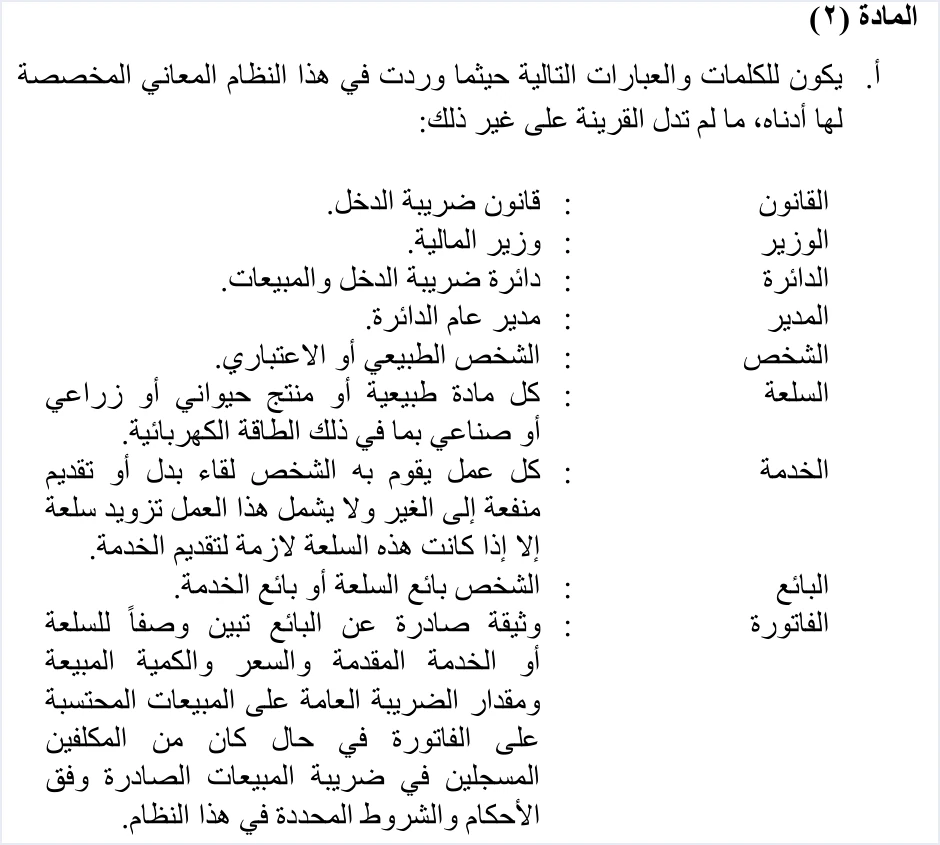
The eleven definitions in Article 2
The table below describes each definition in Article 2(a) of Regulation 34/2019 and lists the articles of the consolidated text where the term appears. The point is to see each definition at work in its place, not to read it on its own. The exact Arabic wording of the definitions that carry a rule is given in the sections that follow.
Scroll the table sideways to see the remaining columns
The table follows the order of the text itself. The first five definitions identify the parties and the authorities. The next six define what is sold, who sells it and the document that records the sale.
The Law, the Minister, the Department, the Director and the person
Article 2 of Regulation 34/2019 begins with five short definitions. Each one is a single line, but each decides who holds a power in a later article.
The Law: the Income Tax Law
Article 2(a) of Regulation 34/2019 defines the Law as the Income Tax Law. The header of the regulation gives that law its full name, Income Tax Law No. 34 of 2014. Note that the number 34 appears in the names of two different texts. Regulation No. 34 of 2019 is not Law No. 34 of 2014.
The effect of this definition shows in Article 15 of Regulation 34/2019, which punishes anyone who fails to issue the invoice under the regulation with the penalties set out in the Law. So Regulation 34/2019 sets no fine amounts of its own and refers to the Income Tax Law instead. Those amounts are explained in our article on the penalties under Articles 64 and 66 of the Income Tax Law.
The Minister and the Director
Article 2(a) of Regulation 34/2019 defines the Minister as the Minister of Finance and the Director as the Director General of the Department. The regulation divides several powers between the two.
- The Minister issues the instructions needed to implement the regulation on the Director’s recommendation, and they must be published in the Official Gazette (Article 16 of Regulation 34/2019). Article 7 of Regulation 34/2019 refers to the Minister’s instructions for the daily aggregate invoice, and Article 11(a) of Regulation 34/2019 refers to them for setting other exempt bodies or categories.
- The Director gives prior approval for a daily aggregate invoice (Article 7 of Regulation 34/2019), and may oblige a person who is not obliged to issue invoices when there is sufficient evidence that the person’s sales exceed the threshold (Article 11(b) of Regulation 34/2019). On the recommendation of a technical committee that the Director forms within the Department, and on a written request from the seller or the body concerned, the Director may amend the data in invoices or issue invoice forms (Article 12 of Regulation 34/2019).
Among the instructions issued this way are Instructions No. 1 of 2019 on Invoicing Affairs and Their Control.
The Department and the person
Article 2(a) of Regulation 34/2019 defines the Department as the Income and Sales Tax Department. Under Article 4(b) of Regulation 34/2019, ISTD takes on issuing and organizing the invoice through the national electronic invoicing program or a direct link to it. Under Article 14 of Regulation 34/2019, ISTD follows up the application of invoicing affairs and their control, and a unit responsible for invoicing affairs is established within it.
The person is defined as a natural or legal person. This definition feeds into the definitions of the service and the seller. It also appears in Articles 6 and 8 of Regulation 34/2019, which speak of every person obliged to organize and issue the invoice, and in Article 11(b) of Regulation 34/2019, which speaks of a person who is not obliged to do so.
Goods and services: where the line falls
Article 2(a) of Regulation 34/2019 defines goods as follows.
«كل مادة طبيعية أو منتج حيواني أو زراعي أو صناعي بما في ذلك الطاقة الكهربائية»
In English, goods are any natural material or any animal, agricultural or industrial product, including electrical energy. No official English translation of this regulation was found; the English here is our rendering, and the Arabic text is the authority.
The definition lists the sources of goods and then states outright that electrical energy is included. Electricity is therefore goods under Regulation 34/2019, by the words of the definition.
The service is defined in the same article.
«كل عمل يقوم به الشخص لقاء بدل أو تقديم منفعة إلى الغير ولا يشمل هذا العمل تزويد سلعة إلا إذا كانت هذه السلعة لازمة لتقديم الخدمة»
In English, a service is any work a person performs for consideration, or the provision of a benefit to others, and this work does not include supplying goods unless those goods are necessary to provide the service. No official English translation of this regulation was found; the English here is our rendering, and the Arabic text is the authority.
The definition has three elements.
- Work a person performs for consideration. This is the first limb of the definition.
- Providing a benefit to others. This is the second limb, joined to the first by the word or.
- Supplying goods is excluded. The work does not include supplying goods, unless the goods are necessary to provide the service.
In this text, then, the line between goods and a service turns on whether the goods are necessary. If a service provider supplies goods that are not necessary to provide the service, that supply falls outside the definition of a service. The text sets no test for what counts as necessary and gives no examples.
One caution remains. These two definitions belong to Regulation 34/2019 alone. How General Sales Tax (GST) treats a particular good or service is read in the General Sales Tax Law, which is a different text. Draw no tax conclusion from the definitions of goods and services here.
The seller and the invoice
Article 2(a) of Regulation 34/2019 defines the seller as the person who sells the goods or sells the service. Read with the definition of the person, the seller can be a natural or a legal person. The seller is the party addressed by several provisions of the regulation, among them Articles 5, 9, 10 and 12 of Regulation 34/2019.
The invoice is defined in the same article, in these words.
«وثيقة صادرة عن البائع تبين وصفاً للسلعة أو الخدمة المقدمة والسعر والكمية المبيعة ومقدار الضريبة العامة على المبيعات المحتسبة على الفاتورة في حال كان من المكلفين المسجلين في ضريبة المبيعات الصادرة وفق الأحكام والشروط المحددة في هذا النظام»
In English, the invoice is a document issued by the seller that shows a description of the goods or service supplied, the price, the quantity sold and the amount of General Sales Tax charged on the invoice where the seller is one of the taxpayers registered for sales tax, issued in accordance with the provisions and conditions set out in this regulation. No official English translation of this regulation was found; the English here is our rendering, and the Arabic text is the authority.
The definition breaks down into four elements.
- A document issued by the seller. The invoice comes from the seller, not from the buyer.
- Description, price and quantity. The document shows a description of the goods or service supplied, its price and the quantity sold.
- The tax amount, on a condition. The amount of General Sales Tax appears where the seller is one of the taxpayers registered for sales tax.
- Issued under the regulation. The document is issued in accordance with the provisions and conditions set out in the regulation, that is, under its other articles.
The third element is consistent with how the National Invoicing System works in practice. A seller who is not registered for General Sales Tax issues an income invoice in the system, and it carries no tax. This article does not read the condition any further than that.
The definition can also be read next to Article 5(a) of Regulation 34/2019, which lists what the invoice contains. The definition describes the document, and Article 5(a) sets out its content in detail. Here is how the two texts compare.
- In both texts. The description of the goods or service, its quantity and its value. The definition speaks of a description of the goods or service supplied, the price and the quantity sold, and Article 5(a) of Regulation 34/2019 speaks of the type of goods or service sold, its quantity and value, and the invoice total.
- Only in Article 5(a) of Regulation 34/2019. The invoice serial number, the seller’s full name and address, the seller’s tax number or national number, and the date the invoice is organized and issued.
- Only in the definition. The amount of General Sales Tax charged on the invoice, for a registered taxpayer.
For a wider view of what an invoice in Jordan must carry, see our article on e-invoicing requirements in Jordan.
Sale of goods and sale of a service: consideration is the difference
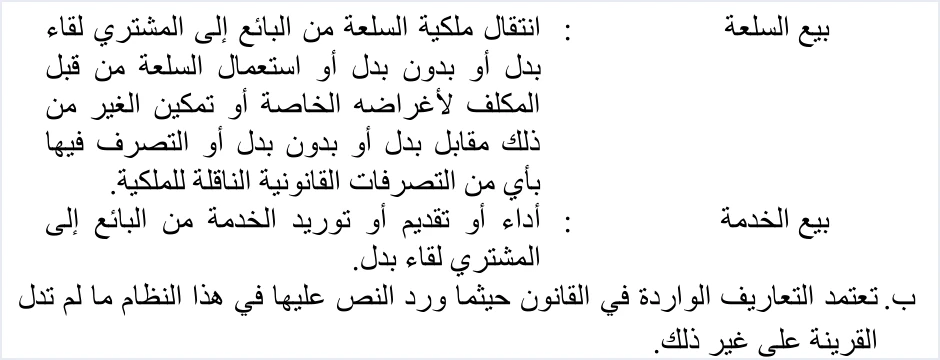
Article 2(a) of Regulation 34/2019 defines the sale of goods in these words.
«انتقال ملكية السلعة من البائع إلى المشتري لقاء بدل أو بدون بدل أو استعمال السلعة من قبل المكلف لأغراضه الخاصة أو تمكين الغير من ذلك مقابل بدل أو بدون بدل أو التصرف فيها بأي من التصرفات القانونية الناقلة للملكية»
In English, the sale of goods is the transfer of ownership of the goods from the seller to the buyer with or without consideration, or the taxpayer’s use of the goods for private purposes or letting others use them, with or without consideration, or disposing of them by any legal act that transfers ownership. No official English translation of this regulation was found; the English here is our rendering, and the Arabic text is the authority.
The definition covers three situations.
- Transfer of ownership from the seller to the buyer, with or without consideration.
- Use of the goods by the taxpayer for private purposes, or letting others use them, with or without consideration.
- Disposal of the goods by any legal act that transfers ownership. The text does not list these acts.
The sale of a service is defined in the same article.
«أداء أو تقديم أو توريد الخدمة من البائع إلى المشتري لقاء بدل»
In English, the sale of a service is the performance, provision or supply of the service from the seller to the buyer for consideration. No official English translation of this regulation was found; the English here is our rendering, and the Arabic text is the authority.
That definition names three acts, performance, provision and supply, but it requires consideration for all of them.
This is where the two definitions part. Goods transferred without consideration fall within the sale of goods. A service provided without consideration does not fall within the sale of a service.
The two sale definitions also bear on when the invoice is issued. Article 3 of Regulation 34/2019 sets the time and date of a sale of goods or a sale of a service as the time and date on which that sale takes place. Article 5(d) of Regulation 34/2019 then requires the seller to issue and organize the invoice when the sale takes place.
Article 2(b): when the Income Tax Law definitions apply
Article 2(b) of Regulation 34/2019 reads as follows.
«تعتمد التعاريف الواردة في القانون حيثما ورد النص عليها في هذا النظام ما لم تدل القرينة على غير ذلك»
In English, the definitions in the Law apply wherever the regulation uses the terms they define, unless the context indicates otherwise. No official English translation of this regulation was found; the English here is our rendering, and the Arabic text is the authority.
The Law here is the Income Tax Law, under the first definition in Article 2(a) of Regulation 34/2019. Article 2(b) of Regulation 34/2019 sets two conditions for applying a definition from the Law.
- The term must appear in the regulation. Article 2(b) does not carry every definition of the Law into Regulation 34/2019, only those the regulation actually uses.
- The context must not indicate otherwise. This is the same limit that opens Article 2(a).
The value of Article 2(b) of Regulation 34/2019 shows with terms the regulation uses without defining them in Article 2. They include the following.
- The buyer. It appears in the two sale definitions and in Articles 5(b), 5(c), 6 and 10 of Regulation 34/2019.
- The taxpayer. It appears in the invoice definition, which speaks of registered taxpayers, and in the definition of the sale of goods.
- The tax period and the tax return. Both appear in Article 8(a) of Regulation 34/2019, which sets when the period for keeping the invoice begins.
This article does not set out the definitions of the Income Tax Law. If you need the meaning of one of these terms, go to the text of the Law that Article 2(b) of Regulation 34/2019 refers to.
How to read the definitions when you issue your invoices
The definitions help a seller most when they are used to read the articles that address the seller. Here are questions to put to the text, each taken from the wording of Article 2 of Regulation 34/2019.
- Is what I sell goods or a service? Match your activity against the two definitions. Remember that electrical energy is goods under the words of Article 2.
- Do I supply goods as part of my service? Ask whether the goods are necessary to provide the service. That is the condition the definition of a service sets.
- Is there consideration for the service? A sale of a service exists only for consideration, unlike a sale of goods.
- Am I registered for General Sales Tax? The invoice definition makes the tax amount part of the invoice for a registered taxpayer. A seller who is not registered issues an income invoice that carries no tax.
- How does the definition affect Article 5 of Regulation 34/2019? Article 5(a) of Regulation 34/2019 requires the seller of any goods or service worth no less than one dinar to organize and issue an invoice in at least two copies. The words goods and service there carry their Article 2 meanings, subject to the exemptions in Article 11 of Regulation 34/2019 and in the instructions.
- Is the term defined at all? If you do not find it in Article 2(a) of Regulation 34/2019, Article 2(b) sends you to the definitions of the Income Tax Law.
These questions are a way of reading the text, not a ruling on any particular case. If your case is still unclear, ISTD is the authority to ask.
Issuing the invoice from software linked to the National Invoicing System
Article 4(a) of Regulation 34/2019 states which electronic invoice is recognized.
«لغايات تنفيذ أحكام هذا النظام تعتمد الفاتورة الالكترونية الصادرة عن برنامج الفوترة الوطني الالكتروني أو الصادرة عن برنامج تم ربطه ببرنامج الفوترة الوطني الالكتروني»
In English, Article 4(a) of Regulation No. 34 of 2019 provides that, for the purposes of the regulation, the electronic invoice that is recognized is the one issued by the National Invoicing System or by a program linked to it. No official English translation of this regulation was found; the English here is our rendering, and the Arabic text is the authority.
ISTD’s questions and answers guide for the National Invoicing System adds the following.
«اما من يمتلك نظام محاسبي يلزمه ربط نظامه مع نظام الفوترة»
In English, ISTD says that a business that has an accounting system must link that system with the invoicing system. ISTD publishes this guide in Arabic only; the English here is our rendering, and the Arabic text is the authority.
The question is covered in detail in our article on whether linking accounting software to the system is mandatory. So if you issue your invoices from accounting software, ISTD’s position, as published in its guide, is that the software be linked to the National Invoicing System.
Qoyod is integrated with the National Invoicing System (JoFotara). For a wider view of the system and how to connect your business to it, read our article Jordan’s National E-Invoicing System, or see how Qoyod works with JoFotara on our National Invoicing System page. For the English names of the portal’s own terms, see our Arabic to English quick glossary of portal terms.
E-invoicing and full accounting in one system
Qoyod is integrated with the National Invoicing System (JoFotara). You issue your invoice in Jordanian dinars from Qoyod, it is booked to your ledgers automatically and sent to the system, and once it is accepted it comes back with a QR code from the Income and Sales Tax Department.
Frequently asked questions
What are the legal definitions in Jordan’s invoicing regulation?
They are the meanings that Article 2 of Regulation No. 34 of 2019 on Organizing and Controlling Invoicing Affairs gives to eleven words and phrases. These meanings apply wherever the terms appear in the regulation, unless the context indicates otherwise.
Is electricity goods under the invoicing regulation?
Article 2 of Regulation No. 34 of 2019 treats electrical energy as goods. It defines goods as any natural material or any animal, agricultural or industrial product, including electrical energy.
What is the difference between a sale of goods and a sale of a service?
A sale of goods covers a transfer of ownership with or without consideration, the taxpayer’s use of the goods for private purposes or letting others use them, and any legal disposal that transfers ownership. A sale of a service exists only for consideration.
Must an invoice always show a tax amount?
The invoice definition in Article 2 of Regulation No. 34 of 2019 ties the General Sales Tax amount to the seller being a taxpayer registered for sales tax. A seller who is not registered issues an income invoice in the National Invoicing System, and it carries no tax.
Who is the Director in Regulation No. 34 of 2019?
Regulation No. 34 of 2019 defines the Director as the Director General of the Department, that is, of the Income and Sales Tax Department. The Director’s powers include prior approval of a daily aggregate invoice, obliging a person who is not obliged to issue invoices when there is sufficient evidence that the person’s sales exceed the limit in Article 11(a), and recommending instructions to the Minister of Finance.
What if the regulation uses a term it does not define?
Article 2(b) of Regulation No. 34 of 2019 refers to the Income Tax Law. Its definitions apply wherever the regulation uses the terms they define, unless the context indicates otherwise.
References
- Regulation No. 34 of 2019 on Organizing and Controlling Invoicing Affairs, as amended, consolidated text (in Arabic), Article 2 (pp. 1 and 2) and the other articles cited above.
- Instructions No. 1 of 2019 on Invoicing Affairs and Their Control, as amended (in Arabic).
- Income and Sales Tax Department (ISTD), questions and answers guide for the National Invoicing System, 2026 (in Arabic).
- Income Tax Law No. 34 of 2014, as amended.