The question of receipt voucher vs invoice in Jordan comes up when a seller collects payment for something sold. Is it enough to hand the buyer a voucher for the amount received? Jordan’s invoicing texts say it is not. A receipt voucher does not take the place of an invoice, except in one case that the invoicing instructions set out for lawyers.
The general obligation is in Article 2 of Instructions No. 1 of 2019 on Invoicing Affairs and Their Control, as amended (Instructions 1/2019). It requires a proper invoice (فاتورة أصولية) for every good or service worth not less than one dinar. The invoice that Regulation No. 34 of 2019 on Organizing and Controlling Invoicing Affairs, as amended (Regulation 34/2019), recognizes is the electronic invoice issued by the National Invoicing System (JoFotara) or by a program linked to it.
This article sets out what the two texts say about the invoice, how the lawyers’ exception confirms the general rule instead of overturning it, and where the receipt voucher sits relative to the invoice in a sale. It ends with what the texts leave open and a checklist to run before you hand a customer a voucher.
Receipt voucher vs invoice in Jordan: what the texts say in brief
The answer rests on two texts published by the Income and Sales Tax Department (ISTD), Regulation 34/2019 and Instructions 1/2019. Four points follow from them.
- The default is a proper invoice. Article 2 of Instructions 1/2019 requires the seller of any good or service worth not less than one dinar to prepare a proper invoice, unless the seller is exempt.
- The regulation does not mention the receipt voucher. The term does not appear anywhere in the sixteen articles of the consolidated text of Regulation 34/2019 that ISTD publishes.
- The instructions mention it for lawyers. Article 6 of Instructions 1/2019 accepts a receipt for amounts collected, or any receipt voucher, from a lawyer, within a set ceiling and for a set purpose.
- The invoice is tied to the sale, not to the payment. Article 5(d) of Regulation 34/2019 requires the invoice to be issued when the sale takes place.
What invoice does Regulation 34/2019 require?
Article 2 of Regulation 34/2019 defines the invoice in the words below.
«وثيقة صادرة عن البائع تبين وصفاً للسلعة أو الخدمة المقدمة والسعر والكمية المبيعة ومقدار الضريبة العامة على المبيعات المحتسبة على الفاتورة في حال كان من المكلفين المسجلين في ضريبة المبيعات»
In English, the invoice is a document issued by the seller that shows a description of the goods or service supplied, the price and the quantity sold, and the amount of General Sales Tax (GST) charged on the invoice where the seller is registered for sales tax. No official English translation of this regulation was found; the English here is our rendering, and the Arabic text is the authority.
The definition is built on the content of the sale itself. It asks for a description of the good or service, its price, the quantity sold, and the tax where the seller is registered for sales tax. It does not make the amount received the basis of the document.
Article 5(a) of Regulation 34/2019 then sets out what the invoice must contain, and it requires the invoice to be prepared in at least two copies. The five details are these.
- The serial number of the invoice.
- The seller’s full name and address.
- The seller’s tax number if the seller is registered for sales tax, and the national number if the seller is not registered for sales tax.
- The date the invoice is prepared and issued.
- A statement of the type of good or service sold, its quantity and value, and the total value of the invoice.
The one-dinar rule and the two-copy rule are explained in our article Minimum Invoice Value in Jordan. For the full picture of what an electronic invoice carries, see our article E-Invoicing Requirements in Jordan.
Content alone is not enough. Article 4(a) of Regulation 34/2019 sets the channel through which a recognized invoice is issued.
«لغايات تنفيذ أحكام هذا النظام تعتمد الفاتورة الالكترونية الصادرة عن برنامج الفوترة الوطني الالكتروني أو الصادرة عن برنامج تم ربطه ببرنامج الفوترة الوطني الالكتروني.»
In English, for the purposes of the regulation, the accepted invoice is the electronic invoice issued by the national electronic invoicing program or by a program that has been linked to it. No official English translation of this regulation was found; the English here is our rendering, and the Arabic text is the authority.
So an invoice that is not issued through the National Invoicing System, or through a program linked to it, is not recognized as a tax document.
Why a receipt voucher does not replace a proper invoice
Article 2 of Instructions 1/2019 requires the seller of any good or service worth not less than one dinar to prepare a proper invoice, unless the seller is exempt under Article 11 of Regulation 34/2019 or under Instructions 1/2019 themselves. The text names both routes to an exemption, so a seller is released from the invoice only through one of them.
The texts themselves offer three angles on where the receipt voucher stands.
- The text. No provision of Regulation 34/2019 accepts a receipt voucher in place of an invoice. The only provision of Instructions 1/2019 that mentions one is specific to lawyers.
- The channel. Version 1.5 of ISTD’s technical guide for integrating with the National Invoicing System through the API defines two document type codes, the new invoice (
388) and the return invoice, or credit note (381). Neither is a document called a receipt voucher. - The timing. By its nature, a receipt voucher records an amount that has been received, while Article 5(d) of Regulation 34/2019 ties the invoice to the sale. The two moments can differ, as a credit sale shows.
Article 5(c)(2) of Regulation 34/2019 contains a detail that makes the difference between the two documents clear.
«إذا زادت قيمة الفاتورة على (10000) دينار يثبت البائع استلامها من قبل المشتري.»
In English, if the value of an invoice exceeds JOD 10,000, the seller must establish that the buyer received it. No official English translation of this regulation was found; the English here is our rendering, and the Arabic text is the authority.
What the paragraph refers to is the buyer’s receipt of the invoice itself, not the seller’s receipt of the price. Proof that the money was collected does not stand in for proof that the invoice was delivered.
Article 6 of Instructions 1/2019: the exception that confirms the rule
Article 6 of Instructions 1/2019 opens by stating that the mechanism set out in it governs invoicing for lawyers. Paragraph (a) of Article 6 of Instructions 1/2019 then accepts a receipt for amounts collected, or any receipt voucher, for the purpose of calculating the tax, in place of the invoice provided for in Article 5 of Regulation 34/2019. This applies to every lawyer whose collected revenue does not exceed JOD 50,000 a year.
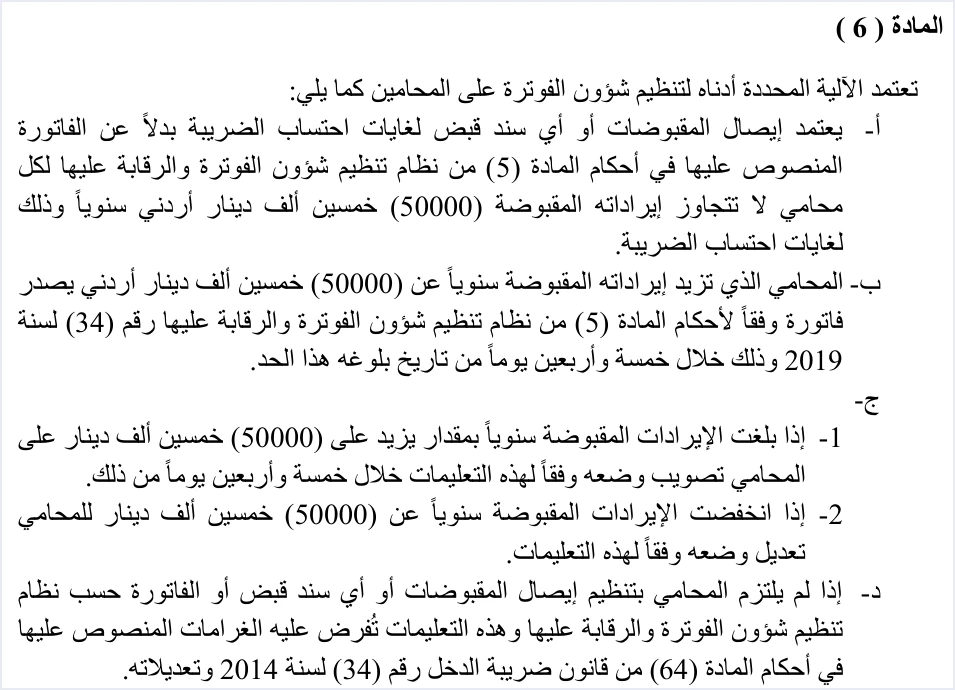
The text carries three limits, each layered on the one before.
- The category limit. In its own words, Article 6 of Instructions 1/2019 is a mechanism for lawyers, so it cannot be extended by analogy to other professions.
- The ceiling limit. Acceptance depends on collected revenue staying within the yearly ceiling, and a lawyer who goes above it moves to the invoice.
- The purpose limit. Paragraph (a) of Article 6 of Instructions 1/2019 accepts the voucher for the purpose of calculating the tax, and it repeats the same phrase at its end.
Why do we say the exception confirms the rule? Instructions 1/2019 needed an express provision to accept a receipt voucher from a single profession, within a ceiling and for a stated purpose. If a voucher could replace the invoice for every seller, that provision would not have been needed. This is our reading of the text, not a statement by ISTD.
Other texts that accept a document in place of an invoice
Article 6 of Instructions 1/2019 is not the only text that uses the words “in place of”. Regulation 34/2019 has two more provisions that use them, and setting them beside the lawyers’ text shows the limits of each.
Scroll the table sideways to see the remaining columns
Article 13 of Regulation 34/2019 differs from the lawyers’ text in its condition. Its wording is quoted below.
«على الرغم مما ورد في هذا النظام تعتمد عقود الإيجار التي تحتوي على البيانات والمعلومات المحددة في المادة (5) من هذا النظام بدلاً من الفواتير.»
In English, notwithstanding anything else in the regulation, lease contracts that contain the details and information set out in Article 5 of the regulation are accepted in place of invoices. No official English translation of this regulation was found; the English here is our rendering, and the Arabic text is the authority.
The contract is accepted because it carries the invoice’s own details, not because it is a different kind of document.
Article 8(b) of Regulation 34/2019 has nothing to do with issuing the invoice. It accepts National Invoicing System data in place of keeping the invoice on paper, so it concerns storage after the invoice has been issued.
Article 12 of Regulation 34/2019 also stays inside the invoice. It allows the Director, on the recommendation of a technical committee and on a written request, to amend the details shown on invoices or to issue invoice forms suited to the nature of the seller’s activity. The article makes room for invoice forms, not for documents that replace the invoice.
Where does the receipt voucher sit relative to the invoice in a sale?
Article 5(d) of Regulation 34/2019 sets the moment of issue in one sentence.
«يتوجب على البائع إصدار وتنظيم الفاتورة عند تحقق واقعة البيع.»
In English, the seller must issue and prepare the invoice when the sale takes place. No official English translation of this regulation was found; the English here is our rendering, and the Arabic text is the authority.
Article 3 of Regulation 34/2019 makes the time and date of a sale the time and date on which the sale takes place. So the invoice follows the sale, while payment may come before it or after it. In a credit sale, the invoice is issued at the time of the sale, and collection follows later as an amount owed by the buyer.

The National Invoicing System reflects this separation in the very first step of issuing an invoice. ISTD’s procedures guide for issuing an invoice in the Jordanian National Electronic Invoicing System, 2026 edition, tells you to press Issue an invoice (تنظيم فاتورة) and then choose one of two options. Cash (نقدي) is for invoices paid in cash, and receivable (ذمم) is for invoices that have not been collected and are payable later.
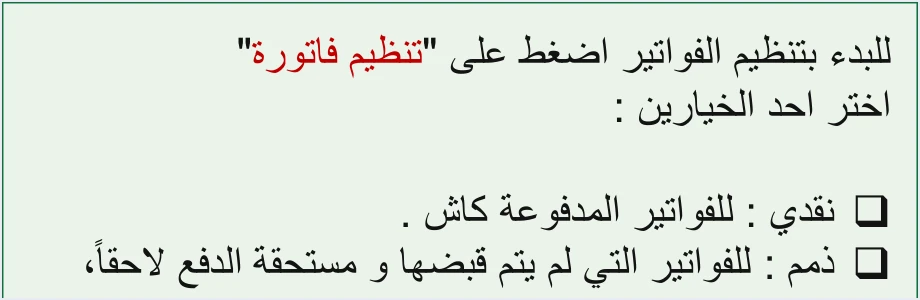
Not having collected the price therefore does not postpone the invoice in the system. It changes the invoice’s type to a receivable invoice. Article 5(b) of Regulation 34/2019 requires the buyer’s name to be stated clearly in a deferred sale, an installment sale or a sale paid in stages. How the invoice types differ is explained in our article Invoice Types in the National Invoicing System.
What happens if you rely on a receipt voucher alone?
Regulation 34/2019 sets no fine amounts of its own. Article 15 of Regulation 34/2019 provides that anyone who does not comply with issuing the invoice under the regulation is punished with the penalties set out in the Law, meaning Income Tax Law No. 34 of 2014, as amended (the Income Tax Law). The Income Tax Law has two routes.
- Article 64 of the Income Tax Law. It imposes an additional tax of no less than JOD 200 and no more than JOD 500. Its cases include refusing to issue an invoice or document when the recipient asks for it, and the amounts are doubled on repetition.
- Article 66 of the Income Tax Law. It lists, among the acts of tax evasion, that the taxpayer did not issue a proper invoice. ISTD’s English translation of the Income Tax Law, which ISTD labels an unofficial translation and under which the Arabic version prevails in case of conflict, reads: “Did not issue a proper invoice.” The penalty is a compensatory fine equal to the tax difference, with imprisonment on repetition.
Article 69 of the Income Tax Law provides that imposing a penalty or a fine does not exempt anyone from paying the tax and the amounts due. Article 10 of Regulation 34/2019 places responsibility for matching the invoice details to the actual sale on the seller and the buyer alike.
What the texts leave open about the receipt voucher
The texts answer the core question, but they leave some practical points without an express answer. We do not answer them here, because the sources we rely on do not answer them either.
- An advance payment before the sale. Regulation 34/2019 ties the invoice to the sale itself, and its text does not address an amount received before the sale takes place.
- A partly paid invoice. Version 1.5 of ISTD’s technical guide does not state whether an invoice with part of its value paid is classed as cash or receivable.
- Payment by card or bank transfer. The issuing procedures guide defines cash (نقدي) as being for invoices paid in cash, and does not mention other payment methods at the same point.
- The form of a receipt voucher for anyone other than a lawyer. Regulation 34/2019 sets no details for a receipt voucher, because it does not accept one as an invoicing document in the first place.
If any of these points matters for your business, ISTD is the reference on it.
Checklist before you hand a customer a receipt voucher
The list below is built on Regulation 34/2019, Instructions 1/2019 and the issuing procedures guide, and it adds no obligation to them.
- Decide whether the sale has taken place. If it has, the invoice is due now, whether or not you have collected the price.
- Issue the invoice through the recognized channel. That channel is the National Invoicing System or a program linked to it, under Article 4(a) of Regulation 34/2019.
- Choose the right payment type. Choose cash (نقدي) if the price has been collected and receivable (ذمم) if it is payable later, with the buyer’s name in a deferred sale.
- Check the five details. They are the ones listed in Article 5(a) of Regulation 34/2019.
- Establish receipt of any invoice above JOD 10,000. Article 5(c)(2) of Regulation 34/2019 asks for proof that the buyer received the invoice, not proof that the price was collected.
- Treat the receipt voucher as a collection document. It does not replace the invoice, except for a lawyer within the conditions of Article 6 of Instructions 1/2019.
When the invoice is issued from accounting software linked to the system, issuing and bookkeeping happen in one place. Qoyod is integrated with the National Invoicing System (JoFotara). You issue your invoice in Jordanian dinars (JOD). Qoyod builds the invoice file in UBL 2.1 format with its unique identifier (UUID) and sends it to the National Invoicing System without any manual intervention. Qoyod checks each invoice at field level as it is created, covering the tax number, the document type and payment method, the General Sales Tax rate and whether the lines are complete, and alerts you to any error before the invoice is sent, to reduce rejections. The details of the integration are on our page Qoyod and the National Invoicing System. For a wider view of the system and how to connect your business to it, read our article Jordan’s National E-Invoicing System.
E-invoicing and full accounting in one system
Qoyod is integrated with the National Invoicing System (JoFotara). You issue your invoice in Jordanian dinars from Qoyod, it is booked to your ledgers automatically and sent to the system, and once it is accepted it comes back with a QR code from the Income and Sales Tax Department.
Frequently asked questions
Is a receipt voucher an invoice in Jordan?
A receipt voucher is not an invoice under Jordan’s invoicing texts. Article 2 of Instructions 1/2019 requires a proper invoice for every good or service worth not less than one dinar, and Article 4(a) of Regulation 34/2019 recognizes the electronic invoice issued by the National Invoicing System or by a program linked to it.
When is a receipt voucher accepted in place of an invoice?
Article 6 of Instructions 1/2019 accepts a receipt for amounts collected, or any receipt voucher, for the purpose of calculating the tax, from a lawyer whose collected revenue does not exceed JOD 50,000 a year. By the wording of Article 6 of Instructions 1/2019, the mechanism is for lawyers only, so it does not extend to anyone else.
If I sell on credit, do I wait until I collect to issue the invoice?
The invoice does not wait for payment. Article 5(d) of Regulation 34/2019 requires it to be issued when the sale takes place, not when the price is collected. In the National Invoicing System, you choose the receivable (ذمم) type in this case, which is meant for invoices not yet collected and payable later.
Does the National Invoicing System issue a receipt voucher?
Version 1.5 of ISTD’s technical guide defines two document type codes, the new invoice (388) and the return invoice (381). The guide contains no document called a receipt voucher.
Is a bank transfer receipt enough in place of an invoice?
Regulation 34/2019 accepts no payment document in place of the invoice. The document it does accept in the invoice’s place is a lease contract that contains the details of Article 5 of Regulation 34/2019, and Article 6 of Instructions 1/2019 adds the receipt voucher for lawyers.
What is the fine for not issuing an invoice and relying on a receipt voucher?
Article 15 of Regulation 34/2019 refers the penalty to the Income Tax Law. Article 64 of the Income Tax Law imposes an additional tax of JOD 200 to 500 that doubles on repetition, and Article 66 of the Income Tax Law counts not issuing a proper invoice as an act of tax evasion, with a fine equal to the tax difference.
References
- Regulation No. 34 of 2019 on Organizing and Controlling Invoicing Affairs, as amended, consolidated text (in Arabic), Articles 2, 3, 4, 5, 8, 10, 12, 13 and 15.
- Instructions No. 1 of 2019 on Invoicing Affairs and Their Control, as amended (in Arabic), Articles 2 and 6.
- Income and Sales Tax Department (ISTD), procedures guide for issuing an invoice in the Jordanian National Electronic Invoicing System, 2026 edition (in Arabic), p. 5.
- Income and Sales Tax Department (ISTD), technical guide for integrating with the National Invoicing System through the API, version 1.5 (in Arabic).
- Income Tax Law No. 34 of 2014, as amended (in Arabic), Articles 64, 66 and 69.
- ISTD’s unofficial English translation of Law No. 34 of 2014 as amended by Law No. 38 of 2018, Article 66 (in case of conflict, the Arabic version prevails).