The legal link between income tax and JoFotara is closer than the two names suggest. Regulation No. 34 of 2019 on Organizing and Controlling Invoicing Affairs, as amended (Regulation 34/2019), is the text that recognizes an invoice issued by the National Invoicing System (JoFotara) or by a program linked to it. That regulation was issued under the Income Tax Law, reads its terms through the definitions of the Income Tax Law, and refers to the Income Tax Law for penalties. The Income and Sales Tax Department (ISTD) oversees both files.
In short, the invoicing texts meet Income Tax Law No. 34 of 2014, as amended, at five points. These are the legal basis of the regulation, the definitions, the penalties, the form of the invoice issued by a seller who is not registered for sales tax, and the role of the invoice in documenting revenue and expenses and in keeping records.
This article follows those points one at a time and cites the official texts that establish each link. It does not explain income tax brackets or exemptions, and it does not repeat fine amounts. Each of those topics has its own article, linked where it comes up.
Income tax and JoFotara: where the link begins
The link begins in the heading of the regulation itself. The consolidated text that ISTD publishes identifies it as Regulation No. 34 of 2019 and states the law it was issued under. Here is the Arabic wording.
«صادر بمقتضى الفقرة (و) من المادة (23) من قانون ضريبة الدخل رقم (34) لسنة 2014»
In English, the heading says that the regulation was issued under paragraph (F) of Article 23 of Income Tax Law No. 34 of 2014. No official English translation of this regulation was found; the English here is our rendering, and the Arabic text is the authority.
So Regulation 34/2019 does not stand on its own. It was issued under a provision of the Income Tax Law.
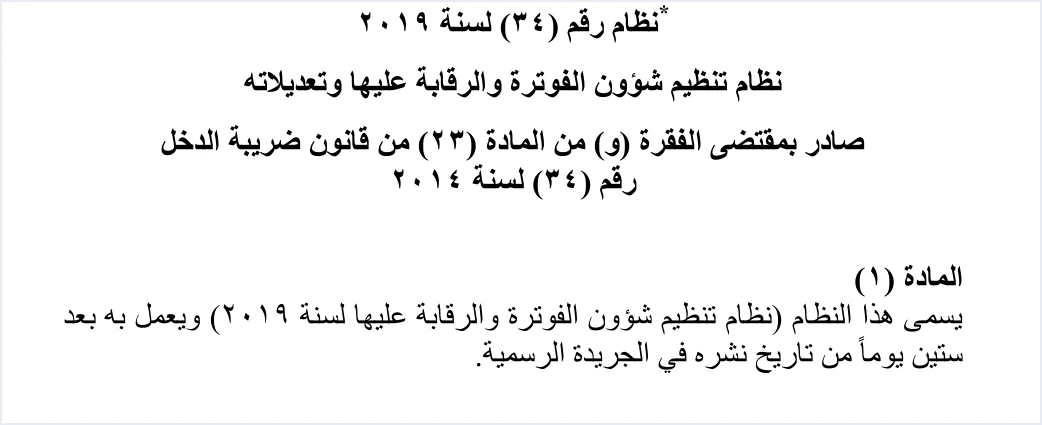
The footnote on the first page states that the original regulation was published in the Official Gazette, issue 5572, dated 1 May 2019. It also states that the regulation was amended by amending Regulation No. 13 of 2023, published in issue 5851 dated 16 April 2023. Article 1 of Regulation 34/2019 provides that it takes effect sixty days after the date of its publication in the Official Gazette.
The numbers hold a trap worth flagging. The regulation and the law both carry the number 34, but they are two different texts. The regulation is No. 34 of 2019, and the law is No. 34 of 2014. Mixing them up leads to attributing an article of the law to the regulation, or the other way around. Nor is it correct to attribute Regulation 34/2019 to Law No. 38 of 2018, because the heading of Regulation 34/2019 names Income Tax Law No. 34 of 2014 as its basis.
This article does not reproduce the text of paragraph (F) of Article 23 of the Income Tax Law. What the heading of Regulation 34/2019 establishes is that this paragraph is the basis under which the regulation was issued, and that is what we rely on here. For the sixteen articles of the regulation one by one, see our article Jordan Invoicing Regulation No. 34 of 2019 Explained.
Definitions: when the regulation reads its terms from the law
Paragraph (a) of Article 2 of Regulation 34/2019 sets the meaning of its basic terms. The first is the Law, which means the Income Tax Law. Then come the Minister, meaning the Minister of Finance, the Department, meaning ISTD, and the Director, meaning the Director General of ISTD.
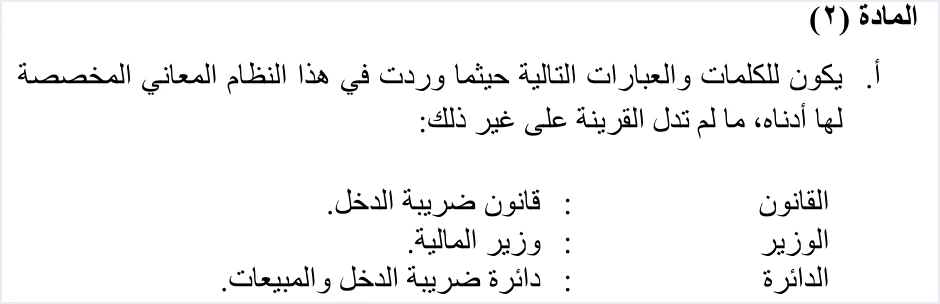
So wherever Regulation 34/2019 says the Law, it means the Income Tax Law. That definition has a direct effect on Article 15 of Regulation 34/2019, which refers penalties to the Law, as the next section shows.
Paragraph (b) of Article 2 of Regulation 34/2019 extends the link beyond a single term. Here is the Arabic wording.
«تعتمد التعاريف الواردة في القانون حيثما ورد النص عليها في هذا النظام ما لم تدل القرينة على غير ذلك»
In English, paragraph (b) of Article 2 of Regulation 34/2019 provides that the definitions in the Law apply wherever the regulation uses those terms, unless the context indicates otherwise. No official English translation of this regulation was found; the English here is our rendering, and the Arabic text is the authority.

Under this provision, a term that Regulation 34/2019 uses without defining it in the list in paragraph (a) takes its meaning from the Income Tax Law, unless the context indicates otherwise. One example is the taxpayer. The term appears in the definition of a sale of goods in Article 2 of Regulation 34/2019, which covers the taxpayer’s use of the goods for their own purposes, yet the list in paragraph (a) does not define it.
The same list contains a definition that sets up a further link, this time with sales tax. Article 2(a) of Regulation 34/2019 defines the invoice as a document that shows, among other things, the amount of General Sales Tax (GST) charged, where the seller is one of the taxpayers registered for sales tax.
Penalties: the regulation refers, the law sets
Regulation 34/2019 sets no fine amounts. Article 15 of Regulation 34/2019 refers the matter to the Law. Here is the Arabic wording.
«يعاقب كل من لم يلتزم بإصدار الفاتورة وفق أحكام هذا النظام بالعقوبات المنصوص عليها في القانون»
In English, Article 15 of Regulation 34/2019 provides that anyone who fails to issue the invoice in accordance with the regulation is punished with the penalties set out in the Law. No official English translation of this regulation was found; the English here is our rendering, and the Arabic text is the authority.
Because the Law in Regulation 34/2019 means the Income Tax Law, the penalty has to be looked for in Income Tax Law No. 34 of 2014, as amended.
Income Tax Law No. 34 of 2014 has two articles directly connected to the invoice, and a third, numbered close to them, that does not concern the invoice. The table below sums up the link of each one in a single line.
On the act listed in Article 66 of the Income Tax Law, ISTD’s English translation of the Income Tax Law, which ISTD labels an unofficial translation and under which the Arabic version prevails in case of conflict, reads: “Did not issue a proper invoice.” The Arabic term for a proper invoice is «فاتورة أصولية».
The detail and scope of Articles 64 and 66 of the Income Tax Law are in our article JoFotara Penalties: Articles 64 and 66 Explained. Article 63 of the Income Tax Law, on the late return, falls outside this article. The Income Tax Law adds in Article 69 that imposing a penalty or fine does not exempt anyone from paying the tax and the amounts due.
The reference to the Income Tax Law is not limited to Regulation 34/2019. Article 6 of Instructions No. 1 of 2019 on Invoicing Affairs and Their Control sets a mechanism specific to lawyers, and provides that failure to comply with it carries the fines set out in Article 64 of Income Tax Law No. 34 of 2014. So the instructions, too, name the article of the law by its number.
A seller not registered for sales tax: which invoice?
Registration for General Sales Tax does not decide whether a seller issues an invoice. It decides the form the invoice takes. Article 5(a) of Regulation 34/2019 requires the seller of any goods or service worth not less than one dinar to organize and issue an invoice. Article 2 of Instructions No. 1 of 2019 restates that duty for a proper invoice and adds the exception, unless the seller is exempt under Article 11 of Regulation 34/2019 or under the instructions. Item 3 of Article 5(a) of Regulation 34/2019 calls for the seller’s tax number if the seller is registered for sales tax, and the seller’s national number if not.
This fits the definition of the invoice in Article 2(a) of Regulation 34/2019 seen above, under which the GST amount appears on the invoice where the seller is registered. A seller who is not registered issues an invoice that carries no sales tax amount.
This is the invoice that JoFotara calls an income invoice. It is the family of invoices that carry no tax, issued by businesses that are not registered for General Sales Tax. Like the other types, it comes in two forms, cash and receivable. In the file sent to the system, the local income invoice carries the code 011 when it is a cash invoice and the code 021 when it is a receivable invoice.
The name income invoice does not make it an income tax return or any part of one. It describes a type of invoice in JoFotara, while income tax on what the business earns has its own law and its own return. For who issues this invoice and what it carries, see our article Income Invoice in JoFotara: Who Issues It, What It Carries.
The invoice and expenses in the income tax calculation
The Income Tax Law looks at an expense through what it actually is and what it is for. Article 2 of Income Tax Law No. 34 of 2014 defines allowable expenses as the expenses totally and exclusively spent or accrued during the tax period to generate taxable income, and Article 6 of the Income Tax Law lists what may be deducted. The Income Tax Law does not assume an automatic expense ratio for any activity, so a deduction rests on actual, documented expenses.
This is where the invoice matters on both sides of a transaction. The sales invoice documents the seller’s revenue, and the purchase invoice documents the buyer’s expense. An actual expense needs evidence, and the invoice is one of the documents that provide it.
The invoicing texts, for their part, decide which invoice is recognized. Here is the Arabic wording of Article 4(a) of Regulation 34/2019.
«لغايات تنفيذ أحكام هذا النظام تعتمد الفاتورة الالكترونية الصادرة عن برنامج الفوترة الوطني الالكتروني أو الصادرة عن برنامج تم ربطه ببرنامج الفوترة الوطني الالكتروني»
In English, Article 4(a) of Regulation No. 34 of 2019 provides that, for the purposes of the regulation, the electronic invoice that is recognized is the one issued by the National Invoicing System or by a program linked to it. No official English translation of this regulation was found; the English here is our rendering, and the Arabic text is the authority.
The practical result is that, for the purposes of Regulation 34/2019, an invoice that is not issued through JoFotara, either directly or from a program linked to it, is not the recognized invoice.
Article 10 of Regulation 34/2019 adds that responsibility for the invoice matching the actual facts rests on the seller and the buyer alike. A buyer who records an expense on the strength of an invoice is not a neutral party. The buyer carries a share of the responsibility for that invoice matching the facts.
So as not to read more into the texts than they hold, this article does not state how ISTD treats, in the income tax calculation, an expense supported by an invoice from outside JoFotara. The consolidated text of Regulation 34/2019 as ISTD publishes it (the 2023 version) contains no article on deducting expenses, and the reference for deductions is the Income Tax Law itself. Exemptions, brackets and withholding at source are covered in our article Income Tax in Jordan.
Keeping invoices: a period counted from events in the tax file
Invoicing meets the tax file again in the retention period. Article 8(a)(1) of Regulation 34/2019 requires invoices to be kept for four years, counted from the latest of three dates. These are the end of the tax period in which the invoice was issued, the filing of the tax return, and the notification of the notice of the result of an administrative assessment return. The start of the period is therefore tied to events in the taxpayer’s tax file, not to the invoice date alone.
Where there is a dispute over the invoice, over the amount of tax due, or over any fines and amounts related to it, retention continues until the dispute is decided or a final decision is issued. Article 8(a)(2) of Regulation 34/2019 adds that in all cases the retention period must not be shorter than the period set in paragraph (a), so the four years are a floor even in a dispute.
Paragraph (b) of Article 8 of Regulation 34/2019 provides that data in the National Invoicing System is accepted in place of keeping the invoice on paper. Article 9 of Regulation 34/2019 requires every seller to enable ISTD to transfer all the data and information on invoices and their contents electronically.
What the texts relied on here do not settle
This article rests on the consolidated text of Regulation 34/2019 as ISTD publishes it, on Instructions No. 1 of 2019, and on the articles of the Income Tax Law cited above. Within the limits of these texts, five questions stay outside what we state.
- The text of paragraph (F) of Article 23 of the Income Tax Law. We establish that it is the basis of Regulation 34/2019, as the heading of the regulation says, and we do not reproduce its content.
- What amending Regulation No. 13 of 2023 changed. The consolidated text of Regulation 34/2019 does not mark the amended articles, so we do not state which article changed.
- How an expense documented by an invoice from outside the system is treated in the income tax calculation, as noted in the section on expenses.
- Any date for the direct link. Article 4(b) of Regulation 34/2019 refers to the timetable prepared for that purpose without setting a date.
- ISTD’s administrative role in invoicing and the channels for contacting ISTD, which this article does not cover.
How to bring the two files together in your daily work
The links above turn into practical steps that a business owner or their accountant can check.
- Establish your General Sales Tax registration status. It decides whether you issue an income invoice or a general sales tax invoice, and which number appears in the seller details.
- Issue the invoice by one of the two recognized routes. That is JoFotara directly, or a program linked to it, as Article 4(a) of Regulation 34/2019 provides.
- Issue it when the sale takes place. Article 5(d) of Regulation 34/2019 ties issuing the invoice to the sale, and Article 3 of Regulation 34/2019 fixes the time and date of the sale as the time and date on which the sale actually occurs.
- Review purchase invoices before you record them. Under Article 10 of Regulation 34/2019, responsibility for the invoice matching the facts lies with the seller and the buyer together.
- Count the retention period from the three dates. Keep invoices for at least four years from the latest of them. Under Article 8(b) of Regulation 34/2019, JoFotara data is accepted in place of keeping paper copies.
- Make the invoice part of your books. An invoice issued in a system that is separate from your accounts needs a second entry before it shows in your revenue.
If you keep your accounts in accounting software, that last step is where the integration counts. Qoyod is integrated with the National Invoicing System (JoFotara). Qoyod builds the invoice file in UBL 2.1 format with its unique identifier (UUID) and sends it to the National Invoicing System without any manual intervention. For a wider view of the system and how to connect your business to it, read our article Jordan’s National E-Invoicing System, or see how Qoyod works with JoFotara on our National Invoicing System page.
E-invoicing and full accounting in one system
Qoyod is integrated with the National Invoicing System (JoFotara). You issue your invoice in Jordanian dinars from Qoyod, it is booked to your ledgers automatically and sent to the system, and once it is accepted it comes back with a QR code from the Income and Sales Tax Department.
Frequently asked questions
What is the relationship between income tax and JoFotara?
The two are linked in law in more than one way. Regulation No. 34 of 2019 on Organizing and Controlling Invoicing Affairs was issued under paragraph (F) of Article 23 of Income Tax Law No. 34 of 2014. Article 2 of Regulation 34/2019 defines the Law as the Income Tax Law, and Article 15 of Regulation 34/2019 refers penalties to it.
Was the invoicing regulation issued under Law No. 38 of 2018?
The heading of Regulation 34/2019 states that it was issued under paragraph (F) of Article 23 of Income Tax Law No. 34 of 2014. That is the basis to cite, not Law No. 38 of 2018.
Where do I find the fines for not issuing an invoice?
You find them in the Income Tax Law, not in Regulation 34/2019. Article 15 of Regulation 34/2019 refers penalties to the Law, and the two articles of the Income Tax Law linked to the invoice are Articles 64 and 66. Article 63 of the Income Tax Law concerns filing the return late.
Does a seller not registered for sales tax issue an invoice?
The seller issues an invoice unless exempt under Article 11 of Regulation 34/2019 or under Instructions No. 1 of 2019. In JoFotara that invoice is an income invoice that carries no sales tax, and it shows the seller’s national number instead of a tax number.
Does the invoice retention period change if a tax dispute arises?
The period extends until the dispute is decided or a final decision is issued. Article 8(a)(2) of Regulation 34/2019 provides that in all cases retention must not be shorter than the four years set in paragraph (a).
Does the invoicing regulation set how expenses are deducted from income?
The consolidated text of Regulation 34/2019 contains no article on deducting expenses. It sets which invoice is recognized for the purposes of its own provisions. Allowable expenses in the income tax calculation are governed by Articles 2 and 6 of the Income Tax Law.
References
- Regulation No. 34 of 2019 on Organizing and Controlling Invoicing Affairs, as amended, consolidated text (in Arabic), heading, footnote and Articles 1, 2, 3, 4, 5, 8, 9, 10, 11 and 15.
- Instructions No. 1 of 2019 on Invoicing Affairs and Their Control, as amended (in Arabic), Articles 2 and 6.
- Income Tax Law No. 34 of 2014, as amended (in Arabic), Articles 2, 6, 63, 64, 66 and 69.
- ISTD’s unofficial English translation of Law No. 34 of 2014 as amended by Law No. 38 of 2018, Article 66.