You issue an invoice to your customer in Amman, the customer receives it, and the amount gets paid. Months later an audit arrives and the invoice falls, because it carries no QR code issued by the National E-Invoicing System. The invoice exists and the money is collected, but it is not a tax document.
That is the heart of the shift the Income and Sales Tax Department imposed in Jordan. Issuing an invoice is no longer an internal process inside your business. It has become an event that passes through a government platform before it reaches the buyer. Whoever misses this difference pays for it twice: once in fines, and once in the input tax deduction their customers lose.
This guide takes the system apart from the beginning: who runs it, what its legal basis is, who it covers, the invoice types inside it, how it works technically, how to connect your business to it in practice, and what the penalties for staying outside are. Along the way you will find a quick self-assessment that tells you where your business stands against the system’s requirements before you start the integration.
What is the National E-Invoicing System and who runs it
The National E-Invoicing System (JoFotara) is a Jordanian government platform through which tax invoices are issued electronically and validated in real time before being delivered to the buyer. Taxpayers and accountants commonly call it Jordan’s national electronic invoicing system, and its portal lives at portal.jofotara.gov.jo.
The owner and operator is the Income and Sales Tax Department under the Ministry of Finance, in cooperation with the Ministry of Digital Economy and Entrepreneurship. The Department is the competent tax authority, and it is the party that issues the credentials connecting your accounting software to the system.
The idea behind the system is simple at its core. The state wanted to see the invoice the moment it is issued, not three months later inside a tax return. That closes the door on fictitious invoices, widens the tax base, and gives the Department a live picture of market activity.
One point confuses many people and deserves attention: the system is not a replacement for your accounting software. The government portal offers free manual invoice entry, but it does not keep your books, calculate your profits, or manage your inventory. Whoever relies on the portal alone runs two separate systems and enters the same data twice.
How Jordan’s National E-Invoicing System evolved
-
2019The legal frameworkThe Regulation for Organizing and Controlling Invoicing Affairs No. 34 of 2019 is issued.
-
December 2022Voluntary launchThe platform goes live, with registration optional for willing businesses.
-
2023Phased mandatory registrationSelected categories of taxpayers are obligated and technical integration testing begins.
-
1 April 2025Full enforcementAll invoices for goods and services must be issued through the system.
-
Beyond 2025Continuous tighteningRemaining small businesses are onboarded and enforcement measures keep escalating.
The legal basis and the rollout phases
The system does not rest on an administrative circular. It rests on clear legislation. The first reference is the Regulation for Organizing and Controlling Invoicing Affairs No. 34 of 2019, issued under Article 23 of Income Tax Law No. 38 of 2018 and amended in 2023. Then came the Amended Billing and Control Regulation No. 2 of 2025, which governs the current phase.
The date that matters most in practice is 1 April 2025. Since that date, issuing invoices for goods and services through the system has been mandatory, whether the sale goes to another business, to an end consumer, or to a government body.
No new phase with a fixed date has been announced after it. What is actually happening is a gradual onboarding of the remaining small businesses and sectors, with continuously tightening enforcement and follow-up procedures. So treat with caution any content announcing a new mandate wave with a specific date and no official text behind it. The obligation has been in force since 2025, and what changes is the strictness of enforcement, not the rule itself.
Who the National E-Invoicing System covers
The scope of the National E-Invoicing System in Jordan is wider than most people assume. This is where the most expensive mistake happens: a business assumes the mandate concerns only those registered for General Sales Tax, and postpones the integration until it reaches the registration threshold.
The mandate covers every seller of goods and every provider of services. That includes shops, companies, and offices, and it also includes the liberal professions: doctors, lawyers, engineers, and consultants. The test is practising an activity of selling or providing services, not tax registration. Anyone planning a consulting practice needs compliant invoicing in the plan from day one, not after the first contract. The full breakdown of obligated and exempt categories is in the guide to who must use e-invoicing in Jordan.
Registration thresholds for General Sales Tax are a separate matter from invoicing. Article 13 of the General Sales Tax Law points to a threshold of JOD 30,000 for services, JOD 75,000 for goods, and JOD 10,000 for manufacturers of goods subject to Special Sales Tax, with no threshold for importers. Where a business runs several activities, the lowest applicable threshold governs.
The difference between a registered and an unregistered business shows in the invoice type, not in the existence of the obligation:
- A business registered for General Sales Tax issues a general sales tax invoice carrying the tax at its rate.
- An unregistered business issues an income invoice with no tax, but it passes through the system like every other invoice.
Some unofficial sources circulate invoicing exemptions for specific categories based on annual sales. Treat those lists carefully: exemptions are activity-based, the list has been amended over time, and the only correct reference is the text of the instructions in force and a direct inquiry with the Income and Sales Tax Department. Never build a decision on an exemption you have not read in the text.
General Sales Tax and its rates
Jordan’s consumption tax is called General Sales Tax, and its standard rate is 16%, the rate an invoice issued through the National E-Invoicing System carries in the general case. That is the correct name and the correct rate, and any content using a different name or a different rate has been copied from another market.
Its legal basis is the General Sales Tax Law No. 6 of 1994 and its amendments, and it is administered by the Income and Sales Tax Department, the same authority that runs the National E-Invoicing System. Setting the rate correctly in your software is therefore not an internal arithmetic detail. It is a statement that reaches the Department with every invoice. The complete guide to General Sales Tax in Jordan covers the rates, registration, and filing in detail.
Note also that the Jordanian dinar is written with three decimal places, because one dinar equals 1,000 fils. Rounding amounts to two decimals produces small differences that accumulate and surface at reconciliation time.
The standard rate is not the only rate, and here begins a gap that costs businesses real money: applying one flat rate across a mixed product catalog. The actual structure is wider than a single rate, and it includes reduced rates, zero rates, exempt goods, and a special tax added on top of sales tax:
- Reduced rates of 1%, 2%, 4%, 5%, and 10% on lists of goods defined in the schedules.
- Special Sales Tax imposed on top of General Sales Tax on specific goods such as tobacco, fuel, and vehicles.
- A zero rate on exports and on supplies to free zones and development zones.
- Exempt goods and services with no input tax deduction, including bread, education, and health services.
- A special rate for the Aqaba zone on listed goods and services.
The remedy is simple, but it has to come at the right time: set the rate at the item level when you first configure the system, not at the moment of issuing each invoice. The error does not show on a single invoice. It shows aggregated in the sales tax return, after hundreds of invoices have already been issued and cleared.
The invoice and note types inside the system
The National E-Invoicing System works with four documents: the income invoice, the general sales tax invoice, the special sales tax invoice, and the return invoice, known in accounting as a credit note. Each document has its use case, and none of them substitutes for another, because the document type is part of the data that reaches the Department.
Each invoice type also comes in two payment forms. A cash invoice is settled immediately, and a receivables invoice is recorded on the customer’s account. The distinction is not cosmetic, because it decides whether the sale enters the receivables balance in your books. In the UBL payload the payment form is part of a three-digit type code that combines the trade type, the payment method, and the tax family.
One rule governs all of the above: an invoice cannot be edited after issuance. Every correction runs through a return invoice, the system’s credit note, which references the original invoice, states the reason for the return, and adjusts quantities only, never exceeding the quantities on the original invoice. The system also rejects negative quantities or prices on invoice lines, a point that surprises anyone used to recording returns as a negative line inside the invoice itself. And unlike some markets, JoFotara defines no debit note: the official technical manual defines exactly two document types, the invoice and the return invoice.
The table below summarizes the four documents and when to use each:
| Document | When you use it | Tax |
|---|---|---|
| Income invoice | A business not registered for General Sales Tax | No tax |
| General sales tax invoice | A registered business selling taxable goods or services | 16% in the general case |
| Special sales tax invoice | Goods subject to Special Sales Tax alongside sales tax | Special rates |
| Return invoice (credit note) | Returns or corrections that reduce a previously issued invoice | Follows the original invoice |
How the system works technically, in plain language
You need no programming background to understand how the National E-Invoicing System operates. Your accounting software builds the invoice in a unified standard format called UBL 2.1, a structured XML file that describes every field on the invoice. The file is encoded and sent to the system’s interface over a secured connection.
Authentication uses two keys from your portal account: the Client ID and the Secret Key, together with the activity number. Your software sends them with every request, so the Department knows who issued the invoice.
Here sits an essential difference. The Jordanian system requires no digital signature and no electronic certificate from the taxpayer on the invoice. Some e-invoicing systems in other countries require an encrypted signature and a certificate issued by an accredited authority. That requirement does not exist in Jordan. The integration relies solely on the credentials you generated from the portal.
As for the QR code, its source is not your software. The Department issues the code and returns it to you after checking and accepting the invoice. The working rule every accountant should memorize: no code, no legal invoice. The buyer can verify the invoice by scanning the code through the Sanad app.
The invoice’s journey from your software to the buyer’s hands
Finally, the model the system runs on is real-time clearance. That means the Department validates the invoice before it reaches the buyer, rather than being reported afterwards. This differs from periodic reporting systems where you upload a sales file at the end of the month. In practice it means a broken connection stops your ability to deliver a compliant invoice, which is reason enough to choose stable accounting software that is already integrated.
The practical integration steps, one by one
Connecting your business to the National E-Invoicing System is a shorter administrative procedure than most business owners expect. It needs no programmer and no electronic certificate, just three values you generate yourself from the system portal and enter into your accounting software once.
Before you start, prepare two things: your business data at the Income and Sales Tax Department must be current and correct, and you need a clear decision on who handles the integration inside the business. The Secret Key you will generate is effectively your business’s password before the system, and whoever holds it can issue invoices in its name. The system requires no external intermediary to complete the integration. The business owner or the accountant can do it from the business’s own portal account.
Follow the steps in the order below and skip none of them. Setting tax rates and reviewing the invoice template before the first real invoice is far cheaper than correcting them later with return invoices, because a cleared invoice cannot be edited. The longest part of the process is not the settings themselves but reviewing the item catalog before going live.
The order is as follows:
- Prepare your tax number. Confirm your business data at the Department is current and your tax registration number is correct. The General Sales Tax registration number consists of 7 digits.
- Register on the system portal. Create your business account at portal.jofotara.gov.jo, or log into it if it already exists, and follow the linking procedure guide published on the portal.
- Generate the integration credentials. From inside your account, generate the Client ID and the Secret Key, and obtain the activity number. Store them somewhere safe; the Secret Key is the equivalent of your business’s password.
- Enter them in your accounting software. Open the National E-Invoicing System integration settings and paste the three values.
- Issue a test invoice. Confirm the QR code comes back and appears on the invoice template, then scan it to verify.
- Review the invoice template. Confirm the legal name of the business, the tax number, the buyer’s details, the tax breakdown, and the currency in Jordanian dinars all appear.
Step six is the one people skip and then return to after the first auditor’s note. The Jordanian invoice template has mandatory fields, and their absence leaves the invoice incomplete even if the system accepted it technically.
The penalties for non-compliance
The impact of a violation spreads across three levels, and the most dangerous one is not the fine.
First: the invoice is void as a tax document. An invoice not issued through the National E-Invoicing System is not accepted. That means the buyer loses the right to deduct input tax, and the expense is not recognized for income tax purposes. This turns the problem from yours into your customer’s, which is exactly why larger businesses refuse to deal with an unconnected supplier.
Second: the monetary fine. The fine ranges from JOD 200 to 500 per violation, and it doubles on repetition, under the penalty provisions the invoicing framework refers to in the Income Tax Law. Violations are counted per incident, so a business with high invoice volume accumulates amounts quickly. Failing to issue a proper invoice can also be treated as tax evasion, with a compensatory fine equal to the tax difference.
Third: exclusion from government tenders. Public bodies require compliant invoices, and whoever cannot issue them drops out of government procurement entirely.
Put it in a concrete example. A trading business in Amman sells goods worth JOD 10,000 and adds General Sales Tax at 16%, bringing the invoice total to JOD 11,600. If that invoice is issued outside the system, the registered buyer loses a deduction of JOD 1,600 from their input tax, and loses the expense recognition as well. The value destroyed here exceeds the fine itself.
Is your business ready for the National E-Invoicing System?
Review these seven items before issuing your first compliant invoice.
- Your tax number is current at the Income and Sales Tax Department.
- Your business account is active on the National E-Invoicing System portal.
- The Client ID, Secret Key, and activity number are generated and stored safely.
- The credentials are entered in your accounting software and the connection works.
- General Sales Tax rates are set correctly on your products and services.
- Your invoice template shows the mandatory fields and the currency in dinars.
- Your team knows corrections are made with a return invoice, never by editing an issued invoice.
The checklist above shows you the items, but it does not tell you exactly where you stand or which item to start with. The JoFotara readiness check asks you five questions about portal registration, how you issue invoices, your integration credentials, the QR code, and how you correct a faulty invoice, then gives you a risk score out of 15, a readiness percentage, and a specific recommendation for the next step. It is free, asks for no email, and its result is indicative, with the Income and Sales Tax Department’s instructions remaining the reference.
The common mistakes when dealing with the system
The mistakes that keep recurring with the National E-Invoicing System are mostly not technical. They are old assumptions carried over from the paper-invoice era into a system that clears the invoice the moment it is issued. Most of them happen in the first weeks after integration, and most of them are corrected once, at setup, and never return.
The cost of error here is double. On one side, the Department may reject the invoice, so it never reaches the buyer in compliant form. On the other, the invoice may be accepted technically while carrying a wrong tax rate or a wrong payment form, passing quietly and surfacing in the sales tax return or the receivables balance months later. And a rejected invoice does not count as issued at all, so it must not be handed to the buyer as it is.
The second kind is the more dangerous, because a cleared invoice cannot be edited, so the correction becomes a chain of return invoices instead of one edit. The list below gathers what actually recurs at businesses that recently connected, and reviewing it item by item before going live spares you most of it:
- Assuming that not being registered for sales tax means being exempt from invoicing. The unregistered business issues an income invoice, and it is not exempt from passing through the system.
- Trying to edit an issued invoice. The invoice is locked, and the only route is a return invoice (credit note) referencing the original.
- Recording a return as a negative line. The system rejects negative quantities and prices.
- Confusing cash and receivables invoices. Choosing the wrong form distorts the receivables balance and confuses collections later.
- Relying on manual entry in the portal. It satisfies the legal obligation, but it leaves your books out of the picture and doubles the work. The same logic applies to spreadsheets, as the guide on when to stop managing invoices in Excel lays out.
- Applying one flat tax rate to every item. Alongside the general 16% rate there are reduced rates, exempt goods, and zero-rated goods, and Special Sales Tax is added on top of sales tax for specific goods.
- Neglecting to archive the integration credentials. Losing the Secret Key stops issuance until you regenerate it.
The last point leads to a wider question: do you want an invoicing tool that merely connects you to the system, or a complete accounting system where the connection is one part? The difference shows the moment you compare a standalone tool with full cloud accounting, where the invoice, the entry, the inventory movement, and the reports live in one place.
Qoyod and the National E-Invoicing System
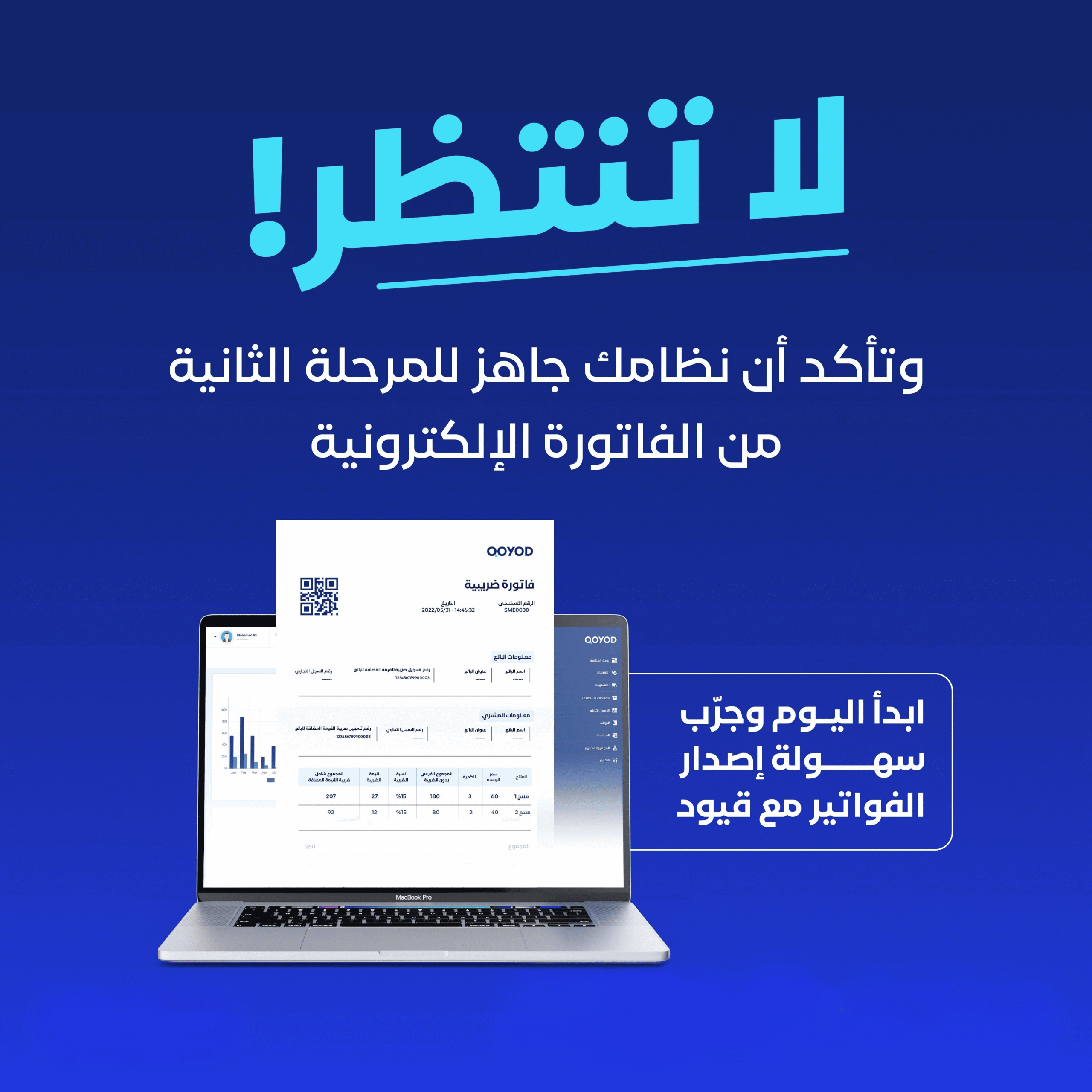
Qoyod accounting software is compatible and integrated with the National E-Invoicing System (JoFotara). The integration is built inside the system itself, so an invoice you issue from Qoyod is sent to the Department and comes back carrying the QR code, with no intermediary tool and no re-entry in a separate portal.
In practice, this integration means the invoice is never entered twice. You create it in Qoyod, it is built in the standard format and sent to the Income and Sales Tax Department with the credentials you entered once, then the QR code comes back and appears on the Jordanian invoice template, ready to deliver and scan. At no step do you need to open the system portal manually.
Whether moving to a system is worth it at all is an operational question rather than a legal one, and it is worth settling before you integrate: when the free portal is enough and when you need an accounting system.
One thing gets said imprecisely in the market and deserves a note. There is no official accreditation list for accounting software published by the Income and Sales Tax Department in Jordan. The accurate description of any software, Qoyod included, is compatibility and integration with the National E-Invoicing System, nothing more. Any party claiming official accreditation from the Department owes you an answer about where that accreditation comes from.
When invoices start at a sales counter rather than a keyboard, the same integration question moves to the till itself, which is what choosing a POS system in Jordan works through.
The steps to activate the integration inside Qoyod
- Generate the Client ID, the Secret Key, and the activity number from your business account on the system portal.
- Open the National E-Invoicing System integration settings in your Qoyod account.
- Paste the three values and save the settings.
- Set the General Sales Tax rates on your products and services.
- Issue a test invoice and confirm the QR code comes back.
- Review the Jordanian invoice template to confirm the mandatory fields are complete.
After these steps, compliant invoicing becomes part of your daily cycle rather than an extra task. You issue the invoice from the same screen where you record the sale, so the journal entry is created, the inventory is deducted, and the customer balance updates at the same moment.
What Qoyod offers the Jordanian market
Connecting to the National E-Invoicing System alone is not enough. The invoice that cleared and returned with its code is still a complete accounting event: revenue to record, inventory to deduct, a customer balance that moves, and sales tax accumulating until filing time. The real question when choosing a system is what happens after the moment of clearance.
In the Jordanian market specifically, small details turn into daily differences: the tax named General Sales Tax rather than another market’s label, the dinar with three decimal places, the tax number on the invoice template, and the income invoice for businesses not registered for tax. A system that does not handle these details from the start forces you to patch them manually in every cycle, and they are details a generic setup designed for another market does not address.
That is why the benefit is not measured by the number of features, but by the number of times you do not have to enter the same data twice, and the number of reports that come out correct without another manual compilation at month end. These are the capabilities serving the Jordanian business inside Qoyod:
- A General Sales Tax engine. Calculation set to the general 16% rate with support for reduced rates and exempt and zero-rated items, and the tax named General Sales Tax inside the system, not another market’s label.
- The system’s documents in full. Income invoice, general sales tax invoice, special sales tax invoice, and return invoices (credit notes), each in its cash and receivables forms.
- A Jordanian invoice template. It shows the tax number, the mandatory fields, and the system’s QR code, with display in Arabic and English.
- The Jordanian dinar as a base currency in invoicing and reports, with multi-currency support for anyone selling outside Jordan.
- Complete accounting behind the invoicing. A chart of accounts, journal entries with ready templates, cost centers, bank reconciliation, fixed assets, and inventory management with multiple warehouses and branches.
- Recurring invoices and automatic payment reminders for anyone selling on subscriptions or periodic contracts, so the invoice issues on schedule without being recreated every cycle.
- Excel import for sales and purchase invoices, entries, opening balances, customers, suppliers, and products, with templates up to 5,000 rows and a per-row error report. This is the fastest route for moving your data from an old system.
- A ready library of financial and operational reports with filters, period comparison, advanced analysis, and export to Excel and PDF, built on the same data that produced the invoices, so there is no gap between what you sent the Department and what appears in your statements.
- User permissions, so a salesperson can issue an invoice without seeing the financial statements.
- Operational integrations through the API and Zapier, invoice delivery by email and WhatsApp, and a mobile app for following the business outside the office.
Behind all of this sits operating experience accumulated in a market that went through a similar transition. More than 25,000 businesses run on Qoyod accounting software in the Saudi market, which passed through a comparable phased e-invoicing mandate, and that experience is what the National E-Invoicing System integration in Jordan is built on.
Start your free trial and issue your invoices through the national system
What this means for accounting firms
The accounting firm in Jordan is not a secondary party in this equation. Most small and medium businesses hand their accounting books to an external office, and that office is the one that effectively decides which system gets used. It is also the first to feel the impact of the National E-Invoicing System, because every invoice a client issues arrives in the books already cleared and locked against editing.
The shift to real-time invoicing changed the nature of the firm’s work. It is no longer about collecting paper invoices at month end and entering them in one batch, because the invoice is now cleared the moment it is issued. A firm working on a cloud system sees its clients’ activity as it happens and catches the error before it turns into a painful adjustment at period close. A firm that reviews each client’s sales month by month catches rate errors before the return, and a ready monthly sales report template helps standardize that review.
And if you manage clients on an old, unconnected system, the migration path is known and plannable. Practical experience in moving from one accounting system to another says the hardest part is not transferring balances. It is setting the chart of accounts and the tax rates correctly before the first invoice.
Frequently asked questions
What is the National E-Invoicing System?
A Jordanian government platform run by the Income and Sales Tax Department in cooperation with the Ministry of Digital Economy and Entrepreneurship. The invoice is sent to it the moment it is issued, gets validated, and returns with a QR code, and without that code the invoice is not considered a tax document.
Who must use the National E-Invoicing System in Jordan?
Every seller of goods and provider of services, including the liberal professions. Businesses registered for General Sales Tax issue a sales tax invoice, unregistered businesses issue an income invoice with no tax, and everyone passes through the system.
How do I register in the National E-Invoicing System?
Create your business account on the system portal at portal.jofotara.gov.jo using your business data and tax number, then generate the Client ID, the Secret Key, and the activity number from inside the account, and enter them in your accounting software to complete the integration.
Can I edit an invoice after issuing it through the system?
No. The invoice is locked after clearance. Corrections are made with a return invoice (credit note) that references the original invoice, adjusts quantities only, and never exceeds the original quantities. The system also rejects line items with negative quantities or prices.
How do I verify an invoice issued through the system?
Scan the QR code printed on the invoice through the Sanad app. The code is issued by the Income and Sales Tax Department after the invoice is accepted, and its presence is the proof the invoice actually cleared.
What are the penalties for not complying with the National E-Invoicing System?
An invoice issued outside the system is not accepted as a tax document, so the buyer loses the input tax deduction and the expense is not recognized for income tax. The fine ranges from JOD 200 to 500 per violation, doubling on repetition, alongside exclusion from government tenders.
Do I need a digital signature certificate to connect to the system?
No. The integration in Jordan relies on the Client ID, the Secret Key, and the activity number only. The taxpayer is not required to sign the invoice digitally or obtain an electronic certificate.
Is Qoyod compatible with the National E-Invoicing System?
Yes. Qoyod is compatible and integrated with the National E-Invoicing System (JoFotara), so the invoice is sent from inside the software and returns carrying the QR code. Jordan has no official accreditation program for accounting software, so the accurate description is compatibility and integration, not accreditation.
The practical summary
The National E-Invoicing System mandate has been in force in Jordan since 1 April 2025, and enforcement tightens year after year. An invoice that does not pass through the system is not an invoice in the eyes of the Income and Sales Tax Department, however complete it looks on paper.
Before moving to execution, fix four points: the mandate covers every seller of goods and provider of services, not only those registered for General Sales Tax; the document types are four, each with its place; corrections are made with a return invoice, not by editing the invoice; and the QR code is issued by the Department, not by your software. Whoever settles these points before the first invoice saves themselves most of what others fix later through adjustments. And if you are not sure where you stand on these points, find out with five questions through the JoFotara readiness check before an audit finds out for you.
Your next step is clear: open your account on the portal, generate the integration keys, and enter them in an accounting system that handles the sending and clearance and then carries on to your books and reports. When the integration is part of the system rather than an add-on above it, compliance turns from a monthly burden into a procedure you barely notice.