A customer pays a credit invoice, and the seller or the seller’s accountant now has a practical question about credit sale invoice payment JoFotara rules. Do you send anything to the National Invoicing System (JoFotara) to show the invoice has been paid? Does the invoice change from a receivable (credit-sale) invoice to a cash invoice once the money comes in? The official guides published by the Income and Sales Tax Department (ISTD) define no document and no message to be sent on payment. The payment method is settled once, when the invoice is issued, and the collection is then recorded in the business’s own books.
Our article Receipt Voucher vs Invoice in Jordan explains why a receipt voucher does not replace the invoice. This article follows the invoice after it is issued, from the day of the credit sale to the day the money is collected, and it separates what the official guides document from what they do not.
Credit sale invoice payment JoFotara: the short answer
The answer rests on two official guides. The first is the technical guide for integrating with the National Invoicing System through the API, version 1.5. The second is the procedures guide for issuing an invoice in the Jordanian National Electronic Invoicing System, 2026 edition. Four points follow from them.
- The payment method is chosen at issue. The issuing guide asks you to choose cash (نقدي) or receivable (ذمم) in the very first step, and the invoice file carries that choice in the second digit of its type code.
- There is no payment document. The technical guide defines only two document types, the new invoice (
388) and the return invoice (381). - An invoice is not edited after it is issued. The documented correction runs through a return invoice, and on quantities only.
- Collection is an accounting event. The receivable invoice is booked to the customer’s account in accounts receivable, and that balance is closed in the books when the money is received.
The payment method is fixed at issue, not on collection
Issuing an invoice on the portal starts with a single choice between two types. After you press the Issue an invoice tile (تنظيم فاتورة), the procedures guide for issuing an invoice asks you to choose cash (نقدي) for invoices paid in cash, or receivable (ذمم) for invoices that have not been collected and are payable later.
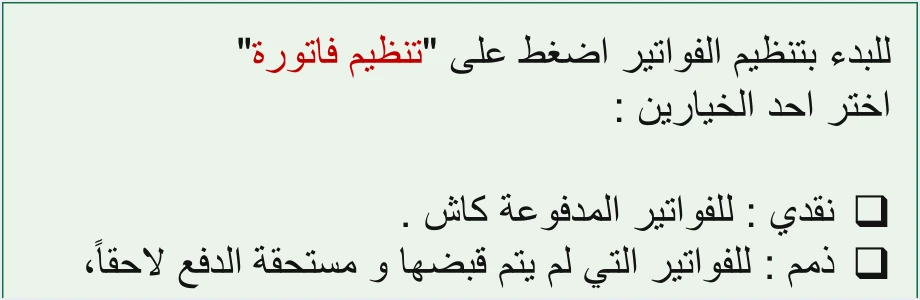
That definition describes the invoice on the day it is issued. In the guide’s wording, a receivable invoice is one that has not yet been collected and is payable later. The guide mentions no later step that reclassifies it once the money is received.
When you integrate through the API, the file carries the same information in a three-digit code, held in the name attribute of the cbc:InvoiceTypeCode element. The first digit is the trade type. The second digit is the payment method, 1 for cash and 2 for receivable. The third digit is the tax family, 1 for income, 2 for General Sales Tax (GST) and 3 for Special Sales Tax. The table on page 33 of the technical guide lists the codes for the general sales tax invoice.
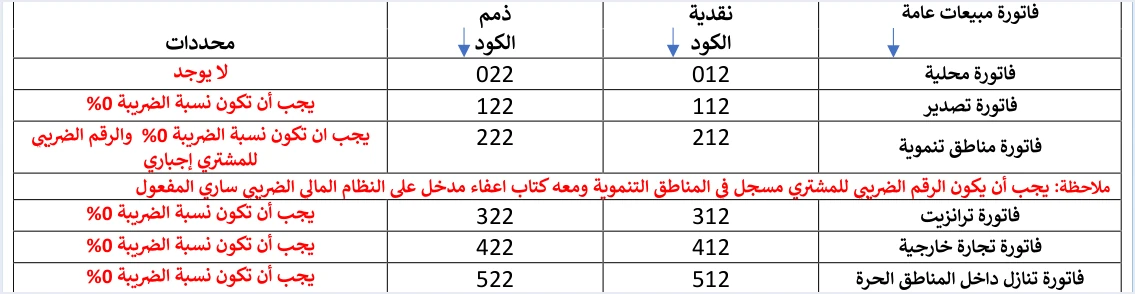
So a local cash invoice under General Sales Tax has the code 012, and a local receivable invoice under General Sales Tax has the code 022. The only difference is the middle digit. This code is part of the invoice the system accepted, and it does not change after acceptance, because an invoice is not edited once it is issued. For the full matrix across all six trade types, see our article Invoice Types in the National Invoicing System.
Why is nothing sent to the system on payment?
The answer comes from three places in the technical guide, and each one supports the others.
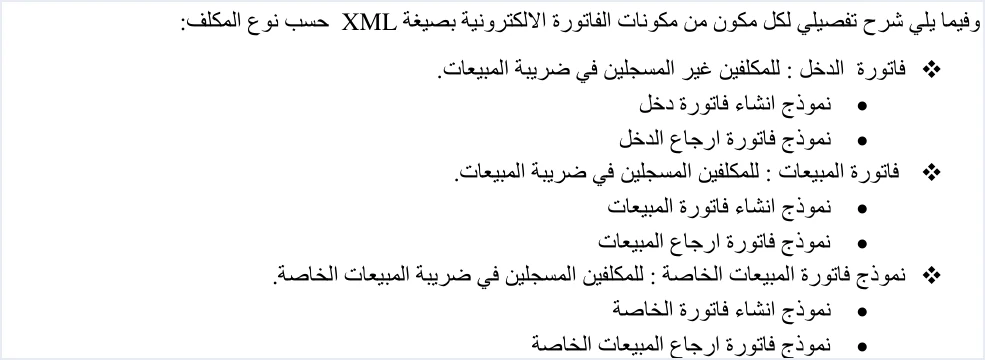
The first is the list of models. The guide lists the XML invoice models by type of taxpayer, and each type has only two, create an invoice and return an invoice. There is no model for a payment or collection notice.
The second is the value of the document type. The value of the cbc:InvoiceTypeCode element is either 388 for a new invoice or 381 for a return invoice, which in legal terms is a credit note. Version 1.5 defines no third value.
The third is the payment means element. A developer might expect the cac:PaymentMeans element to carry the payment method or notice of a payment. The guide places it on the return invoice only, with the code 10 and the return reason in cbc:InstructionNote.
This fits the way the system itself works. The invoice is sent to JoFotara, ISTD returns a response, and a QR code comes back once the invoice is accepted. The invoice was accepted on the day of the sale, well before the customer pays, and the guide does not ask you to send it again or to send anything with it.
Where is the collection of a receivable invoice recorded?
The value of a receivable invoice is booked to the customer’s account in accounts receivable, and it stays open until the money is received. On collection, the seller closes the customer’s balance in the books by the amount received and documents the receipt with a receipt voucher. A receipt voucher is an accounting document between the seller and the customer. It is not one of the two document types the technical guide defines.
The texts also contain a detail that keeps two kinds of proof apart. Article 5(c)(2) of Regulation No. 34 of 2019 on Organizing and Controlling Invoicing Affairs reads as follows.
«إذا زادت قيمة الفاتورة على (10000) دينار يثبت البائع استلامها من قبل المشتري»
In English, Article 5(c)(2) of Regulation No. 34 of 2019 provides that if the value of the invoice exceeds 10,000 dinars, the seller proves that the buyer received it. No official English translation of this regulation was found; the English here is our rendering, and the Arabic text is the authority.
What must be proved is that the buyer received the invoice, not that the seller received the price. Recording the collection in the books therefore does not replace proof that a large invoice was delivered.
Article 5(d) of Regulation No. 34 of 2019 ties issuing the invoice to the sale taking place. The invoice follows the sale, and the collection follows whatever payment terms the seller and the customer agreed. The timing of issue at the moment of sale is also covered in our article Quotation vs Invoice in JoFotara.
The receivable invoice from sale to payment
The table below sets out the stages of a receivable invoice, and what happens at each stage in JoFotara and in the business’s books.
Scroll the table sideways to see the remaining columns
Practical cases after payment
The cases below apply the rules above to situations a seller meets. The figures are for illustration.
Case 1: the customer pays the full amount a month later
A trader registered for General Sales Tax sells goods to a local customer for JOD 1,000 before tax, payable in a month. The trader issues a new invoice with the code 022 and the buyer’s name on it, the system accepts it, and a QR code comes back. A month later the customer pays JOD 1,160. In this case the trader sends nothing to the system, and the invoice stays as it was accepted, with its code 022. The trader records the receipt in the books and closes the customer’s balance.
Case 2: the customer pays in two payments
The customer pays half on delivery and half two months later. The technical guide does not say whether this invoice should be classed as cash or receivable when it is issued. Article 5(b) of Regulation No. 34 of 2019 mentions a sale paid in several payments, but only to require the buyer’s name, and it does not deal with the invoice type code. So we give no answer here on the code, and ISTD is the authority on it.
Case 3: the customer pays, then returns part of the goods
After paying, the customer returns two units out of ten. The return invoice (381) carries the same code as the original invoice, 022 in our example. The guide states that a return invoice takes the original invoice’s code and currency, and that only the value of the cbc:InvoiceTypeCode element changes. The return invoice refers to the original invoice by its number, its unique identifier and its total, and it carries the same buyer details and the reason for the return. The return is on quantities only, and it cannot exceed the quantity sold.
Case 4: the customer paid at the time of sale, but the invoice was issued as receivable
The accountant finds that the customer paid cash on the day of the sale, but the invoice was issued with a receivable code. The invoice cannot be edited after it is issued, and the documented correction through a return invoice works on quantities. Correcting the payment method alone, while the quantities stay correct, is not covered by the guide. We describe no route for it here, and ISTD is the authority on it.
Case 5: a discount granted on payment
The customer asks for a discount for paying early, without returning any goods. The guide documents a discount in the invoice lines at the time of issue, and it documents the discount on a partial return according to the quantity returned. It does not deal with a discount agreed after issue without any quantity being returned. This case is not documented in the guide, and it would not be accurate to describe a route for it in the system.
What the guides do not document about collecting a receivable invoice
The official guides leave some practical questions without a clear answer. We list them as they stand, without filling the gaps with a conclusion of our own.
- A partly paid invoice. Neither the technical guide nor Regulation No. 34 of 2019 says whether it should be classed as cash or receivable.
- The payment means element on a new invoice. The guide documents it on the return invoice only, and does not deal with it on an invoice with the value
388. - Converting a receivable invoice to cash after payment. No guide mentions a step for this, and none deals with correcting the payment method alone.
- Payment by card or bank transfer. The procedures guide for issuing an invoice describes cash (نقدي) as being for invoices paid in cash, and it does not mention other payment methods at that point.
- Payment status on the portal. The procedures guide for issuing an invoice describes no field or indicator that shows whether a receivable invoice has been paid.
For questions on any of these, the technical guide refers you to ISTD’s technical support committee for invoicing affairs through its website, istd.gov.jo.
Checklist when collecting a receivable invoice
This checklist is based on the official guides and on Regulation No. 34 of 2019, and it adds no obligation of its own.
- Confirm that the original invoice was accepted. The reference is the invoice status the system returns, and the QR code on the invoice.
- Do not look for a step to send the payment. The technical guide defines no document for collection, so no new document is created in the system at this stage.
- Record the receipt in the books. Link it to the original invoice number so that the right customer balance is closed.
- Keep the original invoice’s identifiers. Its number, its unique identifier and its line numbers are needed if the customer returns goods later.
- Keep returns and discounts apart. The documented return is on quantities, and a discount granted on payment without any return is not documented in the guide.
- Ask ISTD about the undocumented cases. The main ones are partial payment and correcting the payment method alone.
When the invoice is issued from accounting software linked to the system, issuing and booking happen in one place. Qoyod is integrated with the National Invoicing System (JoFotara). You issue your invoice in Jordanian dinars, and Qoyod sends it to the system without any manual intervention. Qoyod checks each invoice at field level as it is created, covering the tax number, the document type and payment method, the General Sales Tax rate and whether the lines are complete, and alerts you to any error before the invoice is sent, to reduce rejections. This matters for a receivable invoice in particular, because the invoice cannot be edited after it is sent, and the guide documents no route for correcting the payment method alone. The details of the integration are on our page Qoyod and the National Invoicing System. For a wider view of the system and how to connect your business to it, read our article Jordan’s National E-Invoicing System.
E-invoicing and full accounting in one system
Qoyod is integrated with the National Invoicing System (JoFotara). You issue your invoice in Jordanian dinars from Qoyod, it is booked to your ledgers automatically and sent to the system, and once it is accepted it comes back with a QR code from the Income and Sales Tax Department.
Frequently asked questions
Do I send anything to JoFotara when I collect a receivable invoice?
Version 1.5 of the technical guide defines no document or message for payment. Its two document types are the new invoice (388) and the return invoice (381), and each type of taxpayer has only two models, create an invoice and return an invoice.
Does a receivable invoice become a cash invoice after payment?
No official guide mentions a step for this conversion. The payment method is chosen when the invoice is issued and is carried in the second digit of its type code, and an invoice is not edited after it is issued.
Does JoFotara issue a receipt voucher on payment?
The technical guide covers only the new invoice and the return invoice, and it includes no document called a receipt voucher. The seller documents the receipt in the books with a receipt voucher, which is an accounting document and does not replace the invoice.
How do I handle a receivable invoice that has been only partly paid?
The customer’s balance in the books is reduced by the amount received. Whether a partly paid invoice is classed as cash or receivable is not settled by the technical guide, and Article 5(b) of Regulation No. 34 of 2019 mentions a sale paid in several payments only to require the buyer’s name.
What code does a return invoice carry against a paid receivable invoice?
The return invoice carries the same three-digit code as the original invoice, including the receivable digit, and only the value of the cbc:InvoiceTypeCode element changes, to 381. The return is on quantities only and cannot exceed the quantity sold.
Is the buyer’s name required on a receivable invoice?
The procedures guide for issuing an invoice always requires the buyer’s name on a receivable invoice. Article 5(b) of Regulation No. 34 of 2019 also requires the buyer’s name to be stated clearly in a credit sale, an installment sale or a sale paid in several payments.
References
- Income and Sales Tax Department (ISTD), technical guide for integrating with the National Invoicing System through the API, version 1.5 (in Arabic), pp. 10 and 33.
- Income and Sales Tax Department (ISTD), procedures guide for issuing an invoice in the Jordanian National Electronic Invoicing System, 2026 edition (in Arabic), p. 5.
- Regulation No. 34 of 2019 on Organizing and Controlling Invoicing Affairs, as amended, consolidated text (in Arabic), Articles 5(b), 5(c)(2) and 5(d).