




Fixed Asset Register Report is a comprehensive tool that enables you to track all your organization’s assets and analyze their financial performance across specific time periods. This report provides a detailed view covering asset cost, depreciation, additions, disposals, and book value, helping you make informed financial decisions and strengthening your audit readiness.
Report Highlights:
-
Detailed Asset Display: Includes all fixed assets registered in the system.
-
Flexible Time Analysis: Choose the time period you want to analyze assets during (from – to).
-
Automatic Book Value Calculation: Displays the opening and closing balance for each asset according to the specified period.
-
Precise Depreciation Tracking: Allows you to monitor depreciation expenses and their accumulation clearly.
-
Organized Structure: Assets classified by type and lifecycle, with subtotals and totals for each classification by productive life.
-
Bilingual Interface: Supports Arabic and English.
Who Can Use the Report?
-
Available only to Advanced Plan subscribers
-
Can be accessed by the Super Admin user, or any other user granted permission through permissions settings
Important Notes:
The report cannot currently be exported to PDF or Excel.
How to Access the Report:
Reports > Fixed Assets > Fixed Asset Register Report
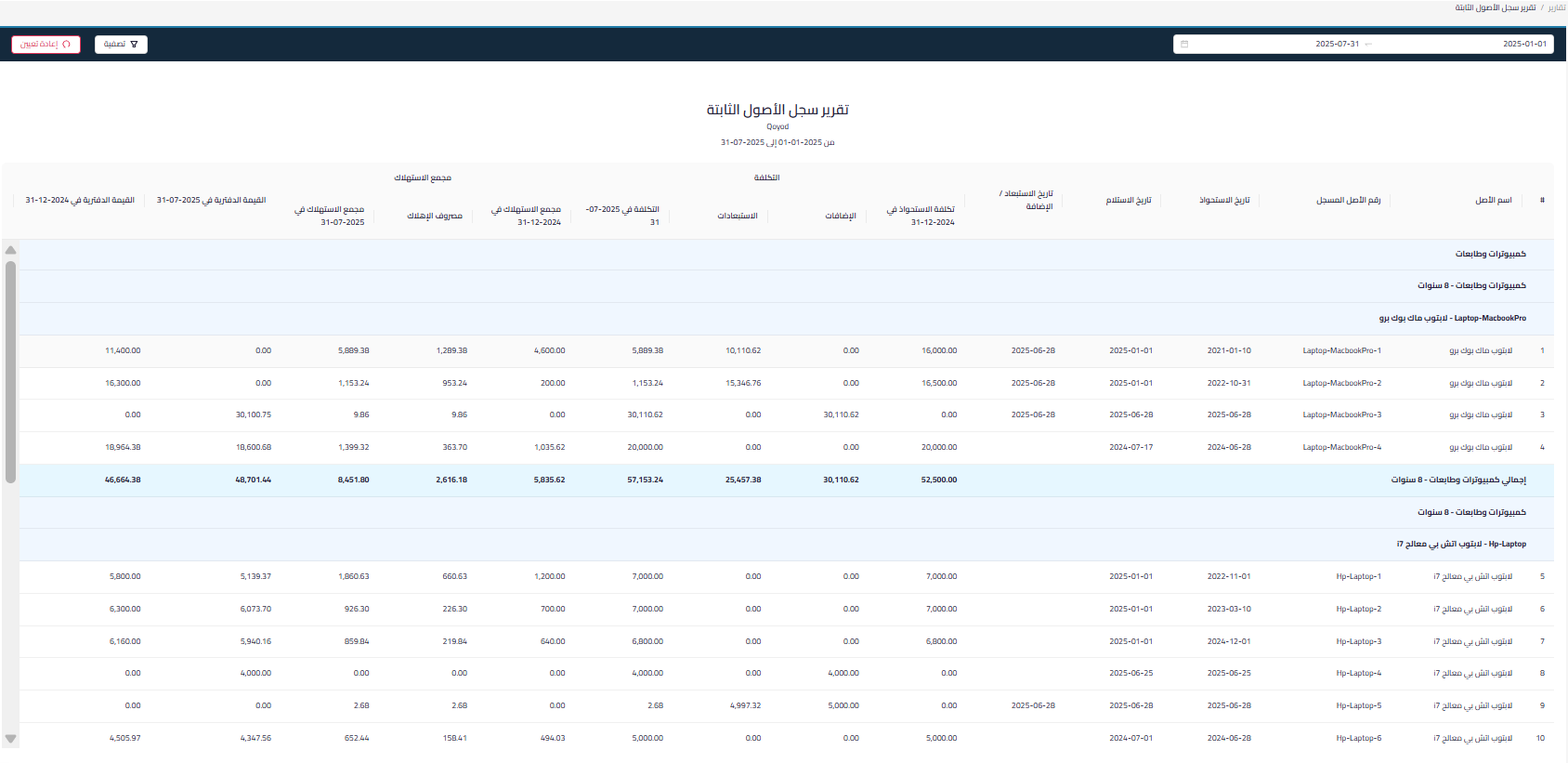
Fixed Asset Register Report, and its function is to show users a complete picture of each fixed asset within the organization: when it was recorded, what its cost was, whether anything was added to it, whether it was disposed of, how much depreciation it has accumulated, and what its current book value is and in different comparison periods.
In simpler terms:
It is a report that helps you understand an asset’s journey from the day it enters the system to today.
What Does the Report Explain in General?
The report brings together data for each fixed asset in one place, such as:
- Asset identification data
- Purchase or acquisition date
- Date of use commencement
- Disposal or addition date if any
- Asset cost
- Any increases to it
- Any portion disposed of
- Depreciation calculated on it
- Accumulated depreciation
- Depreciation expense
- Current and previous book values
What is Meant by Fixed Asset Here?
A fixed asset is anything your organization owns and uses in its operations for a long time, such as:
- Equipment
- Furniture
- Vehicles
- Machinery
- Buildings
- Any asset not for direct sale but for use within the business activity
How Do We Read the Report?
The report is typically read from 4 main perspectives:
1) Asset Data Itself
At the beginning of each row appears the asset identification, such as the asset name and its registered number.
This data is only meant to distinguish each asset from others, especially if you have more than one asset of the same type.
2) Important Dates
The report displays multiple dates, and each has a different meaning:
- Acquisition Date: When the asset was purchased or acquired
- Receipt Date: When the asset was actually received or became ready
- Addition / Disposal Date: If the asset received an increase or was partially or fully disposed of
Having these dates is important because it determines:
- When depreciation calculation begins
- Whether the asset still exists
- Whether the asset underwent any changes during the period
3) Asset Cost and Movement
This section clarifies financial movement on the asset and includes:
- Original Cost: The asset’s value when first registered
- Additions: Any amounts added later to the asset, such as improvements or upgrades
- Disposals: If the asset was sold, partially or fully disposed of, or written off
This helps the user know:
- Did the asset remain the same since registration?
- Was it upgraded?
- Was it taken out of service or disposed of?
4) Depreciation and Book Value
This is the most important accounting part of the report.
What is Depreciation?
Depreciation means spreading the asset’s cost over its years of use, because the asset is not considered a complete expense from day one; rather, a portion of its value is charged to each accounting period.
The Report Clarifies Several Matters Here:
- Period Depreciation: The portion charged as an expense during the specified period
- Accumulated Depreciation: The sum of all depreciation accumulated on the asset since its initial use
- Depreciation Expense: What was recorded as an expense on the asset
- Book Value: The remaining value of the asset after subtracting depreciation from it
What is the Difference Between Cost and Book Value?
- Cost: The asset’s value at the time of purchase or registration
- Book Value: Its current value in the records after calculating depreciation
Simply put:
An asset may have been purchased for a certain amount, but over time and use its accounting value decreases, and this is where the book value appears.
Why Does the Report Show More Than One Book Value?
It is clear from the image that the report does not settle for just the current value; instead, it compares different periods, such as:
- Book value at the end of a previous period
- Book value at the end of the current period
This is useful in knowing:
- How the asset’s value changed over time
- Whether it underwent depreciation during the period
- Whether something was added or disposed of that affected its value
What is the Benefit of “Accumulated Depreciation”?
Accumulated depreciation is the total amount depreciated from the asset since its initial use until the report date.
Its benefit is that it clarifies:
- How much was previously charged to expenses
- How much of the asset’s value remains
- Whether the asset is nearing the end of its accounting life or not
What Does Having Groupings Within the Report Mean?
The report in the image is organized in groups, which means it does not display assets randomly; rather, it groups them under similar classifications.
The purpose of this is:
- Facilitate asset review by type
- Know the total of each group
- Understand asset distribution within the business more clearly
When is This Report Important?
This report is very important in the following cases:
- When reviewing the organization’s existing assets
- When preparing financial statements
- When verifying calculated depreciation
- When identifying assets that have been disposed of
- When reconciling accounting records with reality
- During internal or external audit
- When deciding to purchase or replace an asset
What Does the Simple User Benefit From This Report?
The simple user doesn’t need to understand every accounting term in depth; it’s enough to know that the report answers clear questions such as:
- What are my registered assets?
- When did each asset enter the system?
- Does the asset still exist or has it been disposed of?
- Has depreciation been charged to it?
- How much accounting value is left?
- Were any additions or modifications made to it?
How Can You Explain the Report to the Client in a Very Simple Way?
You can describe it to them this way:
This report displays a record of each fixed asset in your organization from the time it was registered until the report date, showing its cost, any additions or disposals made to it, the depreciation calculated on it, and its remaining value in the records.
Important Notes When Understanding the Report
- The report is accounting-based and not a market valuation of the asset
This means it does not show how much the asset can be sold for in the market now, but rather how much it is worth in the accounting records. - A decrease in value on the report is usually due to depreciation and not necessarily because the asset is damaged.
- A disposal does not always mean a loss; it could mean a sale, write-off, or removal of the asset from use.
- Additions mean the asset was upgraded or its cost increased after its initial registration.