We are pleased to announce product management inside Qoyod POS, on both the Web POS and the Android app. You can now create, edit and archive your products, and manage categories and units of measure, directly from the POS without opening Qoyod accounting.
Before this release, adding a new product or changing a price meant going back to the accounting system, an extra step for store owners, branch managers and merchants who run their business from the POS alone. This release moves catalog management to the POS itself, and every product you create there is a complete Qoyod product, with the right accounts and the ZATCA tax reason where one is needed, so your accountant has nothing to fix later.
Where to find it
- Web POS: Products in the side menu, with three tabs: Products, Categories and Units of Measure. Product settings sit under Settings, in Product Settings.
- Android app: Products in the side menu. Product settings, categories and units of measure are under Settings.
How it works
- Open Products and tap Add Product.
- Choose the type: Product, Service or Recipe.
- Fill in the name, category, unit, selling price and tax, plus the tax reason when it is asked for.
- Generate or type the SKU and barcode.
- Optionally, for the Product type, mark it purchasable and enter the buying price.
- For a Recipe, add the ingredients.
- Save. The product is available for sale on the POS right away.
Products list
- Search by name or SKU on both platforms; the Web also searches by barcode.
- Filter by type, category and status (active or archived). On the Web you can also sort by newest or by name.
- Tap any product to see its details.
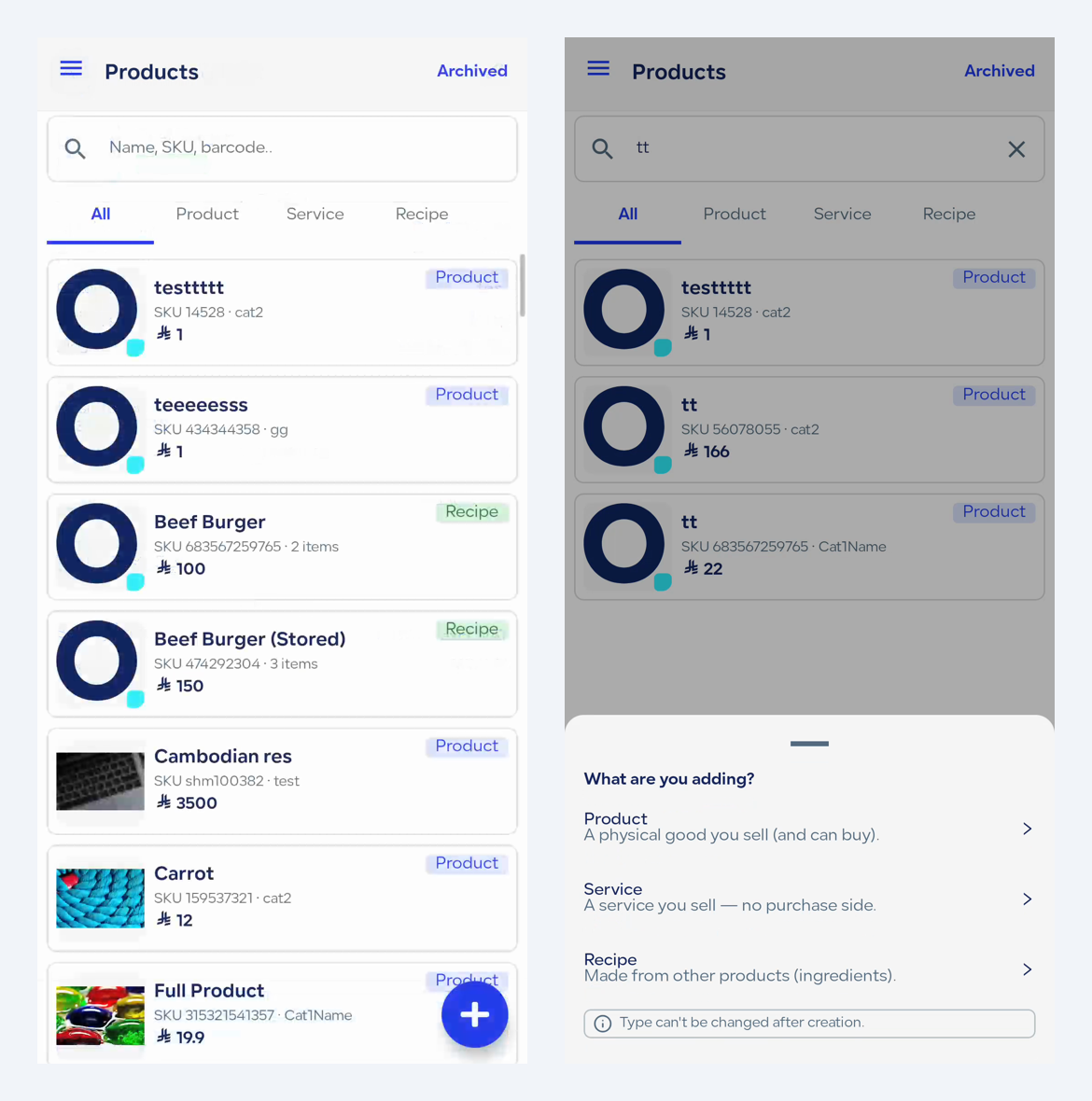
Three item types
You pick the type first, and it cannot be changed after creation: Product, Service, or Recipe, a product made of other products.
 View full size
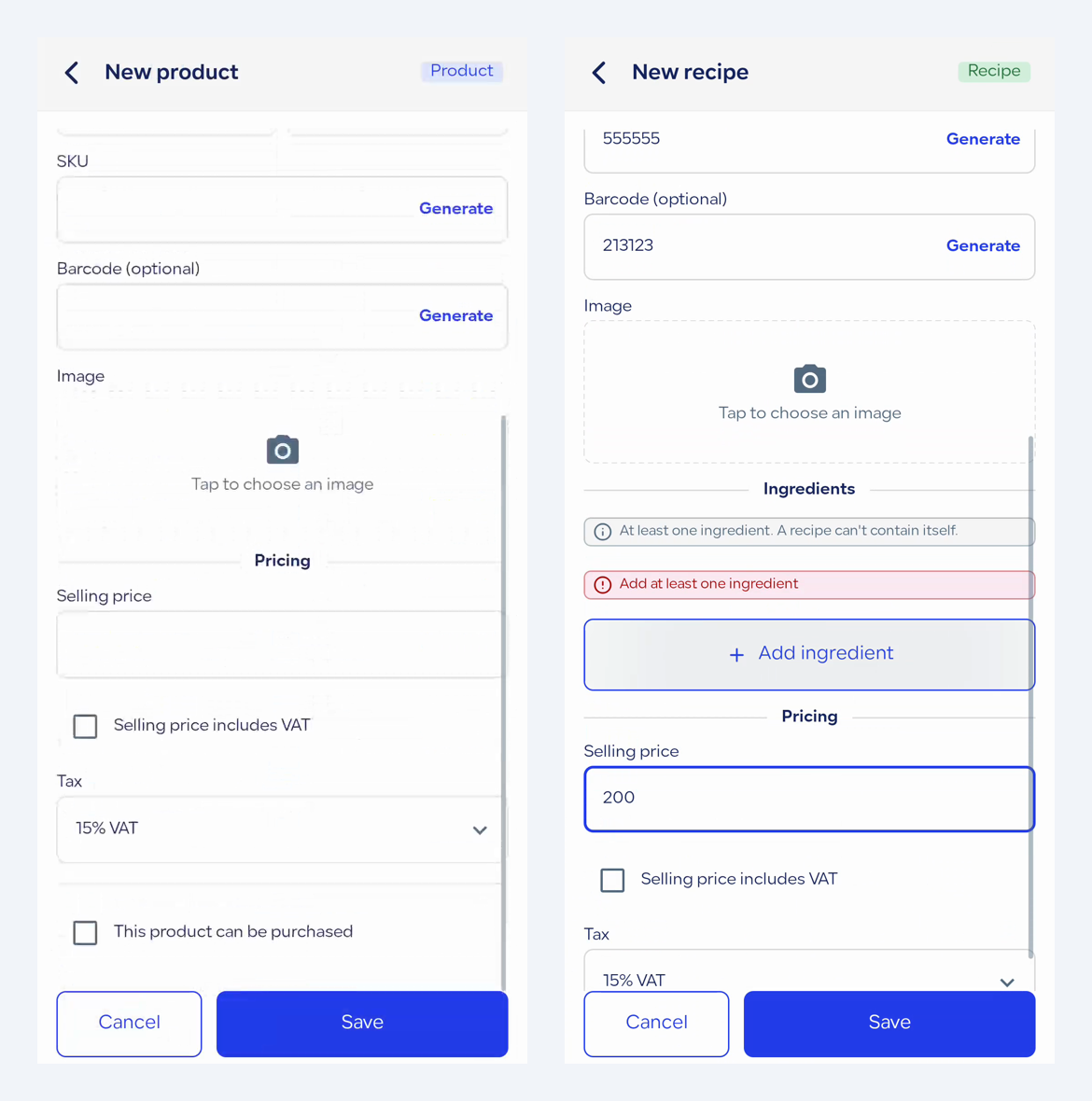
The product form
- Arabic and English names; entering one is enough.
- Description, image, category and unit of measure.
- Selling price, with a switch for whether it includes VAT, and the tax.
- SKU and barcode, with a Generate button that creates unique values. You can still type them by hand, and duplicates are checked against your product settings.
- For the Product type: a “This product can be purchased” option that adds a buying price, with its own VAT-inclusive switch.
- Add a new category or unit of measure from inside the product form.
ZATCA tax reason
When the tax is zero-rated, exempt or not subject, the form asks for the reason, and only the reasons that match the selected tax are offered. The product’s tax data is complete from day one, which helps you avoid the VAT exemption reason code alert and the zero-rate tax reason code alert on invoices.
Recipes
Add the ingredients, each with a product, a quantity above zero and a unit. At least one ingredient is required, and a recipe cannot contain itself. Recipes require the advanced products feature on your plan.
 View full size
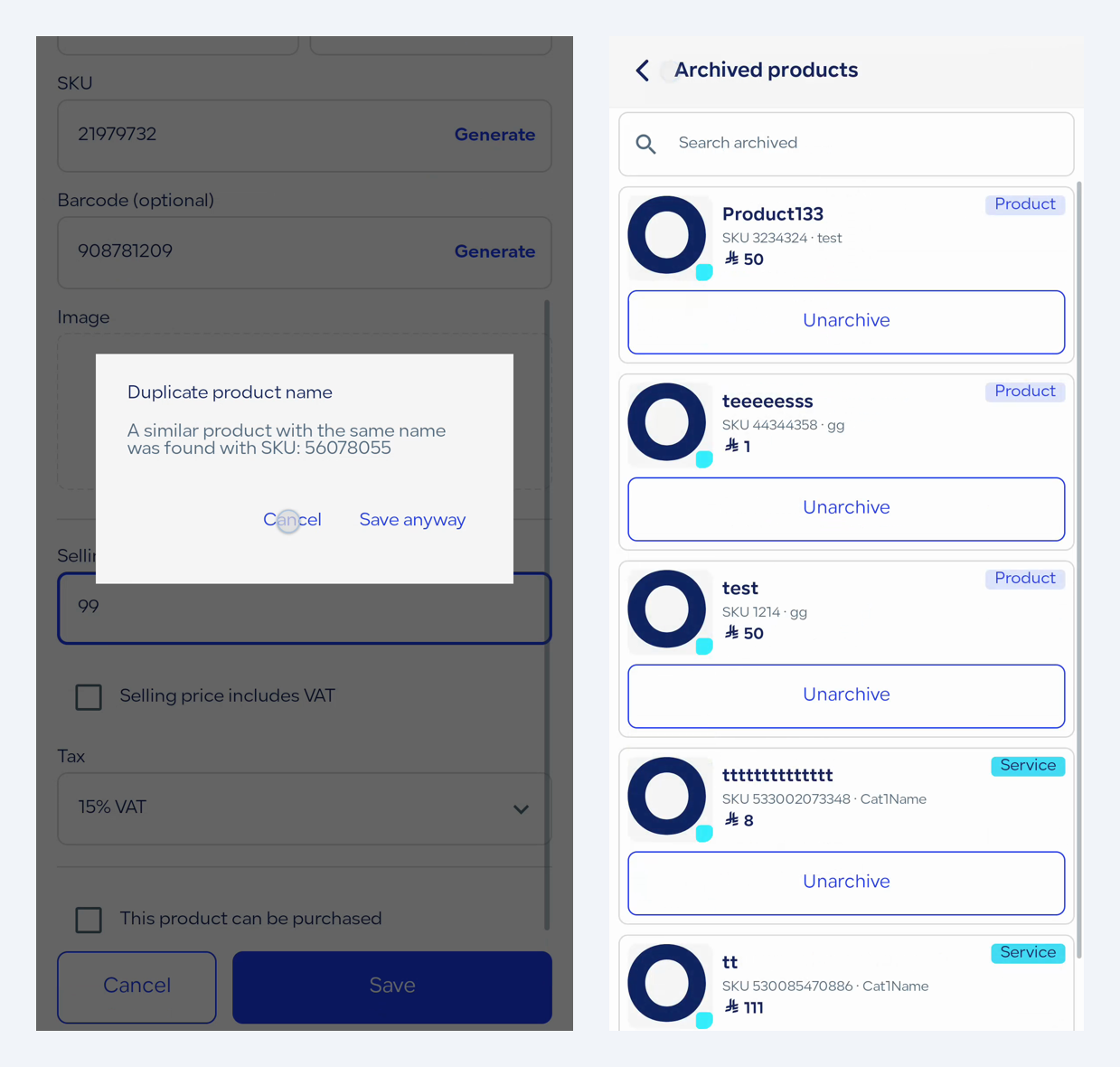
A warning on a duplicate name
If a name is already used by another product, a warning shows the existing product’s SKU, and you can choose Save anyway to continue.
Archive and delete
- Archived items leave the sales screen and the active list, and past invoices are kept. You can unarchive them later, and the app has a dedicated Archived products screen.
- Delete is available only for products never used in sales, purchases, stock movements or recipes. Otherwise, archive the product instead.
 View full size
Categories and units of measure
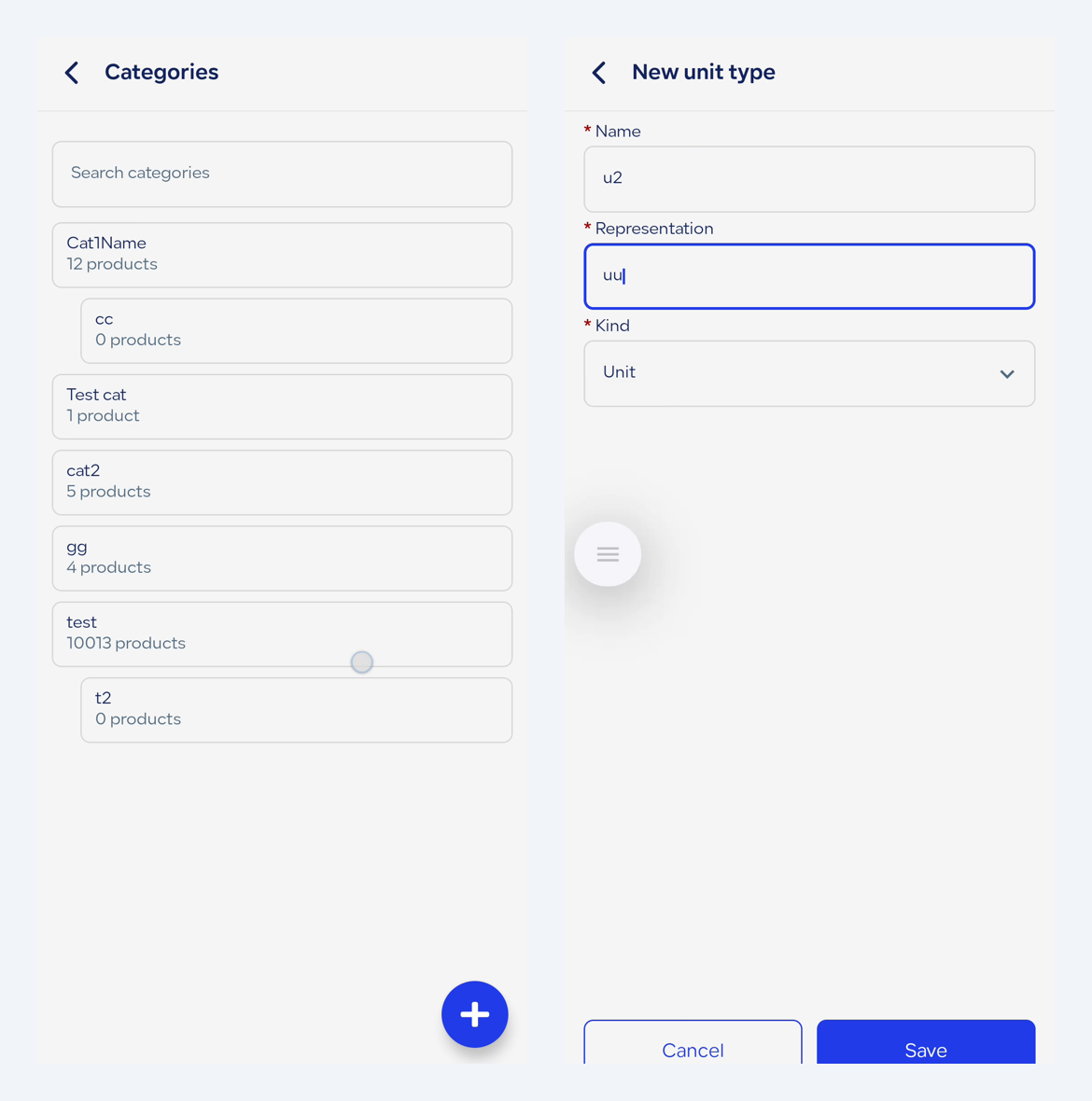
- Categories have two levels, using a parent category, and can be created, edited and deleted. A category cannot be deleted while it holds products or sub-categories.
- Units of measure have a name, a symbol and one of six kinds: Unit, Weight, Working Time, Length or Distance, Area, Volume. A unit cannot be deleted while any product uses it.
 View full size
Product settings
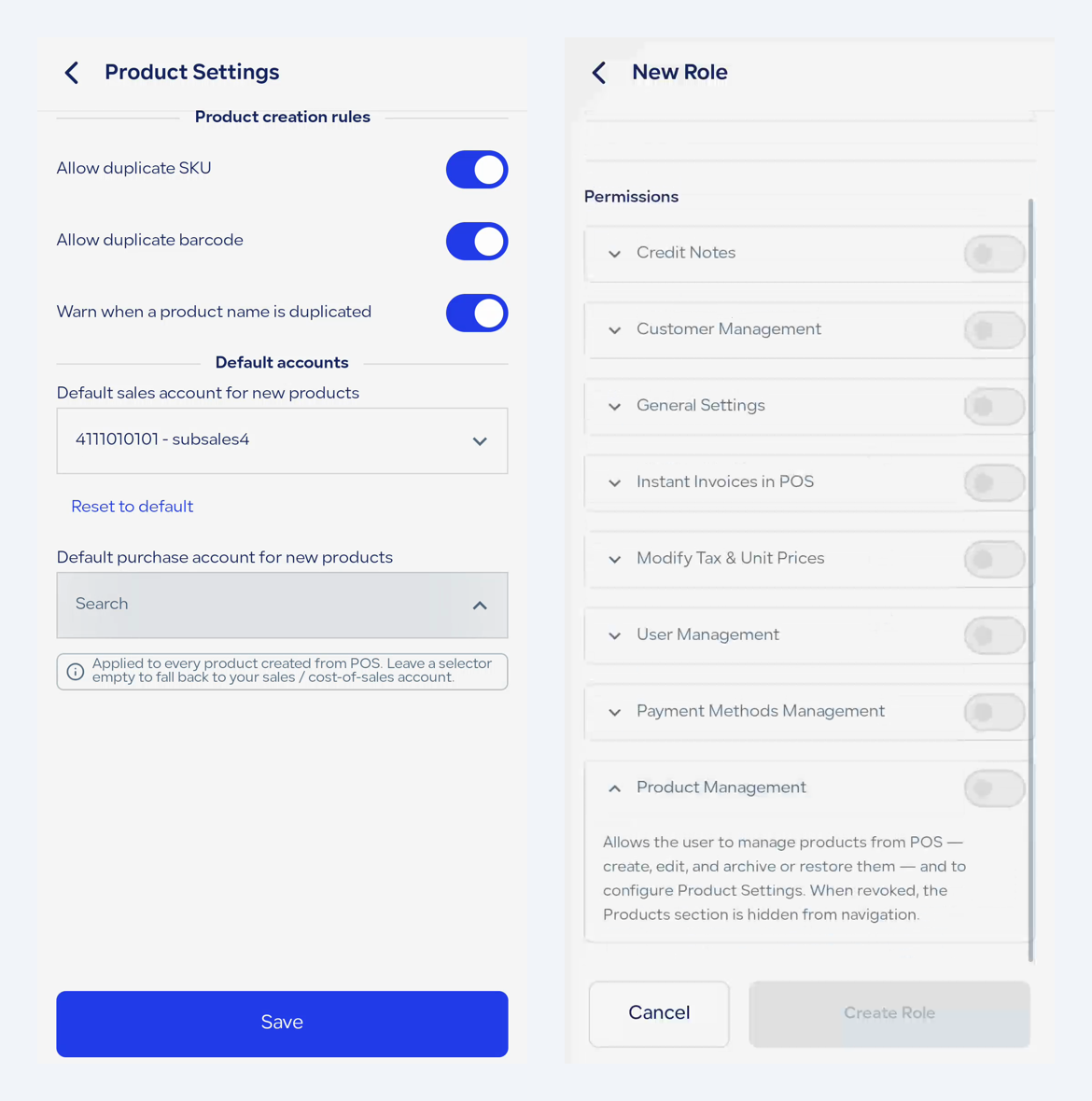
- Product creation rules: control duplicate SKUs, duplicate barcodes, and the warning when a product name is duplicated.
- Default accounts: the default sales account and default purchase account for new products.
On the Android app
On large tablets the list and the details sit side by side, and category chips on the sales screen show product counts. To install the app, see how to download the Qoyod POS app.
Limits in this phase
- Saving products needs an internet connection. When offline, a message explains this, and selling from saved products continues.
- The unit of measure is locked once the product has transactions.
- Selling a recipe does not deduct ingredient stock, and products created at the POS do not track quantity in this phase.
- If no default account is set and the standard accounts were changed in the chart of accounts, product creation is blocked with a message pointing the admin to product settings.
Permissions
The feature is controlled by the Product Management permission in roles, and product settings also require the Settings permission. Roles are set up through POS user management from inside settings.
 View full size
What makes it useful
- A full catalog managed from the POS, on the Web and the Android app.
- Three item types: Product, Service and Recipe.
- Automatic SKU and barcode generation, with duplicate checks.
- The tax reason is asked for only when needed, with matching options only.
- Two-level categories and six kinds of units of measure, addable from inside the product form.
- Archiving that keeps past invoices, and safe deletion for unused products.
- Default accounts that send every product to the right accounts.
Who it is for
Store owners, branch managers and POS-only merchants: add an item or change a price without a trip to the back office, and keep a clean sales list without losing your history. And accountants who want products to arrive with correct accounting and tax data from the start.
The feature is available now in the Products section of the Web POS and the Android app.
For the full steps, see how to manage products from Qoyod POS.
Read next