Invoicing almost always starts in Excel. One file, a few columns, a formula that adds 15% VAT. For a year or two it does the job, and the whole team learns its quirks by heart.
Then one thing changes. Monthly invoice volume climbs, or a second person needs the same file, or a notice arrives from the Zakat, Tax and Customs Authority (ZATCA) with your integration date for the Fatoora platform. At that point the question stops being about comfort and becomes a question about capability.
This article is not a tutorial on building an invoice in a spreadsheet, and it is not a migration guide for moving off another accounting platform. It covers a single decision: invoice management in Excel, when it stops being good enough, and how to get out without missing a single invoice.
What Excel is genuinely good at
The honest starting point is what spreadsheets do well. Arguments that open with “spreadsheets are always wrong” lose credibility fast with an owner who knows his file inside out, and who knows that file is part of how the business got here.
A spreadsheet is a general-purpose calculator, and that is the source of both its strength and its limits. It imposes no structure on you. It never asks which account a figure belongs to, and it never stops you typing any value into any cell.
That freedom is ideal while the question is only arithmetic. It turns into a liability the moment a number becomes a document with consequences outside the file.
So the useful question is not whether Excel is good or bad. It is what job you are asking it to do, and whether that job ends inside the sheet or creates an obligation beyond it.
Excel is excellent in three specific situations:
- Free-form calculation. Pricing models, supplier quote comparisons, what-if scenarios on gross margin. No accounting system matches a blank sheet for flexibility.
- Very low volume. A business issuing ten invoices a month to one or two customers, no inventory, no team. A full system here solves a problem that does not exist yet.
- Analysis after the fact. Exporting finished figures from a system into a sheet to build a board pack or a custom view. That is the original job of a spreadsheet, and it stays useful after any migration.
The problem is not the tool. The problem is that an invoice is not only a calculation. It is a source document that carries a tax obligation, an accounting entry, and a claim on a customer. A file does not manage those three, however tidy it looks.
That distinction is why accounting books exist as a separate concept from a worksheet.
Five signals Excel has stopped being enough
The switch rarely happens on a single trigger. It happens when two or three of the following land in the same month.
1. Your Fatoora integration date has arrived
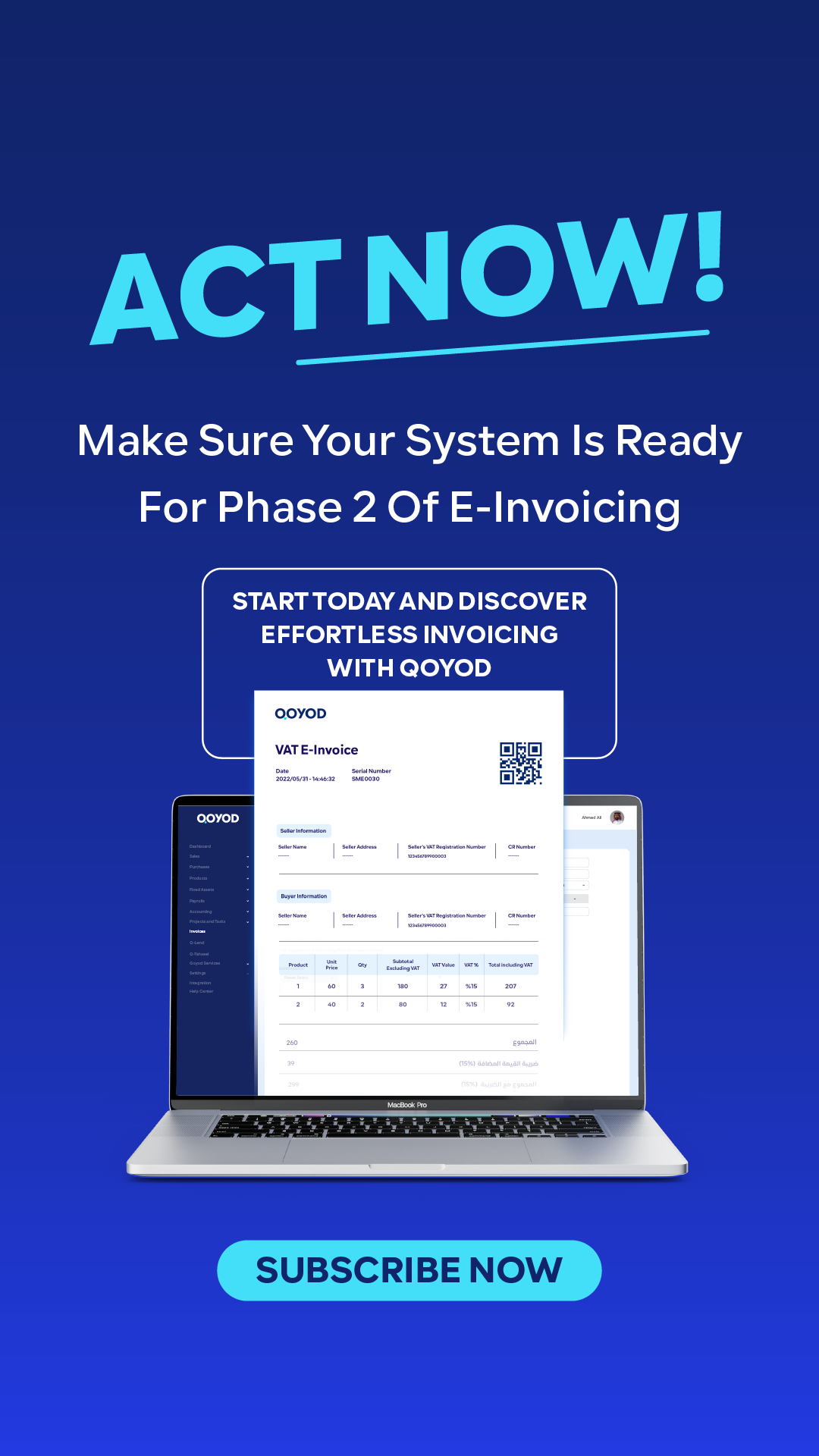
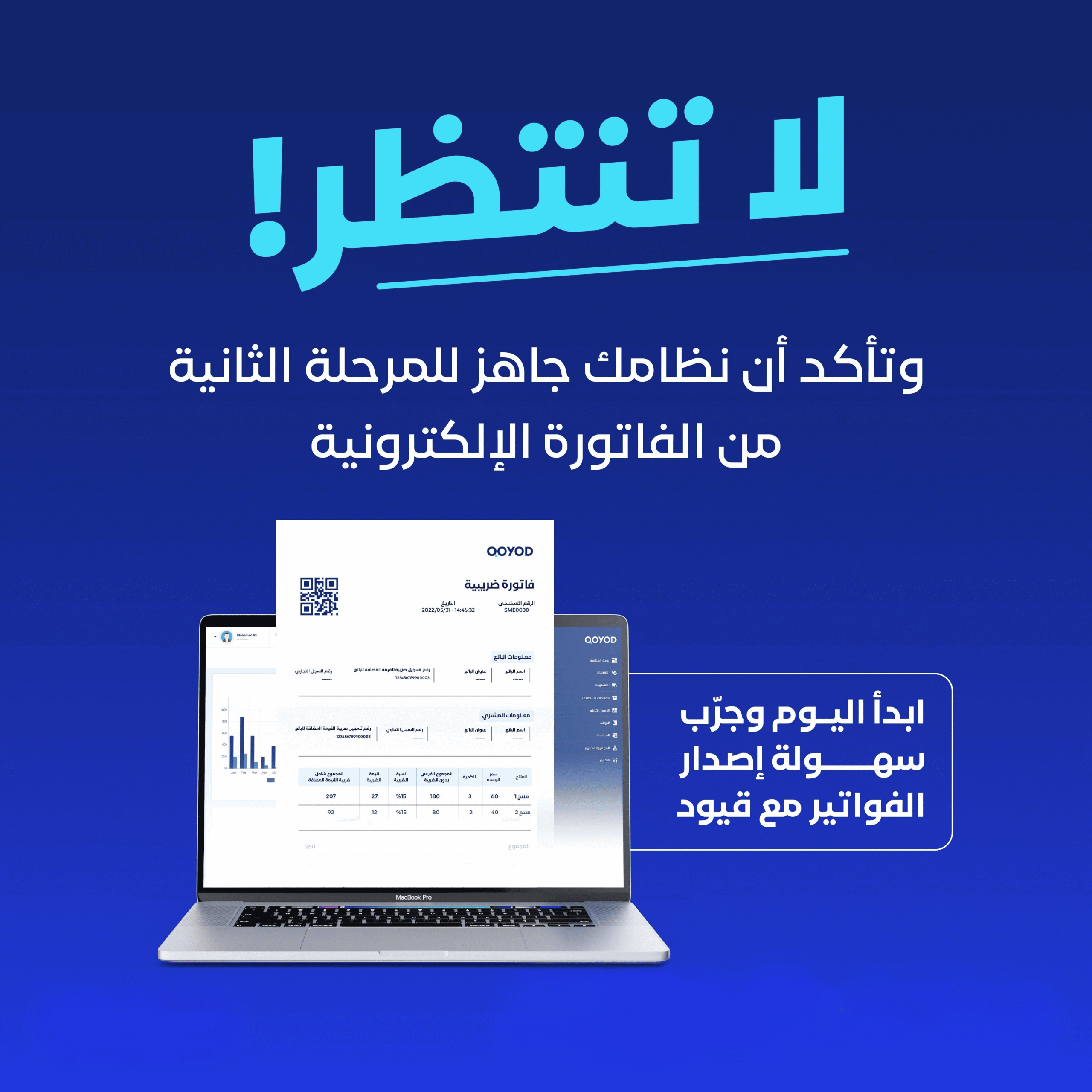
This is the clearest signal and the hardest to postpone, though Phase 1 already precedes it for any VAT-registered business. Phase 2 of Saudi e-invoicing (integration) does not ask for a good-looking invoice. It asks for an invoice in a specific format, transmitted electronically to the Fatoora platform, carrying a cryptographic stamp, a signature, and a valid QR code.
ZATCA notifies every targeted business at least six months before its integration date. Once that notice arrives, a spreadsheet is not merely inconvenient, it is structurally unable to comply. It prints a picture of an invoice. It cannot generate the compliant invoice file, cannot transmit it, and cannot receive the authority’s response.
The usual workaround is buying a middleware tool that converts spreadsheet output into a compliant invoice. The result is two systems instead of one, and two running costs. What Phase 2 actually requires is laid out on the e-invoicing page, and the terminology is defined under ZATCA e-invoicing.
2. Data entry has become the job
Measure it once, honestly. How many minutes does one invoice take from opening the file to sending it? Multiply by monthly volume.
At 20 invoices a month the number stays tolerable. At 150 it eats a meaningful share of someone’s week, and every extra sale adds entry hours rather than profit. That is the first point where growth stops being purely good news.
3. More than one person needs the same file
A spreadsheet is built for one editor at a time. Once a salesperson, an accountant, and a branch manager all need it, copies multiply: one on the desktop, one in an email thread, one called “final v3”.
The damage does not show immediately. It shows at quarter end, when nobody knows which copy is authoritative, or when two invoices carry the same reference number from two different files. Duplicate numbering is a systems problem, not a discipline problem.
4. Issuing an invoice moves nothing behind it
In an accounting system, issuing an invoice moves several things at once: the accounting entry, the customer balance, the stock balance if the line is a product, and the VAT return at period end.
In Excel, issuing an invoice moves nothing. You move all of it later, by hand, from memory or from a second file. Every extra manual step is a new chance to be wrong, and eventually a gap between book stock and physical stock.
5. You cannot see who owes you without recalculating
The practical test: how much do your customers owe you right now, and since when? If answering means opening a file, sorting columns, and computing date differences, you are not managing collections. You are rebuilding the picture from scratch every time.
This shows up in cash before it shows up in the books. A business that cannot see its receivables clearly chases them late, and chasing late costs cash, not just time.
A short checklist before you decide to switch
You do not need every item. Two or three of these landing in the same month is enough to start looking for a replacement.
- Your Fatoora integration date has been notified
- Invoice entry consumes whole working days
- Several people work on different copies
- A duplicate or missing invoice number appeared
- Journal entries are posted manually per invoice
- Customer balances need a manual calculation
Spreadsheet versus accounting system, in practice
The useful comparison is not a feature count. It is what happens when something goes wrong. A spreadsheet allows the mistake and then stays silent. A system either prevents it or flags it before month end turns it into a problem.
So the table below does not rank the two tools on what they can do. It compares them on five points where the difference shows up in daily work: Fatoora integration, invoice numbering, the accounting effect an invoice carries, several people working on the same data, and building reports. Those are the points owners actually complain about.
The five are not equally costly to get wrong. A bad report can be rebuilt in an hour. An invoice that already reached a customer or the authority is corrected through another document and another cycle of work. So read each row with one question in mind: what does a mistake here cost me?
Invoice management: spreadsheet versus accounting system
| Dimension | Spreadsheet | Accounting system |
|---|---|---|
| Fatoora integration | Not available Prints an image of an invoice. It cannot generate or transmit the compliant file. |
Built in Issue, transmit, and track invoice status from the same screen. |
| Invoice numbering | Manual Duplicates and gaps are possible, especially across copies. |
Auto-numbered An automatic sequence per document type, with no competing copies claiming the same number. |
| Accounting impact | Disconnected Entry, customer balance, and stock are updated in a later manual step. |
Linked Entry, customer balance, and stock move when the invoice is approved. |
| Working as a team | Many copies No permissions and no record of who changed what, or when. |
One copy Per-user permissions plus an activity log covering every action. |
| Reporting | Rebuilt each time Every report needs columns sorted and formulas rewritten. |
Ready A library of preset reports with filters and period comparison. |
The real difference sits in the last line of every row. A spreadsheet depends on a person paying attention. A system depends on a written rule. Attention gets tired at month end. Rules do not.
Two cases that show the difference
Raw volume does not settle the decision on its own. The two cases below are built from patterns that recur across Saudi small and mid-sized businesses.
A services firm, 35 invoices a month, one user
A consultancy issues about 35 invoices a month to corporate clients, holds no inventory, and is run by the owner on a single file. Entry costs under three hours a month, there are no competing copies, and nobody argues about which number is correct.
This firm is not in operational trouble. Its only real pressure is regulatory: when does its Fatoora integration date land. The right move is to tidy the file now and switch a month or two before that date, rather than switching today under no particular pressure.
A retail store, 400 invoices a month, three users and inventory
A store issues roughly 400 invoices a month across counter sales and credit sales, three people work on it, and stock moves daily. Entry here is a standing daily job rather than an occasional task, book stock drifts from physical stock every month, and customer balances are recomputed for every collection call.
This store is already late, whatever its integration date. What it pays today is not software fees. It is entry hours, stocktake variances, and slow collections. Each month of delay also grows the volume of data that will eventually have to be moved.
If the underlying question is which system to choose, the comparison in best cloud accounting software for small businesses covers it, and the cost side is broken down in e-invoice pricing in Saudi Arabia.
What holds owners back
Most owners who already know Excel has run out of room still wait a year or more. The reasons repeat, and each deserves a straight answer.
“I will lose my invoice history”
This was a fair objection until recently. Sales invoices and purchase invoices can now be imported into Qoyod from a single Excel file, covered in detail in the next section. Re-typing a full year by hand is no longer the price of entry.
“My team will not learn a new system”
The team learned Excel, which is a harder tool than an invoice screen. The real resistance is not to learning. It is to losing control of a file one person knows perfectly. The fix is to have that same person issue invoices in the system alongside the file for two weeks, until the totals match.
“The cost is not justified”
Cost is only meaningful against something. Compare it with monthly entry hours, with the effect of a ZATCA-rejected invoice on a client relationship, and with the hours an external accountant spends cleaning spreadsheets before a filing. Note also that ZATCA and the Qawaem platform are separate obligations, as explained in Qawaem platform versus ZATCA.
“Now is not the right time”
This is the most dangerous objection because it always sounds reasonable. Practically, the right time is the start of a new tax period, when the prior period is closed and its balances are fixed. Postponing to mid-period doubles the work instead of reducing it.
How to leave Excel without missing an invoice
The common mistake is treating this as a one-day switch. A business picks a month end, moves everything across in one evening, and discovers the next morning that a customer record is missing and an urgent invoice cannot be issued from anywhere.
What works better is opening the system and closing the file gradually, so that at every moment one place is capable of issuing a correct invoice. That imposes an order: the data an invoice depends on first, then the invoices themselves, then the decision to retire the file. Any other order means entering some data twice.
The four steps below follow that order rather than easiest-first. Each one clears a precondition for the next. Cleaning the file spares you carrying duplicates across. Loading the master records is what makes the invoice import possible at all. Importing in batches exposes a mistake while it is still small. A retirement date stops the file coming back.
Four steps to switch without downtime
Step three used to be the hard one, which is why it gets its own section below.
The invoices themselves now move in one file
Customers, suppliers, products, and opening balances could always be imported into Qoyod from Excel. Invoices could not, until the sales and purchase invoice import release.
Three steps: download the template from the Import button on the invoices page, fill it in, upload it. It holds up to 5,000 rows, its headers are protected from edits, and its dropdowns carry the approved values from your account.
What matters most is the import report. Not every row succeeds first time, and it does not just say the upload failed: it lists each failed invoice with its row number and the reason, so you fix those rows and re-upload.
Field-by-field instructions are in the knowledge base: how to import sales invoices via Excel and how to import purchase invoices via Excel.
This is a manual import from a template you fill in, not an automatic connector. Anyone who would rather not do it can use the account-transfer service from Qoyod professional services.
How Qoyod helps with invoice management after Excel
Switching is not only learning a new screen for issuing an invoice. It means that what used to live across an invoice file, a customer file, a stock file, and a VAT calculator now lives in one place, and that every invoice you issue leaves its mark there without you carrying it from file to file.
The difference shows up in small details before it shows up in the reports. An upload passes an immediate validation before processing: an empty file is rejected with a clear message, and an old template carrying unapproved dropdown values is stopped with a request to download the current one.
Once processing starts you can move around the system freely, and the result report arrives by email in your own language.
What follows is not a general feature list. These are the points someone moving off a spreadsheet actually touches in the first month:
- Bulk invoice import. Sales and purchase invoices are created by uploading one Excel file of up to 5,000 rows, with a report showing why each individual row failed. Repeating the same reference number across several rows tells the system to treat them as line items on a single invoice.
- Phase 2 compliance inside the system. Qoyod is ZATCA certified and integrated with the Fatoora platform, so an invoice is issued, transmitted, and tracked from the same screen. Details sit on the ZATCA Phase 2 compliance page.
- Compliance alerts before submission. Ten smart compliance alerts review an invoice before it reaches the authority and flag the common format, date, and identifier errors. They reduce the risk of rejection rather than removing it, and the ten errors are broken down in e-invoice rejection in ZATCA Phase 2.
- Approvals and permissions. An imported invoice follows the user’s own permission, exactly as a manually created one does. Users with approval permission get invoices created as approved with an immediate journal entry; users without it get invoices held as pending approval.
- An activity log for every import attempt. Each attempt is recorded under the Import transaction type with the user’s name and timestamp, and its detail view shows the file name plus the count of successful and failed invoices. That is an audit trail a spreadsheet never gave you.
- Sales and purchases in one place. An invoice connects to the customer, the product, stock, and the reports with no manual re-entry, as set out on the sales and purchase modules page.
Invoice import is available to all customers automatically, with no setup and no upgrade.
Mistakes that repeat in the first month
A switch succeeds or stalls in its first month. Four mistakes show up more than the rest.
Uploading invoices before master records. An invoice needs a customer and a product that already exist in the system. Uploading the invoice file first produces a long failure report whose only cause is missing master data.
Writing names instead of reference numbers. The customer or supplier reference number is matched against the reference-number field on the record, not against the name. A file written with names instead of reference numbers fails row after row, and breaks the largest number of rows for the smallest reason.
Applying a percentage discount and a value discount on the same line. The system does not accept both on one line item. Pick one before filling the template.
Leaving the file open for editing. Without a retirement date, at least one person keeps using it, and you end up with two versions of the truth. Fixing the date is half the battle.
What to do if you are still within Excel’s range
Not every reader is ready to switch today, and that is a legitimate position. But Excel’s range is narrower than it looks: it is the range of a business not registered for VAT. A registered business has been bound by Phase 1 of e-invoicing since 4 December 2021, whatever its integration date.
If you are genuinely inside that range, the practical move is not switching today. It is arranging your file so that switching later is cheap.
Three actions are enough: give every customer and supplier a stable reference number now, keep numbering sequential with no gaps, and hold one table rather than a folder of monthly files, which is the same discipline behind double-entry bookkeeping.
Two free tools help in the meantime. Gauge your setup with the ZATCA readiness check, remembering that your actual scope comes from your own ZATCA notification and not from a self-assessment. Validate the QR code on an invoice you receive with the e-invoice QR code reader.
Frequently asked questions
Is managing invoices in Excel against the rules in Saudi Arabia?
The file itself is not a violation if your business is not registered for VAT. If it is registered, Phase 1 of e-invoicing has applied since 4 December 2021: invoices must be issued through an electronic solution in a structured format, and handwritten, Word, or Excel output does not qualify. Phase 2 adds integration with the Fatoora platform once your own date arrives, so Excel invoicing is not a question that waits for an integration date. Either way, the business remains bound by tax invoice requirements for mandatory fields and VAT calculation.
How many invoices a month means it is time to leave Excel?
There is no single number, because volume is not the only variable. A business issuing 40 invoices a month with three users and inventory may need to switch sooner than one issuing 120 invoices to a single customer with no stock. Volume combined with user count and inventory is the real indicator.
Can prior-year invoices be moved across?
Sales and purchase invoices can be imported through an Excel template holding up to 5,000 rows per file, so earlier periods go across in batches. Check the two knowledge base articles linked above for the mandatory fields before filling the template.
What is the difference between importing and an automatic connection?
Importing means you fill an Excel template and upload it yourself, and the system processes it and returns a report. An automatic connection means two systems exchange data without your involvement. Invoice import in Qoyod is the first kind: a manual, file-based operation, not a live sync with another platform.
Do I need an accountant to make the switch?
Not necessarily, if your balances are simple and your books are tidy. But having someone review the opening balances and the chart of accounts before the first invoice avoids expensive corrections later. Understanding what an electronic invoice must contain is the minimum before you start.
What about credit notes and corrections?
A rejected e-invoice is not edited and re-sent. The correction path is a credit note plus a new corrected invoice, which a spreadsheet has no mechanism for at all. The distinction between the two note types is set out in credit note versus debit note, and the sales-side case in sales debit note.
Does switching mean abandoning Excel completely?
No. Spreadsheets remain an excellent analysis tool afterwards: export your reports from the system into Excel and build whatever view you want. What ends is using the sheet as the official record of your invoices, not using it as a calculator. The broader capability set sits under Qoyod accounting software.
The practical takeaway
Excel was not a mistake. It was the right stage for a certain size. That stage ends at one of three moments: your Fatoora integration date arrives, data entry becomes a standing daily job, or a second user starts working on the same data. And before any of them, being registered for VAT already makes electronic issuance mandatory.
If one of those moments has arrived, the old blocker is gone. Master records and balances move first, then the invoices themselves move in batches from a single Excel file, with a report telling you exactly what succeeded and what failed. After that you set a date on which the file stops accepting any new invoice.
What does not deserve postponing is the decision, not the execution. Work out which moment is closest, pick the start of a coming tax period as the switch date, and start giving every customer and supplier a stable reference number. Three hours of work today saves a week later.