A designer in Riyadh, a marketing consultant in Jeddah, a developer taking contract work from a Dammam agency. Three different people, one recurring worry: someone told them that the moment they picked up a freelance work document, the e-invoicing rules landed on them too.
They did not. In Saudi Arabia the e-invoicing obligation is triggered by one thing only: registration for value added tax. Not by holding a freelance work document, not by having a commercial register, not by the kind of clients you invoice or the size of the fees you charge. If you are not registered for VAT, you are not inside the e-invoicing regime at all.
That single distinction settles most of the confusion, and it is where this guide starts. From there we work through where a registered freelancer sits in the Phase 2 wave series, what the 1 February 2027 date genuinely is (it is not a deadline), what the practical minimum looks like when you invoice individuals rather than companies, and at what point a spreadsheet stops being enough.
Start here: are you registered for VAT?
Answer that one before anything else about invoices, QR codes or Fatoora.
If you are registered for VAT, you have been inside the e-invoicing regime since 4 December 2021. That is the start date for Phase 1 (Generation), which applies to every VAT-registered taxpayer in the Kingdom, non-residents excepted. There is no size carve-out and no profession carve-out: a one-person consultancy carries the same Phase 1 obligation as a company with two hundred staff.
If you are not registered for VAT, you are not obligated to issue electronic invoices under the regulation. You still invoice your clients, because they need a document for their own books, but what you issue is a regular commercial invoice, not a tax invoice. You do not charge VAT on it, you do not put a VAT number on it, and no QR requirement follows you.
The real question, then, is not “am I a freelancer” but “am I over the registration threshold”.
- Being registered for VAT, whether the registration was mandatory or voluntary
- Taxable turnover above SAR 375,000, which makes registration mandatory
- Choosing to register voluntarily once turnover passes SAR 187,500
- Holding a freelance work document on its own
- Holding a commercial register for a sole establishment
- Invoicing large corporate clients who ask for a tax invoice
The two thresholds that decide everything
The Zakat, Tax and Customs Authority (ZATCA) sets two figures, measured on taxable turnover over the last twelve months or the expected next twelve months.
Two details in that sentence do most of the work. The first is that the window is rolling, and forward-looking as well as backward-looking. It is not your calendar-year income, so one large retainer can carry you over a threshold months before the year ends.
The second is what taxable turnover actually means: your standard-rated and zero-rated supplies together. Exempt supplies do not count towards it. That matters here, because work delivered to clients outside the GCC is zero-rated rather than outside the system, and zero-rated turnover still counts. A developer billing European clients exclusively can sit above the mandatory threshold, not below it.
With those two points settled, the figures themselves are short.
- Above SAR 375,000: registration is mandatory. You must register, you must charge VAT at 15%, and Phase 1 applies to you from the day the registration takes effect.
- Between SAR 187,500 and SAR 375,000: registration is voluntary. You may register, and if you do, you take on the full set of obligations that come with it.
- Below SAR 187,500: you are not eligible to register at all. The choice is not open to you, and neither is the obligation.
If you want to sanity-check what 15% does to a given fee before you quote it, the VAT calculator does the arithmetic in both directions, tax-inclusive and tax-exclusive.
One point that trips up non-Saudi residents working here on a freelance basis: your residency status does not create a separate rule. What matters is whether you are making taxable supplies in the Kingdom and where your turnover sits against those two numbers. The exception runs the other way, for non-residents making taxable supplies in Saudi Arabia, who must register regardless of any threshold and who sit outside the e-invoicing regulation.
Not registered? What that actually means in practice
Being outside the regime is not a loophole and it is not a lesser status. It simply means a different document.
You issue an ordinary invoice: your name, your client’s name, a description of the work, the amount, the date, your payment details. No VAT line, because you are not entitled to charge it. No VAT number, because you do not have one. No QR code, because the QR requirement belongs to simplified tax invoices issued by registered taxpayers. Charging VAT while unregistered is not a shortcut to looking more professional, it is a problem you do not want.
Two things are still worth doing, though, and they cost you nothing.
Track your turnover continuously, not annually. Registration is triggered by a rolling twelve-month view, and the expected next twelve months count too. A freelancer who signs a single large retainer in March can cross SAR 375,000 long before December. Finding that out in the following year’s tax season is the expensive way.
Keep the paperwork as if you were registered. Numbered invoices, dated receipts, a clean record of what each client paid and when. The day you register, the quality of that history decides whether your first return takes an afternoon or a fortnight. Even a plain price quote template that flows into a consistently numbered invoice beats a folder of ad-hoc PDFs.
When voluntary registration is worth it, and when it is not
Once your turnover passes SAR 187,500 you have a genuine decision to make, and it is a commercial one rather than a compliance one.
It tends to make sense when most of your clients are VAT-registered businesses. They reclaim the VAT you charge, so your 15% costs them nothing in real terms, while you get to reclaim input tax on your own costs: software subscriptions, equipment, a co-working desk, professional services. It also removes the awkward conversation with a procurement department that will only onboard suppliers who can issue a proper tax invoice.
It tends not to make sense when you invoice individuals and unregistered small businesses. They cannot reclaim anything, so your 15% is a straight price increase to them, and you have taken on filing obligations and Phase 1 compliance in exchange for a competitive disadvantage.
Either way, do not treat registration as a formality you can undo casually. It brings ZATCA e-invoicing with it from day one, and returns are filed quarterly for anyone under SAR 40 million of annual taxable turnover.
Registered? Phase 1 applies from day one
This is the part that catches newly-registered freelancers off guard. Phase 1 is not scheduled, phased or waved for you. The moment your VAT registration is live, the Generation requirements apply.
There is no onboarding period built into it, and no wave to wait for: waves belong to Phase 2, which is a separate layer described further down this page. A freelancer whose registration took effect last Tuesday carries the same Generation obligation as a taxpayer who has been registered since 2021.
That is why the sequence matters. The decision to register for VAT is also the decision to change how you invoice, and the two are best taken in the same week rather than six months apart, when a client asks for a document your current process cannot produce.
In plain terms, Phase 1 requires that:
- Tax invoices and their associated notes are issued through an electronic solution. Handwritten invoices, a Word template and a manually edited Excel sheet do not satisfy it.
- The solution meets the technical requirements set out in ZATCA’s E-Invoicing Resolution.
- Issued invoices are stored electronically in a tamper-evident way, so that a document cannot be quietly edited or deleted after it has been issued.
That last point is the one people underestimate. It is not about where the file lives, it is about whether the record can be altered after the fact. An invoice numbered 0043 that you re-opened and edited last Tuesday is exactly what the requirement exists to prevent. If that describes your current process, the article on when to stop managing invoices in Excel walks through the failure points in detail.
Where you sit in the Phase 2 waves
Phase 2 (Integration) is the second layer, and it is the one that is rolled out in waves. It started on 1 January 2023, and it requires your system to connect to ZATCA’s Fatoora platform so that invoices are validated and transmitted in real time rather than simply generated correctly.
Waves are assigned by annual VAT-taxable revenue, and they have been working steadily downwards. For a freelancer or a sole proprietor, only the last two matter.
-
4 Dec 2021Phase 1 beginsGeneration applies to every VAT-registered taxpayer, with non-residents outside its scope. No wave, no threshold.
-
30 Jun 2026Wave 24 closesRevenue above SAR 375,000, which is the same figure as the VAT mandatory-registration threshold.
-
24 Jul 2026Wave 25 announcedRevenue above SAR 187,500 in 2022, 2023, 2024 or 2025. The first wave to reach below mandatory registration.
-
1 Feb 2027Wave 25 window opensIntegration starts from this date. It is an opening date, not a deadline, and the closing date is not published.
Wave 24 covered taxpayers with revenue above SAR 375,000 and closed on 30 June 2026. That figure is not a coincidence: it is the same number as the VAT mandatory-registration threshold, which is why so much commentary at the time claimed the wave series had reached everybody and finished. It had not.
Wave 25 was announced on 24 July 2026, and it is the reason this article exists. Its threshold is SAR 187,500, the voluntary-registration threshold, which makes it the first wave in the series to go below mandatory registration and reach taxpayers who chose to register rather than had to. Its integration window opens on 1 February 2027.
Two things about Wave 25 that are routinely reported wrong
1 February 2027 is a start date, not a deadline. ZATCA’s Arabic announcement says integration begins from that date, and it is the Arabic text that governs for Saudi regulatory instruments. The wave’s closing date has not been published, so any article telling you to be compliant “by” or “before” 1 February 2027 is inventing a date. Plan early because it is sensible, not because someone quoted you a deadline that does not exist.
The threshold is met in any single year, never by adding years together. Wave 25 looks at whether your revenue exceeded SAR 187,500 in 2022, or 2023, or 2024, or 2025. One qualifying year is enough. Four years of SAR 120,000 each do not sum into scope, and a single strong year in 2023 followed by three quiet ones does put you there.
The practical instruction that follows from both points: do not self-assess your way into or out of a wave. ZATCA notifies the taxpayers it is targeting directly, at least six months before their integration date. That notification is the binding fact for you, and the date inside it is your date. If you have not received one, you are not in the wave, however your own arithmetic reads.
Phase 1 versus Phase 2: what changes in practice
The two phases get conflated constantly, so it is worth separating what each one actually asks of you.
The cleanest way to hold them apart is to ask where the invoice goes after you create it. Under Phase 1 it goes to your customer and nowhere else: your obligation is to generate it through a compliant solution and store it so that it cannot be quietly altered afterwards. Under Phase 2 it goes to ZATCA as well, and for one of the two document types it goes to ZATCA first.
The second difference is setup. Phase 1 asks you to choose a compliant invoicing system. Phase 2 asks you to onboard one: a CSR, an OTP you generate as the taxpayer, a compliance CSID, sandbox checks, then a production CSID. The table below sets the two side by side.
| Phase 1 (Generation) | Phase 2 (Integration) | |
|---|---|---|
| Who | Every VAT-registered taxpayer, non-residents excluded | Only taxpayers in an announced wave, notified directly by ZATCA |
| Since | 4 December 2021 | 1 January 2023, rolled out in waves |
| Core requirement | Issue through a compliant electronic solution and store tamper-evidently | Additionally connect the solution to the Fatoora platform |
| Where the invoice goes | To your customer | To ZATCA as well, for clearance or reporting |
| Technical setup | A compliant invoicing system | CSR, an OTP from the taxpayer, a compliance CSID, sandbox checks, then a production CSID |
Under Phase 2 the two document types behave differently, and the difference is not cosmetic.
A standard tax invoice, which is what you issue to a business or a government entity, requires clearance. It is submitted to ZATCA first, ZATCA returns the cleared XML carrying its stamp, and only then may you send the invoice to your buyer. A simplified tax invoice, which is what you issue to an individual consumer, is handed to the buyer immediately and reported to ZATCA within 24 hours. A common piece of misinformation applies that 24-hour window to everything. It does not apply to standard invoices, and treating it as though it does would have you delivering a B2B invoice before it has been cleared, which is precisely what Phase 2 prohibits.
The practical minimum when your clients are individuals
Plenty of registered freelancers invoice consumers rather than companies: a photographer, a private tutor, a personal trainer, a home-based baker. Their working document is the simplified tax invoice, and its content requirements are the ones to get right first.
For a VAT-registered freelancer invoicing individuals, these are the items that decide whether an invoice holds up, before any Phase 2 wave reaches you.
- Issue through an electronic solution, never a hand-edited file
- Carry the QR code on every simplified tax invoice
- Show your legal name and VAT registration number
- State the VAT amount separately from the net amount
- Store issued invoices so they cannot be edited or deleted afterwards
The QR code is the item most often misunderstood. On a simplified invoice it is generated and signed by your solution, encoding the seller name, the VAT number, the timestamp, the invoice total including VAT, the VAT total and the cryptographic elements. On a standard invoice it works the other way round: ZATCA generates the QR string during clearance and returns it to you to render. If you want to see what a live one contains, the e-invoice QR code reader decodes the tags for you.
The address fields that actually cause rejections
There is a persistent story that the additional number of the Saudi National Address is a mandatory invoice field and that leaving it blank fails the invoice. It is not, and it does not. In ZATCA’s validation rules the seller-address and buyer-address checks are flagged as warnings rather than hard errors, and the four-digit additional number is not part of the condition that is actually evaluated. Address-related rejections trace back to the district, the postal code and the building number.
Fill the additional number in anyway, because it completes your registered National Address and carriers use it. Just do not confuse it with the unit or apartment number inside the building, which is a different thing entirely. The full explanation of the additional number untangles the two.
When you need a system connected to Fatoora
Phase 1 is satisfied by any compliant electronic solution. Phase 2 is not: it is a live connection, clearing standard invoices before they reach the buyer and reporting simplified ones within 24 hours.
Three signals say the time has come.
You have received a ZATCA notification. That is not a signal but an instruction, and the date inside it is yours. Six months goes quickly once a CSID and sandbox checks are involved.
Your turnover exceeded SAR 187,500 in any of 2022, 2023, 2024 or 2025 and you are registered. The notification is a matter of when, not whether.
Your clients are businesses and government entities. Procurement teams want a cleared standard tax invoice, and a supplier who cannot produce one becomes a manual exception.
The ZATCA readiness check walks through the setup questions, and the guide to technical integration with Fatoora covers the CSID flow. Freelancers incorporated as a sole establishment should read the e-invoicing guide for sole proprietorships for the entity-level setup.
What happens if you get it wrong
The penalty picture is less frightening than the headlines, and more structured.
Every e-invoicing violation opens with a warning and no fine. That is the rule rather than a concession, and it comes with a correction window of 30 or 60 days depending on the violation. Only if the same violation recurs does a fine attach, and it then climbs a graduated ladder across six tiers plus a seventh for anything beyond the sixth occurrence.
That structure is worth understanding before the numbers, because it changes what a first mistake costs you. A freelancer who issues invoices from a Word template after registering, notices it, and moves to a compliant solution inside the correction window pays nothing at all. The cost attaches to leaving it uncorrected, not to getting it wrong once.
Two numbers are worth keeping straight, because they are widely misquoted:
- Failure to integrate all e-invoicing systems with ZATCA from the mandated date starts at a warning, then SAR 10,000 on the second occurrence, rising to SAR 50,000 beyond the sixth.
- Failure to issue e-invoices within the statutory periods, a missing QR code, or missing required data fields follow their own scales and top out at SAR 40,000, not 50,000.
There is also a twelve-month reset. A violation counts as a repeat only if it recurs within twelve months of the previous penalty decision. After twelve clean months, the same violation is treated as new and starts again at a warning with no fine. The full breakdown of ZATCA violations and penalties sets out every tier.
How Qoyod helps a freelancer stay on the right side of this
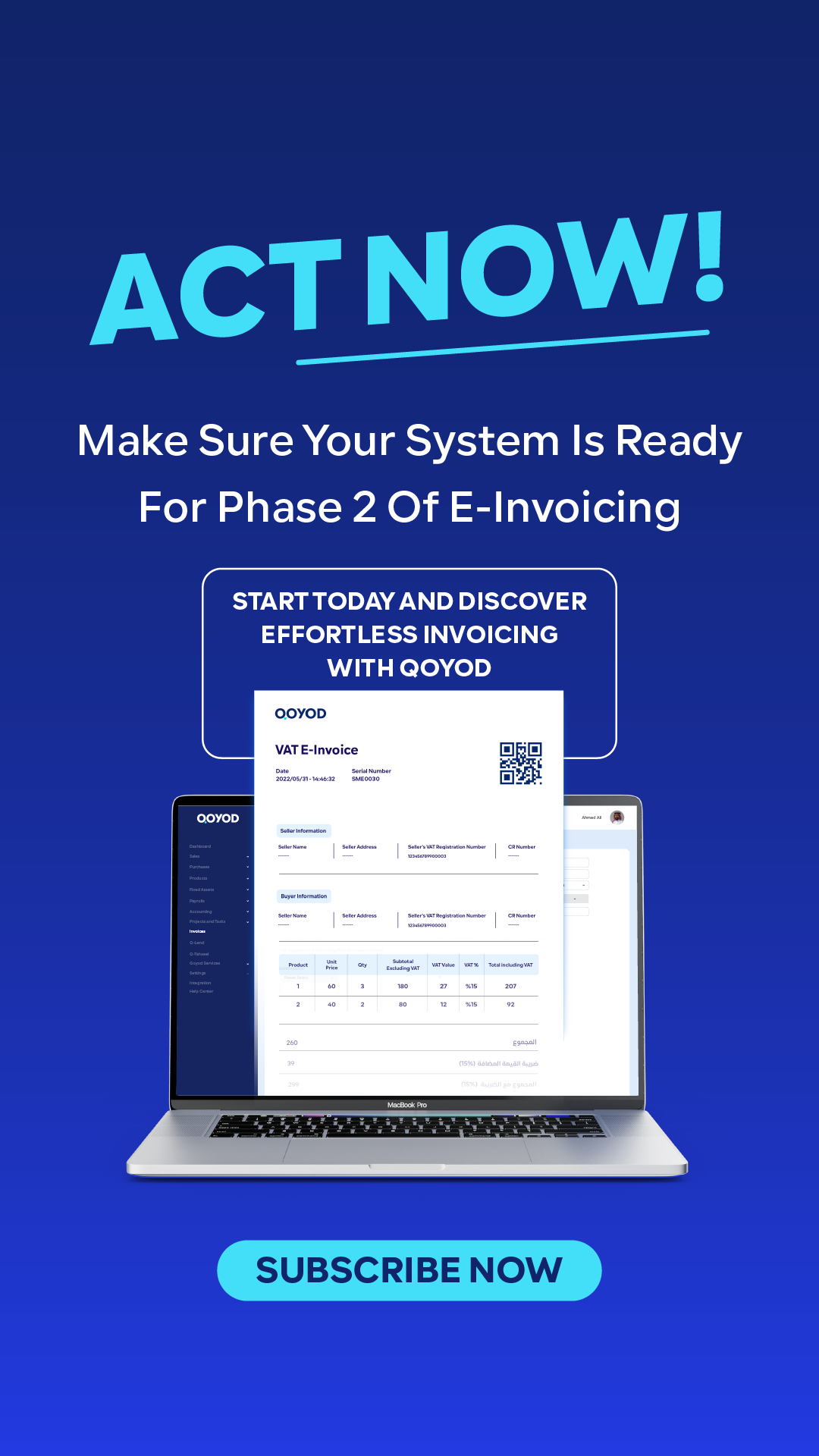
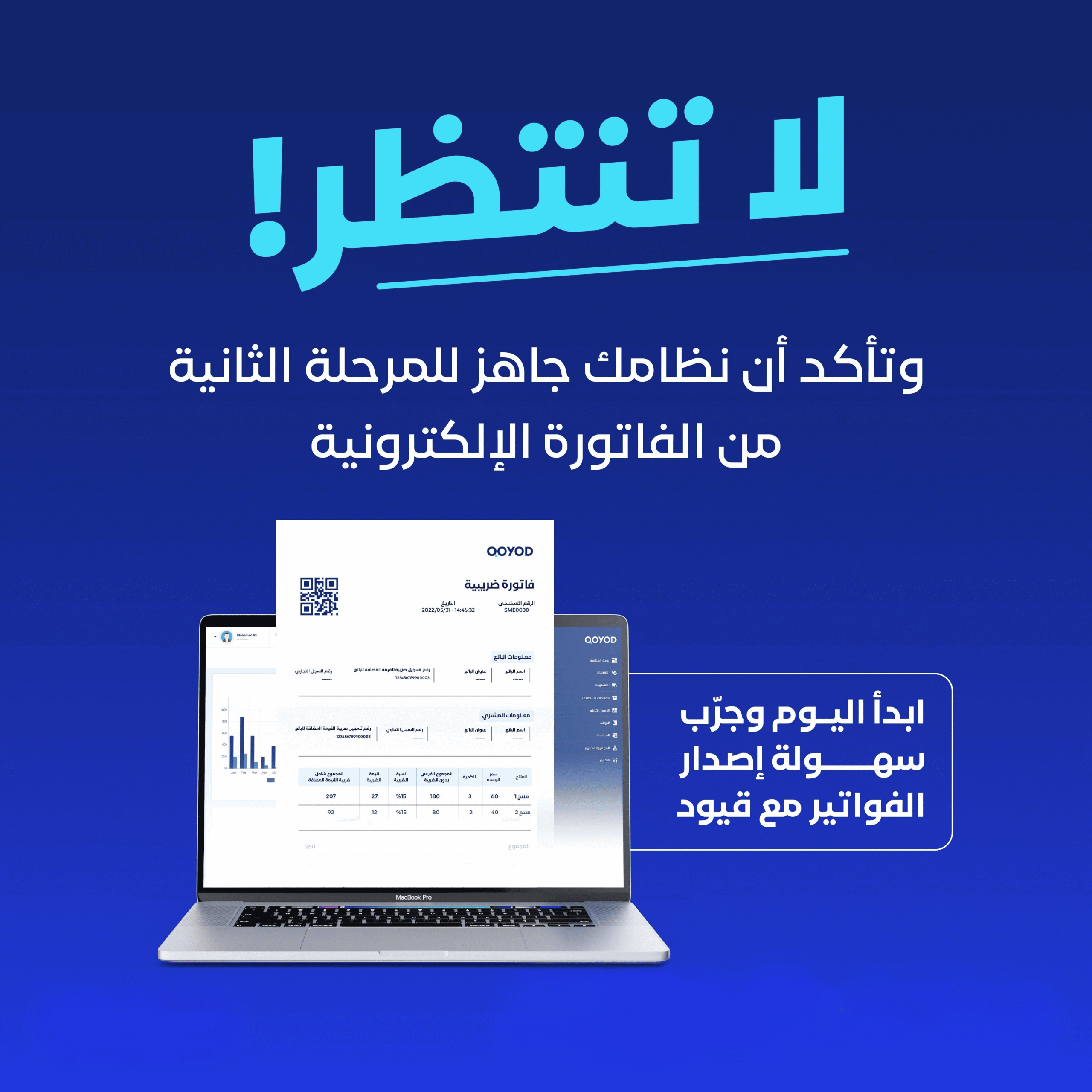
Qoyod is ZATCA Phase 2 certified and integrated with the Fatoora platform, which means the compliance machinery is the product’s problem rather than yours. For a one-person business, a few capabilities carry most of the weight.
What that buys a freelancer is mostly time rather than features. The parts of compliance that actually consume a one-person week are small and repetitive: picking the right document type for each buyer, getting identifier formats right, keeping the tax classification straight on a mixed invoice, and not losing an evening to a rejection that could have been caught before submission.
So read the list below against your own week rather than against a feature comparison. If you are in Phase 1 and invoicing individuals, the first two items are the ones that matter; the clearance and CSID items only become relevant once a notification reaches you.
- Both invoice flows, handled correctly. Phase 2 clearance for the standard tax invoices you send to companies and government entities, and 24-hour reporting for the simplified invoices you hand to individuals. The XML is generated to the UBL 2.1 specification with the QR code, cryptographic stamp and invoice chain, and sales invoice PDFs embed the tax XML as a PDF/A-3 attachment, so you send one file instead of two.
- Compliance alerts before submission, not after rejection. Real-time ID format validation catches a badly formatted commercial register, tax identification or national ID number as you type it, which is one of the most common causes of a ZATCA warning. There are prompts for a missing address, for VAT exemption and zero-rated reason codes, and for the additional seller identifier (BT-29) that government invoices require. These alerts reduce the risk of rejection; they do not block you, and they do not replace ZATCA’s own validation.
- The CSID onboarding, guided per device and branch. Registering the cryptographic stamp identifier with ZATCA is something you do as the taxpayer, and Qoyod walks the flow rather than leaving you with a portal and a specification document.
- Automatic tax calculation across categories. Standard, zero-rated and exempt classification per line, so a mixed invoice splits the tax correctly, and your VAT return data aggregates from what you actually posted.
- Invoicing from your phone. The Qoyod mobile app matters more for freelancers than for office-based businesses, because the invoice usually needs issuing at the client’s site rather than back at a desk.
One honest note on trials so you plan correctly: the free trial runs on the entry plan, so you can set up your accounting and start issuing invoices, but Phase 2 linkage with ZATCA is available on the Pro and Advanced plans. If integration is the reason you are looking, choose the plan accordingly rather than expecting to test the connection during the trial.
Frequently asked questions
Does a freelance work document make me subject to e-invoicing?
No. The freelance work document is not a tax registration and carries no VAT number, so no e-invoicing obligation comes with it. Scope is decided by VAT registration alone. Our guide to the freelance work document in Saudi Arabia covers what the document actually does.
I earn SAR 150,000 a year. What do I have to do?
Nothing on the e-invoicing side. You are below SAR 187,500, so you are not eligible to register for VAT and the regime does not reach you. Issue ordinary commercial invoices without VAT, keep them numbered and dated, and watch your rolling twelve-month turnover so that crossing a threshold does not surprise you.
I registered voluntarily last year. Am I in Wave 25?
Possibly, and you should not decide it yourself. Wave 25 covers taxpayers whose revenue exceeded SAR 187,500 in any one of 2022, 2023, 2024 or 2025. ZATCA notifies the taxpayers it targets directly, at least six months ahead of their integration date, and that notification is what binds you. Phase 1, meanwhile, has applied to you since your registration took effect.
Is 1 February 2027 my deadline?
No. It is the date the Wave 25 integration window opens. ZATCA’s Arabic announcement says integration starts from that date, and the closing date has not been published, so nobody can tell you what it is. Your own binding date is the one in your notification.
Do I need a QR code on every invoice I issue?
The QR requirement sits on tax invoices issued by VAT-registered taxpayers, and it is the simplified tax invoice, the one you give an individual consumer, that carries the seller-generated QR. On a standard tax invoice under Phase 2, ZATCA generates the QR string during clearance and returns it to you. If you are not registered for VAT, you are not issuing tax invoices, so no QR requirement applies to you.
What is the difference between a standard and a simplified tax invoice?
A standard tax invoice goes to a business or a government entity and requires clearance under Phase 2, meaning ZATCA validates and stamps it before you deliver it to the buyer. A simplified tax invoice goes to an individual consumer, is handed over immediately and is reported to ZATCA within 24 hours. The related question of corrections is covered in our guide to credit notes and debit notes.
Can I keep using Excel if I am registered for VAT?
Not as your invoicing system. Phase 1 requires issuing through a compliant electronic solution and storing invoices tamper-evidently, and a spreadsheet you can reopen and edit fails the second requirement by design. Excel remains perfectly useful for planning and analysis alongside a proper invoicing system.
What happens if my invoice is rejected by ZATCA?
A rejected e-invoice cannot be edited and resent. The correction is always a credit note followed by a new, corrected invoice. For a standard tax invoice Qoyod creates and links the credit note automatically, and you issue the new invoice; for a simplified tax invoice the credit note is created manually and then the new invoice is issued. Our article on the most common Phase 2 rejection causes goes through them one by one.
The short version
Take one thing from this guide: the decision tree. Not registered for VAT means not obligated to issue electronic invoices, whatever document you trade under. Registered for VAT means Phase 1 has applied to you since the day your registration took effect, no wave required. Phase 2 arrives only when ZATCA notifies you, and for the smallest registered taxpayers that conversation begins with Wave 25, whose window opens on 1 February 2027.
Everything else, from QR codes to CSIDs to clearance flows, follows from which branch you are standing on. Work out your branch first and the rest stops being noise. If you are ready to put a compliant system behind it, a cloud accounting system built for the Saudi market handles electronic invoice mechanics, tax registration number validation and ZATCA integration, so you can go back to the work you actually charge for. If your turnover has you weighing up registration in the first place, start with the VAT rules in Saudi Arabia.