




Three patterns redefining work
The National Transformation Program, in cooperation with the Ministry of Human Resources and Social Development, worked on developing the legislative and regulatory environment for modern work patterns, with the aim of opening diverse work opportunities suited to different segments of society. The result is an ecosystem of three official platforms, each with its own document or contract.
Source: National Transformation Program, Annual Report 2025, modern work patterns. The percentage is a Qoyod calculation from the published counts.
The differences between the three patterns are substantive. Freelance work gives the individual a document allowing them to practise an independent activity and sell services to more than one client. Flexible work is an hourly contract with an establishment, and remote work is a full employment contract performed away from the workplace. All three share one thing: they open the door to income for groups for whom a traditional full-time schedule was never a practical option, from students to mothers to residents of smaller cities.
A labour market hitting record numbers
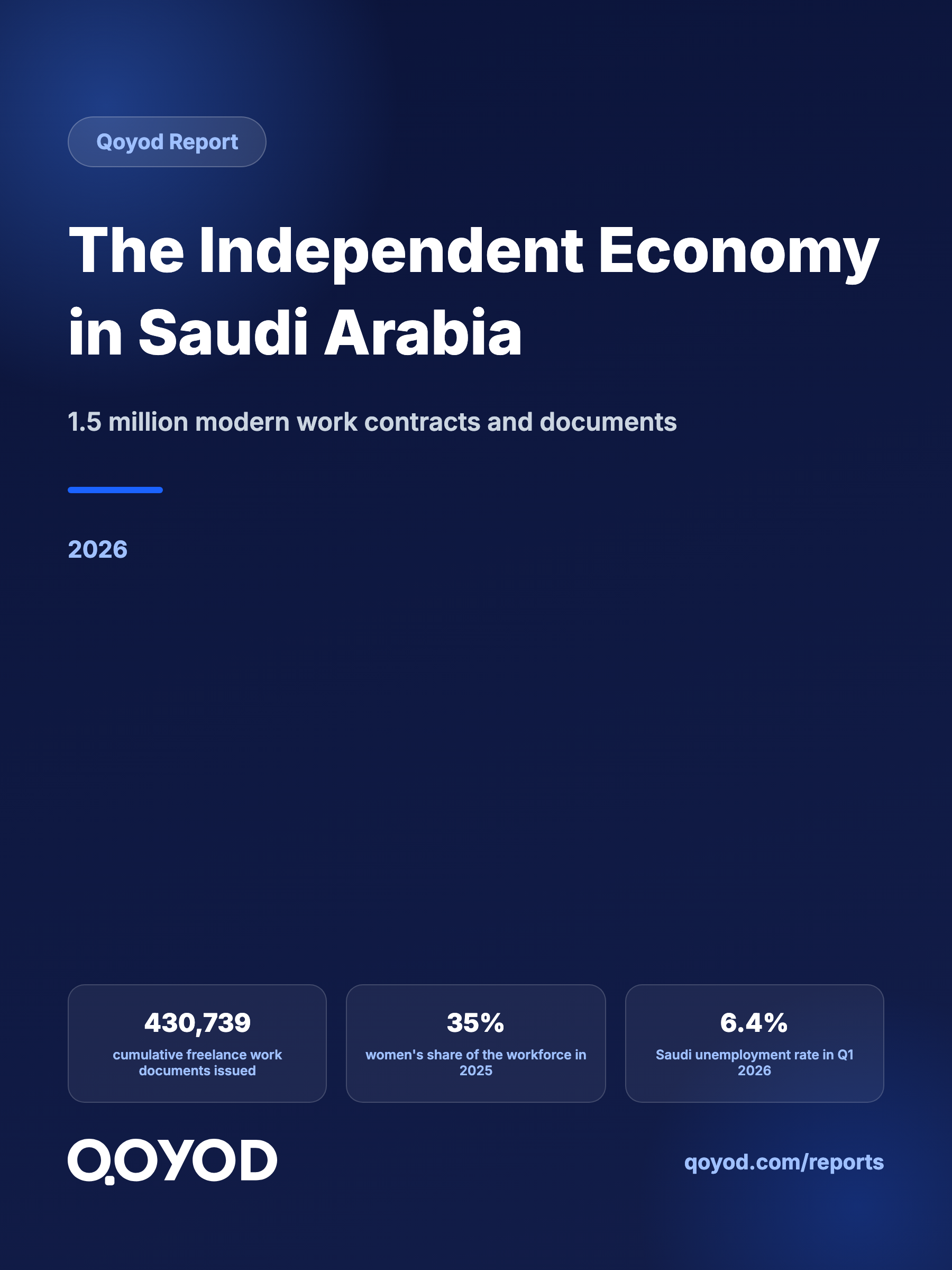
This expansion in work patterns comes in the context of a Saudi labour market at its strongest. The unemployment rate among Saudis fell to 6.4% in the first quarter of 2026, down from 7.2% in the fourth quarter of 2025, the lowest level on record. Unemployment among Saudi women fell to 9%, and among Saudi men to 4.9%.
Saudi women: the standout transformation
The independent economy in Saudi Arabia cannot be read in isolation from the most important shift the labour market has seen in eight years: the rise of women’s participation. The figures in the National Transformation Program annual report speak for themselves.
Source: National Transformation Program, Annual Report 2025, the transformation journey in empowering women.
Behind these numbers sit tangible empowerment programs: more than 370,000 women benefited from the Wusool transport support program, and more than 52,000 female employees from the Qurrah childcare program. And this is exactly where modern work patterns prove their value: freelance and remote work remove the transport barrier and the fixed-schedule barrier at once, making them among the fastest routes for women to enter the labour market.
Who is the Saudi freelancer?
Data published by Al-Watan newspaper on the profile of freelance workers indicates that the largest age group is 25 to 34, and that 62% hold a bachelor’s degree against 31% with a secondary qualification or below. Riyadh leads the geographic distribution at roughly 27%, followed by Makkah at roughly 22% and the Eastern Province at roughly 14%. Trade and retail lead the activities at roughly 38%, followed by manufacturing and professional services.
So the picture is not one of marginal work, but of educated young people in their productive years building an independent income stream. And this is precisely the group that needs financial tools as professional as their ambition.
What the freelance work document gives you
The freelance work document is a document approved by the Ministry of Human Resources and Social Development that allows individuals to register in a number of activities and to practise work independently in the activities the ministry has approved through the freelance work portal. It is issued electronically and free of charge.
Source: Freelance platform, Ministry of Human Resources and Social Development.
It is important to understand the dividing line: the document regulates the practice of an independent activity, and it is neither a commercial register nor a substitute for one. When the activity expands and becomes an establishment with employees and branches, the commercial register becomes the appropriate legal form. And the register base in the Kingdom is widening at a record pace of its own, with active establishment registers reaching 1,280,505 by the end of the second quarter of 2026.
The financial side: what a freelancer actually needs
This is where the distance opens between a freelancer whose income grows and one who keeps working without a clear picture of their numbers. Four financial matters decide the difference:
First, separate your accounts. The commercial bank account the document makes available to you is not an administrative luxury, it is the foundation that makes calculating income and expense possible at all. Mixing personal spending with business spending turns any profit calculation into an estimate rather than a number.
Second, invoicing. Many freelancers’ clients today are registered businesses that require an invoice for every service and will not pay without one. A structured invoice is not a formality, it is the condition for working with companies and the source of documentation in any dispute.
Third, the tax registration threshold. VAT registration is mandatory once annual taxable supplies exceed SAR 375,000, and optional above SAR 187,500. Tracking that figure monthly rather than discovering it at year end is the difference between registering on time and a costly delay. Once registered, e-invoicing compliant with the Zakat, Tax and Customs Authority becomes part of the daily workflow.
Fourth, optional social insurance. The optional social insurance registration available to document holders is a decision worth calculating rather than deferring, because it builds retirement coverage that the nature of independent work does not provide automatically.
Prepared by Qoyod based on the published freelance work document benefits and Zakat, Tax and Customs Authority provisions.
This is exactly the need a simple accounting system covers from day one. Qoyod is an Arabic cloud accounting system that records income and expense by line, issues electronic invoices compliant with the Zakat, Tax and Customs Authority, and shows net profit and outstanding receivables at any moment, so a freelancer knows their real number before it becomes a question at year end.
From freelance work to an establishment: the natural path
Many Saudi businesses today started as a small individual project. And the numbers confirm this path is now wide open: the number of small and medium enterprises in the Kingdom exceeded 1.7 million in 2025, compared with 429,026 in 2016, according to the National Transformation Program annual report.
Source: National Transformation Program, Annual Report 2025, growth of small and medium enterprises in partnership with the Small and Medium Enterprises General Authority (Monsha’at).
Recommendations
Five practical steps for anyone working independently in Saudi Arabia:
- Issue your freelance work document before your first commercial transaction. It is free and electronic, and it lets you open a commercial bank account and access digital payment solutions.
- Separate your commercial account from your personal account from day one. Without that separation there is no real profit figure to rely on.
- Issue an invoice for every service. Your registered business clients need it to pay, and you need it for documentation.
- Track the SAR 375,000 ceiling of annual taxable supplies. Crossing it makes VAT registration mandatory.
- Plan for the expansion stage early. When the activity becomes an establishment with employees, the commercial register is the next step, and organised books make that transition smooth.
1.5 million contracts and documents across modern work patterns, women’s participation doubled in eight years, and unemployment at its lowest level: these are the marks of an economy that has opened the doors of work in many forms. And the freelancer who builds their financial system with the same seriousness they bring to their craft is the one who turns irregular income into a sustainable business.
Sources
- National Transformation Program: Annual Report 2025, modern work patterns (430,739 freelance work documents, 726,825 flexible work contracts and 339,134 remote work contracts), the transformation journey in empowering women, and the growth of small and medium enterprises.
- Freelance platform, Ministry of Human Resources and Social Development: definition of the freelance work document, program goals and the benefits provided.
- Ministry of Human Resources and Social Development: issuing and renewing the freelance work document service.
- General Authority for Statistics: Labour Market bulletin, Saudi unemployment down to 6.4% in Q1 2026 from 7.2% in Q4 2025, with unemployment among Saudi women at 9% and Saudi men at 4.9%.
- Ministry of Commerce: Quarterly Business Sector Bulletin, Q2 2026, active establishment commercial registers at 1,280,505.
- Al-Watan newspaper: the profile of freelance workers in Saudi Arabia, age group, education level, geographic distribution and leading activities.
- Zakat, Tax and Customs Authority: mandatory VAT registration threshold of SAR 375,000 and voluntary threshold of SAR 187,500, and compliant e-invoicing.