




Five years of unbroken growth
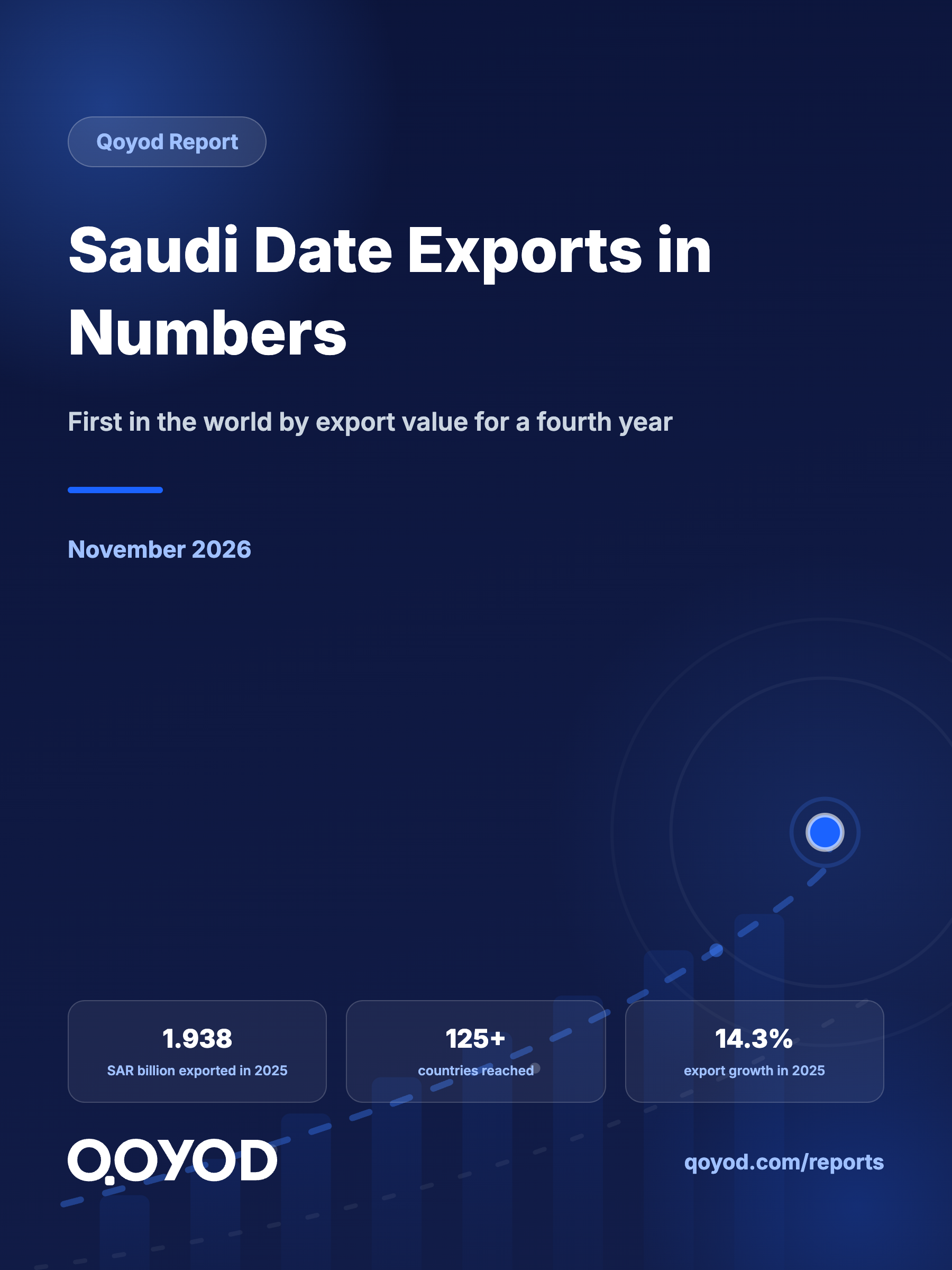
Date exports stood at SAR 1.215 billion in 2021, then SAR 1.280 billion in 2022, SAR 1.462 billion in 2023, SAR 1.695 billion in 2024 and SAR 1.938 billion in 2025. The value rose +59.5% in four years, a compound annual growth rate of about 12.4%.
Over the last three years annual growth has held between 14% and 16%: +14.2% in 2023, +15.9% in 2024 and +14.3% in 2025. Over the same period the market base widened from 119 countries at the end of 2023 to more than 125 in 2025.
Source: National Center for Palms and Dates, International Trade Centre data. Growth rates are Qoyod’s calculation.
Where Saudi dates go
According to Al-Eqtisadiah’s analysis of General Authority for Statistics data, date exports totalled about SAR 8.2 billion from 2021 to May 2026. The UAE led the markets with more than SAR 2.4 billion, about 29% of the total, followed by Yemen at about SAR 829 million, Kuwait at about SAR 511 million, Jordan at about SAR 378 million and Oman at about SAR 361 million. Over the same period exports were about 56 times imports.
More distant markets are growing too: exports to India rose +25% and to Denmark +33% in 2025 compared with 2024, according to the National Center for Palms and Dates.
Source: General Authority for Statistics, analysed by Al-Eqtisadiah, August 2026. UAE share is Qoyod’s calculation.
37 million palms behind it all
The Kingdom had about 37.6 million date palms in 2024, more than 32.2 million of them productive, and date output reached about 1.92 million tonnes, according to the Ministry of Environment, Water and Agriculture. Saudi Arabia ranks second in the world in date production with about 17% of global output, and its self-sufficiency in dates exceeds 125%, according to the CEO of the National Center for Palms and Dates.
Source: Ministry of Environment, Water and Agriculture (2024 figures) and National Center for Palms and Dates (2025 figures).
| Year | Exports (SAR billion) | Annual growth |
|---|---|---|
| 2021 | 1.215 | base year |
| 2022 | 1.280 | +5.3% |
| 2023 | 1.462 | +14.2% |
| 2024 | 1.695 | +15.9% |
| 2025 | 1.938 | +14.3% |
Source: National Center for Palms and Dates. Growth rates are Qoyod’s calculation.
What people in the date chain need
Behind every shipment of dates stand small and medium businesses: farms, packing plants, wholesalers, gift shops and exporters. Their accounting question is much the same: what did this item cost me, how much did I earn on it, and how do I invoice a customer in another country correctly?
First, know each item’s margin. Every date variety has its own price and cost, and the seasons move both. The product cost and profit margin report in Qoyod shows average cost and margin per item, category and location, calculated from actual purchase invoices. It requires purchases and inventory to be switched on, which are outside the Basic plan.
Second, cost a box from its components. A gift box holds dates, packaging and labels. The composite products feature lets you define an item by its components, so components are deducted from stock when the manufacturing order is recorded. It is available on the Advance plan only. It is worth being clear that Qoyod is an accounting system, not a manufacturing system.
Third, invoice exports correctly. Qoyod supports multiple currencies and keeps standard-rated, zero-rated and exempt transactions apart. Exports outside the Gulf Cooperation Council are zero-rated for VAT. For sales to GCC states, which are the largest markets for Saudi dates, check the tax treatment with your adviser before invoicing.
Fourth, make your invoices compliant from the first shipment. E-invoicing in Qoyod complies with Zakat, Tax and Customs Authority requirements, and Phase 2 integration is available on the Pro and Advanced plans. Each plan’s scope differs, so review the details with the sales team before choosing.
Prepared by Qoyod based on documented system capabilities and National Center for Palms and Dates figures.
Recommendations
Four practical steps to take from the numbers in this report:
- Watch the fastest-growing markets, not only the largest: India and Denmark grew by more than 25% in a single year.
- Calculate the margin of each variety and each pack size separately; the highest-priced item is not always the most profitable.
- Classify every export invoice for tax before issuing it, and distinguish Gulf markets from more distant ones.
- Build readiness before the season, not during it: documented stock, known costs and compliant invoices.
SAR 1.938 billion, unbroken growth since 2021, more than 125 countries and first in the world for a fourth year: these are the numbers of a national product carrying the Kingdom’s name to the world within the path of Saudi Vision 2030. The business that knows the cost of each item precisely is the one that can compete for its share of this growth.
Sources
- Okaz, relaying the National Center for Palms and Dates, 3 October 2026: 2025 exports about SAR 1.938 billion, first in the world for a fourth year, more than 125 countries, more than 37 million palms.
- Arab News, relaying the Saudi Press Agency, 3 October 2026: International Trade Centre data (SAR 1.215 billion in 2021, SAR 1.695 billion in 2024, SAR 1.938 billion in 2025), second in world production at about 17%, self-sufficiency above 125%.
- Ajel, relaying the National Center for Palms and Dates, March 2024: 2023 exports of SAR 1.462 billion against SAR 1.280 billion in 2022, and 119 importing countries.
- Al-Madina, relaying the National Center for Palms and Dates, May 2026: exports to India up 25% in 2025.
- Al-Madina, relaying the National Center for Palms and Dates, April 2026: exports to Denmark up 33% in 2025.
- Al-Eqtisadiah, August 2026: analysis of General Authority for Statistics date-export data from 2021 to May 2026 (about SAR 8.2 billion) and the largest markets.
- Ministry of Environment, Water and Agriculture, July 2026: 2024 output of about 1.92 million tonnes and 37.6 million palms, more than 32.2 million of them productive.
- Zakat, Tax and Customs Authority: VAT rates and e-invoicing requirements.