




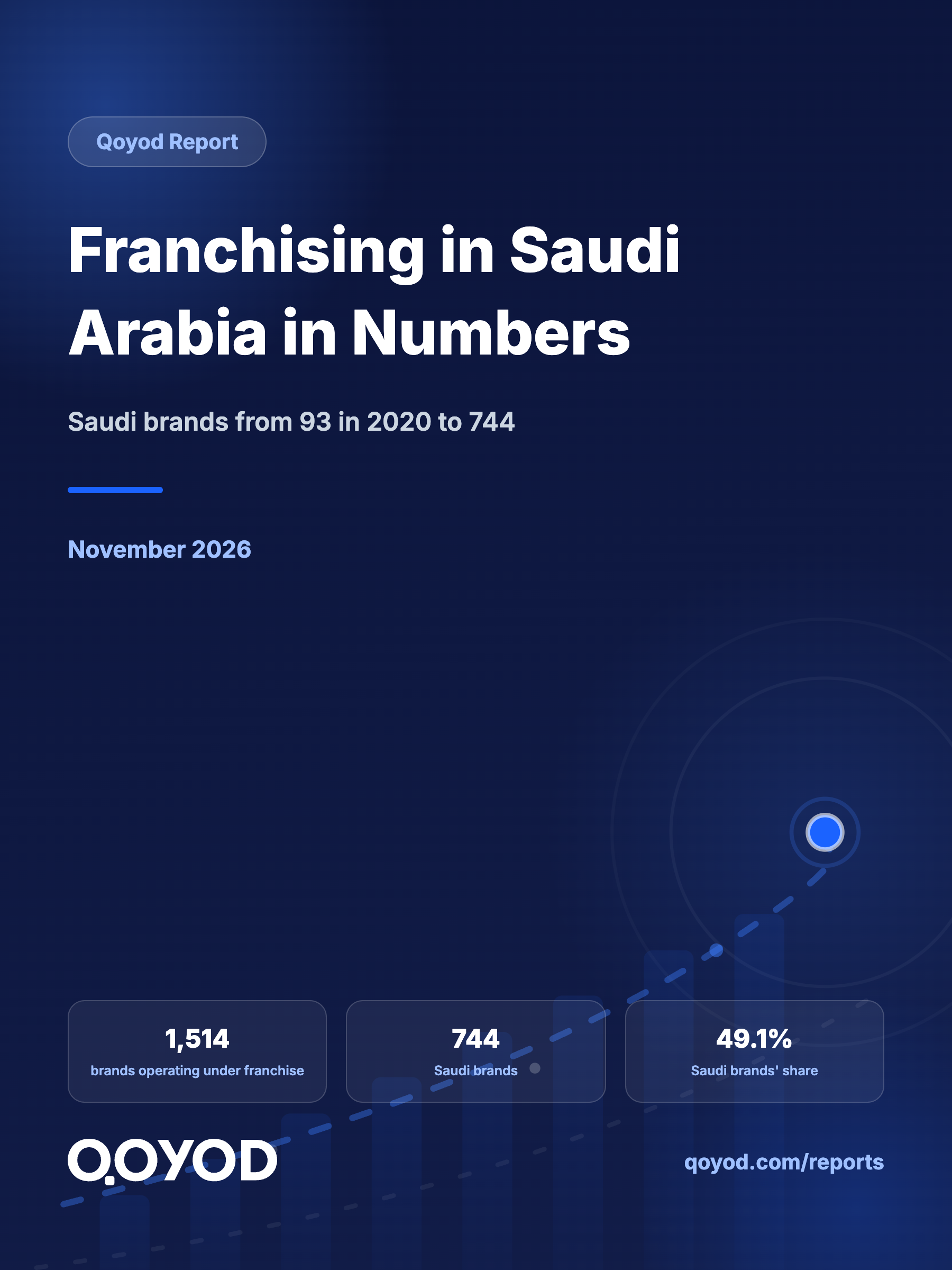
From 692 brands to 1,514
When Monsha’at’s Franchise Center was founded in 2020, the market had about 692 franchised brands, 93 of them local, about 13% of the total. By the end of the second quarter of 2026 the count reached 1,514, more than double (+118.8%).
What stands out is where the increase came from. Of the 822 brands added to the market since 2020, 651 were Saudi, about 79% of the entire addition. Foreign brands grew too, from 599 to 770, but it is the Saudi brand that led the expansion.
Source: Small and Medium Enterprises General Authority (Monsha’at), July 2026. Foreign brand count and multiples are Qoyod’s calculation.
The Saudi brand nears half the market
The local share rose from about 13% in 2020 to 49.1% in 2026. Monsha’at says its Franchise Center directly helped convert 214 local brands to franchising, more than 28% of the local brands operating today, and verified the readiness of 2,636 brands to grant franchises.
That last number matters most for anyone watching the market: 2,636 brands have passed the readiness check, so behind today’s operating brands sits a large pipeline of brands ready to expand. The Center also ran 11 franchise tours across the Kingdom’s regions, with more than 258 participating brands and more than 7,102 visitors.
Source: Small and Medium Enterprises General Authority (Monsha’at), July 2026.
A market of about SAR 60 billion and more than 15,000 outlets
The chair of the National Franchise Committee at the Federation of Saudi Chambers, Dr. Khalid Al-Ghamdi, put the size of the Kingdom’s franchise market at about SAR 60 billion, with annual growth of 27% and more than 15,000 franchise outlets. The committee aims to help at least five national brands expand into global markets by the end of 2026.
Food and beverages lead the franchise sectors, with restaurants and cafés a large part of them, followed by retail, education, healthcare, services and entertainment.
| Indicator | 2020 | Q2 2026 |
|---|---|---|
| Franchised brands | 692 | 1,514 |
| Saudi brands | 93 | 744 |
| Foreign brands (Qoyod calculation) | 599 | 770 |
| Saudi brands’ share | about 13% | 49.1% |
| Growth since 2020 | Total +118.8% · Saudi × 8 | |
Source: Monsha’at, July 2026. Foreign brands and growth rates are Qoyod’s calculation.
What the franchisor and the franchisee need
A franchise is a financial relationship before it is a sign over a shopfront. The franchisor sells a proven model, and an investor is convinced only by the numbers of its branches: what a branch costs, what its margin is, and when it pays back. The franchisee pays recurring fees and needs to know whether the branch actually profits after them.
First, separate each branch’s numbers. Branch management in Qoyod lets you follow more than one location in a single subscription, and the number of locations follows the plan: one on Basic, three on Pro and five on Advanced. Each branch’s costs can be tracked through cost centers linked to projects, available from the Pro plan.
Second, know each item’s margin at each branch. The product cost and profit margin report shows average cost and margin per item, category and location, calculated from actual purchase invoices. It requires purchases and inventory to be switched on, which are outside the Basic plan. These are the numbers a franchisor builds its investor pitch on.
Third, organise the recurring fees. Recurring invoices in Qoyod, available from the Advanced plan, are issued automatically on schedule and suit fixed fees agreed with the franchisee. A royalty calculated as a percentage of sales changes every month, so it is invoiced at its actual amount once the month’s sales are closed.
Fourth, keep every branch compliant with e-invoicing. E-invoicing in Qoyod complies with Zakat, Tax and Customs Authority requirements, and Phase 2 integration is available on the Pro and Advanced plans. It is worth being clear that Qoyod’s consolidated financial reports combine subscriptions belonging to one legal entity, so they serve a franchisor across its own company-owned branches, and they do not combine franchisees’ accounts, since each franchisee is a separate business. Each plan’s scope differs, so review the details with the sales team before choosing.
Prepared by Qoyod based on documented system capabilities and Monsha’at figures.
Recommendations
Four practical steps to take from the numbers in this report:
- If you are thinking of franchising your brand, start with a full year of separate numbers for each branch, the first thing a serious investor asks for.
- If you are buying a franchise, calculate the branch’s profit after the recurring fees, not before them.
- Keep fixed fees and variable royalties apart in your accounts, so you know which one presses on your margin.
- Contact Monsha’at’s Franchise Center before you expand; it has verified the readiness of 2,636 brands so far.
1,514 franchised brands, 744 Saudi brands where there were 93, and a local share nearing half: these are the numbers of a national brand that grows and spreads within the path of Saudi Vision 2030. The brand that knows each branch’s numbers precisely is the one that can sell its model with confidence.
Sources
- Small and Medium Enterprises General Authority (Monsha’at) via Okaz, 12 July 2026: 1,514 franchised brands at end of Q2 2026, 744 of them local; 692 brands including 93 local in 2020; 214 local brands converted with the Center’s support; 2,636 brands verified as ready.
- Monsha’at via Al-Madina, relaying the Saudi Press Agency, 12 July 2026: the same figures, plus 11 franchise tours with more than 258 brands and more than 7,102 visitors.
- Al-Eqtisadiah, 6 September 2026: statement by the chair of the National Franchise Committee, Dr. Khalid Al-Ghamdi (market size SAR 60 billion, annual growth 27%, more than 15,000 outlets, and the target of five national brands expanding globally by end-2026).
- Zakat, Tax and Customs Authority: e-invoicing requirements.