




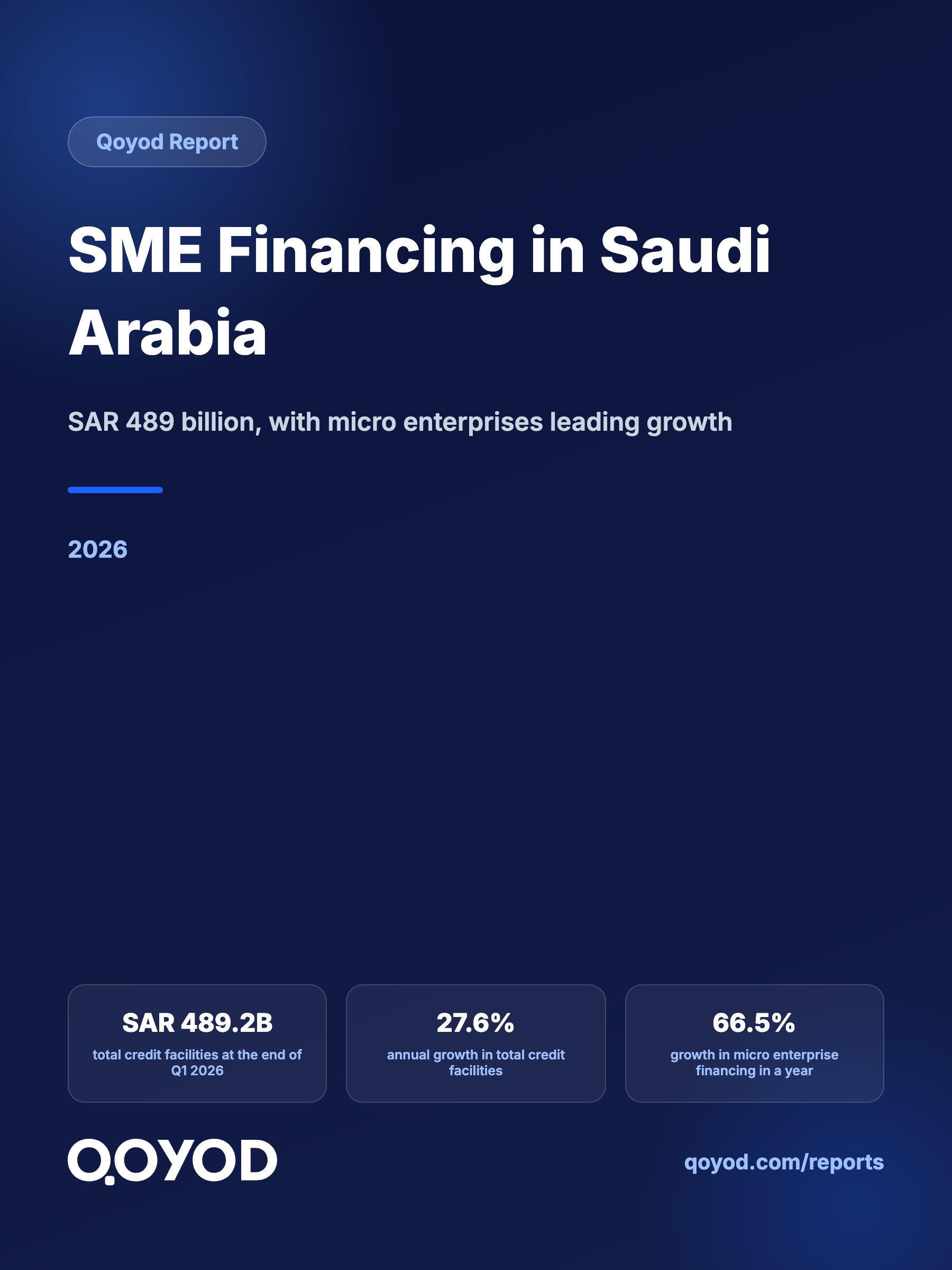
SAR 489 billion: the size of financing today
According to Table 14 of the Saudi Central Bank Monthly Statistical Bulletin, total credit facilities extended by banks and finance companies to micro, small and medium enterprises reached SAR 489.2 billion at the end of Q1 2026, against SAR 383.3 billion in the same quarter of 2025, an annual growth rate of 27.6%.
Extending the line backwards shows the scale of the shift. At the end of Q1 2021 the figure was only SAR 188.4 billion. Financing directed to this segment has therefore grown 160% in five years, a high growth rate by the standards of any financing segment.
Source: Saudi Central Bank, Monthly Statistical Bulletin June 2026, Table 14. Figures are total facilities from banks and finance companies, including on-balance and off-balance sheet facilities.
The real story: micro enterprises lead
The total alone hides the most important finding in the data. Breaking financing down by enterprise size shows the smallest segment growing fastest by a wide margin: micro enterprise financing grew 66.5% in one year, against 21.6% for small and 21.1% for medium enterprises.
Source: Saudi Central Bank, Monthly Statistical Bulletin June 2026, Table 14. Percentages are Qoyod calculations from the published figures.
This shift deserves a pause. Five years ago, at the end of Q1 2021, micro enterprise financing stood at just SAR 11.1 billion. Today it is SAR 89.1 billion, eight times higher. Its share of total financing rose from 14% only a year ago to 18.2% today.
Who lends: banks or finance companies?
The split by lender shows banks are the main channel by a wide margin. Of the SAR 489.2 billion total, banks provided SAR 466.7 billion, or 95.4%, while finance companies provided SAR 22.5 billion, or 4.6%.
Source: Saudi Central Bank, Monthly Statistical Bulletin June 2026, Table 14.
That share has a direct practical consequence for a business owner: the banking channel is the primary route to financing, and credit assessment generally rests on financial statements, credit history and consistent cash flow, though the details differ from one lender to another. Readiness for financing therefore starts in the books, not on the day of the bank visit.
Where does your business sit? The official revenue classification
Before talking about financing, a business must know its classification, because the classification determines which financing products and government programs apply to it. The unified definition issued by the Small and Medium Enterprises General Authority is based on revenue first, and on headcount when revenue data is unavailable, as with new businesses.
| Classification | Annual revenue | Employees |
|---|---|---|
| Micro | SAR 0 to 3 million | 1 to 5 |
| Small | SAR 3 to 40 million | 6 to 49 |
| Medium | SAR 40 to 200 million | 50 to 249 |
Kafalah: the guarantee that opens the bank’s door
The best known obstacle facing a small business is not a lack of willingness from the bank, it is a lack of collateral. This is why the Kafalah program for guaranteeing SME financing was created, to carry part of the financing risk on the business’s behalf.
According to a statement by the programme’s chief executive reported by Ajel, guaranteed financing reached SAR 14.1 billion during 2025 alone, through more than 7,000 guarantees benefiting 5,463 enterprises and enabling SAR 19.7 billion in total financing, up 5% in total financing enabled versus 2024. Cumulatively, from the programme’s launch in 2006 to the end of 2025, it approved more than 73,000 guarantees benefiting over 27,000 enterprises, with total financing of approximately SAR 131 billion against guarantees worth more than SAR 93 billion, and 46 enterprises graduated to the Nomu parallel market.
Source: statement by the Kafalah programme chief executive, reported by Ajel, cumulative figures to the end of 2025.
One essential point is often misunderstood: the guarantee addresses a shortage of physical collateral, it does not address a weak financial file. The bank still studies the application and decides; the guarantee only reduces its risk. A business needs both: a sound financial file, and a guarantee to cover what is missing.
What a lender actually requires
After all these numbers the practical question remains: why is one application approved and another declined? The answer usually lies not in the size of the business but in the readiness of its financial file. Four elements recur in every credit assessment:
First, regular financial statements. An income statement and balance sheet covering consecutive periods, not figures assembled at year end. A lender reads the trend, not the snapshot.
Second, a clear separation between the business and its owner. Mixing personal spending with business spending makes profit impossible to verify, and is one of the fastest routes to a declined application.
Third, cash flow that proves the ability to repay. Book profit does not pay instalments, cash does. A consistent record of collecting from customers is an integral part of that picture.
Fourth, sound tax and regulatory compliance. VAT returns filed on time, electronic invoicing compliant with the Zakat, Tax and Customs Authority, and, for businesses subject to the requirement, financial statements filed when due.
Prepared by Qoyod based on standard credit assessment criteria. Indicative; requirements vary by lender.
These four elements are not built in the week before a bank visit, they accumulate through consistent accounting operations. Qoyod is an Arabic cloud accounting system that records revenue and expenses by line, produces an income statement and balance sheet at any time, issues electronic invoices compliant with the Zakat, Tax and Customs Authority, and produces a customer debt ageing report that tracks uncollected invoices across consecutive comparison periods. So when the moment to apply arrives, the numbers are ready rather than assembled in a rush.
Recommendations
Five practical steps to take away from the figures in this report:
- Work out your classification first. Your annual revenue determines whether you are micro, small or medium, and the financing products available to you follow from that.
- Build your financial statements monthly, not annually. A lender reads a twelve month trend, and late books mean a weak file no matter how good the business is.
- Separate the business account from your personal account. Without that separation profit cannot be proven, a recurring reason for decline that has nothing to do with the quality of the business.
- Ask about Kafalah if collateral is the obstacle. The program is designed precisely to close that gap, but it does not compensate for weak financial statements.
- Put your tax compliance in order before applying. Returns filed on time and compliant electronic invoicing are part of the creditworthiness picture.
SAR 489 billion, 27.6% growth in a year, and micro enterprise financing multiplying eightfold in five years: these are the numbers of a financing market that has opened its doors to Saudi businesses at an unprecedented level. And the business that captures its share is not necessarily the largest, it is the one that reaches the door with its financial file ready.
Sources
- Saudi Central Bank: Monthly Statistical Bulletin June 2026, Table 14 “Credit Facilities Provided To Micro, Small And Medium Enterprises” (the primary source for all financing figures, size breakdowns and lender splits in this report).
- Saudi Central Bank: the unified enterprise classification issued by the Small and Medium Enterprises General Authority, revenue and headcount thresholds, as published in the footnote to Table 14.
- Kafalah programme via Ajel: SAR 14.1 billion in guaranteed financing during 2025, and cumulative figures from 2006 to the end of 2025 (more than 73,000 guarantees, over 27,000 enterprises, about SAR 131 billion in financing and more than SAR 93 billion in guarantees).
- Kafalah program for guaranteeing SME financing: programme overview and its role in covering the collateral gap.
- Zakat, Tax and Customs Authority: VAT obligations and compliant electronic invoicing.