




One quarter tells the story: from SAR 44bn to 69bn
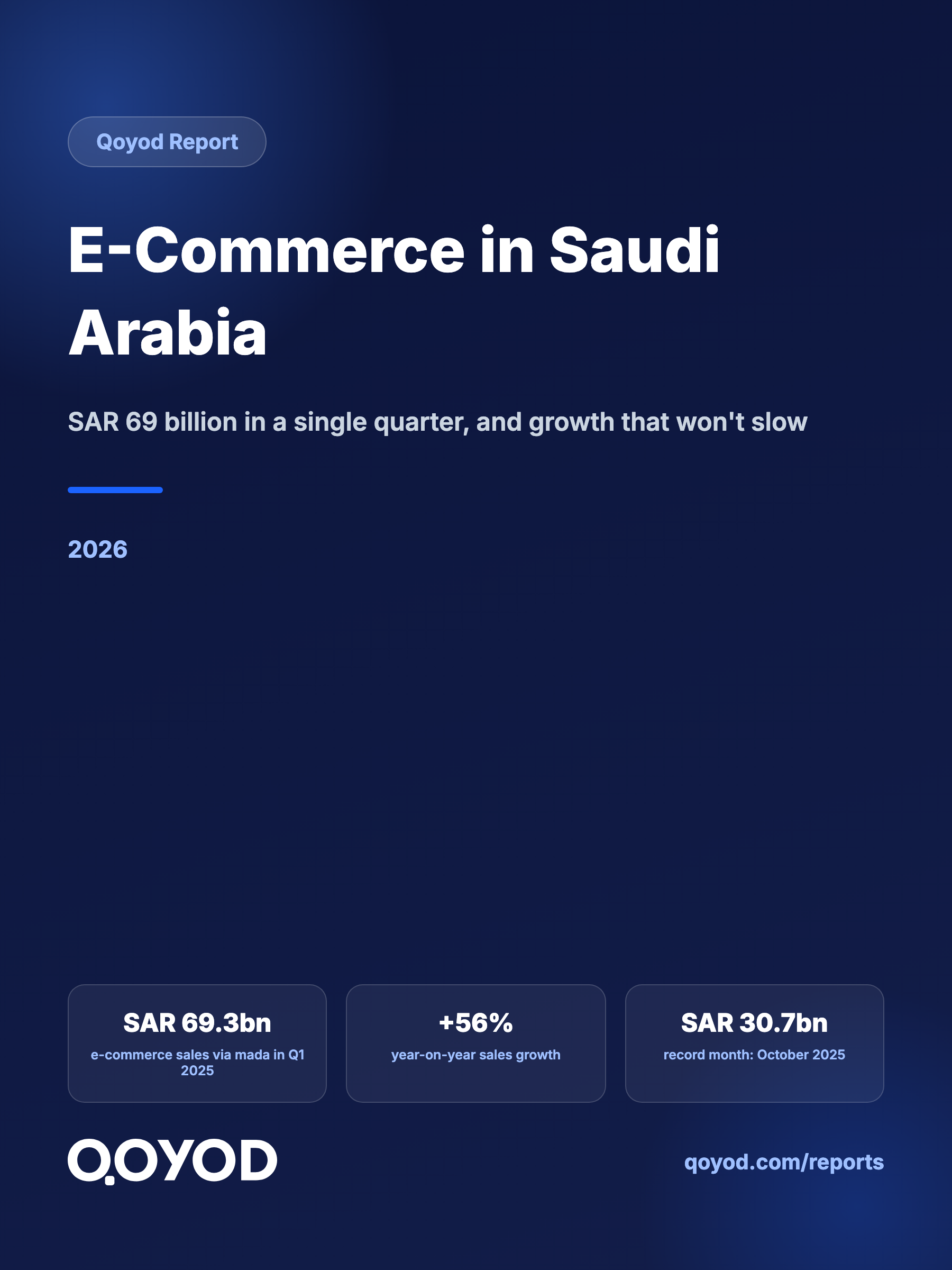
The clearest indicator of how fast Saudi e-commerce is accelerating is a like-for-like comparison of first quarters. According to official Saudi Central Bank (SAMA) data reported by the Saudi Press Agency, e-commerce sales via mada cards exceeded SAR 69.3 billion in Q1 2025, up from around SAR 44 billion in Q1 2024. That is 56% year-on-year growth in just twelve months.
SAR billion
SAR billion
Source: Saudi Central Bank (SAMA) via the Saudi Press Agency, 2024 and 2025.
Transaction counts show the growth is not just larger baskets but a wider base: more than 370 million online purchases were made via mada in a single quarter, roughly four million transactions a day. Online buying has shifted from a seasonal behaviour to a daily habit.
SAR 30 billion in a single month: seasonality builds the peaks
At the monthly level, October 2025 recorded the year’s highest monthly growth in e-commerce sales via mada, at around SAR 30.7 billion in one month, according to Al Arabiya’s reading of central bank data. Monthly peaks of this kind usually track shopping seasons and promotions, and they carry a practical signal for merchants: digital purchasing power concentrates in narrow windows that must be prepared for early, in inventory, operations, and financing.
Source: Saudi Central Bank (SAMA) as read by Al Arabiya, December 2025.
The infrastructure behind the growth: digital payments first
This climb did not come out of nowhere. Behind it sits a structural shift in how people pay. Electronic payments reached 85% of total retail transactions in 2025, up from 79% in 2024, after the Kingdom passed its Vision 2030 target of 70% early, back in 2023. As we tracked in our Digital Economy & Technology report, cash fell to 39% of spending in 2024 from 71% in 2019, while e-commerce sales via mada multiplied more than 19 times between 2019 and 2024.
Sources: Saudi Central Bank (SAMA) via Arab News 2025, and Qoyod’s Digital Economy & Technology report.
What does this mean for store owners and small businesses?
Growth is an opportunity, but it also multiplies the operational load behind the screen. A store fulfilling thousands of orders a month faces accounting challenges the customer never sees, and they compound with every season:
| Operational challenge | Accounting impact |
|---|---|
| Thousands of orders across channels (store, app, marketplaces) | Exhausting manual entry and recording errors that scale with volume |
| Payment gateway settlements, fees, and returns | A gap between recorded sales and the amounts actually collected |
| Inventory moving across multiple channels and warehouses | Inaccurate counts and a distorted cost of goods sold |
| A compliant tax invoice for every order | E-invoicing obligations multiply with transaction volume |
| Peak seasons pressing on liquidity and inventory together | Purchasing and financing decisions need live numbers, not estimates |
Wider access to financing adds fuel: SME lending reached about SAR 468 billion by the end of Q4 2025, up 33% year on year according to Monsha’at’s SME Monitor, giving merchants more room to finance inventory and seasonal expansion.
This is exactly where accounting automation earns its keep. Qoyod, a cloud-based Arabic accounting platform, connects to Salla through the official Qoyod app and to Zid through the FAI Sync app, syncing orders, customers, and products straight into your books and issuing a ZATCA-compliant e-invoice for every order, with no manual entry, whatever the size of the season.
Outlook and recommendations
Every official indicator points the same way: a widening buyer base, digital payments beating their targets ahead of schedule, and seasonal peaks climbing year after year. Practical recommendations for store owners:
- Plan seasons with numbers: an October peak of SAR 30.7 billion in one month means inventory and liquidity are decided before the season, not during it.
- Connect your store to your accounting system from day one; manual entry that works at 100 orders collapses at 10,000.
- Reconcile gateway settlements regularly so the gap between sales and actual collections never accumulates.
- Track profit margin per sales channel separately; revenue growth does not automatically mean profit growth.
Saudi e-commerce is setting records every quarter. The winners will not simply be those who sell more, but those who know their numbers in real time and turn growth into managed profit.
Sources
- Saudi Press Agency (SPA): e-commerce sales via mada in Q1 2025 at SAR 69.3bn, up 56%, with over 370 million transactions.
- Saudi Press Agency (SPA): e-commerce sales via mada in Q1 2024 above SAR 44bn.
- Al Arabiya: e-commerce sales record their highest monthly growth in October 2025 at SAR 30.7bn (reading of SAMA data).
- Saudi Central Bank (SAMA) via Arab News: electronic payments at 85% of retail transactions in 2025.
- Monsha’at SME Monitor: SME lending at SAR 468bn by end of Q4 2025 (+33% YoY).