Last updated: 25 August 2026
Accounting Entries form a fundamental part of the accounting system and are the bedrock for documenting all financial transactions in line with the standards set by the Saudi Organization for Chartered and Professional Accountants (SOCPA) and the Zakat, Tax and Customs Authority (ZATCA). These entries establish the rules for a company’s financial reporting. For small and medium-sized enterprises (SMEs), mastering these entries can sometimes feel like a hurdle, potentially limiting focus on growth and innovation. In the Kingdom, accurately documenting financial operations through entries is a core requirement for tax and regulatory compliance, especially as ZATCA’s Phase 2 e-invoicing rolls out wave by wave to smaller businesses, making review and auditing processes simpler under ZATCA’s requirements. This article provides a comprehensive guide to understanding these essential financial tools.
What Is an Accounting Entry? Definition and Meaning
An accounting entry is the formal record of one financial transaction in a company’s books. It names the accounts the transaction touched, the amount that moved, and the date it happened. In plain terms, an entry in accounting is one documented movement of value: a sale, a purchase, a payment, a wage, or a transfer between accounts.
Every entry has two sides, a debit and a credit, and the two sides must always be equal. Accounting Entries are the primary tools used to document financial operations within companies, and they are critical for recording transactions accurately enough to satisfy local legal requirements under double-entry bookkeeping.
Because entries capture each transaction as it occurs, whether direct or indirect, they show the real financial condition of the business rather than an estimate of it. By documenting operations this way, accountants and managers can evaluate the entity’s performance, analyze profits and losses, identify financial strengths and weaknesses, and make informed, sound decisions based on reliable accounting information.
Types of Accounting Entries
Accounting entries are used to record financial events in a company’s accounting ledgers, aiming to ensure the integrity and balance of financial information. The main types of these entries include:

Journal Entry
The journal entry is the cornerstone for recording the daily transactions of establishments. It is structured according to the financial statement requirements adopted under the International Financial Reporting Standards (IFRS) endorsed in the Kingdom.
A journal entry is the stage of the accounting cycle where a financial or commercial movement is first recorded in the accounting records. It applies regardless of the size or type of the transaction, and it carries a short explanation of the details: the date the transaction was executed and the parties involved in it. The entry is written in the journal first and posted afterwards to the general ledger, or to a subledger that later feeds the general ledger. Because journal entries follow the double-entry method, two accounts are always affected, so there is always a debit side and a credit side. For a fuller comparison of the two books, see our guide to the journal and the ledger.
| Account | Debit | Credit |
| A/C / (Bank) | 3,000 | |
| A/C / (Capital) | 3,000 |
Simple Entry
A simple entry records a financial transaction that affects only one account on the debit side and one account on the credit side. Paying employee wages out of the company bank account is a typical example: the wages expense account is debited and the bank account is credited by the same amount.
| Account | Debit | Credit |
| A/C / (Employee Wages Expense) | 12,000 | |
| A/C / (Bank) | 12,000 |
Reversing Entry
A reversing entry is an adjusting entry that is deliberately reversed at the start of the next period. The accrual it created, an accrued wage expense for example, is cancelled once the actual payment is recorded, so the expense is not counted twice. It is not a tool for fixing mistakes; that is the rectifying entry below.
Compound Entry
A compound entry is used to record financial transactions that affect two or more accounts in the journal. For instance, when a company purchases raw materials on credit, a compound entry is used to increase the Raw Materials account and increase the Creditors account.
- Compound Entry – Multiple Debits:
| Account | Debit | Credit |
| A/C / (Bank) | 10,000 | |
| A/C / (Cash) | 55,000 | |
| A/C / (Debtors / Customer X) | 65,000 | |
| Total | 65,000 | 65,000 |
- Compound Entry – Multiple Credits:
| Account | Debit | Credit |
| A/C / (Assets – Furniture) | 4,700 | |
| A/C / (Cash) | 4,000 | |
| A/C / (Bank) | 700 | |
| Total | 4,700 | 4,700 |
- Compound Entry – Multiple Debits and Credits:
| Account | Debit | Credit |
| A/C / (Internet Expense) | 2,000 | |
| A/C / (Gas Expense) | 1,000 | |
| A/C / (Bank) | 2,250 | |
| A/C / (Cash) | 750 | |
| Total | 3,000 | 3,000 |
Transaction Entry
A transaction entry records a movement that affects an earlier entry or the balance still due on an account, and it updates the accounting record on the strength of new information. If a customer settles SR 500 of an outstanding invoice, the entry debits Cash by SR 500 and credits Accounts Receivable by SR 500.
Rectifying Entry
A rectifying entry, also called a correcting entry, is passed to fix an error already written into the books of original entry or into an account in the ledger. It differs from a reversing entry in scope: the rectifying entry amends the misstated figure directly, rather than cancelling a whole prior accrual.
Transfer Entry
A transfer entry moves an amount from one account to another. It is used both for routine internal movements and for repairing a booking made against the wrong account. If a company moves SR 500 from its savings account to cash, the transfer entry credits the savings account by SR 500 and debits cash by SR 500.
Closing Entry
The closing entry is used at the end of the accounting period to close temporary accounts and transfer balances to the closing account.
- Closing Expenses:
| Account | Debit | Credit |
| A/C / (Profit and Loss) | XXX | |
| A/C / (Expense) | XXX | |
| (CLOSING EXPENSE) | ||
- Closing Revenues:
| Account | Debit | Credit |
| A/C / (Revenue) | XXX | |
| A/C / (Profit and Loss) | XXX | |
| (CLOSING REVENUE) | ||
Opening Entry
The opening entry is used at the beginning of the accounting period to record the initial balances of the financial accounts, establishing the starting balance for the accounting duration. It carries forward the closing balance of the previous period, including assets, liabilities and capital, and that carried figure becomes the current period’s starting balance.
| Account | Debit | Credit |
| A/C / (Assets) | XXX | |
| A/C / (Capital) | XXX |
Government Accounting Entries
Government accounting entries follow different rules from private-sector entries, because they rest on the accounting principles and laws approved by the relevant government body. They cover recorded financial transactions, budgets and expenses, alongside the revenues attached to the government entity.
Adjusting Entries
Adjusting entries are used to modify financial balances and achieve accuracy at the end of the accounting period. Examples include:
Accrued Revenue Adjustment
This is a vital accounting process aimed at recording revenue a company is entitled to after providing services or products, but for which cash has not yet been received.
Example: A consulting firm in the region provided services worth SR 35,000 but hasn’t received the cash by the end of the accounting year.
| Account | Debit | Credit |
| A/C / (Accrued Consulting Revenue) | 35,000 | |
| A/C / (Consulting Revenues) | 35,000 |
Accrued Expense Adjustment
This refers to expenses belonging to a specific accounting period that haven’t been recorded or paid yet. This adjustment ensures the accuracy of accounting records.
Example: Employee wages totaling SR 250,000 were incurred but only SR 210,000 was recorded in the trial balance. An accrued expense of SR 40,000 is required.
| Account | Debit | Credit |
| A/C / (Wages) | 40,000 | |
| A/C / (Accrued Wages) | 40,000 |
Unearned Revenue Adjustment
This involves revenue received in advance before the corresponding service or product is delivered. The part belonging to the current fiscal year is recognized, while the remainder is classified as a current liability.
Example: XYZ Company leased its administrative headquarters to ABC Company for three years for SR 300,000, receiving the full amount in advance. The adjustment recognizes one year’s revenue (SR 100,000).
| Account | Debit | Credit |
| A/C / (Unearned Rental Revenue) | 100,000 | |
| A/C / (Rental Revenues) | 100,000 |
Prepaid Expense Adjustment
This concerns payments made in advance for expenses that will benefit future periods.
Example: A company paid SR 200,000 upfront for two years’ rent. The adjustment recognizes one year’s expense (SR 100,000).
| Account | Debit | Credit |
| A/C / (Rent Expense) | 100,000 | |
| A/C / (Prepaid Rent) | 100,000 |
How to Write a Journal Entry
Writing an accounting entry is a short, repeatable routine. Fix the date and a plain description of the transaction, identify the accounts it touches and the direction each one moves in, record the amount on both sides, confirm that the two sides are equal, and post the entry to the ledger.
The layout matters as much as the arithmetic. Every table in this article reads the same way: the first column names the account, the second column carries the amount when that account is debited, and the third carries it when the account is credited. A debited account and a credited account never share a row, so the direction of each line is readable at a glance, and the debit column and the credit column must reach the same total.
Accuracy at this stage prevents the duplications and misclassifications that surface months later. Beyond the two amounts themselves, a few further details belong in every well-formed journal entry:
- Description: A short note on what the transaction was and why it was made.
- Cost Center: Cost centers are assigned according to the local organizational structure to identify departments and projects. This is crucial for generating detailed financial reports that meet the requirements of government and regulatory bodies.
- Entry Number: A sequential number that makes the entry easy to trace later.
- Ledger Page Number: The page in the General Ledger the entry is posted to.
- Date: The date the transaction actually took place.
Worked Examples and Exercises on Journal Entries
The fastest way to internalize the rules above is to work through complete entries. Each of the three exercises below states the transaction, the accounts and numbers involved, and the reason the entry takes the shape it does.
Exercise 1: A cash purchase of office materials
Company X bought office materials for SR 500 in cash from Company Y.
- Date: 2024-XX-XX.
- Debit account number and name: 511 / Material Purchase.
- Debit amount: SR 500.
- Credit account number and name: 101 / Cash.
- Credit amount: SR 500.
Why the entry looks like this: office materials were bought for SR 500 in cash, so the Material Purchase account (511) increases by that amount while the Cash account (101) decreases by the same amount.
Exercise 2: A cash sale to a customer
SR 2,000 was collected in cash from a customer against a sale.
- Date: 2024-XX-XX.
- Debit account number and name: 101 / Cash.
- Debit amount: SR 2,000.
- Credit account number and name: 411 / Sales.
- Credit amount: SR 2,000.
Why the entry looks like this: the Cash account (101) increases by SR 2,000 because cash came in, and the Sales account (411) is credited by the same amount because revenue is recognized. Revenue accounts carry a credit balance, so a sale always credits Sales.
Exercise 3: Payment of wages and salaries
Employee wages and salaries of SR 10,000 were paid.
- Date: 2024-XX-XX.
- Debit account number and name: 621 / Wages and Salaries.
- Debit amount: SR 10,000.
- Credit account number and name: 101 / Cash.
- Credit amount: SR 10,000.
Why the entry looks like this: the Wages and Salaries account (621) increases by SR 10,000 because the expense was incurred, while the Cash account (101) decreases by the same amount because the money left the business.
Effortless Entry Creation with Qoyod System
Entries can be confusing, especially for owners of small and medium businesses that do not yet have an accounting team.
Modern accounting software, like Qoyod, simplifies this work. By simply recording an invoice, payment, or expense, the system automatically generates the complex Accounting Entries in the background. Entries that originate from a document you already record, a sales invoice, a receipt, a payment, are written for you; the ones that express a judgement rather than a document, such as accruals, reclassifications and corrections, are still yours to make as manual journal entries.
That shifts the work from writing entries to reviewing them, which is where an accountant’s judgement earns its keep. You can post a few transactions during the free 14-day trial and read the entries the system produces before committing. The trial runs on the Basic plan, so plan scope differs and some capabilities need a higher plan, so check the scope you need with the sales team.
The Importance of Accounting Entries for Saudi Businesses
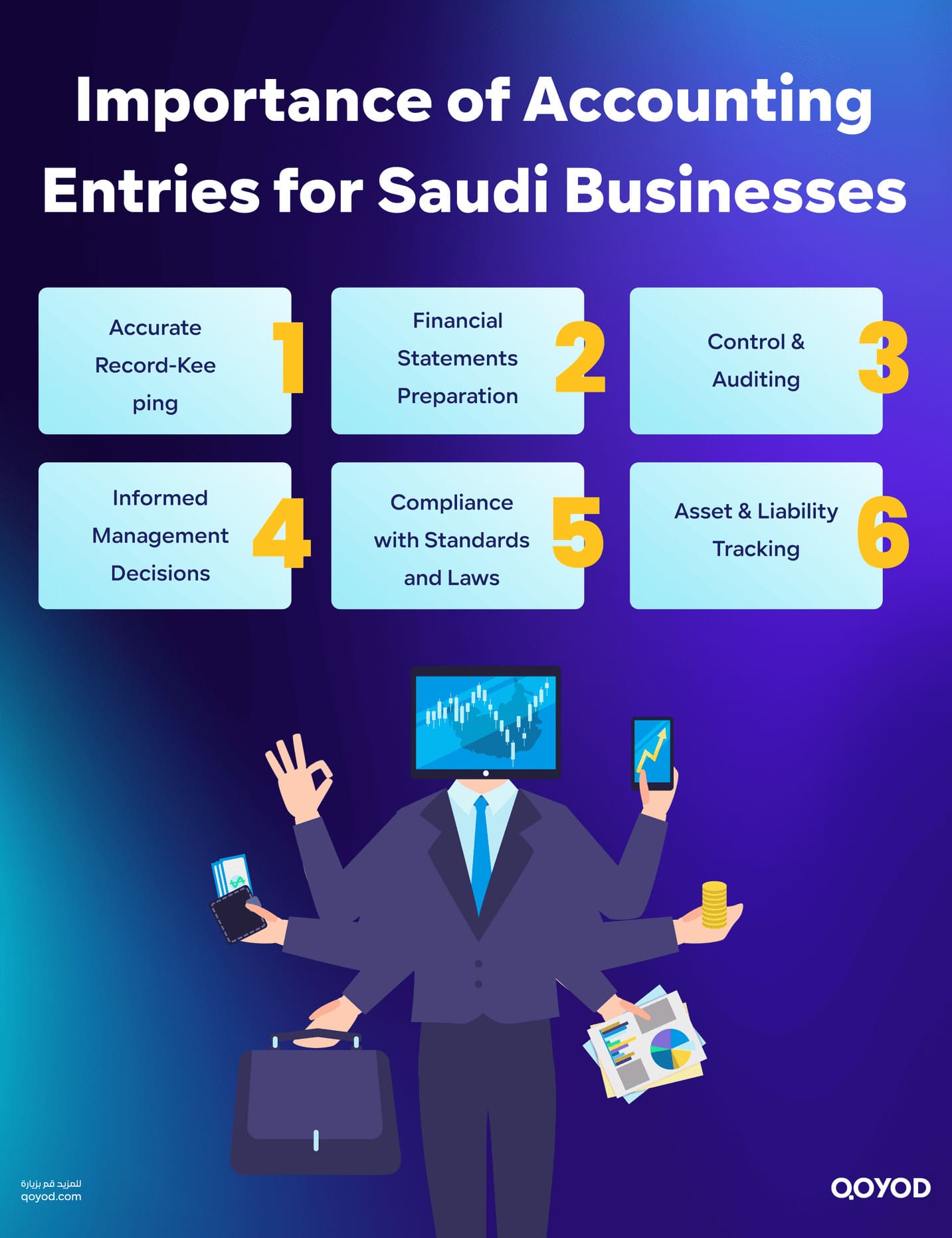
Accounting Entries play a vital role in ensuring the integrity and accuracy of financial data, providing a reliable foundation for managerial and investment decisions in the local market. Their value rests on three properties that no other record in the business carries at once.
First, they give a detailed record of every financial transaction the company makes, which makes it straightforward to trace where money came from and where it went. Second, they give a clear picture of the company’s financial position at any point in time, so managers can see which activities generate profit and which absorb it, and where income and expenses actually originate.
Third, they add reliability and transparency to the financial statements, and that is what makes those statements usable for strategic decisions, for performance evaluation, and for demonstrating compliance with accounting standards. Together those three properties turn into the following practical benefits:
- Accurate Documentation and Recording of Financial Operations: Entries act as the official record for every financial transaction, ensuring a complete record for easy tracking.
- Preparation of Financial Statements and Reports: Financial statements rely on data recorded in the entries. Entries are the basis for preparing the reports that external auditors and regulators examine, enhancing transparency and credibility in companies.
- Financial Control and Auditing: Entries support the internal control system that keeps financial records reliable. They facilitate external auditing, allowing auditors to verify the correctness of records against accounting standards, and they are what a trial balance is built from.
- Informed Management Decisions: Entries provide detailed information on financial performance. Management can use this data to analyze performance, identify strengths and weaknesses, and make better decisions regarding operational activities, investments, and financing in the Kingdom.
- Compliance with Accounting Standards and Laws: They ensure organizations adhere to accounting standards adopted by SOCPA and local tax and legal regulations, particularly the mandatory e-invoicing system. Compliance reduces legal and financial risks, avoiding potential fines and penalties.
- Tracking Assets and Liabilities: Entries track and record all company assets and liabilities, providing the net worth of the company for appropriate financial decisions.
Legal Significance of Accounting Entries
Accounting Entries are crucial not just for internal finance but also for the legal and compliance framework. The purpose of the journal is to hold a balanced record of accounts in strict date and number sequence, from which every account, debit or credit, is posted to the general ledger. That sequence is what makes the record defensible when it is examined.
- Documenting Rights and Obligations: Entries act as legal evidence, documenting the company’s rights and obligations. Local commercial and civil laws mandate maintaining accurate records, used to prove the validity of commercial transactions and define rights and liabilities in legal disputes.
- Accurate Tax Calculation: Taxes, including Zakat and VAT, are a key part of the relationship between businesses and the state. Accounting Entries are essential for determining the correct tax liability, ensuring adherence to ZATCA’s regulations, and avoiding legal accountability.
- Impact of Tax Laws and Regulations: Constant changes in tax laws, such as updates to VAT, directly affect how entries are prepared. Companies must adapt their systems to align with these new laws, often requiring specific documentation to support the entries for tax auditing.
- Compliance and Risk Protection: Compliance with tax and regulatory laws is vital for protecting the company from substantial financial penalties or criminal liability. Accurate and organized records minimize legal and tax risks, enhancing the company’s reputation.
Accounting Standards and Their Influence on Entries
Accounting standards are rules and principles that dictate how financial transactions are recorded and reports are prepared.
The Role of Accounting Standards
- Standardization: Ensures uniformity in recording and presenting transactions, making financial data comparable between different companies, whether locally or internationally.
- Transparency and Reliability: Boosts the confidence of investors and creditors in the company’s financial data.
- Compliance: Helps companies comply with local and international regulations, minimizing risks.
Types of Accounting Standards
Companies predominantly comply with the International Financial Reporting Standards (IFRS), adopted in the Kingdom, in addition to updates issued by SOCPA.
- IFRS (International Financial Reporting Standards): Issued by the International Accounting Standards Board (IASB), used in over 140 countries.
- GAAP (Generally Accepted Accounting Principles): Primarily used in the US.
Core Accounting Principles Impacting Entries
Accrual Basis: Revenue and expenses are recorded when earned or incurred.
Historical Cost: Assets are recorded at their original cost.
Going Concern: Assumes the company will continue to operate.
Matching Principle: Expenses are matched with the revenue they generated.
Consistency: Accounting policies are applied uniformly.
Full Disclosure: All material financial information is disclosed.
Materiality: Focus on information that could influence users’ decisions.
The Importance of Internal and External Auditing
In the business landscape, internal and external auditing are twin pillars ensuring the integrity of financial data, particularly the Accounting Entries.
Internal Auditing: The Company’s Vigilant Eye
Internal auditing is an in-house function that evaluates financial and administrative operations, assessing internal control systems to prevent errors and fraud.
- Focus: Checking control systems, verifying financial records, and ensuring operations align with established policies.
- Goal: Risk assessment and providing reports to senior management.
External Auditing: An Independent Integrity Seal
External auditors, who are completely independent, examine the financial statements to provide an unbiased opinion on their accuracy and reliability.
- Focus: Reviewing financial records against accounting standards (IFRS) and local laws.
- Goal: Issuing an audit report that certifies the integrity of the financial statements to the public, investors, and regulatory bodies like ZATCA.
The synergy between internal and external auditing maximizes effectiveness and enhances public trust.
Professional Ethics in Accounting Entries
Professional ethics are the moral compass for accountants, ensuring that the numbers in the Accounting Entries reflect a true and fair view. An entry is only as trustworthy as the person who wrote it, and the pressure to make a period look better than it actually was exists in businesses of every size, not only large ones.
Ethical failure here is rarely dramatic. It looks like a revenue entry dated a few days early, an expense quietly pushed into the following period, or a related-party transaction recorded without disclosure. Each of those entries balances perfectly, and each one misstates the company’s real position.
That is why the standards governing the entries are matched by a code of conduct governing the accountant. The principles below apply whether entries are written by hand or generated by software, because the judgement about what a transaction actually was still belongs to a person:
- Integrity: Being honest and straightforward in every step, recording every transaction as it happened without manipulation or fabrication. This is the basis of trust.
- Objectivity: Viewing matters from a neutral angle, making decisions based on facts and evidence, not personal opinions or external pressures.
- Confidentiality: Safeguarding sensitive and secret information.
- Avoiding Conflicts of Interest and Pressure: Accountants must be strong enough to resist pressures to alter figures, sticking to professional principles.
- Documentation and Disclosure: Documenting every transaction and decision. Accountants have an ethical responsibility to report any illegal or unethical activity.
Conclusion: Transforming Challenges into Opportunity with Qoyod
Accounting Entries are an essential part of the accounting process and may sometimes present a challenge to small/medium-sized businesses focused on growth. However, these regulations should not be viewed as an obstacle to innovation; rather, they present an opportunity to enhance financial performance and excel.
By embracing advanced, intelligent accounting systems that leverage data analysis, like Qoyod Accounting Software, companies can move beyond traditional constraints. Qoyod empowers businesses to achieve accurate, transparent, and timely financial reporting, ensuring adherence to correct accounting standards and compliance with all ZATCA requirements, including the mandatory e-invoicing system.
Try Qoyod Accounting Software now to make your business operations easier and more accurate with solutions designed for companies in the region. Start your free 14-day trial and see your entries written for you.
Join our community. Follow us on LinkedIn and X (Twitter) for the latest articles and updates in accounting and finance.
FAQ: Essential Questions about Accounting Entries
What are Accounting Entries?
Accounting Entries are the fundamental method used to document and record all financial transactions that occur within a company. Their primary purpose is to ensure commitment to the standards set by the Saudi Organization for Chartered and Professional Accountants (SOCPA) and facilitate subsequent auditing. They include Debit and Credit accounts and a brief Description, playing a key role in preserving financial rights and analyzing the company's performance.
What are the main types of Accounting Entries?
The most common types of Accounting Entries essential for businesses include: the Journal Entry, the Simple Entry, the Compound Entry, the Reversing Entry (an adjusting entry that is cancelled at the start of the next period), the Rectifying Entry (used for error correction), the Closing Entry (for year-end procedures), the Opening Entry (for period start), and the Adjusting Entry (used to finalize revenues and expenses at the end of the accounting period according to local standards).
What is the difference between a Simple Entry and a Compound Entry?
A Simple Entry records only one account in the Debit side and one account in the Credit side. In contrast, a Compound Entry involves more than one account on either the Debit side, the Credit side, or both. This is typical for complex transactions, such as multiple payments or a purchase involving partial credit.
How should Accounting Entries be written correctly?
To write a correct accounting entry, you must accurately identify the Debit account and the Credit account, provide a concise Description of the transaction, and properly document the Date, Entry Number, and Ledger Page. It is also vital to assign a Cost Center according to the company's structure to ensure easy review and compliance with regulatory systems.
Why are Accounting Entries important for financial management?
The organized and accurate recording of Accounting Entries provides a reliable foundation for preparing financial reports, evaluating profits and losses, identifying financial strengths and weaknesses, and making informed decisions regarding investment or cost reduction. Furthermore, it significantly facilitates tax assessment and auditing, especially with ZATCA's requirements and the e-invoicing system.
How do Accounting Entries relate to local laws?
Accounting Entries serve as legal evidence to substantiate transactions before official authorities or in legal disputes. They are essential for accurately calculating tax liabilities and ensuring the company's full compliance with regulations like the Zakat, Tax and Customs Authority (ZATCA) system, thereby avoiding legal penalties.
What are the most important accounting standards that affect the writing of entries?
Companies adhere to the International Financial Reporting Standards (IFRS), supplemented by updates from SOCPA. These standards require that operations be recorded accurately and transparently, particularly adhering to the principles of the Accrual Basis, Consistency, and Full Disclosure.
What is the difference between internal and external auditing of entries?
Internal Auditing is an internal function that monitors the integrity of the entries and continuously assesses operations from within the company. External Auditing, however, is an independent examination by an external party to confirm the fairness, accuracy, and compliance of the financial records with local regulations and standards.
How does professional ethics play a role in Accounting Entries?
Professional ethics mandate that the accountant maintains Integrity, Objectivity, and Confidentiality when recording Accounting Entries. This requires accurate documentation of all details without manipulation, preserving the trust of the company and regulatory bodies, and ensuring the validity of financial decisions.