




Three and a half times in a single year
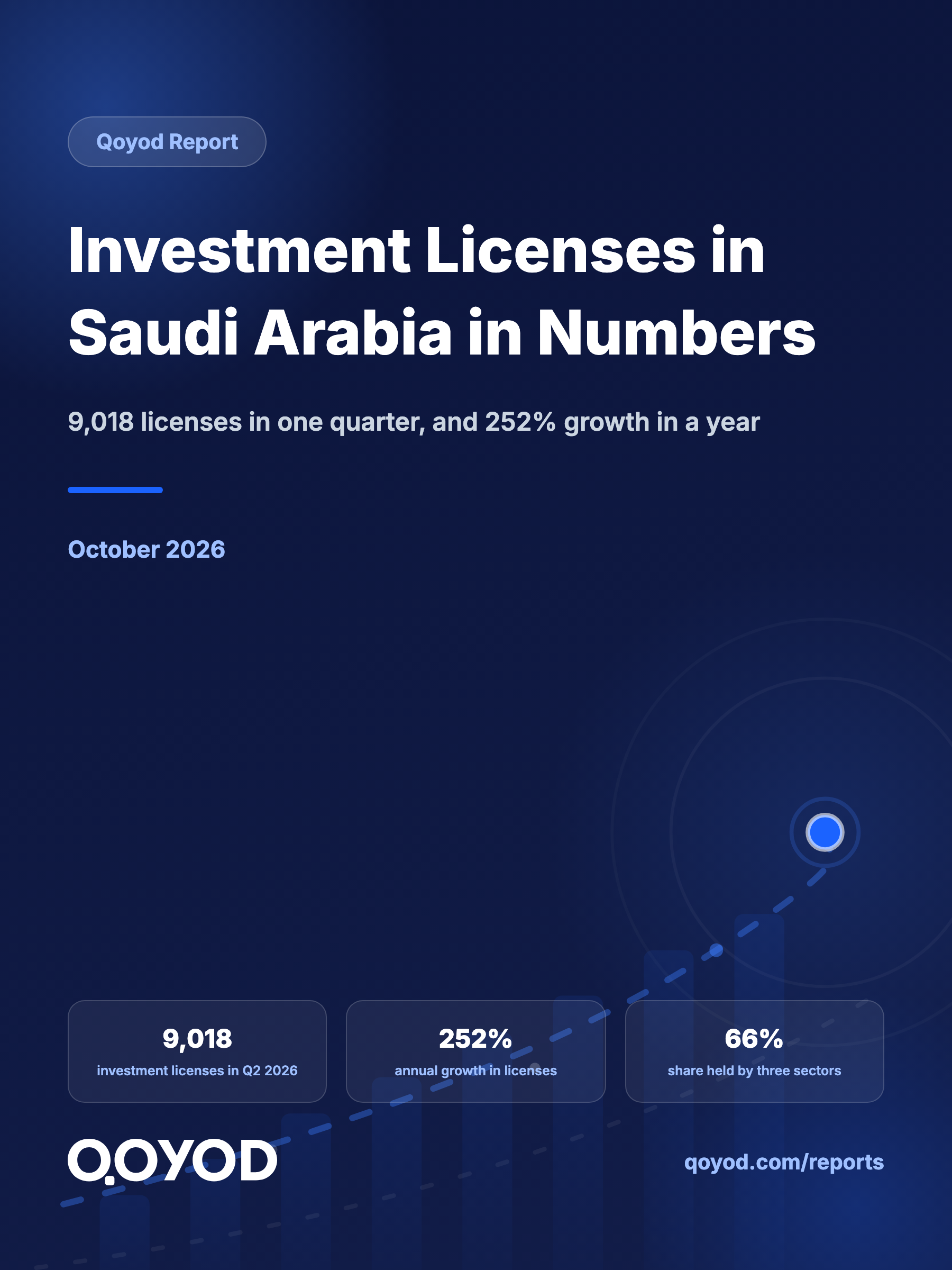
Investment licenses issued in the Kingdom during the second quarter of 2026 rose to 9,018, against about 2,561 in the same period last year, growth of +252% according to Ministry of Investment data.
The difference is 6,457 additional licenses in one quarter. Dividing issuance by the days of the quarter gives roughly one hundred licenses a day, a new investment door opening every few minutes of the working day.
Source: Ministry of Investment, investment licenses issued in Q2 2026, as published by Okaz and Al-Bilad.
Three sectors carry two-thirds of issuance
Most licenses concentrated in three activities: construction, wholesale and retail trade, and manufacturing. Together they account for about 66% of licenses issued during the quarter.
According to the sector-level figures published, construction led with about 2.6 thousand licenses, up +218%, followed by wholesale and retail trade with about 2.3 thousand, up +285%, then manufacturing with more than one thousand, up +284%. In other words, issuance in each of the three rose to more than three times its prior level. About a third of issuance (34%) was spread across the rest of the economy.
| Sector | Licenses issued (approx.) | Annual growth |
|---|---|---|
| Construction | 2.6 thousand | +218% |
| Wholesale and retail trade | 2.3 thousand | +285% |
| Manufacturing | more than 1 thousand | +284% |
| The three combined | about 66% of the total | three times and above |
Source: Ministry of Investment, as published in the press. Sector figures are approximate as reported, and appear in only one publication.
Source: Ministry of Investment, as published in the press. Figures are approximate as reported.
What this means for a business starting today
Every one of these licenses is a business starting out, and its first questions are accounting questions before they are commercial ones. A business that builds its books correctly from day one saves itself a rebuild later, and the order below spells out how.
First, know where you stand against the VAT registration threshold. Registration is mandatory if your taxable supplies exceed SAR 375,000 a year, and voluntary if they exceed SAR 187,500. That question decides whether you will issue tax invoices and file periodic returns, so settle it before the first invoice, not after.
Second, build the chart of accounts before the first entry. The setup service at Qoyod covers the initial accounting setup and account structure, so you begin with books organised around your actual activity rather than a generic template you adjust later.
Third, issue your first invoice in compliant form. E-invoicing in Qoyod complies with Zakat, Tax and Customs Authority requirements for Phase 1 and Phase 2, so you do not need to rework your invoicing path as the business grows.
Fourth, know the profit of each activity on its own. If you are in trade, the product cost and profit margin report in Qoyod shows average cost and margin per item, category and location, calculated from actual purchase invoices. If you are in contracting or services, the Tasks and Projects module tracks time and cost and ties them to the accounting entries, so each project’s result stands on its own.
Prepared by Qoyod based on documented system capabilities and the registration thresholds published by the Zakat, Tax and Customs Authority.
Recommendations
Four practical steps to take from the numbers in this report:
- Estimate your expected annual revenue and compare it with the SAR 187,500 and SAR 375,000 thresholds before you issue your first invoice.
- Organise your chart of accounts around your activity: trade, contracting or manufacturing. A generic template costs you more time later.
- Separate the business’s accounts from the owner’s from day one. That separation is the first thing a lender asks for when you need financing, and the SME financing report covers it in detail.
- Record expenses and invoices weekly, not at month end. Fresh books show you the profit picture while you can still act on it.
9,018 licenses, growth of +252%, and roughly one hundred licenses a day: this is the picture of an economy opening its doors to a new generation of businesses within the path of Saudi Vision 2030. The business that begins with organised books is the one that learns early whether it is profitable, and where.
Sources
- Ministry of Investment via Okaz: investment licenses issued in Q2 2026 rose 252% to 9,018 against about 2,561 in the same period last year (primary source for the total and growth). The Ministry’s original bulletin was not available when this report was prepared; the figures are relayed from it as published.
- Ministry of Investment via Al-Bilad (20 August 2026): licenses concentrated in wholesale and retail trade, construction and manufacturing at about 66% of the total, matching the total and growth reported by Okaz.
- Sama News Agency: the three sector figures (construction 2.6 thousand, up 218%; wholesale and retail trade 2.3 thousand, up 285%; manufacturing more than one thousand, up 284%).
- Zakat, Tax and Customs Authority: VAT registration thresholds, SAR 375,000 mandatory and SAR 187,500 voluntary, and e-invoicing requirements for Phase 1 and Phase 2.