




From 79% to 85% in a single year
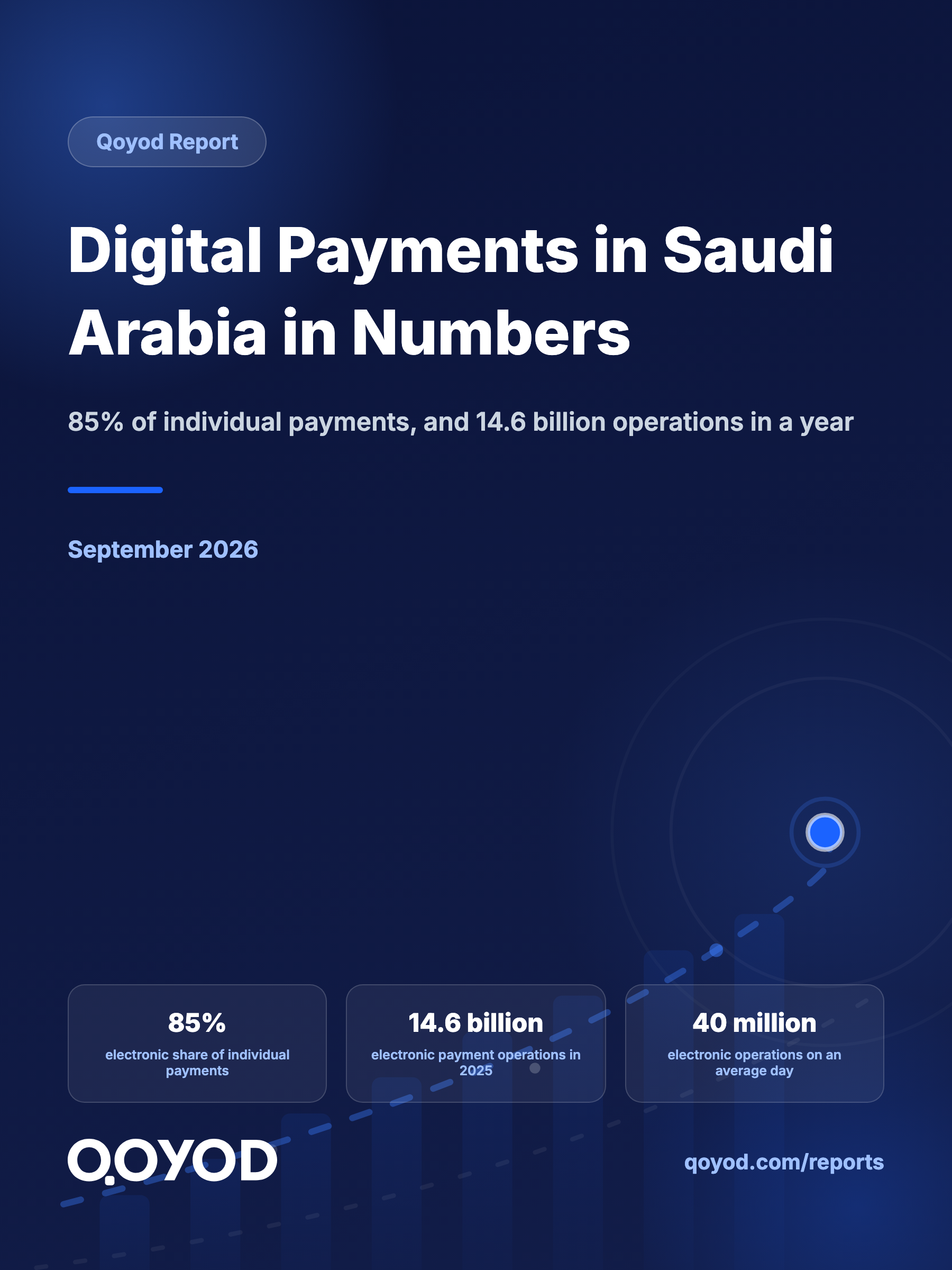
The figures published by the Saudi Central Bank are clear: electronic payments reached 85% of all payment operations carried out in the individual retail segment by the end of 2025, against 79% in 2024.
Six percentage points in twelve months looks small until you remember the share was already high. Moving from 79% to 85% means more than a quarter of what remained of non-electronic payments converted in one year.
That level places the Kingdom among the world’s advanced adopters of digital payment, on a path led by Saudi Vision 2030 toward reduced reliance on cash.
Source: Saudi Central Bank, statement on the electronic payments share for 2025.
14.6 billion operations: forty million a day
Behind the percentage stands an enormous volume. Electronic payment operations carried out through the national payment systems reached about 14.6 billion in 2025, against 12.6 billion in 2024, growth of +15.9%.
Divide that by the days of the year and the daily meaning emerges: roughly forty million electronic payments executed in the Kingdom every day. From an accounting standpoint, each one is a recorded movement that can be traced and reconciled.
Source: Saudi Central Bank. The daily average is a Qoyod calculation dividing total operations by the days of the year.
Transactions are growing faster than their value
Now move from the annual total to the weekly pulse. We matched every available 2026 week against the same week of 2025 in the Saudi Central Bank’s point-of-sale bulletins, and two patterns appeared together.
The first is that growth was positive in all seven weeks, in both transaction counts and value. The second, and analytically the more interesting: transaction counts grew by an average of +10.1% while value grew by an average of +4.5%.
What does it mean for transactions to grow at nearly double the rate of value? It means the increase is coming from smaller, more frequent payments. Electronic payment is no longer reserved for large purchases; it has become the default method for small everyday ones.
| Week (2025 vs 2026) | Transaction growth | Value growth |
|---|---|---|
| 20 Jul vs 19 Jul | +9.5% | +3.3% |
| 27 Jul vs 26 Jul | +9.5% | +4.5% |
| 3 Aug vs 2 Aug | +10.9% | +6.7% |
| 10 Aug vs 9 Aug | +11.1% | +5.3% |
| 17 Aug vs 16 Aug | +11.3% | +5.7% |
| 24 Aug vs 23 Aug | +7.8% | steady |
| 31 Aug vs 30 Aug | +10.4% | +6.0% |
| Average | +10.1% | +4.5% |
Source: Qoyod calculation from the Saudi Central Bank’s weekly point-of-sale bulletins, each 2026 week compared with its matching 2025 week.
In the most recent available week, 30 August to 5 September 2026, point of sale alone recorded 267.8 million transactions worth SAR 15.84 billion, at an average bill of SAR 59.1.
What it means when 85% of your customers pay electronically
This share is not a general economic headline; it is a change in the nature of your books. When the overwhelming majority of your receipts are electronic, your revenue becomes almost fully traceable and reconcilable, and the gaps that cash used to create shrink.
First, make bank reconciliation a weekly habit. Every electronic receipt leaves a trace on the statement. Qoyod connects to banks for reconciliation purposes, so you catch discrepancies close to their date rather than months later.
Second, understand the hardware boundary precisely. An important point many get wrong: the Qoyod point-of-sale device issues and prints invoices, while card amounts are collected through the payment provider’s terminal, and the transaction is then recorded in the system. Knowing that separation keeps you from building an operating procedure on a wrong assumption.
Third, tie e-invoicing to payment activity. Forty million daily operations in the market mean issuing speed and compliance are an operating requirement, not a luxury. E-invoicing in Qoyod complies with Zakat, Tax and Customs Authority requirements for Phase 1 and Phase 2.
Fourth, read frequency, not just totals. If market growth is coming from smaller and more numerous transactions, the bill-count metric now matters as much as sales value. Compare periods in Qoyod’s reports, up to 13 consecutive periods, and watch both indicators together.
Prepared by Qoyod based on documented system capabilities and the figures in this report.
Recommendations
Four practical steps to take from the numbers in this report:
- Offer multiple electronic payment options at the till. In a market where 85% of operations are electronic, limited payment choice becomes an obstacle to closing the sale.
- Track bill counts as an independent metric. Transaction growth of +10.1% against +4.5% in value means frequency is the current engine of growth.
- Close the reconciliation cycle weekly. The digital trace of every operation makes reconciliation fast; only postponement makes it hard.
- Review invoicing readiness before peak seasons. Compliance is built on ordinary days and tested on busy ones.
85% of individual payments, 14.6 billion operations, forty million every day, and frequency growing faster than value: these are the numbers of an economy that has moved to digital payment with confidence within the path of Saudi Vision 2030. The business that turns that digital trace into organised books benefits twice: in the sale, and in knowing its result precisely.
Sources
- Saudi Central Bank: the electronic payments share reached 85% of total individual payment operations in 2025 against 79% in 2024, with about 14.6 billion electronic operations through the national payment systems against 12.6 billion in 2024.
- Saudi Central Bank: Weekly Points of Sale Transactions, report for the week ending 5 September 2026 (transaction count, value and average bill for the latest available week).
- Saudi Central Bank: Weekly Points of Sale Transactions for 2025 and 2026 (reports for the weeks ending 16 August, 6 September and 13 September 2025, and 8 August and 5 September 2026), the basis for the year-on-year comparison of transaction counts and value.
- Zakat, Tax and Customs Authority: e-invoicing requirements for Phase 1 and Phase 2.