




Profit is not cash
The most common misunderstanding in business management is confusing profit with cash. Profit is recorded the moment of the sale, even if the amount has not arrived yet, while cash flow is the actual money moving in and out of the bank. A business selling at an excellent margin may be unable to pay salaries if its sales stay suspended in uncollected receivables. That is why it is said that profit is an opinion, but cash is a fact.
Accounting rule: a profitable-on-paper business can still stumble if it runs out of cash. Cash flow is the survival metric.
The tool that measures liquidity health is the Cash Conversion Cycle (CCC): how many days money stays outside the business from buying inventory to collecting the sale. The shorter this cycle, the more liquidity is available for operations and growth.
The shorter the cycle, the more liquidity available for growth and operations. Standard accounting definition.
The Kingdom is speeding up cash digitally
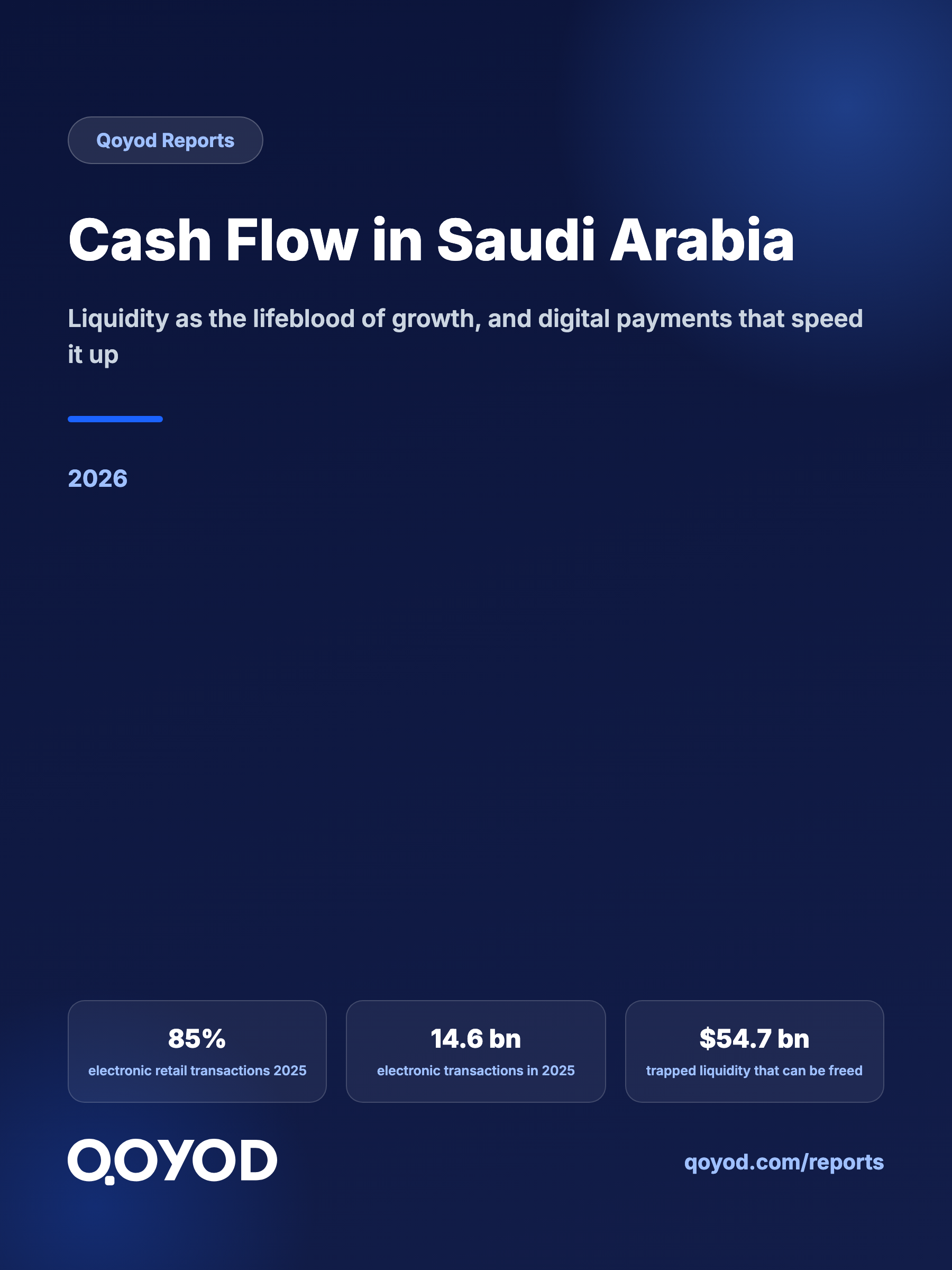
One of the strongest drivers of cash flow in Saudi Arabia is the accelerating shift to digital payments. According to the Saudi Central Bank (SAMA), the share of electronic payments rose to 85% of total retail transactions in 2025, up from 79% in 2024, after the Kingdom beat Vision 2030’s 70% target early in 2023.
% of retail transactions
% of retail transactions
Source: Saudi Central Bank (SAMA) via Arab News. The Vision 2030 target (70%) was achieved early in 2023.
The absolute figures are clearer: the number of electronic transactions reached about 14.6 billion in 2025 versus 12.6 billion in 2024. The SARIE instant payment system processed about 784 million transactions, up more than 32%, and the SADAD system about 373 million. Every instant digital transaction means cash that arrives faster and is recorded automatically, the essence of healthy cash flow.
Source: Saudi Central Bank (SAMA) via Arab News, 2025.
Trapped liquidity: an opportunity, not a burden
Despite faster payments, a large share of liquidity remains “trapped” in working capital: uncollected receivables, unsold inventory, and unsettled payment terms. PwC’s Middle East Working Capital Study 2025 estimated that around $54.7 billion of liquidity is trapped in listed regional companies, with an average collection period of 81.1 days. This is not a loss but liquidity that can be released through better management of collection, inventory and payables.
Source: PwC Middle East Working Capital Study 2025 (FY2024 data). Average collection period 81.1 days.
Liquidity tools within businesses’ reach
Alongside internal management, liquidity financing tools have expanded in Saudi Arabia. SME financing reached about SAR 420.7 billion by the end of Q2 2025, up 37% year on year, with “invoice financing” a leading component because it turns uncollected receivables into instant liquidity. This is supported by the Kafalah program, which guarantees up to 80% of eligible financing.
| Lever | Effect on cash flow |
|---|---|
| Speeding up collection (e-invoicing + reminders) | Shortens how long money stays outside the business |
| Digital and instant payments | Faster cash arrival and accurate automatic recording |
| Inventory management | Reducing idle stock frees up frozen liquidity |
| Negotiating payment terms | Aligning supplier payment dates with the collection cycle |
| Invoice financing and Kafalah | Temporarily bridges the liquidity gap without halting operations |
The first condition for all of the above is visibility: you cannot manage what you cannot see. This is where the accounting system comes in. Qoyod, an Arabic cloud accounting system, shows your cash-flow statement, customer and supplier balances, receivables aging and financial reports in real time and compliant with e-invoicing, so you manage your liquidity on a number, not a guess.
Outlook to 2030 and recommendations
As instant digital payments expand and business digitization deepens, cash movement is expected to accelerate further and the collection time gap to shrink gradually. Practical recommendations:
- Separate cash tracking from profit tracking, and monitor cash flow and the cash conversion cycle monthly.
- Adopt digital payments and e-invoicing to speed up cash arrival and document it automatically.
- Free up liquidity frozen in receivables and inventory before resorting to financing.
- Use invoice financing and Kafalah as a considered interim liquidity solution, not a substitute for disciplined management.
Cash flow is not just a line in the financial statements; it is the heartbeat of the business. Whoever manages it with clear visibility and digital tools turns liquidity from a constraint on growth into fuel for it.