




September slides, then jumps in its final week
Start with the shape of the month. According to the Saudi Central Bank’s weekly point-of-sale bulletin, September 2025 opened at SAR 14.95 billion in the week of 31 August to 6 September, then fell to SAR 13.11 billion, then to SAR 12.40 billion. Three consecutive weeks of decline.
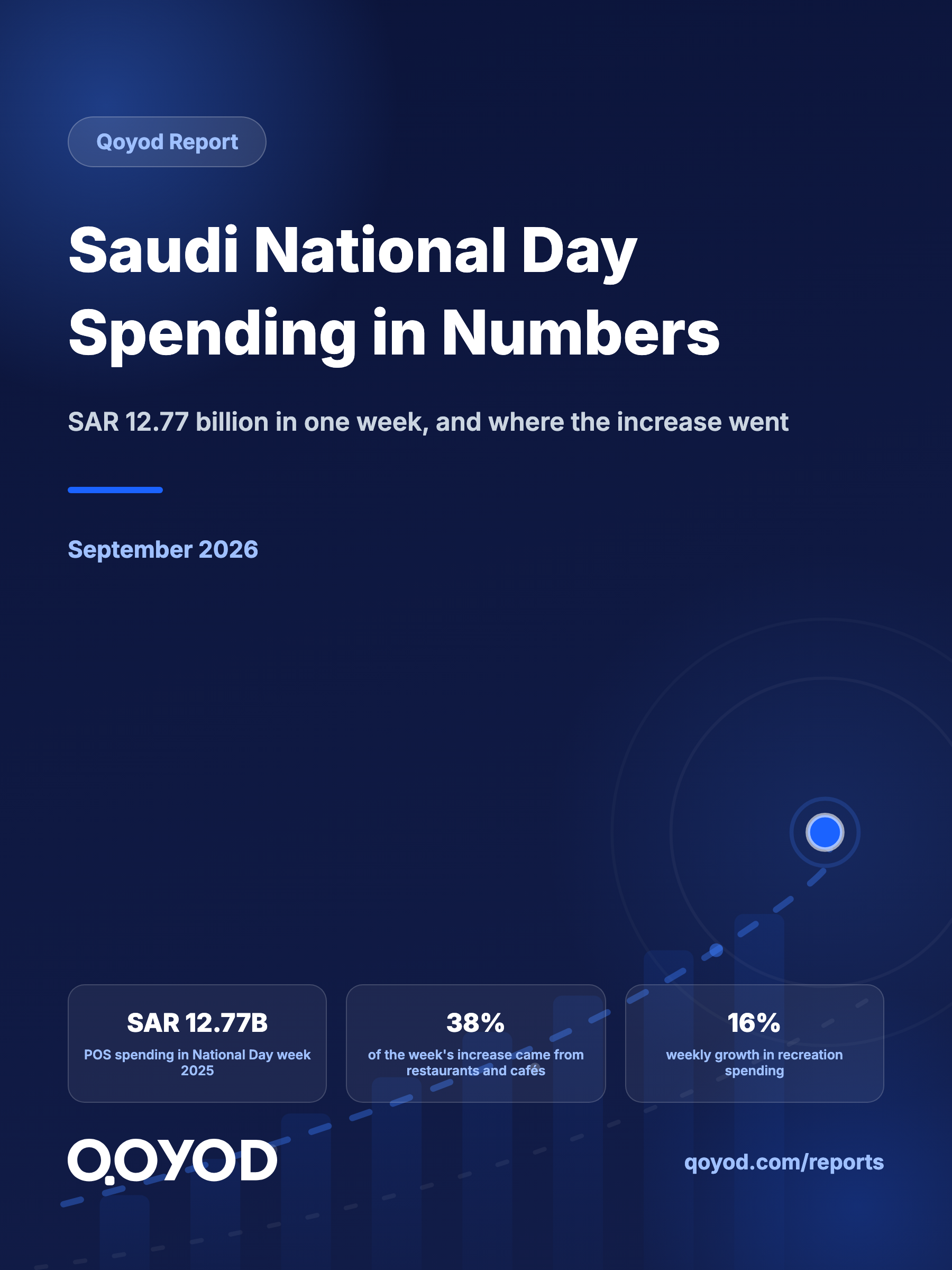
In the fourth week, 21 to 27 September, the figure rose 3.0% to SAR 12.77 billion. The only rising week in the entire month, and the week that contains National Day.
The same pattern appeared in 2024, more sharply: SAR 13.35 billion in the first week of September, then 12.20, then 11.97, then an 11.9% jump to SAR 13.39 billion in the week of 22 to 28 September. National Day week did not merely break the decline that year. It posted the highest figure of the month.
Source: Saudi Central Bank, Weekly Points of Sale Transactions, reports for the weeks ending 27 September 2025 and 28 September 2024. Values in SAR billion.
38% of the increase came from one table
Spending in the week of 21 to 27 September 2025 rose by SAR 368.3 million over the preceding week. Where did that increase come from?
SAR 140.3 million of it, or 38% of the entire increase, came from a single activity: restaurants and cafés. Add furniture and home supplies, apparel and accessories, and the “other” grouping, and four activities account for 96% of the weekly increase.
Source: Qoyod calculation from the Saudi Central Bank weekly POS bulletin, difference between the week of 21 to 27 September 2025 and the week of 14 to 20 September 2025.
In percentage terms the picture sharpens. The total rose 3.0%, while recreation rose 16.0%, telecommunication 12.0%, furniture 11.9%, personal care 10.3% and restaurants and cafés 9.7%. Those activities grew three to five times faster than the market did in the same week.
| Activity | Week value (SAR million) | Weekly change |
|---|---|---|
| Recreation | 255.3 | +16.0% |
| Telecommunication | 155.7 | +12.0% |
| Furniture & home supplies | 682.0 | +11.9% |
| Recreation & culture | 379.0 | +10.7% |
| Personal care | 114.0 | +10.3% |
| Restaurants & cafés | 1,587.9 | +9.7% |
| Bakeries & pastries | 255.2 | +8.0% |
| Apparel, clothing & accessories | 951.1 | +7.9% |
| Food & beverages | 1,852.6 | +2.3% |
| Electronic & electric devices | 204.9 | +1.8% |
| Total POS | 12,771.9 | +3.0% |
Source: Saudi Central Bank, Weekly Points of Sale Transactions, week of 21 to 27 September 2025 compared with the preceding week.
The 2024 bulletin used a slightly different activity taxonomy and produced almost the same ranking: food and beverages up 28.0%, recreation and culture up 24.6%, telecommunication up 21.0%, furniture up 16.5%, restaurants and cafés up 12.1%, clothing and footwear up 8.3%. Two different years, one list of winners.
And the activities that pay for that week
Not every activity wins in this week, and this is the part the usual coverage of the headline number leaves out.
Hotels fell 5.1% in National Day week 2025, and 18.3% in the 2024 equivalent. Education dropped 34.3% in 2025 and 21.3% in 2024, a predictable seasonal fall once the back-to-school wave ends. Jewelry declined 7.5% in 2025 after rising in the week before it.
Source: Saudi Central Bank, Weekly Points of Sale Transactions, week of 21 to 27 September 2025, change on the preceding week.
The fastest growth was outside Riyadh
Riyadh accounts for 35.7% of POS spending in the Kingdom, SAR 4.56 billion in National Day week 2025, followed by Jeddah at SAR 1.80 billion and 14.1%. That is the familiar picture.
Look at growth rather than size and the ranking inverts. Riyadh grew 1.5% that week, while Hail grew 8.6%, Hafr Al-Batin 6.9%, Buraidah and Taif 5.1% each, and Makkah 4.8%. Relative to their size, the smaller cities moved most.
Source: Saudi Central Bank, Weekly Points of Sale Transactions, Table 2.1 “By Cities”, week of 21 to 27 September 2025.
What this means for the week of 20 to 26 September 2026
The 96th Saudi National Day falls on Wednesday 23 September 2026, inside the week running from Sunday 20 September to Saturday 26 September on the POS bulletin’s calendar.
This year’s spending base is higher. In the week of 16 to 22 August 2026, POS spending reached SAR 14.17 billion across 237.3 million transactions, against SAR 13.41 billion in the equivalent week of 2025 (17 to 23 August), annual growth of 5.7%.
If the National Day week lift repeats as it did in the past two years (3.0% in 2025 and 11.9% in 2024) on a week whose base is close to the current level, the week of 20 to 26 September 2026 lands between SAR 14.6 billion and SAR 15.9 billion. That is arithmetic built on the pattern repeating, not an official forecast: the level of the preceding week is what will actually set the number.
Source: Saudi Central Bank, Weekly Points of Sale Transactions, reports for the weeks ending 28 September 2024, 27 September 2025 and 22 August 2026.
What a business owner prepares before the week
The operational reading is straightforward: the week brings a different basket, not a bigger market. A restaurant, a café, an apparel store and a home-supplies shop see a short peak compressed into a handful of days, while a hotel or a training centre sees the opposite. The brevity is the real problem: a stock or invoicing error has no room to be fixed inside the same week.
First, load stock quantities before the week starts. In Qoyod, a stocked item with a zero balance cannot be sold from the POS app, and quantities are not added from the app itself but from the web system through opening balances, a purchase invoice, or a stocktake. Preparing quantities in advance prevents selling from stopping in the busiest hours of the week.
Second, confirm e-invoicing readiness. A sales peak is not the moment to discover a compliance problem. E-invoicing in Qoyod complies with Zakat, Tax and Customs Authority requirements for Phase 1 and Phase 2, and the system exchanges invoices with the Authority automatically.
Third, set discount permissions before the rush. The point-of-sale system lets you define who can grant a discount and the maximum percentage they may apply. In a week full of offers, that setting is what protects the margin at the till.
Fourth, mind offline mode. The app works without internet, but an invoice whose sync has not completed is lost if the user signs out before syncing finishes. The peak-day rule: no sign-out before sync completes. Details on the offline mode page.
Fifth, prepare the post-peak read. Returns rise after occasion weeks, and the question worth answering is not “how much did we sell” but “how much did we earn, and on which item”. The product cost and profit margin report in Qoyod shows average cost and margin per item, category and location, and period comparison extends to 13 consecutive periods.
Prepared by Qoyod based on documented system capabilities. The point-of-sale system is a paid add-on, separate from the accounting plans and not included in the free trial.
Recommendations
Five steps to take from the numbers in this report:
- Read your own category, not the total. A 3% market rise means nothing to a restaurant whose activity grew 9.7%, nor to a hotel that fell 5.1% in the same week.
- Fix your week precisely: 20 to 26 September 2026. The peak is days, not a month, and any preparation that starts after Sunday 20 September is late.
- Prepare stock and invoicing before the week, not during it. Operational errors in a short week cannot be corrected inside it.
- Cost your discounts before launching them. The activities that grow in this week grow on demand, and an uncosted discount eats a margin that was already coming.
- Measure once it ends. Compare the week with the one before it and with last year’s National Day week, at item level rather than totals.
One week a year changes the Saudi spending basket this clearly, and it lasts seven days. The business that benefits from it is not the one that spends most on offers, but the one that arrives with stock loaded, invoicing ready, and numbers it can actually read once the week is over.
Sources
- Saudi Central Bank: Weekly Points of Sale Transactions, report for the week of 21 to 27 September 2025 (primary source for the total, activity and city figures of National Day week 2025).
- Saudi Central Bank: Weekly Points of Sale Transactions, report for the week of 22 to 28 September 2024 (National Day week 2024 and the September weeks preceding it).
- Saudi Central Bank: Weekly Points of Sale Transactions, report for the week of 16 to 22 August 2026 (current spending base and transaction count).
- Saudi Central Bank: Weekly Points of Sale Transactions, report for the week ending 13 September 2025 (figures for the week of 17 to 23 August 2025 used in the annual growth calculation).
- Zakat, Tax and Customs Authority: e-invoicing requirements for Phase 1 and Phase 2.