|
Expert summary This article covers the major accounting errors that have damaged companies and investors worldwide. It explains what causes them, how an error differs from fraud, and what the biggest scandals teach us about governance and disclosure. Useful for finance teams, accountants, and SMEs that want tighter financial control. |
Major accounting errors are a constant challenge in business. Size and experience do not protect a company from them.
The damage goes well beyond the immediate financial loss. A single misstatement can hurt a company’s reputation, erode investor and customer trust, and unsettle the wider market. Every wrong figure in the books, careless or accidental, can distort a financial report. Distorted reports lead to bad decisions, and those decisions affect everyone with a stake in the business.
So why write about major accounting errors? Because awareness is the first line of defence. Accuracy is not a technical detail. It is a strategic pillar that protects companies and economies from the fallout of misstatements. That fallout is real: heavy fines, legal penalties, and in the worst cases the collapse of a household name, as the Enron scandal in the United States showed.
Studying these cases also shows how technology, expertise, oversight, and ethics work together to contain the risk. This matters most for small and medium-sized businesses (SMEs). If you run one on a cloud accounting system such as Qoyod Accounting Software, three habits keep you safe:
- Run proper internal and external audit procedures.
- Use smart tools that flag irregularities early.
- Correct deviations the moment they appear, not at year end.
Watch the Qoyod video on accounting errors
Defining Accounting Errors and Their Common Types
An accounting error is a mistake made while recording, processing, or posting financial data. The result is a financial report that is inaccurate or misleading.
That has three knock-on effects:
- Decisions get made on the wrong numbers.
- Tax compliance is put at risk.
- Financial disclosure loses its credibility.
Types of Accounting Errors and Their Common Causes
| Type of Error | Brief Description | Common Cause | Impact |
| Error of Original Entry | The wrong amount is entered from the start (for example, 10,000 instead of 1,000). | Distraction, or numbers never checked. | Final statement figures are wrong. |
| Duplication Error | The same transaction is recorded twice, such as an expense or income invoice entered more than once. | Duplicated effort, or no entry review. | Figures in the reports are inflated. |
| Error of Omission | A transaction is never recorded at all, such as a missed supplier invoice. | Lost documents, or data never entered. | Accounts are incomplete and results are off. |
| Error of Commission | The right amount goes into the wrong sub-account, such as posting customer A’s payment to customer B. | The chart of accounts is not understood, or the team is under pressure. | Customer and supplier balances get mixed up. |
| Transposition Error | Two digits are swapped during input (for example, 396 instead of 369). | Fast typing, no second check. | Small gaps that are hard to spot without reconciliation. |
| Error of Principle | A transaction is recorded in a way that breaks accounting standards, such as booking a personal expense as a company expense. | Limited experience, or standards such as IFRS are not known. | Very risky for tax and standards compliance. |
| Entry Reversal Error | A transaction is recorded the wrong way around: an expense booked as income, or the reverse. | Haste, or no review. | Profit and loss results are distorted. |
| Reconciliation Error | Records do not match the bank account or the ledger, which points to a wrong or missing entry. | Weak reconciliation routine, or no oversight. | The final balance is unreliable. |
| Compensating Error | Two errors cancel each other out, such as an expense and an income both inflated by the same amount. | Pure chance. | Hard to detect, because the totals look right. It still skews financial analysis. |
Detailed Causes of Major Accounting Errors
To keep financial control tight, an SME needs to know where major accounting errors actually come from. Here are the nine most common sources.
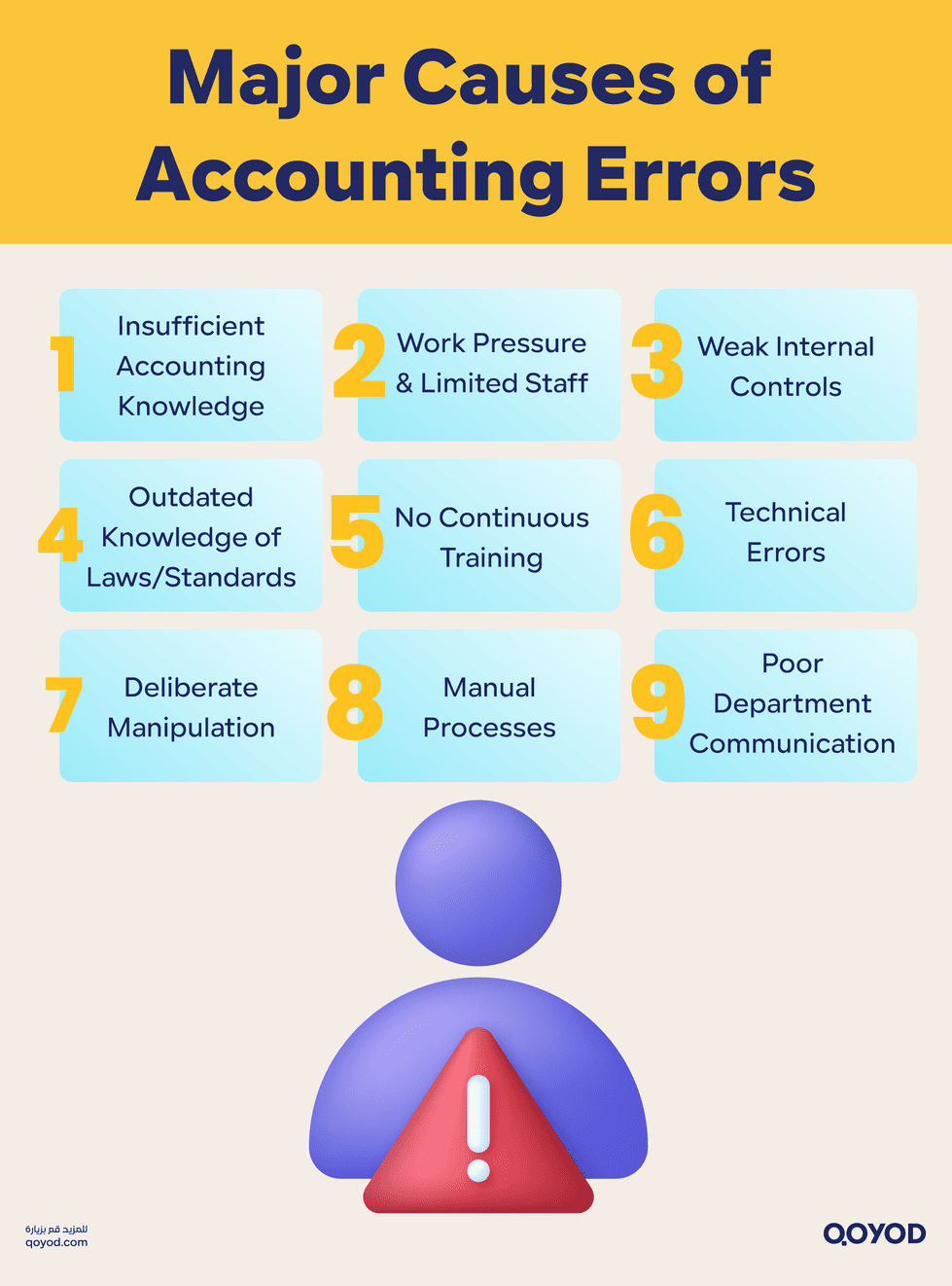
1. Weak Professional Qualification and Accounting Comprehension
Some accountants simply do not know the standards well enough. They may misclassify a transaction, or apply the wrong rule to it. The gap is in training, not intent.
Check out the Qoyod video about accounting mistakes
2. Work Pressure and Limited Human Resources
A crowded workload, too few staff, and tight deadlines all push accountants to rush. Verification and review are the first steps to be skipped, especially at period end or in a busy season. Entries then get recorded incorrectly, or missed altogether.
3. Weak Internal Control and Auditing
With no regular internal auditing, errors go unnoticed and pile up. The same gap makes it easier for manipulation or fraud to take hold.
4. Failure to Keep Pace with Changing Laws and Accounting Standards
Legislation and standards keep moving, both locally and internationally. Teams that do not follow the updates apply outdated rules. That directly affects how assets and liabilities are valued.
5. Lack of Guidance and Continuous Training:
Without ongoing training, staff are left unprepared. They struggle with crises, with new software, and with the digital tools that now handle financial data.
6. Technical Errors and Misuse of Accounting Software:
Software helps, but it is not immune. Wrong input, system faults, poor data integration, or a lost backup after a power cut can all corrupt the records.
7. Lack of Integrity or Intentional Manipulation:
In some organisations the error is deliberate. Losses get hidden, or profits inflated, to mislead investors or regulators. This is the most dangerous category by far, and the most damaging to business survival and market trust.
8. Reliance on Traditional Manual Processes:
Paper ledgers and manual workflows raise the odds of a miscalculation or a bad transfer of figures.
9. Lack of Communication or Poor Coordination Between Company Departments:
When departments do not talk, accurate figures never reach the people who need them. This shows up most often in transfers between branches or projects, and it distorts the final records.
Watch the Qoyod video on accounting errors
Accounting Errors vs. Accounting Fraud
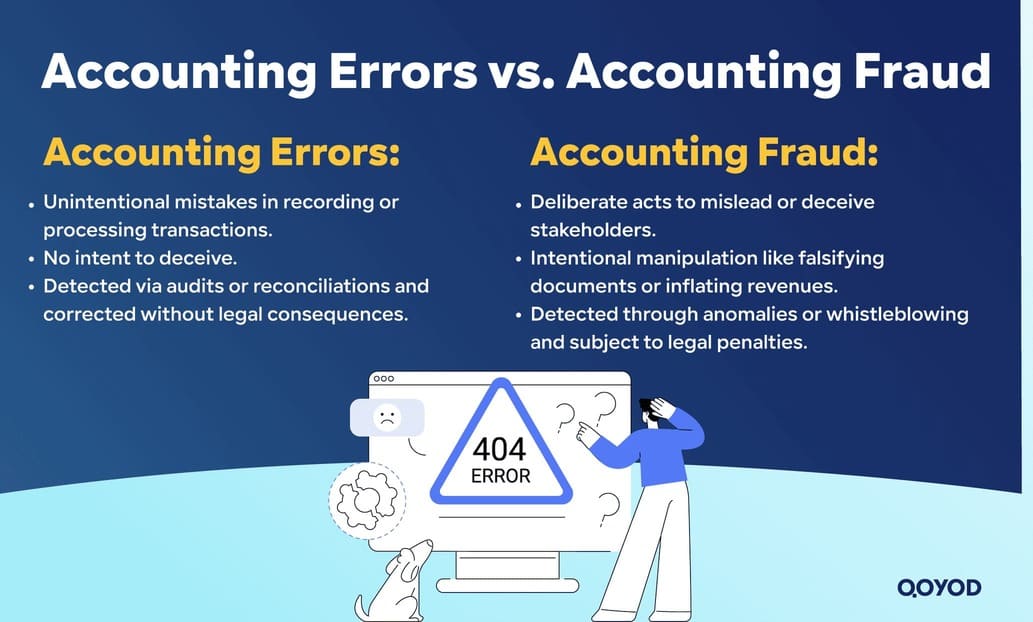
The dividing line is intent. Global financial oversight bodies treat the two very differently because of it.
Accounting Errors
These are unintentional slips made while recording, processing, or posting transactions. They usually come from oversight, negligence, inexperience, or pressure.
- Key characteristic: there is no plan to mislead users or regulators.
- How they surface: periodic reconciliations or internal audits.
- How they are fixed: an adjusting journal entry, or a restatement. There is no direct legal liability unless the error is material.
Accounting Fraud
Fraud is a deliberate act meant to deceive. It usually comes from management or staff chasing personal or company gain.
- Key characteristic: intent. Forged documents, fictitious transactions, hidden debts, or inflated revenue. It feeds on weak internal control.
- How it surfaces: unexplained swings in the numbers, repeated corrective entries, or a whistleblower.
- What follows: legal action and severe penalties for everyone involved.
View the Qoyod video on accounting errors
Case Studies: Major Accounting Scandals That Collapsed Companies
Five cases, two of them Saudi, show how quickly a misstatement can bring a company down.
Mobily Saudi Arabia Case
This is one of the largest financial scandals in the history of the Saudi market. The crisis broke in 2014, when the company was found to have inflated revenue over six straight quarters. It had recognised contracts that were not yet ready for service as revenue due, which breaches international accounting standards.
The fallout was immediate:
- Mobily’s stock fell from SAR 91 to SAR 61 in a short period, costing shareholders billions of riyals.
- More than a thousand shareholders filed lawsuits against five executives.
- Trading was suspended for long stretches, the CEO was dismissed, and new management was appointed.
- The Capital Market Authority imposed strict oversight and a full review of the financial statements.
Investigators later confirmed that Mobily had booked revenue on capital lease contracts and services that did not yet exist. The aim was to show strong results, even though the company could not deliver on those contracts.
In 2020 a court ordered five former officials to pay more than SAR 1.2 billion in compensation to over a thousand affected parties. Recovering the money proved hard. The defendants had limited solvency, and the parent company was not held directly responsible.
The lesson is threefold: transparency matters, internal and external control both matter, and revenue recognition must follow the global standards to the letter. It also pushed the market to strengthen disclosure and governance so misstatements are caught sooner.
Saad Group Saudi Arabia
The collapse of the Saad Group, founded by businessman Maan Al-Sanea, is the largest financial shock Saudi Arabia and the Gulf have seen.
It started in 2009. The Group and Ahmad Hamad Al Gosaibi and Brothers defaulted on debts of more than $22 billion, and dozens of banks around the world went after Al-Sanea in court. He had forged documents and set up fictitious companies to use the Al Gosaibi family trade name. That let him raise huge loans in their name, without their knowledge, and pour the money into an international empire spanning real estate, aviation, and energy.
Investigators found that the Group’s associated bank in Bahrain was a shell with no real clients. Its only purpose was moving funds between accounts.
In 2017 Saudi authorities froze Al-Sanea’s assets and auctioned his properties. The sales raised under SAR 600 million, a fraction of the debt. A Saudi court later sentenced him to prison for corruption and money laundering.
The case exposed how dangerous weak governance and family control can be inside a large company. It also accelerated the Kingdom’s regulatory reforms, aimed at rebuilding confidence and transparency in the private sector.
Details of the Enron Collapse
Enron was one of the largest energy companies in the United States. Founded in 1985, it expanded into energy trading and financial services.
Through the 1990s its leadership, Kenneth Lay, Jeffrey Skilling, and CFO Andrew Fastow, built complex accounting schemes that hid enormous debts in off-balance-sheet Special Purpose Entities (SPEs). The company used creative accounting to book fictitious or inflated profits. Its external auditor, Arthur Andersen, signed off on the practices instead of raising the alarm.
The deception broke open in October 2001. Enron restated its accounts for 1997 to 2000 and wiped hundreds of millions of dollars off its declared profits. The stock fell from more than $90 to less than $1, billions in shareholder savings were lost, and over 4,000 jobs were put at risk.
Nortel’s Canadian Scandal
Nortel, the Canadian telecoms equipment giant, ran one of the most serious accounting scandals of 2000 to 2003. Management falsified profits and revenue for years to show a level of profitability the business never reached.
The main techniques were:
- Recognising revenue early.
- Shifting financial reserves between periods.
- Pushing expenses into later years.
- Counting contracts that were never performed as revenue.
The point of it all was executive bonuses, which topped $70 million on those false results.
External auditors and audit committees eventually uncovered the scheme. Senior management, including the CEO and CFO, were dismissed en masse. Billions were wiped off the market value, the share price crashed, and thousands of employees lost their jobs when the company went bankrupt in 2009. Nortel paid $2.5 billion to settle shareholder lawsuits, and its shares were permanently delisted from the Toronto Stock Exchange.
WorldCom Scandal
WorldCom is one of the largest accounting scandals ever to hit the telecoms sector and the US economy. The company was the second-largest telecoms firm in the United States, built on aggressive expansion through acquisitions.
When the market slowed and competition sharpened, management turned to deceptive accounting to hide losses and inflate profits. It booked more than $3.8 billion of ordinary operating expenses as capital expenditure, so the costs could be depreciated over several years. The result was artificial profits and, for a while, investor confidence.
Internal audit finally uncovered it. The full overstatement exceeded $11 billion.
The scandal became public in mid-2002 and market confidence collapsed. It triggered the largest bankruptcy the United States had seen up to that point, with debts of nearly $41 billion. Thousands lost their jobs, and investor and pension savings were wiped out. The telecoms sector and global markets fell sharply, and regulators reopened the whole question of disclosure and governance for listed companies.
Consequences of Accounting Errors: Impact on Shareholders, Market, and Economy
Major accounting errors hit on three levels at once: the shareholder, the market, and the wider economy.
1. Impact on Shareholders and Investors
Inflated revenue or hidden losses give investors a false picture of performance. They buy or hold on bad information, and the losses that follow can be severe.
2. Impact on the Market
Scandals cost listed companies their credibility. Regulators suspend trading to protect investors, prices swing sharply, and demand for rigorous audits rises. Assurance gets more expensive, and traders grow more cautious.
3. Economic Impact
At the economy level, accounting scandals can trigger a sectoral slowdown and a drop in investment. They can threaten market stability and drag down the credit ratings of the banks involved as financiers. That is why regulators worldwide keep tightening disclosure and transparency rules.
In short: lost market value, lost confidence, heavy financial losses, a legislative backlash, and lasting change to how financial governance is practised.
Lessons Learned: Modern Governance and Financial Disclosure Procedures
Every major scandal points the same way: companies need stronger governance and disclosure procedures to stay transparent and avoid financial collapse.
Key Governance Takeaways
- Separation of powers: keep executive management separate from financial oversight. Set up independent internal audit committees to review operations continuously.
- Strict disclosure policies: give every stakeholder accurate, timely financial information. Apply severe penalties for any attempt to hide or falsify data.
- Digitalisation and automation: regulators increasingly expect automated auditing that flags deviations as they happen. This is where a modern cloud accounting system earns its place.
- Risk analysis and training: analyse financial risk, guarantee audit independence, and train staff on disclosure ethics and transparency.
The conclusion is simple. Success is not measured by results alone. Governance and disclosure are what hold investor confidence and economic stability together.
The Role of Qoyod Accounting Software in Reducing Accounting Errors
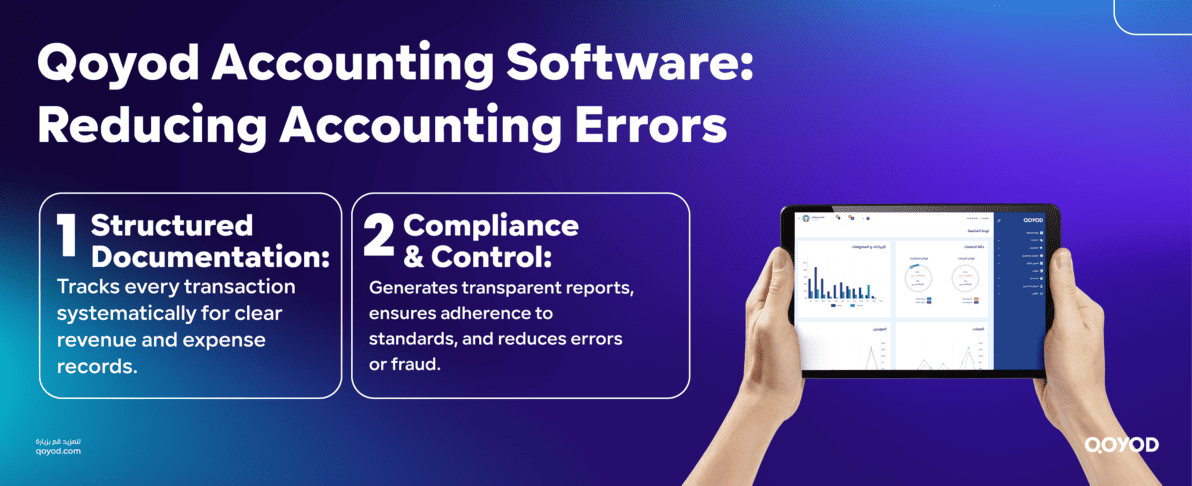
Qoyod Accounting Software strengthens transparency and governance inside an organisation. It is the backbone of accurate financial documentation.
- Structured documentation: every transaction is documented systematically. Revenue sources and spending stay traceable, so decision-makers and investors can review performance and verify results at any time.
- Compliance and control: Qoyod produces transparent reports that reflect the real state of the business, which builds trust with regulators and investors. It supports compliance with local and international accounting standards, helps enforce internal policy, and reduces the room for error or fraud by tracking every financial movement.
Frequently Asked Questions (FAQ) about Accounting Errors
What is the difference between accounting errors and financial fraud?
Accounting errors are unintentional. They come from oversight or inexperience. Fraud is deliberate, and it aims to mislead users or regulators for illicit gain. Errors are usually caught internally. Fraud leads to legal investigations and severe penalties.
What are the main types of accounting errors?
The main types are entry errors, duplicated or omitted entries, transposition errors, missing bank reconciliation, misapplied standards, and inaccurate revenue or expense valuation. Each one affects the accuracy of the company’s reports.
How do accounting errors affect investors?
They give investors a false view of the company’s financial position, which leads to bad decisions and lost capital. In major cases they also cost the market its confidence and send the share price down sharply.
How can accounting errors be detected early?
Reconcile regularly, review entries, use reliable software, train staff on auditing, and keep both internal control and periodic external audits active.
What is the impact of a lack of governance and disclosure?
Weak governance leaves a company open to errors and scandals. Oversight breaks down, the risk of manipulation and money laundering rises, investor and market trust erodes, and the company and its management can face legal and financial penalties.
How do digital systems like Qoyod Accounting Software help?
They record every transaction accurately and transparently, which makes internal and external auditing easier and cuts the chance of an error or a duplicate. They also analyse data instantly and flag deviations, which strengthens governance and control.
Conclusion: Fostering Transparency and Preventing Recurrent Accounting Disasters
Transparency is now a core objective of any modern financial system, and past crises are the reason why. Regulators and companies have learned the same lesson: transparency is not a compliance box to tick. It is a culture built on accurate, timely, and complete disclosure of the numbers and the decisions behind them.
Try Qoyod Accounting Software now and make your business operations easier and more accurate, with solutions built for modern businesses.