| Expert | This guide explains the five Main Accounting Account Types: Assets, Liabilities, Equity, Revenue, and Expenses. Small and medium businesses use them to keep every record in the right place. Get the sorting right and you get reports you can trust, healthier cash flow, and easier compliance. A system like Qoyod sets the structure up for you. |
The Essential Guide to Main Accounting Account Types for Business Growth
Every strong business rests on a solid financial base. That base starts with the Main Accounting Account Types. Do you run a small or medium-sized business (SMB)? Then you may struggle to sort transactions, stay compliant, or build reports you can trust. Without the right sorting, simple jobs turn messy. Even e-invoicing or a basic tax calculation can go wrong.
This guide from Qoyod Accounting Software keeps account sorting simple. We explain the five main groups behind every financial statement. You will learn to handle your financial data with confidence and accuracy. A modern cloud accounting system like Qoyod does most of the work for you, so you can focus on growth.
Concept and Importance of Main Accounting Account Types
Set up any accounting system and the first job is always the same. Sort every transaction into a clear group. Each one then lands in the right account. This is not a nice-to-have. It is a basic accounting and legal need.
What are the Main Accounting Account Types?
The main accounts are the top-level groups that shape your Chart of Accounts (COA). Build a COA and you will find five main groups. Sub-accounts and detailed ledger accounts branch out from them. This structure lets you track every resource, debt, income stream, and cost.
The five main groups are: Assets, Liabilities, Equity, Revenues (or Income), and Expenses.
Why is Understanding the Main Accounting Account Types Crucial?
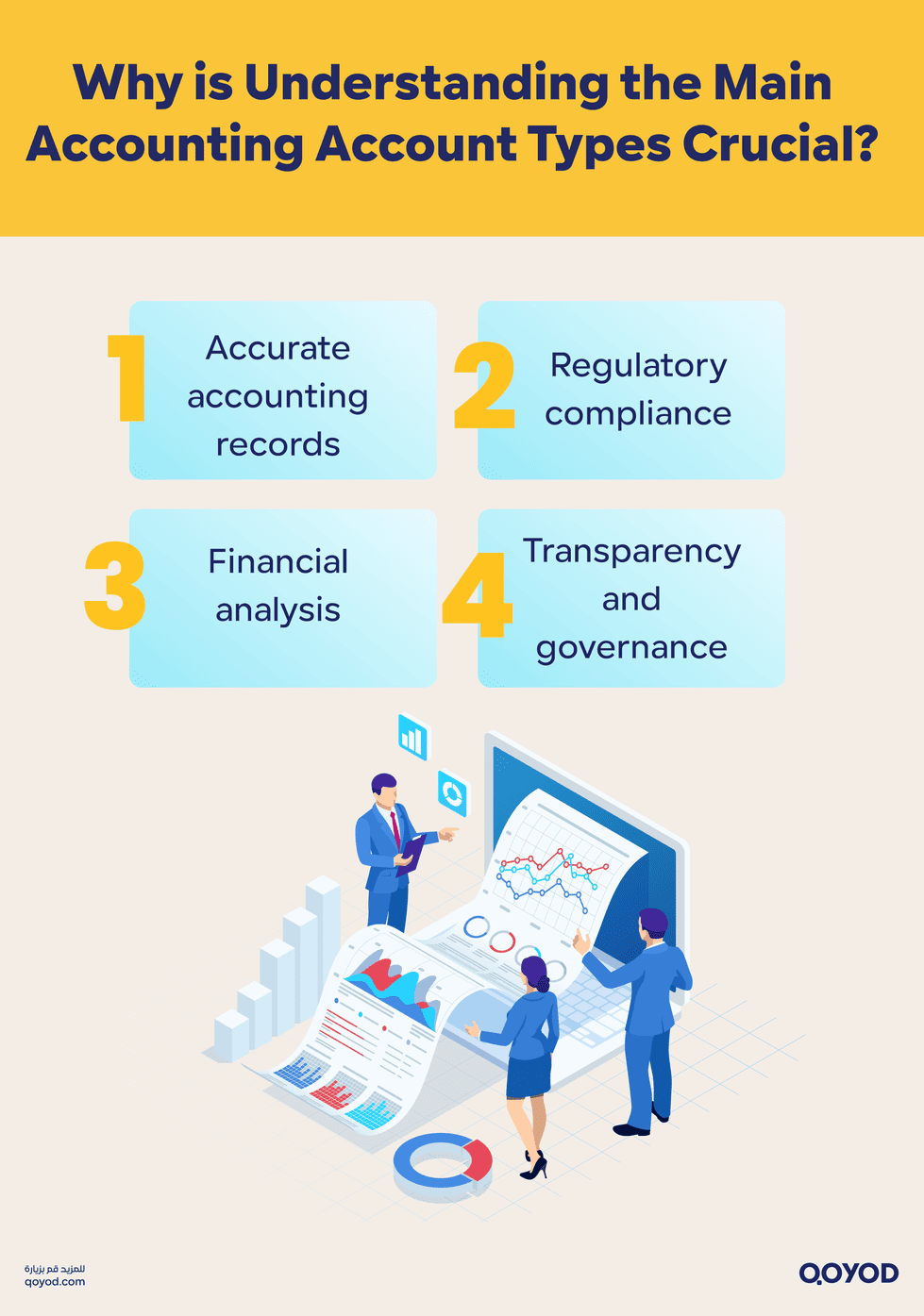
- Accurate Accounting Records: Mix up your accounts and the financial statements go wrong. Bad numbers lead to bad decisions.
- Regulatory Compliance: Your reports must follow GAAP or IFRS standards. One sorting error can trigger audit problems.
- Fundamental Financial Analysis: Know the account type and its debit or credit nature. You can then predict the effect of any transaction, manage cash flow, and run leaner.
- Transparency and Governance: Clear groups show investors and partners that a real system tracks your performance.
Overview of the Five Main Accounting Account Types
Here is a short summary of the five core Main Accounting Account Types:
| Account Type | Definition | Nature | Balance Sheet/Income Statement |
| Assets | What the business owns and expects to gain from later (cash, equipment, inventory). | Debit | Balance Sheet |
| Liabilities | What the business owes to others (accounts payable, loans). | Credit | Balance Sheet |
| Equity | What is left for the owners once you subtract liabilities from assets (capital, retained earnings). | Credit | Balance Sheet |
| Revenues | What the business earns from its main work (sales, service fees). | Credit | Income Statement |
| Expenses | What the business pays to earn revenue or keep running (salaries, rent, utilities). | Debit | Income Statement |
Account Nature (Debit/Credit) Briefly Explained
Two simple rules cover your daily entries:
- Assets and Expenses have a “Debit” nature. They go up with a debit and down with a credit.
- Liabilities, Equity, and Revenues have a “Credit” nature. They go up with a credit and down with a debit.
Detailed Classification and Transaction Handling
In financial accounting, accounts are the units that record what a business does with money. They hold your Assets, Liabilities, Equity, Revenues, and Expenses. Sort them well and your financial data stays clear and easy to read.
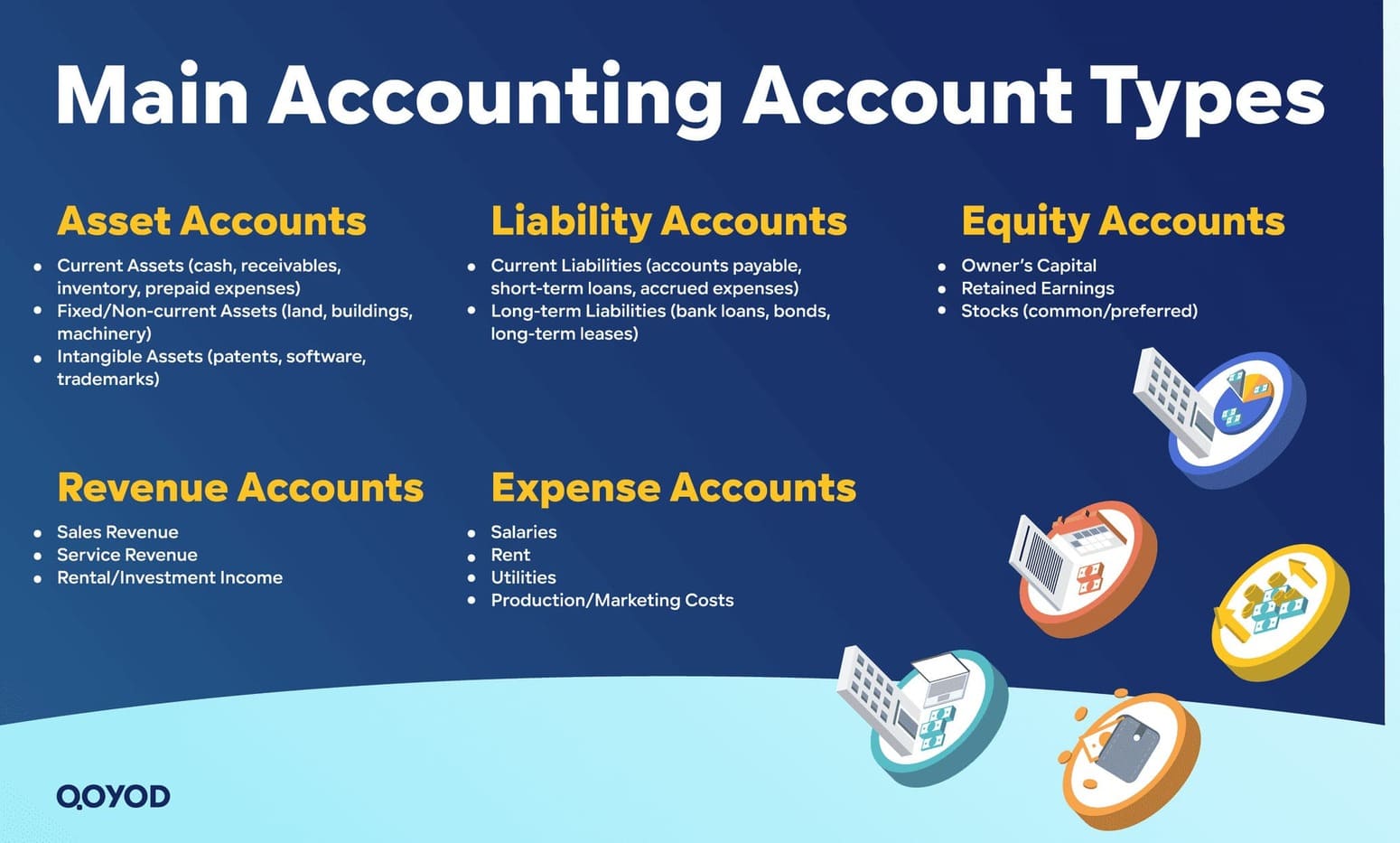
1. Asset Accounts
Asset Accounts cover the resources and rights your business owns. Each one should bring value later. Assets sit at the heart of the Balance Sheet.
Assets usually split into three groups:
- Current Assets: Cash, accounts receivable (money customers owe you), inventory, and prepaid expenses.
- Fixed or Non-current Assets: Land, buildings, machinery, and equipment you use for years.
- Intangible Assets: Patents, software licences, and trademarks. You cannot touch them, but they hold value.
Accounting Treatment: Record an increase in an asset as a “Debit”. Record a drop as a “Credit”.
2. Liability Accounts
Liabilities are what your business owes to other parties. Some are due now, and some fall due later.
They usually split into two groups:
- Current Liabilities: Accounts payable (money you owe suppliers), short-term loans, and accrued expenses.
- Long-term Liabilities: Bank loans that run for years, bonds, and long-term lease debts.
Accounting Treatment: Take a loan or buy on credit and you record the liability as a “Credit”. Your debt has gone up.
3. Equity Accounts
Equity is the value left for the owners once you subtract liabilities from assets.
It includes:
- Capital the owners put in.
- Retained Earnings.
- Common or preferred stock, in the case of joint-stock companies.
Accounting Treatment: Equity rises with profits or fresh owner money. It falls when you pay out profits or make a loss.
4. Revenue Accounts (Income)
Revenues are the money your business earns from its work and the services it sells.
Common types include:
- Sales Revenue.
- Service Revenue.
- Rental Income or investment returns.
Accounting Treatment: Earn revenue and you record it as a Credit. A credit is how revenue grows.
5. Expense Accounts
Expenses are the costs you pay to earn revenue or keep the business running.
They include salaries, rent, utilities, production costs, and marketing.
Accounting Treatment: Expenses go up with a debit. They go down with a credit, or when you close the books at the end of the period.
Advanced Classification: Real, Personal, and Nominal Accounts
The five-way split is the common one. Some accounting schools also use an older three-way split:
- Personal Accounts: These relate to people or legal entities, such as customers, suppliers, and owners.
- Real Accounts: These relate to assets and property, such as cash, buildings, and equipment.
- Nominal Accounts: These cover revenues, expenses, profits, and losses. You close them at the end of the year.
This split makes the debit and credit rule easy to remember. It follows the “Golden Rules” of accounting:
| Account Type | Debit Rule | Credit Rule |
| Personal | The receiver (debtor) | The giver (creditor) |
| Real | What comes in (asset increase) | What goes out (asset decrease) |
| Nominal | All expenses and losses | All revenues and gains |
The Link Between Main Accounting Account Types and the Accounting Equation
Every transaction falls under one of the Main Accounting Account Types. You record it with the Double-Entry Bookkeeping System. Under this system, total debits must match total credits in every journal entry. That keeps the Accounting Equation in balance:
Assets=Liabilities+Equity
Revenues and expenses both change equity, so the fuller version reads:
Assets+Expenses=Liabilities+Equity+Revenues
Learn this link and you can read your financial position straight from the numbers.
Practical Application and Modern Solutions
In today’s digital economy, clean account sorting is a must. Clear groups make financial statements faster to prepare. They also help auditors check your data and help managers decide with confidence.
Qoyod’s Operational Recommendation
Based on our work at Qoyod Accounting Software, we suggest two steps for every business:
- Design a Robust Chart of Accounts: Start with a well-built Chart of Accounts. Include the main and sub-accounts for every job your business does.
- Use Numerical Coding: Give each account a number. Codes speed up recording, search, internal control, and audits.
Bookkeeping Services in Qoyod
Bookkeeping is the backbone of a healthy business. It gives you the accurate data your decisions rest on. Qoyod offers professional bookkeeping services through certified partners. They help owners handle their financial and accounting work.
What bookkeeping means:
Bookkeeping is the steady, routine work of recording and sorting every transaction. It follows accepted accounting standards.
The process aims to:
- Record Revenues, Expenses, Assets, and Liabilities without errors.
- Produce reports that managers and finance teams can trust.
- Keep the business in line with tax rules and financial law.
- Track performance, improve cash flow, and cut accounting and tax risk.
Essential Accounting Tips for Small and Medium Businesses
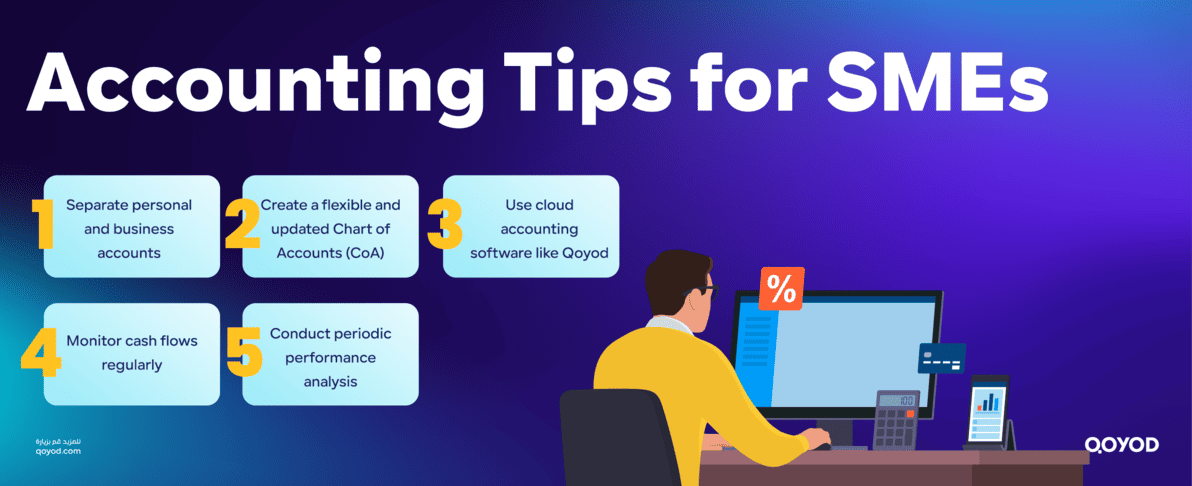
- Separate Personal and Business Accounts: Mixing the owner’s money with company money is a common error in small businesses. It creates confusion at tax and reporting time.
- Create a Flexible and Updated COA: Review your account structure often. Update it as the business grows or as the rules change.
- Use Cloud Accounting Software: Cloud systems like Qoyod give you safe access from anywhere. Your team works faster, wherever they sit.
- Monitor Cash Flows Regularly: Check revenues and expenses every month. It helps you avoid sudden gaps and manage your cash better.
- Review Performance on a Schedule: Look at your financial data at least once a quarter. Check profit, and spot what works and what does not.
Frequently Asked Questions (FAQ) about Main Accounting Account Types
What are the key Main Accounting Account Types that should be in any financial system?
Every system needs five groups: Assets, Liabilities, Equity, Revenues, and Expenses. Together they cover all company work, whether you trade, serve, or manufacture.
How are financial transactions recorded in modern accounting?
You record them with the Double-Entry Bookkeeping System. Every debit in one account is matched by an equal credit in another. That keeps the accounting equation in balance.
Do the account types differ between small and large companies?
No. The basic grouping is the same. Only the level of detail changes. Larger companies hold more sub-accounts under each type, so fixed assets may split into vehicles, buildings, and machinery.
What is the difference between Real, Nominal, and Personal Accounts?
- Real: Assets you can touch or not, such as buildings, cash, and trademarks.
- Nominal: Expenses and revenues.
- Personal: People or institutions, such as customers and suppliers. This split makes the double-entry system easier to follow.
In Conclusion
The Main Accounting Account Types are not just theory. They are the base for any company that wants to order its resources and grow with confidence. In a fast-moving market, accurate numbers build trust.
With Qoyod Accounting Software, you can build that structure and keep your data ready for review, audits, and decisions. Accounting is not just numbers. It is the language of your company’s future, so keep that language clear.
Try Qoyod Accounting Software now to make your work easier and more accurate.
- To learn more about accounting and financial management, visit the Qoyod blog