




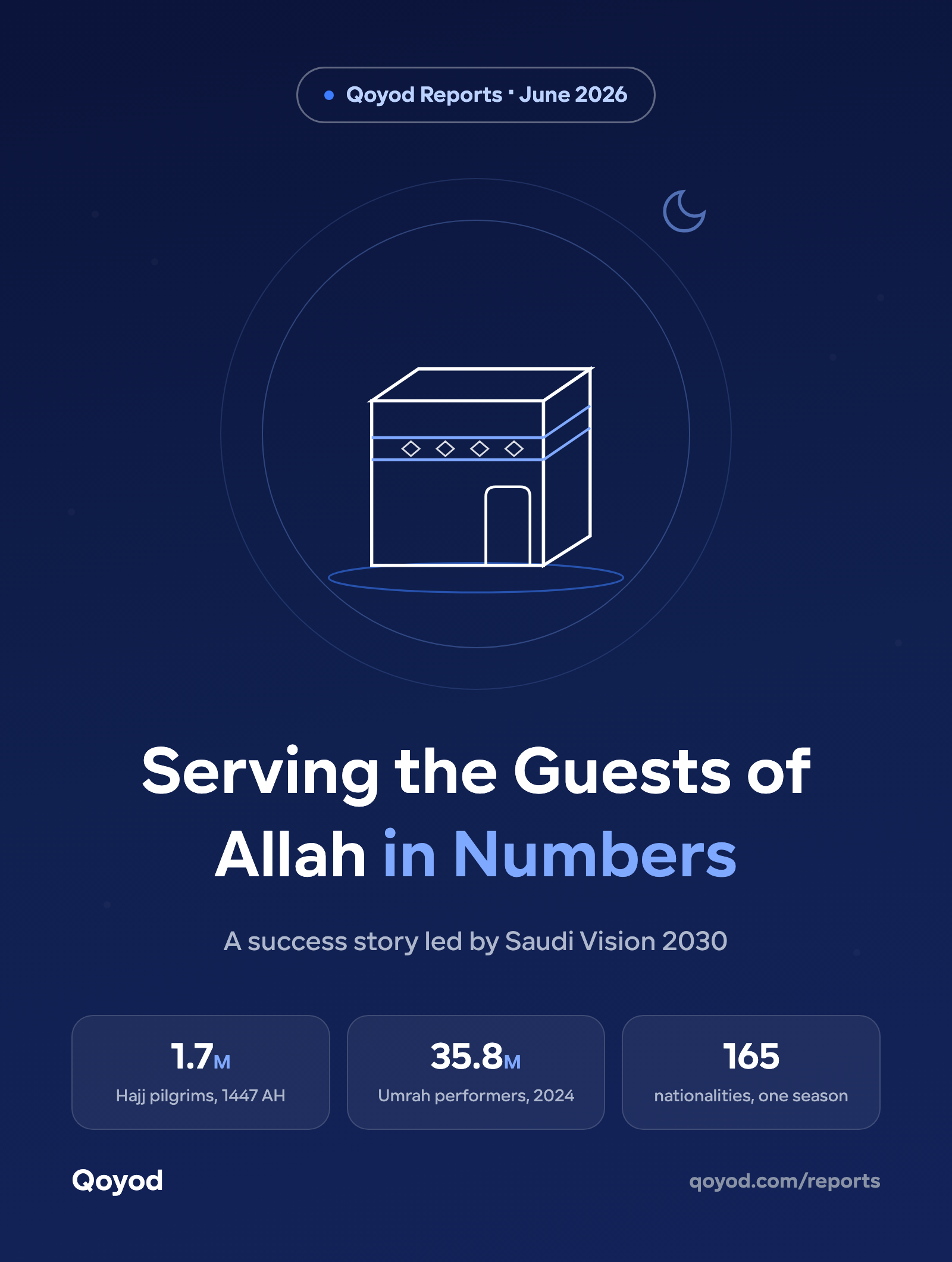
Hajj 1447 AH: Exceptional Organization by Every Measure
The General Authority for Statistics announced that the total number of pilgrims for the 1447 AH Hajj season (May 2026) reached 1,707,301 pilgrims, up 2% from the 1446 AH season. Of these, 1,546,655 pilgrims arrived from outside the Kingdom through its various ports of entry, representing 90.6% of the total, while 160,646 citizens and residents performed the pilgrimage from within the Kingdom. Spread across 165 nationalities, these numbers reflect a singular organizational capability: managing one of the largest human gatherings on earth, within a confined geography and a narrow window of time.
Port-of-entry data shows the scale of logistical readiness the Kingdom put in place to welcome its guests: 96.1% of pilgrims from abroad arrived through air ports, while land and sea ports received the remaining guests with complete fluidity.
893,396Male52.3%
813,905Female47.7%
A Decade of Enablement: Organizational Strength That Rebounds at Record Speed
The time series of pilgrim numbers reveals one of the Saudi system’s greatest strengths: resilience. After the 1440 AH season (2019), when the Kingdom welcomed nearly 2.49 million pilgrims and mobilized more than 350,000 staff to serve them, the global pandemic imposed unprecedented restrictions on mass gatherings worldwide. With recovery, the system regained its momentum in record time, rising from 899,353 pilgrims in 1443 AH to more than 1.84 million in 1444 AH. The numbers more than doubled in a single season, while maintaining the highest standards of safety and quality.
Recovery doubled in a single season: from 0.9 to 1.85 million
What sets this journey apart is not the numbers alone but the quality of the experience behind them: historic expansions of the Two Holy Mosques, smart crowd-flow management, and the Nusuk platform that streamlined the guest’s journey from visa to departure. All of these are direct fruits of Vision 2030 programs that made the pilgrim experience a benchmark of success.
Umrah: On the Road to 30 Million
Vision 2030 set an ambitious target of welcoming 30 million Umrah performers from abroad annually by 2030, up from a capacity of no more than 8 million when the Vision launched. Progress is running ahead of plan: Umrah performers arriving from abroad exceeded 16.92 million in 2024, compared with 13.56 million in 2023, a rise of nearly 25% in a single year that surpassed the 2024 milestone of 11.3 million by a wide margin and well ahead of schedule.
million Umrah performers from abroad
million Umrah performers from abroad
The full picture is even more striking: the General Authority for Statistics recorded 35,802,452 Umrah performers from inside and outside the Kingdom during 2024, including 18.88 million domestic performers. And in the first quarter of 2025 alone (a quarter that included the holy month of Ramadan), more than 15.2 million worshippers performed Umrah, with arrivals from abroad growing 10.7% year on year.
A Year-Round Rhythm: Seasonality You Can Build On
Quarterly data reveals a clear annual rhythm that moves the two Holy Cities. In the first quarter of 2025, which embraced the holy month of Ramadan, more than 15.2 million worshippers performed Umrah; 6.5 million of them arrived from abroad, up 10.7%, and 82.2% of those came through air ports. In the second quarter, following the season, the number reached about 5.4 million. This regular seasonality is not random fluctuation but a complete business cycle that enterprises serving the guests can plan around with precision: larger inventory ahead of Ramadan, trained seasonal staff, and liquidity ready for peak demand.
24% of Q1 performers were Saudi citizens
10.7% growth in arrivals from abroad vs. Q1 2024
Investments Worthy of the Guests of Allah
Behind each of these numbers stands a portfolio of transformative investments the Kingdom launched to raise capacity and service quality together: historic expansions of the Two Holy Mosques, the Haramain High-Speed Railway linking Makkah, Madinah, and Jeddah, an unprecedented hospitality boom in the two Holy Cities, and mega urban projects such as Rua Al Madinah, designed to elevate the readiness of the central district around the Prophet’s Mosque.
The strength of this infrastructure shows at peak season: in Ramadan 1446 AH (2025), the Haramain railway carried 1.2 million passengers across 3,310 journeys and set a record by moving 48,000 passengers in a single day, while 2.21 million seats were made available for the Hajj season. These are operational numbers that place the Saudi transport system among the most efficient in the world.
A Flourishing That Strengthens the National Economy and Opens Doors for Businesses
This vast investment in guests’ comfort returns its benefits to the entire national economy. The Ministry of Tourism announced that inbound visitor spending in the Kingdom reached SAR 159.9 billion in 2025, the highest level in the Kingdom’s history, up 4.1% on 2024, while the travel account recorded a surplus of SAR 49.4 billion. These indicators reflect the success of the economic diversification strategy led by Vision 2030, which we mapped in full in our report on the economy in Saudi Vision 2030.
Most importantly, this prosperity is not confined to mega projects. It opens wide horizons for the small and medium enterprises working in hospitality, catering, transport, retail, and logistics across Makkah and Madinah. Every season brings renewed demand for thousands of local suppliers and operators, which makes financial and operational readiness decisive for seizing these opportunities: from e-invoicing compliant with ZATCA requirements to precise inventory and cash-flow management at seasonal peaks, as we detailed in our Saudi tourism report.
The Sectors That Power Every Season
Behind every smooth guest experience stands a long chain of small and medium enterprises: a hotel that welcomes, a restaurant that feeds, a bus that carries, a store that supplies, and an agency that organizes the journey end to end. With every season, demand renews across these six sectors, each of which Qoyod serves with specialized accounting solutions:
Financial readiness is what turns the season from operational pressure into a growth opportunity: ZATCA-compliant e-invoicing that issues in seconds no matter how transaction volumes multiply, real-time inventory that anticipates the Ramadan and Hajj peaks, and cash-flow reports that ground seasonal hiring and expansion decisions in numbers rather than intuition.
Looking to 2030: Ambition Renewed
The Kingdom advances toward 2030 with the confidence of seeing its targets met ahead of schedule: 30 million Umrah performers from abroad, two Holy Cities expanding to embrace their guests at world standards, and a digital ecosystem that makes the journey of faith easier than ever before. Season after season, thousands of Saudi hands in hotels, restaurants, transport companies, and stores continue writing this story, one that joins the honor of service with excellence in management, keeping the experience of the Guests of Allah a living testament to what an ambitious vision can achieve.
Report sources
- General Authority for Statistics: Hajj 1447 AH season statistics
- General Authority for Statistics: Hajj 1446 AH season statistics
- General Authority for Statistics: Umrah statistics bulletin, Q1 2025
- Ministry of Tourism: inbound visitor spending in 2025 (Al Riyadh)
- Ministry of Tourism: licensed rooms in Makkah (SPA)
- SPA: Haramain High-Speed Railway figures, Ramadan 1446 AH