



A travel agency in Saudi Arabia operates on the thinnest commission margins in the consumer-services sector, often as low as 2% to 8% on tickets and 8% to 15% on hotels and packages. Cash flows in and out in two currencies (and sometimes more), supplier deposits are tied up for weeks, and VAT treatment varies sharply between domestic and international services. This guide explains what sets travel-agency accounting apart, and how the right software keeps every booking and commission visible inside one ledger.
What makes travel-agency accounting different
A travel agency is a low-margin, high-velocity business with the most complex cash settlement cycle in retail services. Every booking moves money in three directions: the customer pays the agency, the agency pays a supplier (airline, hotel, GDS), and a commission lands back days or weeks later. Cash in motion across hundreds of bookings a month means small reconciliation errors compound quickly.
Travel-agency accounting revolves around five connected pieces: supplier deposits and prepayments (airlines and hotel chains often demand advance balances), commission revenue on issued tickets and confirmed hotels, GDS settlement reports (Amadeus, Sabre, Galileo), multi-currency transactions on international bookings, and per-service VAT treatment (domestic vs. international supply). The right software ties all of these inside one ledger.
Day-to-day, an agency handles dozens of moving parts: issuing a ticket through a GDS, capturing a customer payment by card or bank transfer, applying a supplier credit memo for a cancelled segment, reconciling a weekly GDS settlement file, and producing a corporate client’s monthly statement of bookings. Every missed step is either lost commission or an over-stated revenue figure.
The most common accounting challenges in travel agencies
Every Saudi travel-agency operator runs into the same four recurring accounting problems. They share one root cause: there is no single ledger that links the booking, the supplier deposit, the customer payment, and the commission settlement.
1. Confused revenue recognition. An agency selling a 5,000 SAR ticket should not book 5,000 SAR as revenue. The pass-through portion to the airline is a liability, and only the commission (say 250 SAR) is real revenue. Many agencies still record gross sales as revenue, which inflates the P&L and confuses every margin number.
2. Untracked supplier deposits. An agency keeps a 100,000 SAR balance with each major airline as a working capital deposit. Without per-supplier deposit tracking, those balances drift, get partially refunded silently, and quietly tie up cash for months without showing on the dashboard.
3. GDS reconciliation chaos. Amadeus sends a weekly settlement file with hundreds of lines: tickets issued, voids, refunds, change fees, and commission accruals. Reconciling that file manually against the agency’s booking record consumes a full day every week, and small discrepancies pile up until quarter-end.
4. Multi-currency VAT treatment. A domestic ticket sold to a Saudi resident is taxable at 15%. An international ticket sold to a non-resident or for international travel is zero-rated. A corporate booking with mixed segments needs split treatment per segment. Doing this manually invites both penalties and missed input-tax recoveries.
What a travel agency actually needs from its accounting software
A generic accounting tool was built for direct buy-and-sell, not for commission-based travel distribution. The difference shows up in six places:
| Task | Generic accounting tool | What a travel agency needs |
|---|---|---|
| Revenue recognition | Gross ticket as revenue | Only the commission as revenue, supplier portion as liability |
| Supplier deposits | Generic prepayment | Per-supplier balance with running ledger |
| GDS reconciliation | Manual settlement | Automatic per-segment match |
| Multi-currency | Single currency | Multi-currency with daily FX revaluation |
| VAT | Single rate | Domestic 15%, international zero, per segment |
| Corporate billing | Single invoice | Monthly statement with per-employee detail |
Beyond the table, a travel agency specifically needs three capabilities that generic software does not deliver:
- Booking-level accounting, where every issued ticket creates a sales entry split into pass-through (supplier liability) and commission (revenue), so the P&L reflects real net margin instead of gross volume.
- Per-supplier deposit ledger showing the running balance with each airline, hotel chain, and GDS, with automatic deductions on every ticket issued and automatic top-ups when balances fall below the threshold.
- ZATCA-approved e-invoicing with per-segment VAT, transmitting signed XML to the Fatoora platform automatically. Domestic travel at 15% and international travel at zero rate are handled correctly on the same invoice where needed.
How to organize a travel agency’s books step by step
Moving from spreadsheet-based booking tracking to integrated travel-agency accounting takes around one to two weeks. This is the sequence the Qoyod onboarding team applies with every new agency customer:
E-invoicing and ZATCA compliance for travel agencies
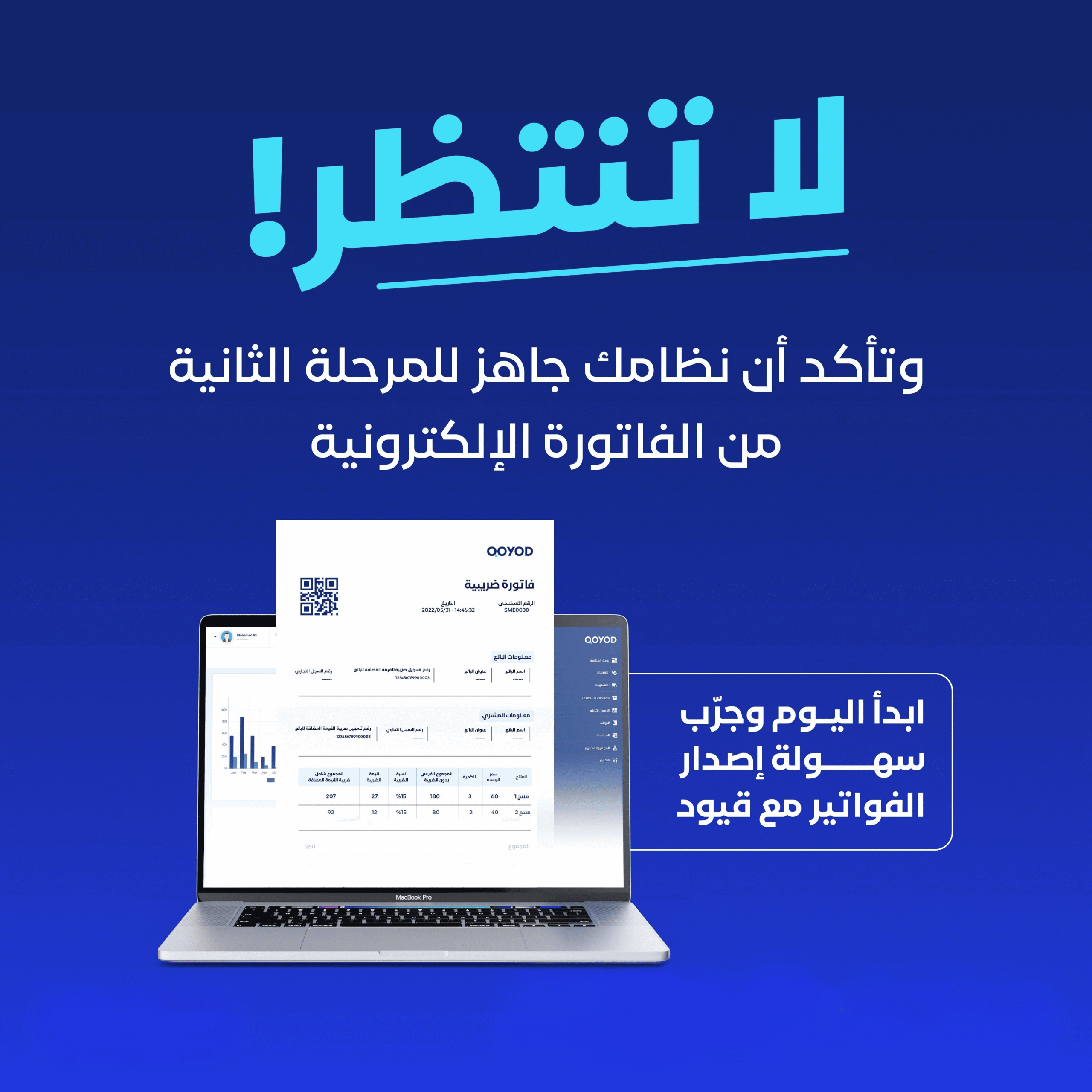
Phase two of ZATCA e-invoicing requires every agency booking invoice to be issued through a certified system connected to the Fatoora platform. Travel agencies issue both simplified tax invoices to individual walk-in customers and standard B2B tax invoices to corporate clients on monthly statements. For a side-by-side comparison of vendor costs, the guide on e-invoicing pricing in Saudi Arabia is the best starting point.
Every booking invoice must include the agency name and tax number, the customer’s details, a sequential invoice number, the date and time, an itemized list of segments with the correct VAT treatment per line (15% domestic, zero on international), the totals before and after VAT, and a QR code. The system generates and transmits a signed XML copy to the Fatoora platform automatically.
How to evaluate a ZATCA-certified system for a travel agency
When evaluating any e-invoicing vendor for a travel agency, verify these six criteria:
- Official ZATCA phase-two certification with a verifiable approval number on the Authority’s portal.
- Per-segment VAT treatment on a single invoice, not a single rate on the whole booking.
- Both Reporting (B2C walk-in) and Clearance (B2B corporate) flows in one system.
- Long-term cloud storage of signed invoices for at least six years.
- A simulation environment for issuing test booking invoices before going live.
- Live input-VAT and output-VAT reports ready in time for the quarterly filing deadline.
Where Qoyod fits in specifically for travel agencies
Qoyod brings together, inside one account: cloud accounting, booking-level revenue split (pass-through vs. commission), per-supplier deposit ledgers, multi-currency with daily FX revaluation, GDS settlement reconciliation, customer and corporate accounts, ZATCA-approved e-invoicing in both Clearance and Reporting flows with per-segment VAT, payroll, and consolidated reports.
The platform handles multi-branch agency operations under one account, with role-based permissions per branch, and runs fully in the cloud so head office, branch managers, and the external accountant share the same numbers from any device, under fine-grained permissions.
For agencies migrating from a legacy system or expanding into new corporate segments, the setup service and the bookkeeping service are part of Qoyod Pro Services, alongside the app marketplace for connecting to GDS partners and payment-gateway providers.
Frequently asked questions
Does Qoyod separate ticket pass-through from commission revenue?+
How does Qoyod track supplier deposits?+
Can Qoyod handle multi-currency transactions?+
How does Qoyod handle per-segment VAT?+
Does the e-invoicing system support B2B Clearance for corporate clients?+
Is technical support available 24/7?+
Running a travel agency does not need a generic accounting tool, it needs a commission-based operating system that ties booking-level revenue, supplier deposits, GDS settlements, and per-segment VAT together inside one ledger. The agencies that consistently grow are the ones that see real net margin per supplier and per corporate client in real time. That capability is what makes Qoyod the right fit for travel agencies in Saudi Arabia.