A general workshop in Saudi Arabia, whether mechanical, electrical, metalworking, welding, or refrigeration, lives or dies on job-card discipline. Each repair or fabrication job opens a card, pulls parts from inventory, accrues technician labor by the hour, and bills the customer when work is done. A single Riyadh workshop can run 80 active job cards a week, hold 1,200 parts SKUs, and employ 9 technicians on different skill rates. Without job-card costing, parts and labor billing accuracy, technician productivity tracking, and ZATCA e-invoicing on every invoice, the workshop discovers at year-end that half the jobs were quoted below cost.
What makes workshop accounting different
A workshop is a job-shop business, not a retail business. Every job is unique, the price is built up from parts cost, labor hours, and a margin uplift, and the customer expects a quote before work starts and an itemized invoice when the job is done. Generic POS or retail accounting cannot model a multi-line job card with parts pulls and labor accruals over five working days.
Workshop accounting revolves around five connected pieces: job-card creation with quote and approval, parts issuance from stock with cost capture, technician labor accrual by skill rate, warranty and rework tracking, and ZATCA simplified tax invoice or standard tax invoice on every billed job.
Daily reality is dozens of postings per day: new job cards opened, parts issued from stock, technician labor logged by job, parts purchases received, customer payments collected, and the daily reconciliation of open jobs against shop capacity.
The most common accounting challenges in workshops
Every general workshop in Saudi Arabia runs into the same four recurring problems. They share the same gap: quotes live on paper, parts move out without ledger attribution, and the gross margin on each job is guessed not measured.
1. Parts pulled without attribution. A workshop holds 1,200 parts SKUs. Without barcode issuance against a job-card number, parts walk out the door, the system count drifts from the physical count by 12% a quarter, and year-end variance lands on COGS.
2. Technician labor underbilled. A senior welder logs 6.5 hours on a fabrication job but the invoice bills 4 hours because the foreman estimated from memory. Three jobs a week with that gap is roughly 9,000 SAR a month of labor revenue unbilled.
3. Quotes versus actuals invisible. A job quotes at 4,800 SAR using 2,000 SAR of parts and 12 hours at 150 SAR. Actual consumption hits 2,600 SAR of parts and 18 hours of labor. The workshop absorbs 1,500 SAR of margin without noticing because no one closes the variance loop.
4. Warranty rework hidden. A repair returns for warranty rework after 18 days. Parts and labor on the rework land on overhead instead of a warranty account, masking 6% to 9% of repeat-failure cost that should drive supplier and process decisions.
What a workshop actually needs from its accounting software
A generic accounting tool was built for selling stocked items, not for opening a 5-line job card, issuing parts against it, accruing labor across three technicians, and billing the customer five days later. The gap is concrete:
| Task | Generic accounting tool | What a workshop needs |
|---|---|---|
| Job cards | Not supported | Open, quote, parts, labor, close |
| Parts issuance | Generic stock out | Per-job attribution with barcode |
| Labor | Not tracked | Per-technician per-job hours |
| Quotes | Manual document | Versus-actuals variance per job |
| Warranties | Not tracked | Rework account with parent job |
| VAT | Flat 15% | Per-line on standard rated |
Beyond the table, a workshop specifically needs three capabilities generic platforms do not deliver:
- Job-card costing with parts and labor, so every job opens with a quote, accrues parts at cost and labor at rate, and closes with a gross-margin number visible to the foreman before invoicing.
- Per-technician productivity reporting, where billable hours per technician per week are visible, idle capacity surfaces early, and skill-rate billing matches the actual person who did the work.
- Warranty and rework tracking, where every warranty job links to the parent job, parts and labor land in a warranty account, and repeat-failure cost per supplier or process is measurable.
How to organize a workshop’s books step by step
Moving a workshop to integrated accounting takes around two to three weeks depending on technician count and parts catalog size. This is the sequence Qoyod applies with every new workshop customer:
E-invoicing and ZATCA compliance for workshops
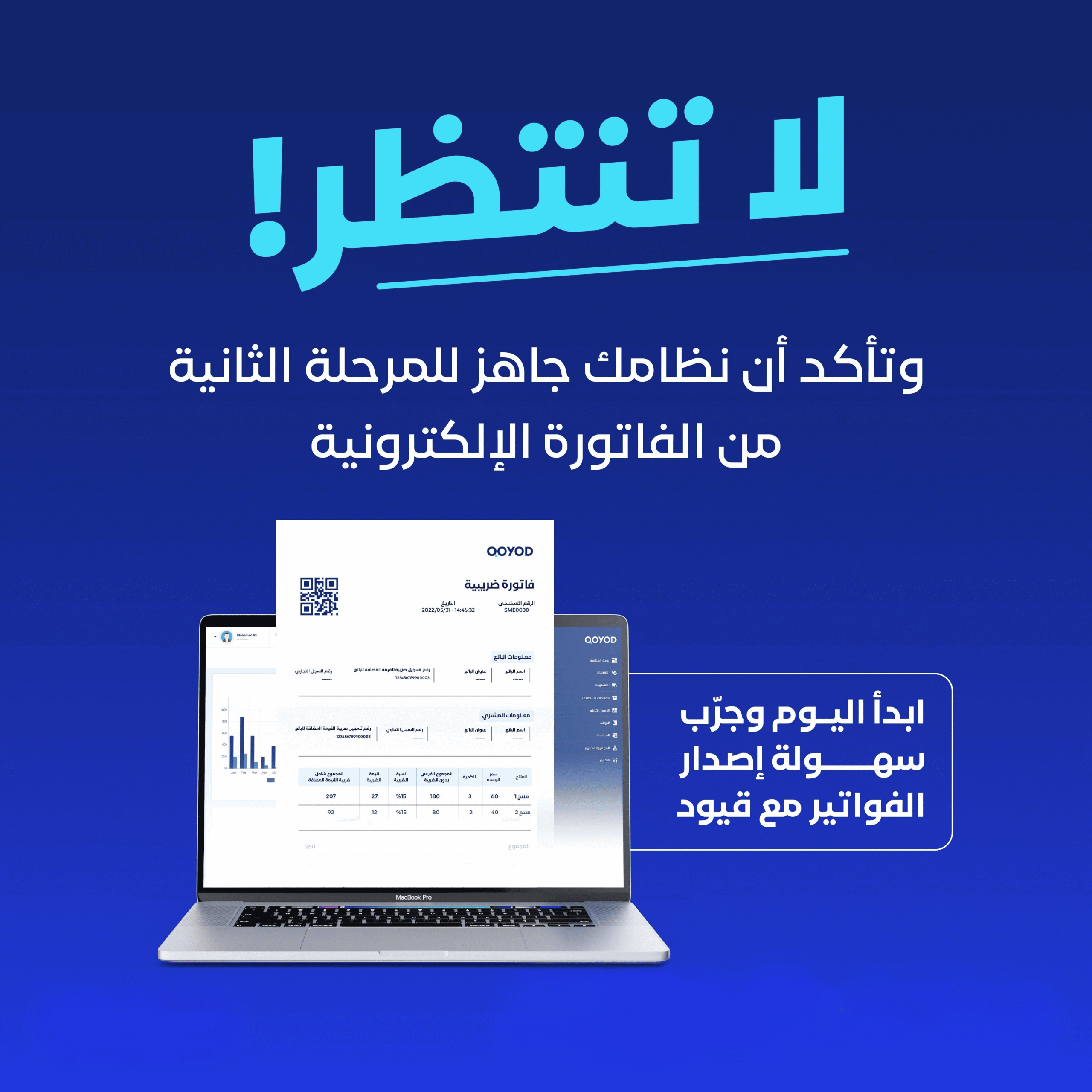
Phase two of ZATCA e-invoicing requires every workshop invoice to be issued through a certified system connected to the Fatoora platform. Workshops issue both simplified tax invoices for retail customers and standard tax invoices for B2B customers through the Clearance flow. For a side-by-side view of vendor costs, read the guide on e-invoicing pricing in Saudi Arabia.
Every invoice must include the workshop name and tax number, a sequential invoice number, the date and time, the buyer name on B2B invoices, an itemized list of parts and labor lines with VAT at 15%, totals before and after VAT, and a QR code. A certified system generates the QR code, signs the invoice in XML, and transmits it to the Fatoora platform inside the Reporting or Clearance window.
How to evaluate a ZATCA-certified system for a workshop
When evaluating any e-invoicing vendor for a workshop, verify these six criteria:
- Official ZATCA phase-two certification with a verifiable approval number on the Authority’s portal.
- Both Reporting (retail simplified) and Clearance (B2B standard) flows in one system.
- Per-line VAT on multi-line job-card invoices.
- Job-card attribution preserved on every parts and labor line.
- Long-term cloud storage of signed invoices for at least six years.
- Monthly input-VAT and output-VAT reports ready in time for the quarterly filing deadline.
Where Qoyod fits in specifically for workshops
Qoyod brings together, inside one account: cloud accounting with job and warranty dimensions, parts catalog with barcode issuance, technician labor accrual with skill rates, quote-versus-actual variance reporting, ZATCA-approved e-invoicing, payroll, and consolidated reports. Every job card, parts pull, labor entry, and customer invoice lands an automatic journal entry inside the same ledger.
The platform handles multi-branch workshop networks under one account, with shared master data (parts catalog, technician rates, customer database), role-based permissions per branch, and either consolidated or per-branch reports. It runs entirely in the cloud, so owners, branch managers, and the external auditor share the same numbers from any device.
For workshops opening new branches or migrating from paper job cards, the setup service and the bookkeeping service are available as part of Qoyod Pro Services, alongside the app marketplace for connecting to inventory and CRM partners.
Frequently asked questions
Does Qoyod support job-card costing for workshops?+
How does Qoyod handle parts issuance and stock?+
Can Qoyod track per-technician productivity?+
Does Qoyod handle warranty and rework?+
Does Qoyod work for multi-branch workshop networks?+
Is technical support available 24/7?+
Running a workshop does not need a generic invoicing app, it needs an operating ledger that ties job cards, parts, labor, warranties, and ZATCA e-invoicing together inside one account. The workshops that consistently grow are the ones that see quote-versus-actual variance and technician productivity every week. That capability is what makes Qoyod the right fit for general workshops in Saudi Arabia.