A retail shop in Saudi Arabia lives or dies on one number: gross margin per item. Margin gets eaten by silent inventory drift, by promotion mistakes, and by missed supplier credit terms. This guide explains what sets retail-shop accounting apart, and how the right software keeps margin, stock, and tax under one roof.
What makes retail-shop accounting different
A retail shop is a high-volume, low-margin business. Hundreds of SKUs move through the till every day, each with a cost price, a selling price, a barcode, and a category. Most lines carry a single-digit margin, so a 1% pricing error or a small inventory shrinkage adds up to thousands of riyals in lost profit before month-end.
Retail accounting revolves around five things at once: barcode-level inventory across one or more branches, a point of sale that issues simplified tax invoices instantly, supplier credit terms running on 30, 60, or 90 days, periodic promotions and discounts, and end-of-day cash reconciliation. The right software ties all of these together inside one ledger, instead of leaving each as a separate file.
Day-to-day work is a long list of small movements: receiving a supplier delivery, labelling items with barcodes, transferring stock between branches, running a price promotion for a weekend, accepting cash and card payments at the till, and closing the day with a cash count. Each of those touches the books, and a missed one is a hole in next month’s P&L.
The most common accounting challenges in retail shops
Almost every retail-shop operator runs into the same four problems, regardless of category. They share one root cause: no single connected system that links the till, the stockroom, and the supplier ledger.
1. Silent inventory shrinkage. The system says you have 60 units of an item, the shelf says 47. The 13 missing units are some mix of theft, mis-scanned barcodes, internal use, and returns that were never logged. Without a daily or weekly stocktake on fast-moving SKUs, the gap only widens.
2. Pricing and promotion errors. A weekend campaign drops 100 SKUs by 15%. On Sunday morning the prices are still in the system at the discounted level, so the first hundred customers pay the discounted price on full-margin items. The lost margin is rarely recovered, because nobody notices until the weekly review.
3. Disorganized supplier credit. Some suppliers give 30 days, some 60, some require post-dated cheques. Without a single payables ledger that shows due dates, you either pay late and damage relationships, or pay early and lose interest-free working capital.
4. Slow tax filings. A shop selling thousands of small-ticket items a month builds up a long list of simplified invoices and supplier purchases. Rolling that up into a VAT return by hand consumes a full day every quarter, and any error opens the door to a penalty.
What a retail shop actually needs from its accounting software
A generic accounting tool tracks invoices but ignores how a shop actually runs. The difference between a generic ledger and a retail-grade platform shows up in six places:
| Task | Generic accounting tool | What a retail shop needs |
|---|---|---|
| Inventory | Manual quantity entries | Barcode scan, live stock per branch |
| Pricing | One price per item | Per-branch pricing and dated promotions |
| Point of sale | Not integrated | POS issues e-invoice and deducts stock in one step |
| Supplier credit | Single payables list | Per-supplier terms with due-date alerts |
| Branch transfers | Manual journal entry | Stock move with cost preserved across branches |
| End-of-day close | Not supported | Cash, card, and refunds reconciled per till per day |
Beyond the table, a retail shop specifically needs three capabilities that generic software does not deliver:
- Barcode-driven inventory on every receipt, transfer, and sale, so the stock figure on screen always matches the shelf. Integrated through the Qoyod app marketplace for barcode hardware and label printers.
- Per-branch reporting with one consolidated view, so head office sees gross margin by branch, by category, and by item, while branch managers see only their own numbers.
- Supplier-credit management with a single payables aging report (current, 30, 60, 90+) and reminders before due dates, so working capital is never wasted on early payments or punished by late ones.
How to organize a retail shop’s books step by step
Going from a shoebox setup to a controlled retail operation does not take more than a working week. These are the six steps the Qoyod onboarding team runs through with every new retail customer:
E-invoicing and ZATCA compliance for retail shops
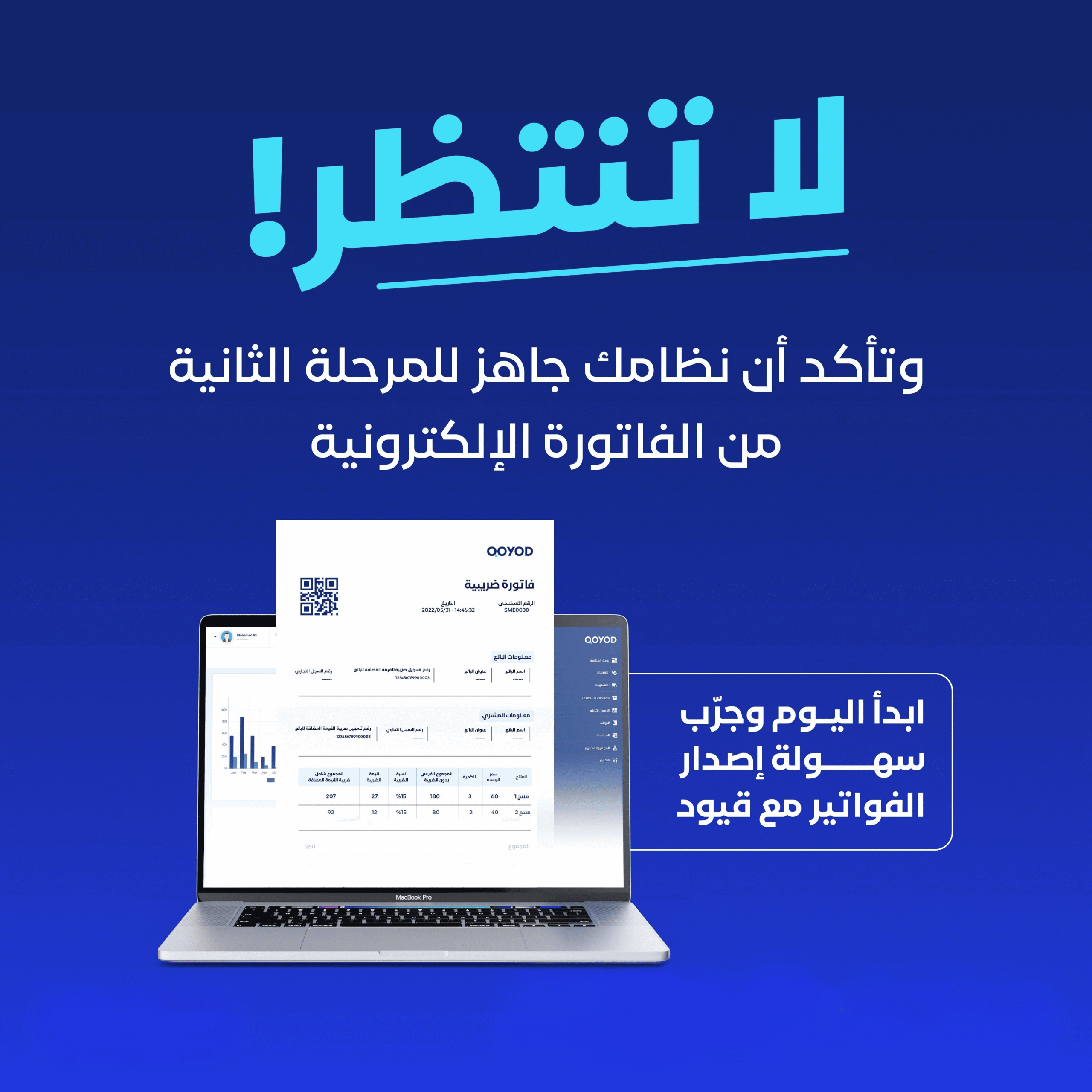
Under ZATCA phase two, every retail shop must issue electronic invoices through a certified system connected to the Fatoora platform. Retail shops almost always use the simplified tax invoice because the customer at the till does not carry a tax number. For a side-by-side cost comparison of vendors, the guide on e-invoicing pricing in Saudi Arabia is worth reading.
Every receipt must carry the shop name and tax number, a sequential invoice number, the date and time, an itemized list, the VAT rate (15%), the totals before and after VAT, and a QR code. The certified system generates all of this automatically and transmits a signed XML copy to the Fatoora platform within 24 hours under the Reporting flow for simplified invoices.
How to evaluate a ZATCA-certified system for retail
When you assess any e-invoicing vendor for a retail shop, verify these six criteria:
- Official ZATCA phase-two certification with a verifiable approval number on the Authority’s portal.
- Automatic XML submission of every receipt inside the time windows for simplified invoices.
- Long-term cloud storage of signed invoices for at least six years.
- A simulation environment for issuing test invoices before going live.
- Receipt issuance in under two seconds, so the till is never slow at peak hours.
- Monthly input-VAT reports ready in time for on-deadline filings.
Where Qoyod fits in specifically for retail shops
Qoyod brings together, inside one account: cloud accounting, barcode-driven inventory, multi-branch POS, supplier and customer accounts with credit terms, ZATCA-approved e-invoicing, payroll, and consolidated branch reports. Every module is linked, so a single scan at the till moves stock, issues the invoice, and posts the journal entry.
The platform supports multiple branches and warehouses under one account, with stock transfers between locations and either consolidated or per-branch reports. It runs fully in the cloud, so head office sees a live view of every branch from any device, and can share access with the external accountant under fine-grained permissions.
For shops opening new branches or migrating from a previous system, the setup service and the bookkeeping service are available as part of Qoyod Pro Services, alongside the app marketplace that connects Qoyod to barcode hardware, label printers, and partner systems.
Frequently asked questions
Does Qoyod work for a single-branch shop?+
How does Qoyod handle barcode scanning at the till?+
What happens to the till if the internet drops?+
Can the system manage multiple branches under one account?+
How does Qoyod handle supplier credit and payables?+
Is technical support available 24/7?+
Running a retail shop does not need a generic accounting tool, it needs a single connected platform that protects margin through live inventory, fast till close, and disciplined supplier credit. The shops that consistently grow are the ones that see every percentage point of margin in real time. That capability is what makes Qoyod the right fit for retail shops in Saudi Arabia.