An online store in Saudi Arabia runs on a chain of moving parts: a storefront (Salla, Zid, or Shopify), payment gateways, shipping providers, and the back-office inventory that feeds all of them. The point where most stores leak profit is the gap between what was sold online, what was actually settled by the payment gateway, and what was shipped. This guide explains how the right accounting software closes that gap.
What makes online-store accounting different
An online store is the most data-rich retail business there is, and at the same time the easiest one to lose track of. Every order touches the storefront, a payment gateway, a shipping provider, your inventory, and the tax ledger, with a different fee or timing on each leg. A single uncoded shipping label can turn a 20% gross margin into a 7% net margin without anyone noticing.
Online-store accounting revolves around five flows: orders coming in from the storefront, payments settling from gateways (Mada, Apple Pay, Tap, HyperPay), stock moving out via shipping providers, returns coming back as refunds, and e-invoices going out for every sale via the Fatoora platform. The right software ties all of these into one ledger.
Daily reality is a long list of small movements: a Salla order syncs to your back office, stock deducts automatically, Mada settles the payment in T+1, the shipping cost lands on your account a week later, and a return comes in 14 days after that. None of this can be done by hand at scale, and every untracked step is a margin leak.
The most common accounting challenges in online stores
Almost every Saudi e-commerce operator runs into the same four problems, regardless of platform. They share one root cause: there is no single ledger that connects the storefront, the gateway, and the shipping provider.
1. Payment-gateway versus order mismatch. The storefront shows 100 successful orders for the day, but the gateway settled 92. The eight missing ones are a mix of chargebacks, failed captures, and pending fraud reviews. Without an automatic reconciliation, those eight are recorded as revenue and never corrected.
2. Hidden shipping costs. A 200-SAR order pays 25 SAR for shipping in the cart, but the courier actually charges 38 SAR after dimensional weight. That 13 SAR gap is invisible to the P&L until shipping bills land at month-end, by which point the order is already booked at a wrong margin.
3. Returns and refund accounting. A customer returns an item after 12 days. The storefront refunds them through the gateway, the courier delivers the box back, and someone has to manually reverse the sale, restock the item, and refund the VAT. Most stores process returns in batches once a week, and the difference between booked and actual revenue grows in between.
4. Multi-channel stock drift. A store selling on Salla and Instagram and through a physical pickup point treats each channel as its own little world. The same SKU sells on three places at once, and without a single stock figure, you end up overselling and refunding angry customers.
What an online store actually needs from its accounting software
A generic accounting tool was built for paper invoices, not for storefront APIs. The gap between a generic ledger and an e-commerce platform shows up in six daily operations:
| Task | Generic accounting tool | What an online store needs |
|---|---|---|
| Order from the storefront | Manual entry | Automatic sync from Salla or Zid |
| Payment-gateway settlement | Treated as one cash deposit | Split into sales, fees, refunds, and adjustments |
| Shipping cost | One general expense | Per-order shipping cost on actual courier billing |
| Returns and refunds | Manual reversal | Auto-reverse sale, restock item, refund VAT |
| Multi-channel stock | Per-channel ledger | Single live stock across every channel |
| VAT on online sales | Manual roll-up | Live VAT report ready to file |
Beyond the table, an online store specifically needs three capabilities that generic software does not deliver:
- Direct integration with the major Saudi storefronts and gateways through the Qoyod app marketplace, so orders, payments, and shipping data flow into one ledger automatically.
- Per-order profitability that subtracts gateway fees, shipping costs, and any refund or chargeback from the order’s gross revenue, surfacing the actual net margin per order, per SKU, and per channel.
- Automatic e-invoicing on every order, ZATCA-certified, transmitted to the Fatoora platform in digitally signed XML, with no manual export.
How to organize an online store’s books step by step
Moving from a spreadsheet-based reconciliation to integrated e-commerce accounting takes around one to two weeks. This is the sequence the Qoyod onboarding team runs through with every new online-store customer:
E-invoicing and ZATCA compliance for online stores
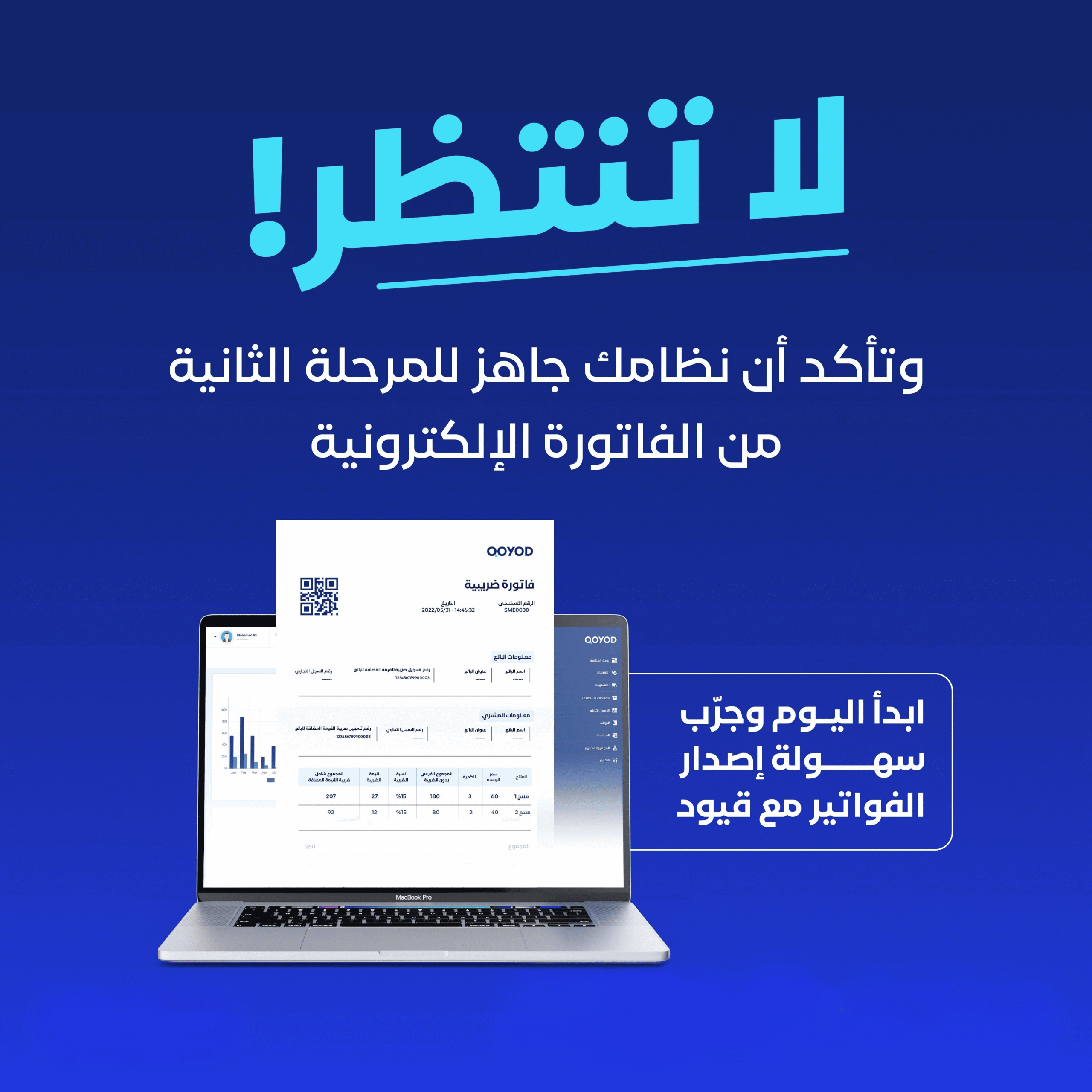
Phase two of ZATCA e-invoicing requires every online sale to be issued through a certified system connected to the Fatoora platform. Most consumer-facing online stores use the simplified tax invoice because the end customer does not carry a tax number. For a side-by-side comparison of vendor costs, the guide on e-invoicing pricing in Saudi Arabia is the best starting point.
Every online invoice must include the store name and tax number, a sequential invoice number, the date and time, an itemized list, the VAT rate (15%), the totals before and after VAT, and a QR code. A certified system generates and transmits a signed XML copy to the Fatoora platform automatically within the 24-hour window for simplified invoices.
How to evaluate a ZATCA-certified system for an online store
When evaluating any e-invoicing vendor for an online store, verify these six criteria:
- Official ZATCA phase-two certification with a verifiable approval number on the Authority’s portal.
- Automatic XML submission of every order within the 24-hour window for simplified invoices.
- Long-term cloud storage of signed invoices for at least six years.
- A simulation environment for issuing test invoices before going live in production.
- Native integration with the major Saudi storefronts and payment gateways, not a manual CSV import.
- Live input-VAT and output-VAT reports ready in time for the quarterly filing deadline.
Where Qoyod fits in specifically for online stores
Qoyod pulls together, inside one account: cloud accounting, multi-channel inventory, storefront integration, payment-gateway reconciliation, shipping-cost tracking, ZATCA-approved e-invoicing, and consolidated reports. Every order moves automatically from your storefront into the ledger, with fees, shipping, and returns already accounted for at the order level.
The platform supports multiple sales channels under one inventory: a Salla storefront, a Zid storefront, Instagram sales, and a physical pickup point can all draw from the same stock figure, with no overselling and no manual stock sync. It runs fully in the cloud, so head office and the external accountant see the same numbers from any device, under fine-grained permissions.
For stores migrating from another platform or launching for the first time, the setup service and the bookkeeping service are part of Qoyod Pro Services, alongside the app marketplace that connects Qoyod to your storefront, payment gateways, and shipping providers.
Frequently asked questions
Does Qoyod integrate with Salla and Zid?+
How does Qoyod reconcile payment-gateway settlements?+
Can I see net margin per order, including shipping?+
How does Qoyod handle returns and refunds?+
Does Qoyod work for a store selling on multiple channels?+
Is technical support available 24/7?+
Running an online store does not need a generic accounting tool, it needs a connected platform that links the storefront, payment gateways, shipping providers, and tax inside one ledger. The stores that consistently grow are the ones that see net margin per order in real time. That capability is what makes Qoyod the right fit for online stores in Saudi Arabia.