A grocery store or minimarket in Saudi Arabia operates on the highest SKU count and the thinnest unit margin in retail. Thousands of products move across the till every day, many of them perishable, most carrying single-digit margins. The point where most groceries lose grip is the combination of silent inventory drift and expiring perishables eating margin one item at a time. This guide explains what sets grocery accounting apart, and how the right software protects margin in a high-velocity, low-margin sector.
What makes grocery accounting different
A grocery store is the most SKU-dense retail business there is. A single store can carry thousands of active SKUs across dry goods, dairy, meat, produce, household, and personal care. Unit margins in this sector are low by nature and are made up on turnover, which is why a small pricing error or unnoticed shrinkage eats a category’s profit quickly.
Grocery accounting revolves around five connected pieces: barcode-driven inventory at SKU level with a disciplined stocktake cycle on perishables, a point of sale that handles both barcoded items and weighed items (meat, produce, cheese), supplier credit terms often running 30 to 60 days, daily promotions and bundles, and end-of-day reconciliation across cash, card, and delivery-app collections. The right software ties all of these inside one ledger.
Daily reality is a high-velocity pipeline: a vegetable delivery arrives at dawn, a dairy order lands mid-morning, the till runs continuously from open to close, perishables get marked down before closing, and the day closes with a cash count and a transfer to the bank. Every untracked step is a margin leak in a sector that runs on volume, not margin.
The most common accounting challenges in grocery stores
Every Saudi grocery operator runs into the same four recurring accounting problems. They share one root cause: there is no single ledger that links the supplier delivery, the shelf, the till, and the supplier payment.
1. Silent inventory shrinkage. The system says you have 80 units of an item, the shelf says 63. The 17 missing units are a mix of theft, mis-scanned barcodes, expired items removed without an adjustment, and customer returns that were never logged. In a 3,000-SKU store, shrinkage can run 1.5% to 3% of revenue without daily cycle counts on fast movers.
2. Perishable write-offs. Dairy, meat, and produce all have narrow expiry windows. Expiry dates are read off the packaging, not from the accounting system, so what keeps write-offs down is operational discipline: a tight stocktake cycle on these categories and a clear markdown rule applied before the shelf date runs out.
3. Pricing and promotion errors. A weekend campaign drops 80 SKUs by 20%. By Sunday morning the prices are still in the system at the discounted level, so the first wave of customers pays the discounted price on full-margin items. The lost margin is rarely caught until weekly review.
4. Supplier-credit confusion. Some suppliers give 30 days, some 45, some 60. Some send weekly statements, some send monthly. Without a single payables ledger that shows due dates and supplier statements side by side, the store either pays late and damages relationships, or pays twice by accident.
What a grocery store actually needs from its accounting software
A generic accounting tool was built for ten-invoice-a-day businesses, not for a till running 800 transactions a day. The difference shows up in six places:
| Task | Generic accounting tool | What a grocery store needs |
|---|---|---|
| Inventory | Manual quantity | Barcode scan with movement history per location |
| Weighed items | Not supported | A till setting that derives quantity from the entered total |
| Pricing | One price per item | Per-branch pricing and dated promotions |
| Perishable categories | Not tracked | Separate categories plus a frequent stocktake cycle |
| Supplier credit | Single payables list | Per-supplier terms with statement matching |
| End-of-day close | Manual count | Cash, card, delivery-app split, per till |
Beyond the table, a grocery store specifically needs three capabilities that generic software does not deliver:
- Barcode-driven inventory with movement history per location, scanned on every receipt, every transfer, and every sale. Receipts, transfers and sales all move the same item record, so stock on hand reflects what is actually on the shelf.
- A workable route for weighed items. There is no direct integration with electronic scales, so weighed lines are handled with the “enter the total to derive the quantity” setting, which works the quantity back out of the amount keyed in using the unit price and VAT.
- Per-supplier credit management with a single payables aging report and the ability to match supplier statements line by line, so working capital is never wasted on early payments or punished by late ones.
How to organize a grocery store’s books step by step
Moving from a paper-based grocery store to integrated accounting takes around one week. This is the sequence the Qoyod onboarding team applies with every new grocery customer:
Retail shops and supermarkets: what changes as you grow
A corner minimarket, a general retail shop and a multi-till supermarket all rest on the same foundation: thousands of barcoded lines, a fast till, stock that moves in real time, and a compliant e-invoice on every sale. What changes between them is the scale of the operation and the number of tills, not the nature of the bookkeeping. That is why one system can serve all three, provided it grows with you in three specific ways.
| Scale of the operation | What defines it | What it needs from the system |
|---|---|---|
| Corner shop or minimarket, one till | Thousands of barcoded lines, one or several suppliers | One account, one warehouse, one POS terminal |
| Supermarket with several tills | Evening peaks and parallel queues | Several POS terminals, per-user permissions, shift reports |
| Retail chain or multiple branches | Prices and stock drift apart between branches | Multiple branches and warehouses with transfers between them |
The three capabilities anyone running more than one till, or more than one branch, ends up asking about:
- Multiple branches and warehouses. More than one location inside a single account, with stock transfers between locations and an independent balance and movement history for each. A shop opening its second branch needs this on day one, otherwise both branches collapse into one number that describes neither.
- Multiple POS terminals. More than one point-of-sale device can run across the branches, with independent permissions per user at the till level, and customers can be allocated to specific terminals.
- Shift and cashier reports. Sales, shift and cashier reports let you reconcile the drawer per shift rather than against a single end-of-day total. Note that session management is available on the Android app only and not in the browser version.
E-invoicing and ZATCA compliance for grocery stores
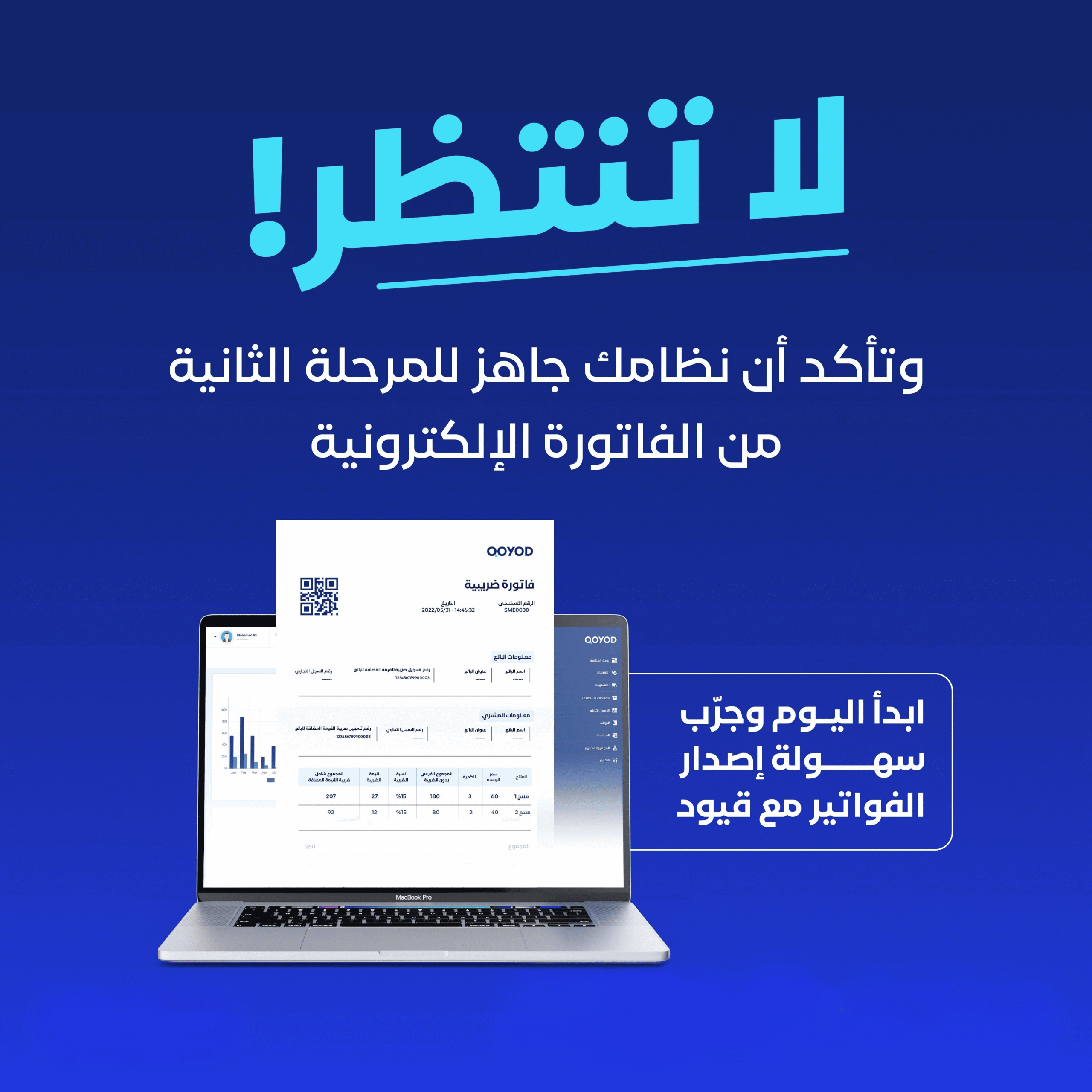
Phase two of ZATCA e-invoicing requires every grocery sale to be issued through a certified system connected to the Fatoora platform. Grocery stores almost always use the simplified tax invoice because the walk-in customer does not carry a tax number. For a side-by-side comparison of vendor costs, the guide on e-invoicing pricing in Saudi Arabia is the best starting point.
Every grocery receipt must include the store name and tax number, a sequential invoice number, the date and time, an itemized list with the correct VAT treatment per line (most groceries are taxable at 15%, some basic food items may be zero-rated), the totals before and after VAT, and a QR code. A certified system generates and transmits a signed XML copy to the Fatoora platform, and simplified invoices carry a 24-hour reporting deadline. That deadline is the seller’s obligation, not a licence to stay offline.
How to evaluate a ZATCA-certified system for a grocery store
When evaluating any e-invoicing vendor for a grocery store, verify these six criteria:
- Official ZATCA phase-two certification with a verifiable approval number on the Authority’s portal.
- Automatic XML submission of every receipt, in time to meet the 24-hour reporting deadline for simplified invoices.
- Long-term cloud storage of signed receipts for at least six years.
- A simulation environment for issuing test receipts before going live in production.
- Receipt issuance in under two seconds, so the till is never slow at peak hours.
- Live input-VAT and output-VAT reports ready in time for the quarterly filing deadline.
Where Qoyod fits in specifically for grocery stores
Qoyod brings together, inside one account: cloud accounting, barcode-driven inventory across multiple branches and warehouses, a POS layer with per-user permissions, supplier and customer accounts with credit terms, ZATCA-approved e-invoicing, payroll, and per-branch or consolidated reports. Every scan at the till issues an e-invoice, deducts stock from the right branch, and posts to revenue in one step.
The platform handles multi-branch grocery operations under one account, with stock transfers between branches, role-based permissions, and either consolidated or per-branch reports. It runs fully in the cloud so head office, branch managers, and the external accountant share the same numbers from any device, under fine-grained permissions.
For grocery stores opening new branches or migrating from a paper-based system, the setup service and the bookkeeping service are part of Qoyod Pro Services, alongside the app marketplace for connecting the surrounding tools a store already runs.
Frequently asked questions
Does Qoyod work for a single-branch minimarket?+
How are weighed items handled at the till?+
How should a store manage perishable categories in Qoyod?+
What happens to the till if the internet drops?+
How does Qoyod handle supplier credit and payables?+
Is the POS included in the free trial?+
Does Qoyod suit a small retail shop with a single till?+
Can I run several branches and several tills from one account?+
Running a grocery store does not need a generic accounting tool, it needs a barcode-driven operating system that ties inventory, the till, suppliers, and tax together inside one ledger. The stores that consistently grow are the ones that protect margin one percentage point at a time. That capability is what makes Qoyod the right fit for grocery stores and minimarkets in Saudi Arabia.