A factory in Saudi Arabia turns raw materials into finished goods through a chain of labor, machinery, and overhead, and every kilo of raw material has to be accounted for at three stages: raw, work-in-progress, and finished. The point where most factories leak margin is the gap between the standard cost they expect and the actual cost they incur. This guide explains what sets factory accounting apart, and how the right software keeps cost of sales and inventory visible across every stage.
What makes factory accounting different
A factory is a multi-stage business with the longest cash-to-cash cycle in industry. Raw materials sit in the warehouse, move into the production line, become work-in-progress for hours or days, finish as stock-ready goods, then ship to customers who pay 30 to 90 days later. Every stage adds cost: raw material, direct labor, machine time, energy, packaging, and overhead allocation.
Factory accounting revolves around five tightly linked things: a bill of materials (BOM) for every finished product, work-in-progress valuation at any point in time, manufacturing overhead allocation across products, finished-goods inventory across warehouses, and per-product cost-of-sales that compares standard against actual cost. The right software ties all of these inside one ledger.
Day-to-day, a factory runs through dozens of movements: receiving raw materials, issuing them to production, recording labor hours, posting machine usage, completing batches into finished stock, and shipping to customers. Each step has an accounting consequence, and a missed step on any of them is a hole in the next month’s gross margin.
The most common accounting challenges in factories
Every Saudi factory operator runs into the same four recurring accounting problems, regardless of what they manufacture. They share one root cause: there is no single ledger that links the bill of materials to actual production output to finished-goods inventory.
1. Standard versus actual cost gap. The BOM says a product costs 42 SAR to make. Three months later, production reports show actual cost is 51 SAR. The 9 SAR gap is a mix of higher raw-material prices, longer setup times, machine downtime, and unallocated overhead. Without per-batch actual cost, the factory cannot pinpoint the source of the gap.
2. Untracked work-in-progress. At any point on the production floor, hundreds of thousands of riyals worth of half-finished goods are in process. Most factories book WIP at month-end by a manual estimate, which means daily cash position is wrong and any urgent decision is taken on bad numbers.
3. Overhead allocation by feel. Rent, utilities, and supervisor salaries should be allocated across products by a sensible driver (machine hours, labor hours, or square meters). When they are lumped into a single overhead expense, every product looks more profitable than it really is, and pricing decisions on the slow movers go the wrong way.
4. Slow stock takes. A factory with thousands of SKUs across raw, WIP, and finished warehouses needs continuous inventory, not annual stocktakes. Annual counts uncover gaps that have been drifting for nine months and lock the team into prior-period adjustments.
What a factory actually needs from its accounting software
A generic accounting tool was built for buy-and-resell businesses, not for multi-stage manufacturing. The difference shows up in six places:
| Task | Generic accounting tool | What a factory needs |
|---|---|---|
| Product cost | Single purchase price | BOM with raw, labor, overhead per unit |
| Inventory | Single warehouse | Raw, WIP, and finished, with stage transfers |
| Production order | Not supported | Production order tied to BOM and actual cost |
| Overhead allocation | Single expense bucket | Allocated by driver (machine hours, labor) |
| Variance analysis | Not supported | Standard vs. actual cost per batch |
| Multi-warehouse stock | One stock figure | Stock per stage and per location |
Beyond the table, a factory specifically needs three capabilities that generic software does not deliver:
- A bill of materials per finished product, with components, quantities, labor minutes, and machine minutes, so every production order automatically computes its expected cost and can be compared against actual.
- Stage-by-stage inventory tracking from raw to work-in-progress to finished goods, with automatic journal entries on every stage transfer, so the cash position is correct every day, not just at month-end.
- Manufacturing overhead absorption by a configurable driver (machine hours, labor hours, square meters), so every product carries its fair share of rent, utilities, and supervision in its cost of sales.
How to organize a factory’s books step by step
Moving from a spreadsheet-based factory to integrated accounting takes around two to three weeks. This is the sequence the Qoyod onboarding team applies with every new manufacturing customer:
E-invoicing and ZATCA compliance for factories
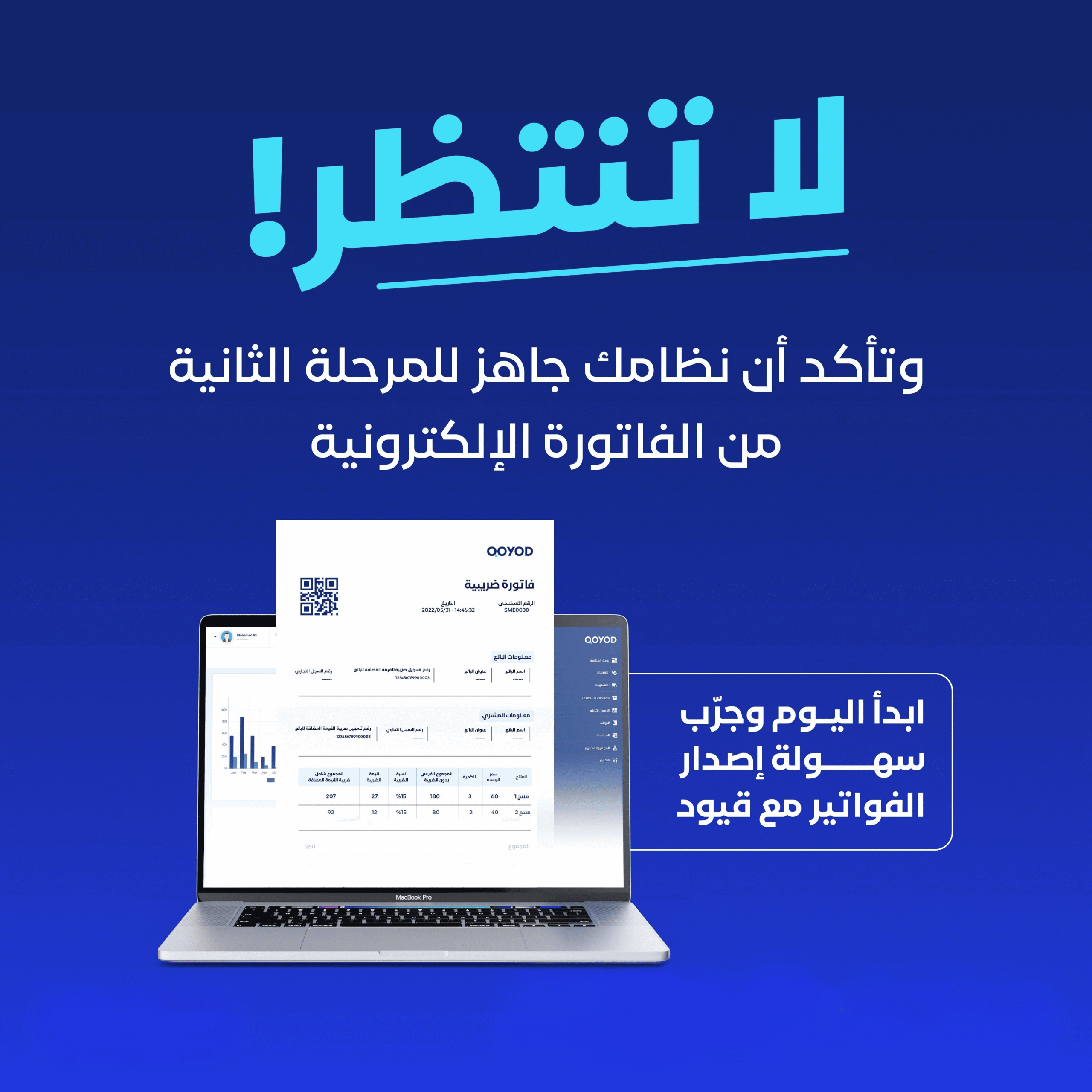
Phase two of ZATCA e-invoicing requires every factory invoice to be issued through a certified system connected to the Fatoora platform. Factories mostly issue B2B tax invoices to distributors and other businesses (with the buyer’s tax number), and the smaller number of direct B2C sales follow the simplified tax invoice flow. For a side-by-side cost comparison of vendors, the guide on e-invoicing pricing in Saudi Arabia is the best starting point.
Every factory invoice must include the factory name and tax number, the buyer’s name and tax number for B2B invoices, a sequential invoice number, the date and time, an itemized list, the VAT rate (15%), the totals before and after VAT, and a QR code. A certified system generates and submits the signed XML to the Fatoora platform for clearance before the invoice is issued (Clearance flow for B2B).
How to evaluate a ZATCA-certified system for a factory
When evaluating any e-invoicing vendor for a factory, verify these six criteria:
- Official ZATCA phase-two certification with a verifiable approval number on the Authority’s portal.
- Both Clearance (B2B tax invoices) and Reporting (B2C simplified invoices) flows in one system.
- Long-term cloud storage of signed invoices for at least six years.
- A simulation environment for issuing test invoices before going live in production.
- Per-warehouse and per-customer reporting on output VAT for B2B distribution.
- Live input-VAT and output-VAT reports ready in time for the quarterly filing deadline.
Where Qoyod fits in specifically for factories
Qoyod brings together, inside one account: cloud accounting, bill of materials, production orders, multi-stage inventory (raw, WIP, finished) across multiple warehouses, manufacturing overhead allocation, customer and supplier accounts, ZATCA-approved e-invoicing in both Clearance and Reporting flows, payroll, and consolidated reports. Every production movement posts an automatic journal entry inside the same ledger.
The platform handles multiple production facilities under one account, with inter-warehouse transfers, and runs fully in the cloud so head office, plant managers, and the external accountant share the same numbers from any device, under fine-grained permissions.
For factories scaling up or migrating from a legacy ERP, the setup service and the bookkeeping service are available as part of Qoyod Pro Services, alongside the app marketplace that connects Qoyod to barcode hardware and partner systems for advanced shop-floor workflows.
Frequently asked questions
Does Qoyod support a bill of materials per product?+
How does Qoyod handle work-in-progress accounting?+
Can the system allocate manufacturing overhead to products?+
Does Qoyod support multiple warehouses and production facilities?+
Does the e-invoicing system support both B2B and B2C flows?+
Is technical support available 24/7?+
Running a factory does not need a generic accounting tool, it needs a multi-stage operating system that ties BOM, production orders, work-in-progress, and finished-goods inventory together inside one ledger. The factories that consistently grow are the ones that see standard versus actual cost per batch in real time. That capability is what makes Qoyod the right fit for factories in Saudi Arabia.