A driving school in Saudi Arabia sells course packages that span six to twelve weeks, collects government fees on behalf of the General Department of Traffic that have to pass through without margin, pays instructors on a mix of salary and per-hour commission, and operates a fleet of training vehicles that consume fuel, maintenance, and insurance daily. Each student pays up front for a package they will consume gradually, every lesson hour ties to a specific instructor and vehicle, and ZATCA e-invoicing applies on every receipt. The difference between a profitable school and a struggling one comes down to accounting discipline on deferred revenue, fee pass-through, and per-vehicle cost.
What makes driving-school accounting different
A driving school is not a regular service business. Students pay 1,800 to 3,500 SAR up front for a package that delivers over weeks of lessons, so the cash collected on day one is mostly a liability, not revenue. Government fees of 400 to 800 SAR per student have to be collected and remitted to the Traffic Department with no margin. Generic accounting tools cannot defer revenue or pass-through fees correctly.
Driving-school accounting revolves around five connected pieces: package revenue recognized as lessons are delivered (not on payment day), government-fee pass-through booked as a liability until remittance, instructor commissions calculated from logged lesson hours, per-vehicle cost tracking (fuel, maintenance, insurance), and ZATCA simplified tax invoice on every student receipt plus B2B tax invoices on corporate-fleet driver training.
Daily reality is dozens of postings per branch: student registrations, package payments, government-fee collection, instructor lesson logs, vehicle fuel purchases, maintenance invoices, government-fee remittance, and the periodic per-vehicle cost review. Each unrecognized lesson is revenue waiting to be booked, and each uncollected government fee is a Traffic Department dispute.
The most common accounting challenges in driving schools
Every driving school in Saudi Arabia runs into the same four recurring problems. They share one root cause: package payments get booked as revenue on the payment day, and government fees mix with operating cash.
1. Package payments booked as revenue. A student pays 2,400 SAR for a 30-lesson package on day one. Booking the full 2,400 SAR as revenue inflates the month’s P&L, mis-states the balance sheet, creates Zakat exposure on revenue not yet earned, and overstates VAT due. Package revenue must be recognized as lessons are delivered.
2. Government fees mixed with operating cash. The school collects 600 SAR per student for Traffic Department fees that have to be remitted within a defined window. Without a fee-pass-through liability, the cash sits in the operating account, payroll runs against it, and the remittance becomes a cash-flow crisis.
3. Instructor commissions calculated by hand. Instructors earn a per-hour commission on lessons delivered, with different rates for theory, parking, and road. Without integrated lesson logs, the payroll team tallies a spreadsheet every month, gets it wrong on at least one instructor, and creates monthly disputes.
4. Per-vehicle cost not tracked. The school operates 18 training vehicles. Each one carries fuel, maintenance, insurance, and depreciation, but the costs all sit in one operating-expense line. The school has no idea which vehicles are cheap to run and which are bleeding cash on repairs.
What a driving school actually needs from its accounting software
A generic accounting tool was built for one-time sales, not for multi-week course packages. The difference is concrete:
| Task | Generic accounting tool | What a driving school needs |
|---|---|---|
| Package revenue | Booked on payment | Recognized per lesson delivered |
| Government fees | Mixed with cash | Pass-through liability |
| Instructor commissions | Manual payroll | Auto-calculated from lessons |
| Vehicle costs | Single expense line | Per-vehicle with dimension |
| VAT on packages | Charged at receipt | Recognized as lessons deliver |
| Student aging | Generic AR | Lesson-balance per student |
Beyond the table, a driving school specifically needs three capabilities that generic platforms do not deliver:
- Deferred revenue per package with lesson-by-lesson recognition, where the cash collected on day one sits as a customer-advance liability and converts to revenue each time a lesson is logged.
- Government-fee pass-through accounting, where the fee collection posts to a liability account on the student-registration day and clears only when the remittance is sent to the Traffic Department.
- Instructor-commission engine driven by lesson logs, generating accurate monthly payroll without manual spreadsheets, with ZATCA-certified simplified tax invoice on every student receipt plus B2B tax invoices on corporate driver-training contracts.
How to organize a driving school’s books step by step
Moving a driving school to integrated accounting takes around two to four weeks depending on branch and vehicle count. This is the sequence Qoyod applies with every new driving-school customer:
E-invoicing and ZATCA compliance for driving schools
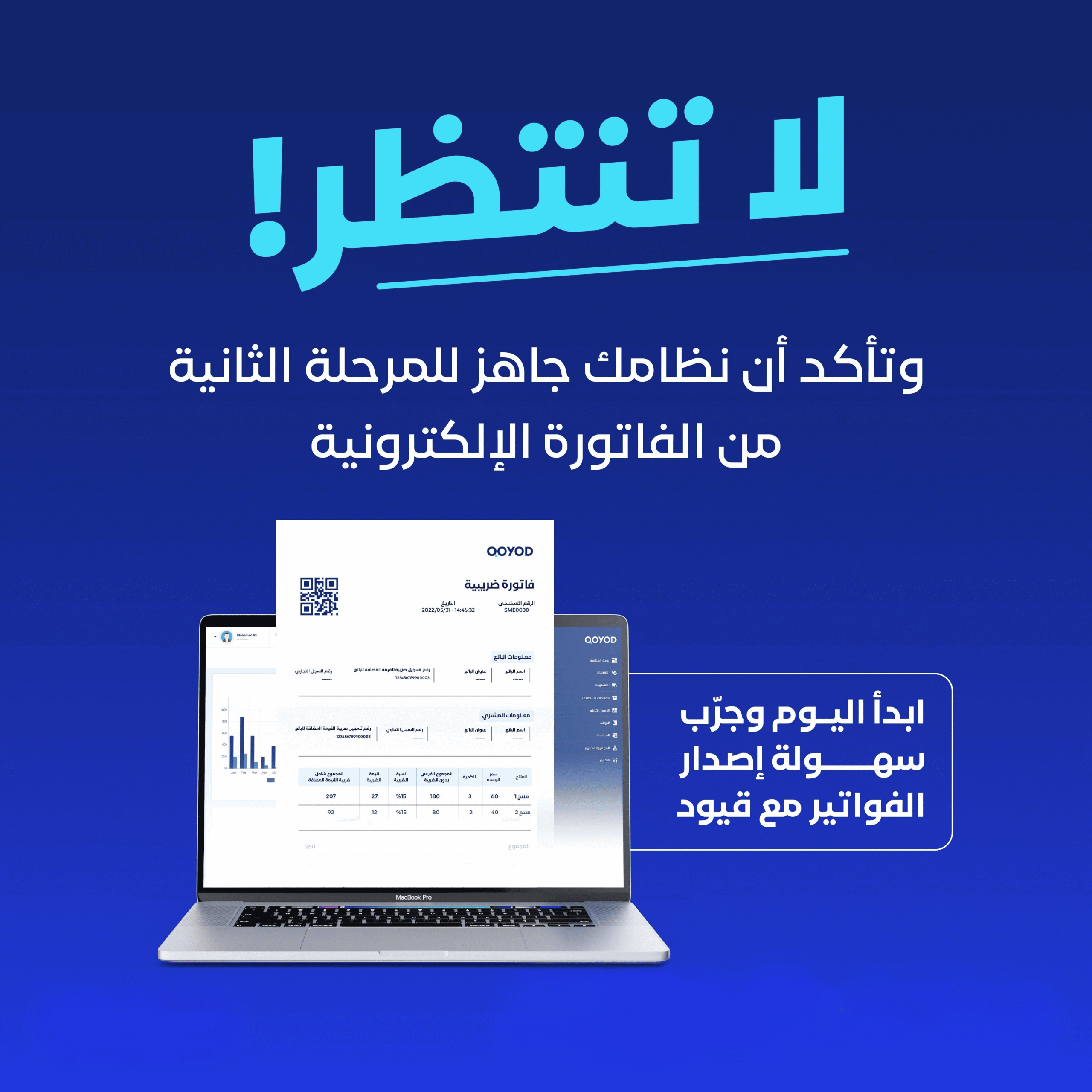
Phase two of ZATCA e-invoicing requires every student receipt and every corporate-training invoice to be issued through a certified system connected to the Fatoora platform. Driving schools issue both simplified tax invoices on individual student receipts and B2B tax invoices to fleet operators and corporate clients through the Clearance flow. For a side-by-side view of vendor costs, read the guide on e-invoicing pricing in Saudi Arabia.
Every invoice must include the school name and tax number, a sequential invoice number, the date and time, the student name, an itemized list with the package, government fees broken out (as pass-through), VAT at 15% on the school’s service portion only, totals before and after VAT, and a QR code. A certified system generates the QR code, signs the invoice in XML, and transmits it to the Fatoora platform automatically inside the Reporting or Clearance window.
How to evaluate a ZATCA-certified system for a driving school
When evaluating any e-invoicing vendor for a school, verify these six criteria:
- Official ZATCA phase-two certification with a verifiable approval number on the Authority’s portal.
- Both Reporting (B2C student receipts) and Clearance (B2B corporate-training contracts) flows in one system.
- Pass-through-fee flagging so government fees do not carry VAT.
- Deferred-revenue posting that defers VAT until lessons are delivered.
- Long-term cloud storage of signed invoices for at least six years.
- Monthly input-VAT and output-VAT reports ready in time for the quarterly filing deadline.
Where Qoyod fits in specifically for driving schools
Qoyod brings together, inside one account: cloud accounting with branch, instructor, and vehicle dimensions, deferred revenue per package with lesson-by-lesson recognition, government-fee pass-through accounting, instructor-commission engine driven by lesson logs, per-vehicle cost tracking, ZATCA-approved e-invoicing, payroll, and consolidated reports. Every package payment, lesson, fee remittance, and vehicle expense lands an automatic journal entry inside the same ledger.
The platform handles multi-branch driving schools and corporate driver-training divisions under one account, with shared master data (instructors, vehicles, courses, COA), role-based permissions per branch, and either consolidated or per-branch reports. It runs entirely in the cloud, so owners, branch managers, and the external auditor share the same numbers from any device.
For schools opening new branches or migrating from spreadsheets, the setup service and the bookkeeping service are available as part of Qoyod Pro Services, alongside the app marketplace for connecting to scheduling and student-management partners.
Frequently asked questions
Does Qoyod recognize package revenue correctly for driving schools?+
How does Qoyod handle government-fee pass-through?+
Can Qoyod calculate instructor commissions automatically?+
Does Qoyod track per-vehicle costs?+
Does Qoyod work for multi-branch driving schools?+
Is technical support available 24/7?+
Running a driving school does not need a generic accounting tool, it needs an operating ledger that ties deferred revenue, government-fee pass-through, instructor commissions, per-vehicle cost, and ZATCA e-invoicing together inside one account. The schools that consistently grow are the ones that see per-vehicle cost and per-instructor utilization every week. That capability is what makes Qoyod the right fit for driving schools in Saudi Arabia.