An advertising agency in Saudi Arabia juggles retainer clients on monthly fees, project clients on milestone billing, media-buy pass-throughs that flow through the agency at zero margin, and a roster of freelance designers, copywriters, and producers paid per deliverable. A single Riyadh-based agency can run 18 active projects, three retainers, and 220,000 SAR of monthly media buys all at once. Without project-based billing, media-buy pass-through logic, and freelance vendor accounting, the agency cannot tell which clients are profitable, how much agency time was burned on a fixed-fee project, or where the margin actually came from.
What makes ad-agency accounting different
An ad agency is a project shop with a media pass-through layer on top. Revenue mixes recurring retainers, milestone-based project fees, and media buys that should never inflate the agency’s P&L. Cost is mostly people: full-time creatives plus freelancers paid per deliverable. Generic accounting tools cannot track a project, a retainer, and a pass-through inside one ledger without distorting margin.
Ad-agency accounting revolves around five connected pieces: project-based billing with milestones and time-tracking, retainer revenue recognition on a monthly schedule, media-buy pass-through accounting at zero net margin, freelance vendor invoices tied to deliverables, and ZATCA tax invoice on every client invoice.
Daily reality is a stream of project milestones invoiced, retainer fees recognized, media buys received from platforms and re-billed to clients, freelance invoices received against deliverables, and team time logged against project codes. Every missed milestone or unbilled retainer becomes a cash-flow problem inside a quarter.
The most common accounting challenges in ad agencies
Every ad agency in Saudi Arabia runs into the same four recurring problems. They share the same root cause: projects live in a project-management tool, media buys live in platform dashboards, and freelancers live in WhatsApp threads, none of them connected to the ledger.
1. Project profitability unknown. A 180,000 SAR brand-identity project sells at a 60% target margin, but a senior designer logs 240 hours instead of the planned 120, and the project quietly closes at 12% margin. Without time tracking tied to project codes, the agency cannot see the burn until the next pitch.
2. Media-buy pass-throughs inflate revenue. A client gives the agency 220,000 SAR a month for paid social and search. Booking it as agency revenue inflates the P&L, distorts agency margin, and creates a ZATCA reconciliation problem when the platform invoice arrives later. Pass-through accounting at zero net is the only correct treatment.
3. Retainer recognition lumpy. A 45,000 SAR-per-month retainer is invoiced quarterly and recognized when invoiced. Revenue spikes one month, drops the next two, and management cannot see real monthly performance. Recognition on the service month, not the invoice month, is the fix.
4. Freelance vendor billing untracked. A freelance illustrator delivers 14 pieces across three projects but invoices the agency for a flat package. Without deliverable-level tracking, the cost lands on one project and the other two projects look more profitable than they really are.
What an ad agency actually needs from its accounting software
A generic accounting tool was built for selling discrete services, not for running 18 concurrent projects, three retainers, and 220,000 SAR of monthly media pass-throughs inside one ledger. The gap is concrete:
| Task | Generic accounting tool | What an ad agency needs |
|---|---|---|
| Project billing | Single invoice | Milestone schedule with time |
| Retainer revenue | Invoiced month | Recognized on service month |
| Media buys | Inflates revenue | Pass-through at zero net |
| Freelancers | Generic AP | Deliverable-linked to project |
| Time tracking | Not supported | Tied to project and role |
| VAT | Flat 15% | Per-line, pass-through aware |
Beyond the table, an ad agency specifically needs three capabilities generic platforms do not deliver:
- Project codes with milestones and time tracking, so every hour a designer or copywriter logs attaches to a project, the milestone invoice fires on the scheduled date, and gross margin is visible in real time.
- Media-buy pass-through ledger, where platform invoices and client re-bills net to zero on revenue, only the agency fee hits the P&L, and ZATCA reconciliation stays clean.
- Retainer revenue schedule, recognizing the monthly fee on the service month regardless of invoice timing, with ZATCA-certified tax invoice on every milestone and retainer billing.
How to organize an ad agency’s books step by step
Moving an ad agency to integrated accounting takes around three to five weeks depending on project volume and client mix. This is the sequence Qoyod applies with every new agency customer:
E-invoicing and ZATCA compliance for ad agencies
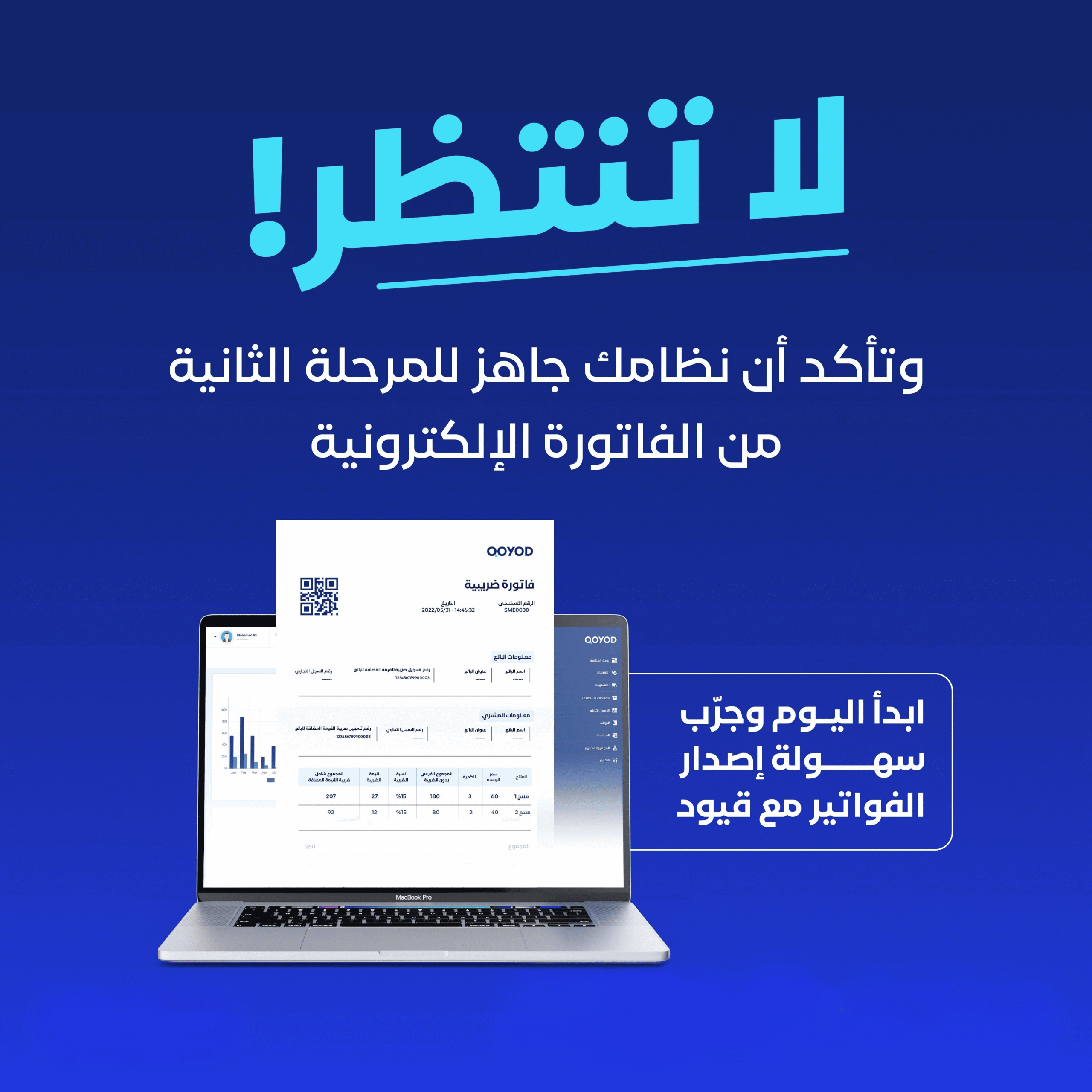
Phase two of ZATCA e-invoicing requires every client invoice and every milestone billing to be issued through a certified system connected to the Fatoora platform. Ad agencies issue almost exclusively B2B tax invoices to client companies through the Clearance flow, with occasional simplified receipts on small project deposits. For a side-by-side view of vendor costs, read the guide on e-invoicing pricing in Saudi Arabia.
Every invoice must include the agency name and tax number, the client name and tax number on B2B invoices, a sequential invoice number, the date, an itemized list of project milestones or retainer line items with VAT at 15%, totals before and after VAT, and a QR code. A certified system generates the QR code, signs the invoice in XML, and transmits it to the Fatoora platform automatically inside the Clearance window.
How to evaluate a ZATCA-certified system for an ad agency
When evaluating any e-invoicing vendor for an ad agency, verify these six criteria:
- Official ZATCA phase-two certification with a verifiable approval number on the Authority’s portal.
- Both Reporting (small deposits) and Clearance (B2B milestone and retainer billings) flows in one system.
- Pass-through VAT treatment for media buys re-billed to clients.
- Per-line VAT on multi-milestone invoices.
- Long-term cloud storage of signed invoices for at least six years.
- Monthly input-VAT and output-VAT reports ready in time for the quarterly filing deadline.
Where Qoyod fits in specifically for ad agencies
Qoyod brings together, inside one account: cloud accounting with project, client, and discipline dimensions, project codes with milestone billing, retainer recognition on the service month, media-buy pass-through ledger at zero net, freelance vendor management at the deliverable level, ZATCA-approved e-invoicing, payroll, and consolidated reports. Every milestone, retainer fee, pass-through, and freelance invoice lands an automatic journal entry inside the same ledger.
The platform handles multi-office agency networks under one account, with shared master data (clients, projects, COA), role-based permissions per office, and either consolidated or per-office reports. It runs entirely in the cloud, so account managers, finance, and the external auditor share the same numbers from any device.
For agencies launching new offices or migrating from a legacy ERP, the setup service and the bookkeeping service are available as part of Qoyod Pro Services, alongside the app marketplace for connecting to project-management and HR partners.
Frequently asked questions
Does Qoyod support project-based billing for ad agencies?+
How does Qoyod handle media-buy pass-throughs?+
Can Qoyod recognize retainer revenue on the service month?+
Does Qoyod manage freelance vendors at the deliverable level?+
Does Qoyod work for multi-office agency networks?+
Is technical support available 24/7?+
Running an ad agency does not need a generic accounting tool, it needs an operating ledger that ties project billing, time tracking, retainer recognition, media pass-throughs, freelancers, and ZATCA e-invoicing together inside one account. The agencies that consistently grow are the ones that see project margin and team utilization every week. That capability is what makes Qoyod the right fit for ad agencies in Saudi Arabia.