Last updated: 2 August 2026
Financial statements are the clearest window into a company. They show how much it earned, what it owns, what it owes, and where its cash went.
Read them well and you can judge a business in minutes. You see its strengths, its weak spots, and the risks it is carrying.
This guide explains what financial statements are, what the five types cover, when they are prepared, and how to build them from a trial balance. A full worked example is included.
What are financial statements?
Financial statements are a set of reports that show how a company performed over a period, and where it stands at the end of it.
Together they answer five basic questions:
- What does the company own? Its assets, such as cash, stock and equipment.
- What does the company owe? Its liabilities, such as loans and unpaid supplier bills.
- What did it earn? Its revenues for the period.
- What did it spend? Its expenses for the same period.
- What is left for the owners? Its equity, or net worth.
Every other financial number in a business, from a bank’s credit decision to an investor’s valuation, is built on these answers.
What are the five financial statements?
There are five statements. Each one answers a different question, and each one is prepared from the same set of accounting records.
What each financial statement tells you
1. Income statement
What it answers: did the business make a profit this period?
It covers a stretch of time, usually a quarter or a year.
- Revenue: sales plus income from other activities.
- Expenses: production, marketing, salaries, rent, and finance costs.
- Bottom line: revenue minus expenses, which gives net profit or net loss.
If you want a ready-made layout to work in, start from the income and expense statement template, then check the result against a profit margin calculator.
2. Statement of financial position
What it answers: what does the business own and owe right now?
Unlike the income statement, it captures a single date rather than a period. It has three parts:
- Assets: cash, bank balances, receivables, stock, and fixed assets.
- Liabilities: loans, supplier balances, and other debts.
- Equity: what is left for the owners once the debts are settled.
Assets always equal liabilities plus equity. Our guide to the statement of financial position walks through each line, including how to classify current assets.
3. Statement of cash flows
What it answers: where did the cash actually come from, and where did it go?
Profit and cash are not the same thing. A profitable company can still run out of money. This statement splits every movement into three buckets:
- Operating activities: cash from sales, minus cash paid for running costs. This is operating cash flow.
- Investing activities: buying or selling fixed assets and investments.
- Financing activities: loans taken or repaid, capital injected, and dividends paid.
It is the fastest way to see whether a business can pay its bills next month.
4. Statement of changes in equity
What it answers: how did the owners’ stake change over the period?
It starts with opening equity and works down to closing equity. Along the way it shows:
- Profit or loss for the period.
- New capital put in by the owners.
- Dividends or drawings taken out.
- Any other movement in reserves.
5. Statement of comprehensive income
What it answers: what else changed in value that the income statement missed?
Some gains and losses never pass through profit and loss. Asset revaluations are one example. Currency movements are another, which matters for any business handling multiple currencies.
This statement is read alongside the income statement, not instead of it.
When are financial statements prepared?
Financial statements are prepared at the end of an accounting period. That is simply the stretch of time whose transactions you are closing off.
In practice, companies use one of these:
- Annual: the standard cycle, tied to the financial year.
- Half-yearly: common for companies reporting to lenders.
- Quarterly: required for listed companies and used widely by management.
- Monthly: internal only, for owners who want to steer the business as they go.
The exact requirement depends on your legal form, your regulator, and your own reporting policy.
Principles of preparing financial statements
Four principles keep financial statements accurate and comparable from one period to the next.
Four rules behind every set of financial statements
Follow these four and your statements stay reliable, comparable and easy for a bank, an auditor or an investor to trust.
- Historical cost: record an item at what you paid for it
- Realisable value: measure at fair market value where required
- Honesty and disclosure: state the policies and estimates you used
- Matching: book revenue and its related expenses in the same period
Historical cost principle
Assets, liabilities and transactions are recorded at their original cost. The figure in the books is what you actually paid, not what the item might fetch today.
This keeps the numbers verifiable, and it makes one period comparable with the next.
Realisable value principle
Some items must be measured at their current fair value instead of their original cost. Doing so gives a truer picture of what the business is worth today.
Honesty and disclosure principle
The statements must be truthful and complete. Nothing that a reader needs is left out.
That includes the accounting policies you followed and the estimates you relied on. If a number involved judgement, say so.
Matching principle
Revenue and the expenses that produced it belong in the same period.
- Record revenue when it is earned, not when the cash lands.
- Record an expense when it is used, not when the invoice is paid.
This is the accrual principle in action, and it is why profit rarely equals the change in your bank balance.
The difference between financial statements and financial reports
The two terms get mixed up often. The difference is scope.
| Financial statements | Financial reports | |
|---|---|---|
| What they are | A fixed set of five reports | Any report that explains or supports the financials |
| Contents | Income statement, financial position, cash flows, changes in equity, comprehensive income | Notes, disclosures, analyses, project reviews, sector reviews |
| Format | Standardised | Flexible, built for the question being asked |
| Timing | Every accounting period | Periodic or one off, as needed |
Periodic financial reports
These accompany the statements each period. They carry the notes and disclosures, plus the non-financial context that helps someone act on the numbers.
They are where the deeper analysis lives.
Non-periodic reports
These are produced on demand, for a specific question. Typical examples:
- A deep dive into one project or one line of business.
- A review of an investment strategy.
- A report requested by a lender, a partner or a regulator.
Both kinds sit on top of the same underlying data, which is why financial analysis is only as good as the bookkeeping beneath it.
Worked example: preparing financial statements step by step
Here is a full example for a small company we will call Company B, for the year 2023.
We start from its trial balance and finish with a complete set of statements. All figures are in SAR.
Step 1: Start with the trial balance
The trial balance lists every account balance at the year end. Debits and credits must be equal before you go any further.
| Account name | Debit (SAR) | Credit (SAR) |
|---|---|---|
| Capital | 36,000 | |
| Revenue | 30,000 | |
| Creditors | 11,000 | |
| Cash on hand | 30,400 | |
| Bank | 19,600 | |
| Salaries | 16,000 | |
| Rent expenses | 7,000 | |
| Electricity expenses | 2,000 | |
| Marketing expenses | 1,600 | |
| Accrued revenue | 400 | |
| Total | 77,000 | 77,000 |
Step 2: Close the revenue accounts
Move the revenue balance into the profit and loss account.
| Entry | Debit (SAR) | Credit (SAR) |
|---|---|---|
| Revenue account | 30,000 | |
| Profit and loss account | 30,000 |
The revenue account is now zero, ready for the new year.
Step 3: Close the expense accounts
Do the same with every expense account. The four expenses add up to 26,600.
| Entry | Debit (SAR) | Credit (SAR) |
|---|---|---|
| Profit and loss account | 26,600 | |
| Rent expenses | 7,000 | |
| Marketing expenses | 1,600 | |
| Electricity expenses | 2,000 | |
| Salaries | 16,000 |
Step 4: Prepare the income statement
Revenue of 30,000 less operating expenses of 26,600 leaves a net profit of 3,400.
| Line | Amount (SAR) |
|---|---|
| Revenue | 30,000 |
| Salaries | (16,000) |
| Rent expenses | (7,000) |
| Electricity expenses | (2,000) |
| Marketing expenses | (1,600) |
| Net profit | 3,400 |
Step 5: Prepare the statement of changes in equity
Add the year’s profit to the opening capital.
| Line | Amount (SAR) |
|---|---|
| Capital at the start of the period | 36,000 |
| Net profit for the period | 3,400 |
| Equity at the end of the period | 39,400 |
Step 6: Prepare the statement of financial position
Finally, list the assets on one side and the liabilities plus equity on the other. Both come to 50,400, so the statement balances.
| Line | Amount (SAR) | Total (SAR) |
|---|---|---|
| Assets | ||
| Cash on hand | 30,400 | |
| Bank | 19,600 | |
| Accrued revenue | 400 | |
| Total assets | 50,400 | |
| Liabilities and equity | ||
| Capital | 36,000 | |
| Creditors | 11,000 | |
| Net profit for the period | 3,400 | |
| Total liabilities and equity | 50,400 |
How Qoyod helps you produce financial statements
Doing all of the above by hand is slow, and one mistyped figure breaks the whole set. Qoyod accounting software builds the statements straight from your day to day entries.
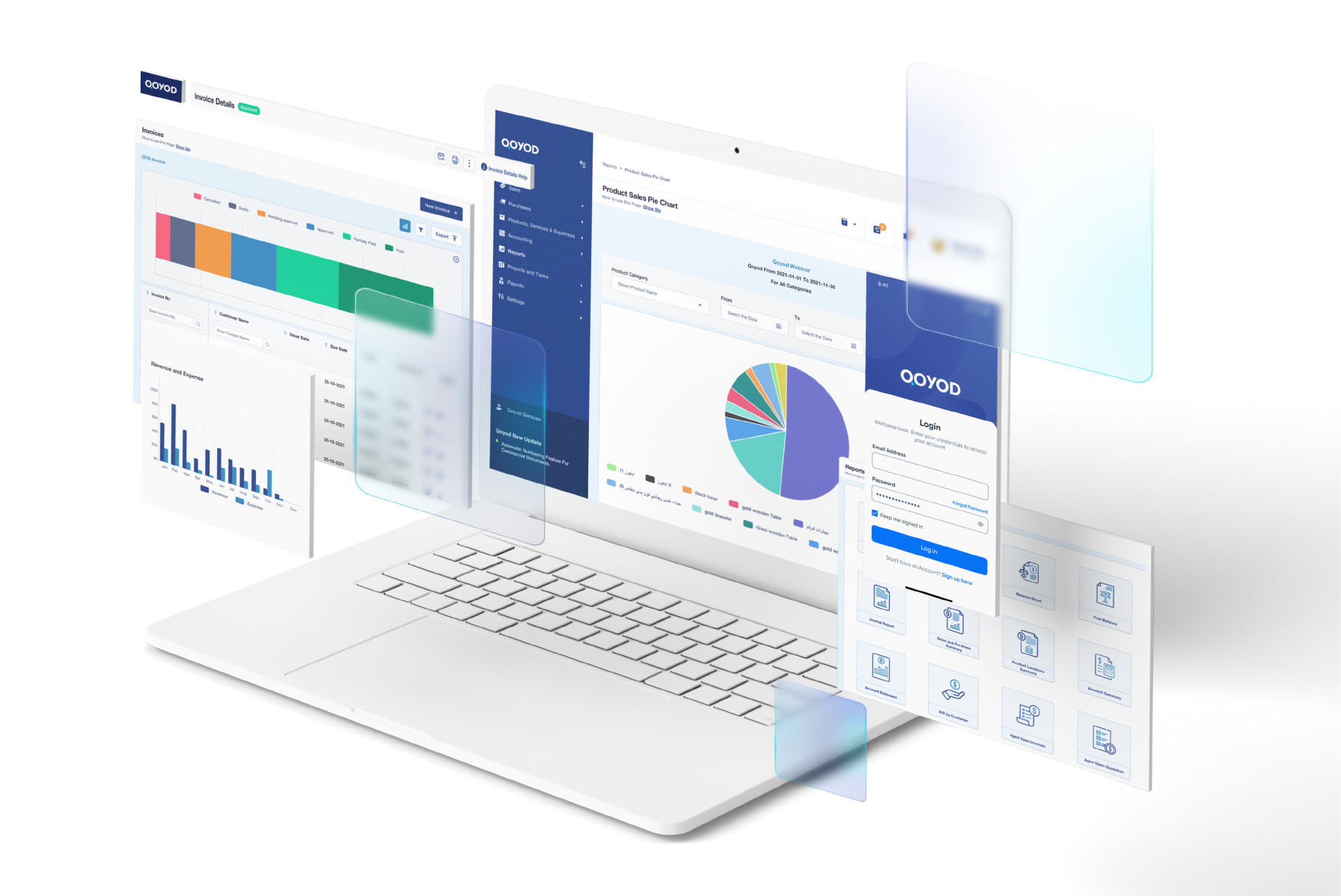
- Ready statements in the Reports menu: income statement, balance sheet, cash flow statement, trial balance, general ledger and journal ledger, all generated from your live data.
- Cash flow on the indirect method: the report starts from net income before interest, tax and zakat, then adjusts for non-cash items and working capital movements.
- Period comparison: compare any statement against a previous week, month, quarter or year, and choose how many periods to line up side by side.
- Advanced analysis: filter a statement by project, branch, warehouse, customer, supplier, employee or product to see what is driving a number.
- Account level control: show full detail or roll the statement up to account type, depending on who is reading it.
- Export and permissions: export to Excel or PDF, and set per role who is allowed to open each report.
You can also see the numbers as they move with real time financial reports, and dig into the detail through the reports library and its filters. If you would rather hand the closing work to someone else, Qoyod Pro Services covers bookkeeping, VAT and account clean up.
Preparing statements by hand vs preparing them in Qoyod
| Task | Manual spreadsheets | Qoyod |
|---|---|---|
| Building the statements | Retyped by hand You total the ledger yourself, then copy the figures into each statement. |
Generated Income statement, balance sheet, cash flows and trial balance are ready in the Reports menu. |
| Comparing periods | Rebuilt each time Every comparison means a new sheet and another round of copy and paste. |
Built in Compare against a previous week, month, quarter or year in a click. |
| Explaining a number | Hard to trace Finding what sits behind a total means hunting through rows and files. |
Advanced analysis Filter the statement by project, branch, customer, supplier or product. |
| Sharing the output | Uncontrolled Files get emailed around with no control over who sees what. |
Role based Report access is set per role, and you export to Excel or PDF. |
Start your free trial and pull your financial statements from one place
Conclusion
Financial statements look intimidating from the outside. They are not. Each one answers a single, plain question about the business.
Once you can read all five together, you can judge a company’s health, spot a cash problem before it bites, and make investment decisions on evidence rather than instinct.
The work is far easier when the numbers come out of a system that is already keeping your books in order. Now that you know what financial statements are, try Qoyod free for 14 days and see your own statements build themselves.
Join our community. Follow us on LinkedIn and X to get our latest articles and updates first.