




An economy diversifying with confidence
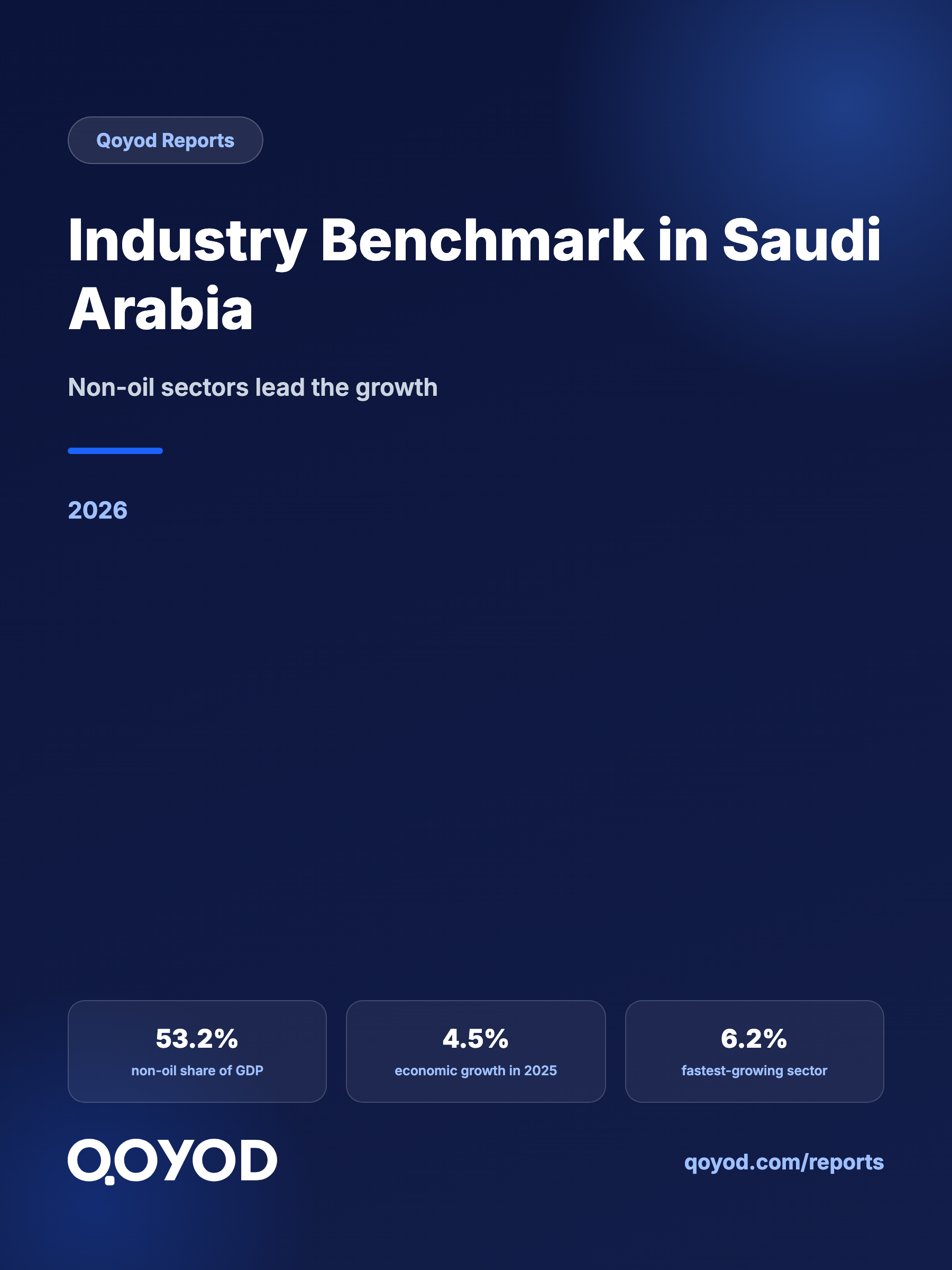
According to the General Authority for Statistics, the Saudi economy grew 4.5% in 2025 to reach about $1.27 trillion in size, with momentum of 5% year on year in the final quarter. But the most important figure is not growth itself, it is its source: non-oil activities that grew 4.9% and contributed about 2.8 percentage points to GDP growth, and now make up 53.2% of the economy. This is the essence of the economic diversification targeted by Vision 2030.
Source: General Authority for Statistics (GASTAT), 2025.
%
trillion USD
Source: General Authority for Statistics (GASTAT) and SPA, 2025.
The fastest-growing sectors
Diversification was not evenly distributed; specific sectors led it. Wholesale and retail trade, restaurants and hotels topped the scene with 6.2% growth, followed by financial, insurance and business services at 6.1%, then electricity, gas and water at 6.0%. These three sectors are the beating heart of the consumer and services economy, and they are where the majority of small and medium enterprises are concentrated.
Source: General Authority for Statistics (GASTAT), sector growth in 2025.
The largest sectors by size
By size and contribution to GDP, wholesale and retail trade, restaurants and hotels come first at 12.3% of GDP, followed by manufacturing (excluding oil refining) at 11.1%, then construction at 8.0%. The fact that trade and hospitality is both the largest and the fastest-growing sector makes it the most prominent engine of the non-oil economy.
Source: General Authority for Statistics (GASTAT), 2025. Shares of total GDP.
What does this mean for a business owner?
A “sector performance benchmark” is not just a figure to read; it is a decision tool. Knowing where the economy is growing and where its size is concentrated helps a business owner to:
| Use | Practical value |
|---|---|
| Choosing or expanding into a sector | Positioning in a growing sector raises the odds of demand and growth |
| Benchmarking the business against its sector | Knowing whether your growth is above or below the sector average |
| Planning pricing and expansion | Reading sector momentum supports capacity and pricing decisions |
| Attracting financing and partnerships | Sector figures strengthen the business’s case before financiers |
But benchmarking against the sector starts with knowing your own business’s numbers accurately first. This is where the accounting system comes in: Qoyod, an Arabic cloud accounting system, gives you a real-time picture of your revenue, expenses, margins and growth, compliant with e-invoicing, so you measure your performance against your sector with confidence instead of guessing. Qoyod serves businesses across every sector this report tracks, from trade and restaurants to services and contracting.
Outlook to 2030 and recommendations
As diversification momentum continues, services, trade and financial sectors are expected to keep leading non-oil growth through 2030. Practical recommendations for businesses:
- Measure your business’s growth annually and compare it to your sector’s average to know your real position.
- Watch the rising sectors (trade, hospitality and financial services) as opportunities to expand or partner.
- Adopt accurate cloud accounting to generate your sector figures in real time and support your decisions.
- Use the official sector figures from the General Authority for Statistics as a benchmark reference.
The Saudi economy today is more diverse and faster moving. A business that knows its position on the sector map, and measures its performance with an accurate number, makes better decisions in a market growing around it.
Sources
- General Authority for Statistics (GASTAT) — GDP, its growth and non-oil activity growth (2025).
- General Authority for Statistics (GASTAT) — sector contributions to GDP and their growth (2025).
- SPA and Arab News citing the General Authority for Statistics.
- Vision 2030 platform — economic diversification and non-oil revenue.