A tailoring or custom-clothing shop in Saudi Arabia builds every order from scratch: customer measurements, fabric pulled from stock, trims and linings, hand and machine labor, and a delivery date the customer holds the shop to. A single Riyadh tailoring shop can run 80 active orders, hold 400 fabric SKUs in 14 categories from thobe cotton to wool suiting, employ 6 to 12 tailors and seamstresses on piece-rate or salary, and manage deposits and final payments across dozens of orders at any moment. Without per-order costing, fabric inventory by meter, deposit workflow, and ZATCA e-invoicing, the shop discovers margin slippage only when year-end inventory variance forces a write-down.
What makes tailoring accounting different
A tailoring shop is a custom-job business, not a retail store. Revenue is per-order, the cost is built up from fabric meters, trims, and labor hours, the customer pays a deposit at order placement and the balance at delivery, and a delayed delivery turns a happy customer into a refund request. Generic accounting tools cannot model an order that opens today, accrues cost over 9 working days, and closes when the customer picks up.
Tailoring accounting revolves around five connected pieces: per-order cost build-up with fabric meters and labor hours, fabric and trim inventory by meter or by piece, deposit and final-payment workflow with order-status tracking, alteration and rework tracking with cost attribution, and ZATCA simplified tax invoice on every order and alteration ticket.
Daily reality is dozens of postings per day: new orders opened with deposit collection, fabric issued by meter, tailor labor logged by order, fitting appointments, alterations booked, final payments collected at pickup, and the daily reconciliation of open orders against shop capacity.
The most common accounting challenges in tailoring shops
Every tailoring shop in Saudi Arabia runs into the same four recurring problems. They share the same gap: orders live in a paper notebook, fabric is cut without measured issuance, and the shop never sees per-order margin until the year is over.
1. Fabric waste invisible. A thobe order at 350 SAR consumes 3.2 meters of cotton at 45 SAR per meter, plus trims. Without per-meter issuance against the order, an extra 0.6 meters gets cut from the same bolt and lands on overhead. Across 280 thobe orders a month that is roughly 7,500 SAR of fabric waste no one tracks.
2. Deposits not reconciled. The shop holds 50% deposits on 80 active orders. A spreadsheet shows 38 orders unpaid but the bank account shows only 31 deposits. Seven deposits taken in cash never made it to the bank, and the gap surfaces three months later.
3. Piece-rate labor wrong. A tailor on piece-rate produces 18 thobes in a week. Manual sheets miscount two thobes, the tailor disputes the payslip, and the owner concedes 200 SAR. Across 8 tailors and 4 paychecks a month, the year-end leak is real.
4. Alterations not priced. Free alterations within 14 days are part of the value proposition. Beyond 14 days, alterations should be billed at 60 SAR. Without an alteration ticket linked to the original order, free alterations creep beyond the window and the shop absorbs the cost.
What a tailoring shop actually needs from its accounting software
A generic accounting tool was built for selling stocked items, not for opening a custom thobe order at 350 SAR, issuing 3.2 meters of fabric and trims against it, logging 4 hours of tailor labor, and closing on pickup with a final payment. The gap is concrete:
| Task | Generic accounting tool | What a tailoring shop needs |
|---|---|---|
| Orders | Generic sales line | Custom order with measurements |
| Fabric | Generic stock | Per-meter issuance by order |
| Labor | Not tracked | Per-tailor piece-rate or hours |
| Deposits | Generic prepayment | Order-linked with balance due |
| Alterations | Not tracked | Linked ticket with window |
| VAT | Flat 15% | Per-line on standard rated |
Beyond the table, a tailoring shop specifically needs three capabilities generic platforms do not deliver:
- Per-order cost build-up with fabric meters and labor, so every order accrues fabric at cost-per-meter, trims at unit cost, and labor at the tailor rate, and per-order gross margin is visible before pickup.
- Deposit and balance workflow tied to order status, where every order has a deposit, a balance, a fitting date, and a pickup date, and the dashboard surfaces orders with overdue balances or missed fittings.
- ZATCA-certified retail invoicing, where every order pickup and every alteration ticket fires a tax invoice with QR code in one flow.
How to organize a tailoring shop’s books step by step
Moving a tailoring shop to integrated accounting takes around two to three weeks depending on tailor count and fabric catalog size. This is the sequence Qoyod applies with every new tailoring customer:
E-invoicing and ZATCA compliance for tailoring shops
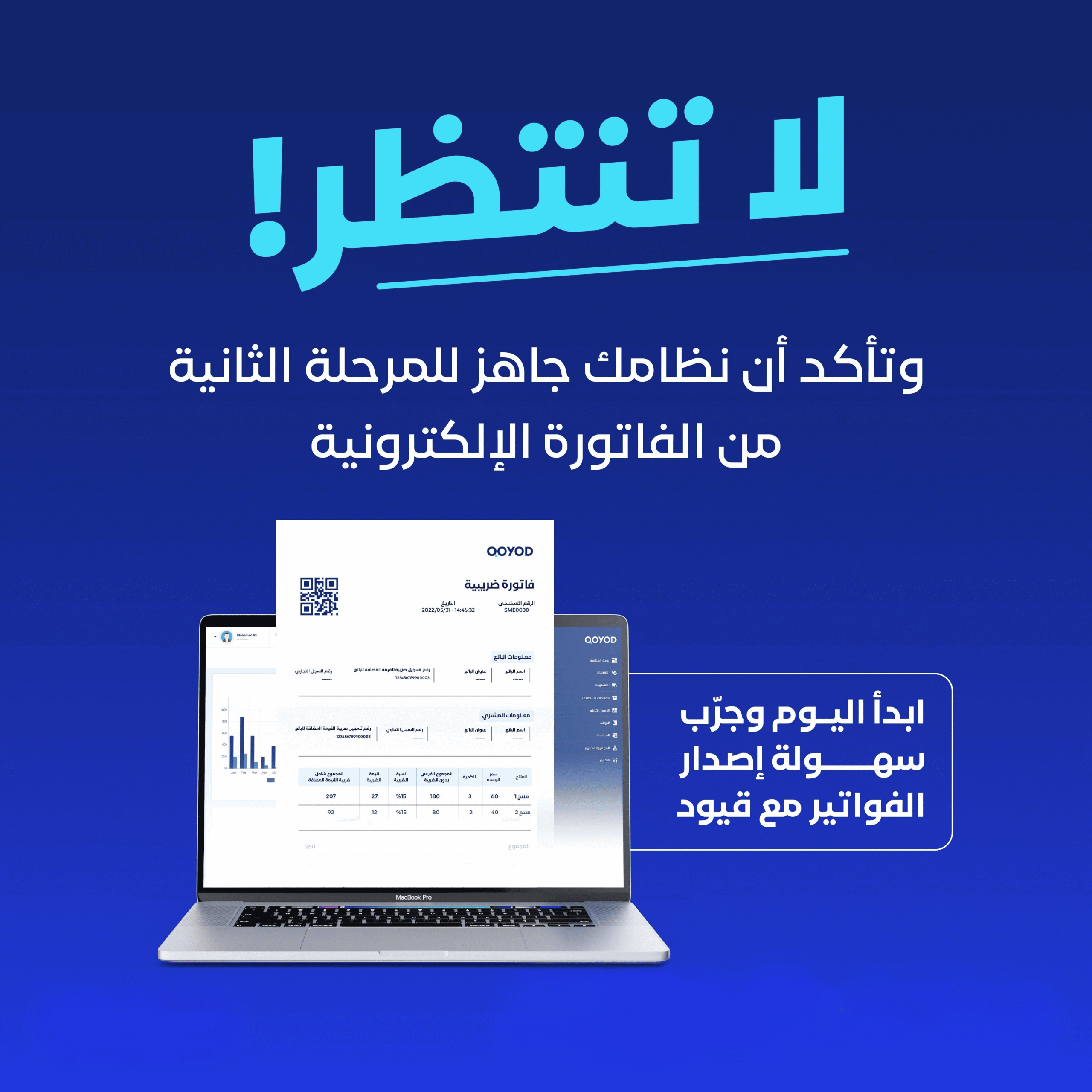
Phase two of ZATCA e-invoicing requires every order pickup and every alteration ticket to be issued through a certified system connected to the Fatoora platform. Tailoring shops issue mostly simplified tax invoices at the counter and occasionally standard tax invoices for corporate uniform orders through the Clearance flow.
Every invoice must include the shop name and tax number, a sequential invoice number, the date and time, the buyer name on B2B uniform invoices, an itemized list of garment, fabric, and labor lines with VAT at 15%, totals before and after VAT, and a QR code. A certified system generates the QR code, signs the invoice in XML, and transmits it to the Fatoora platform inside the Reporting or Clearance window.
How to evaluate a ZATCA-certified system for a tailoring shop
When evaluating any e-invoicing vendor for a tailoring shop, verify these six criteria:
- Official ZATCA phase-two certification with a verifiable approval number on the Authority’s portal.
- Both Reporting (retail orders) and Clearance (B2B uniform orders) flows in one system.
- Per-line VAT on multi-line order invoices.
- Deposit-to-final-payment link preserved on the receipt.
- Long-term cloud storage of signed invoices for at least six years.
- Monthly input-VAT and output-VAT reports ready in time for the quarterly filing deadline.
Where Qoyod fits in specifically for tailoring shops
Qoyod brings together, inside one account: cloud accounting with order and category dimensions, fabric catalog by meter, per-order cost build-up, deposit and balance workflow, alteration tracking, ZATCA-approved e-invoicing, payroll with piece-rate support, and consolidated reports. Every order, fabric pull, tailor labor entry, and customer pickup lands an automatic journal entry inside the same ledger.
The platform handles multi-branch tailoring networks under one account, with shared master data (fabric catalog, tailor rates, customer database), role-based permissions per branch, and either consolidated or per-branch reports.
For shops opening new branches or migrating from paper order books, the setup service and the bookkeeping service are available as part of Qoyod Pro Services, alongside the app marketplace for connecting to POS and CRM partners.
Frequently asked questions
Does Qoyod support per-order costing for tailoring?+
How does Qoyod handle deposits and final payments?+
Can Qoyod track piece-rate tailor pay?+
Does Qoyod handle alterations?+
Does Qoyod work for multi-branch tailoring networks?+
Is technical support available 24/7?+
Running a tailoring shop does not need a generic invoicing app, it needs an operating ledger that ties orders, fabric, labor, deposits, alterations, and ZATCA e-invoicing together inside one account. The shops that consistently grow are the ones that see per-order margin and fabric waste every week. That capability is what makes Qoyod the right fit for tailoring shops in Saudi Arabia.