Production-cost accounting in a Saudi manufacturing business is the discipline of turning raw materials, direct labor, and factory overhead into a defensible unit cost for every finished good. A small Riyadh factory can run 30 production orders a week, consume 1.4 million SAR in raw material per month, employ 45 workers across three shifts, absorb 280,000 SAR in factory overhead, and produce 12,000 finished units. Without bill-of-materials costing, work-in-process tracking, labor and overhead absorption, variance analysis, and ZATCA e-invoicing, the factory cannot price its products with confidence and cannot tell a profitable order from a loss-making one.
What makes production-cost accounting different
A manufacturing business is a transformation business. Raw materials flow into the factory, get consumed by production orders, pick up direct labor and factory overhead along the way, and emerge as finished goods. Every finished unit carries a precise cost composed of material, labor, and overhead. Generic accounting tools cannot model this three-layer transformation.
Production-cost accounting revolves around five connected pieces: bill-of-materials with standard costs per component, work-in-process inventory by production order, direct-labor absorption from shop-floor time tickets, factory-overhead absorption by machine hour or labor hour, and variance analysis (price, quantity, efficiency) at order close. The output is a unit cost that standard costing would recognize.
Daily reality is dozens of postings per day: raw material issued to production orders, finished goods received at order close, direct labor allocated from shift time tickets, overhead absorbed by machine hour, scrap and rework captured at order close, and weekly variance analysis between standard and actual cost.
The most common production-cost accounting challenges
Every manufacturing business in Saudi Arabia runs into the same four recurring problems. They share the same gap: production orders close without measured input-versus-output, labor and overhead get dumped on a P&L line instead of absorbed into units, and the standard cost stays out of date.
1. Material variance invisible. A production order calls for 240 kg of steel at a standard cost of 4.20 SAR per kg. The order actually consumes 268 kg at 4.55 SAR per kg. Without price and quantity variance analysis, the 460 SAR overrun sits in COGS and the standard cost never gets refreshed.
2. Labor not absorbed. A factory pays 180,000 SAR in direct wages this month and produces 12,000 units. Without time tickets that allocate labor to production orders, the wages hit a single P&L line and the unit cost shows zero labor content. Profitability per product becomes guesswork.
3. Overhead under-applied. Factory overhead (rent, utilities, supervision, depreciation) totals 280,000 SAR. The factory absorbs it at 12 SAR per machine hour but only runs 18,000 machine hours, leaving 64,000 SAR under-applied. The unit cost is understated, prices are set too low, and the gap surfaces only at year-end.
4. WIP misstated. Three production orders are 60%, 40%, and 80% complete at month end. Without a work-in-process inventory account that captures partial completion, the inventory valuation either inflates COGS (orders treated as complete) or inflates raw material (orders treated as not started).
What production-cost accounting actually needs from software
A generic accounting tool was built for buying and selling counted items, not for issuing raw materials to production orders, absorbing labor and overhead at the work center, and receiving finished goods at standard cost. The gap is concrete:
| Task | Generic accounting tool | What manufacturing needs |
|---|---|---|
| Costing | Average cost | Standard cost with variance |
| BOM | Not supported | Multi-level bill of materials |
| WIP | Not supported | WIP account by production order |
| Labor | P&L expense | Absorbed per time ticket |
| Overhead | P&L expense | Absorbed per machine hour |
| Variance | Not supported | Price, quantity, efficiency |
Beyond the table, production-cost accounting specifically needs three capabilities generic platforms do not deliver:
- Multi-level bill of materials with standard costs, where every finished good carries a BOM that explodes into components, each with a standard cost, and any BOM revision triggers a unit-cost recalculation.
- Work-in-process by production order, where every order opens a WIP account that accumulates material, labor, and overhead, and closes into finished-goods inventory at order completion with variance lines posted to the P&L.
- ZATCA-certified B2B invoicing through the Clearance flow, where every finished-goods sale fires a standard tax invoice with per-line VAT and the system maintains accurate inventory and cost-of-goods-sold for VAT compliance.
How to organize production-cost accounting step by step
Moving a manufacturing business to integrated production-cost accounting takes around three to four weeks depending on BOM complexity and product count. This is the sequence Qoyod applies with every new manufacturing customer:
E-invoicing and ZATCA compliance for manufacturing
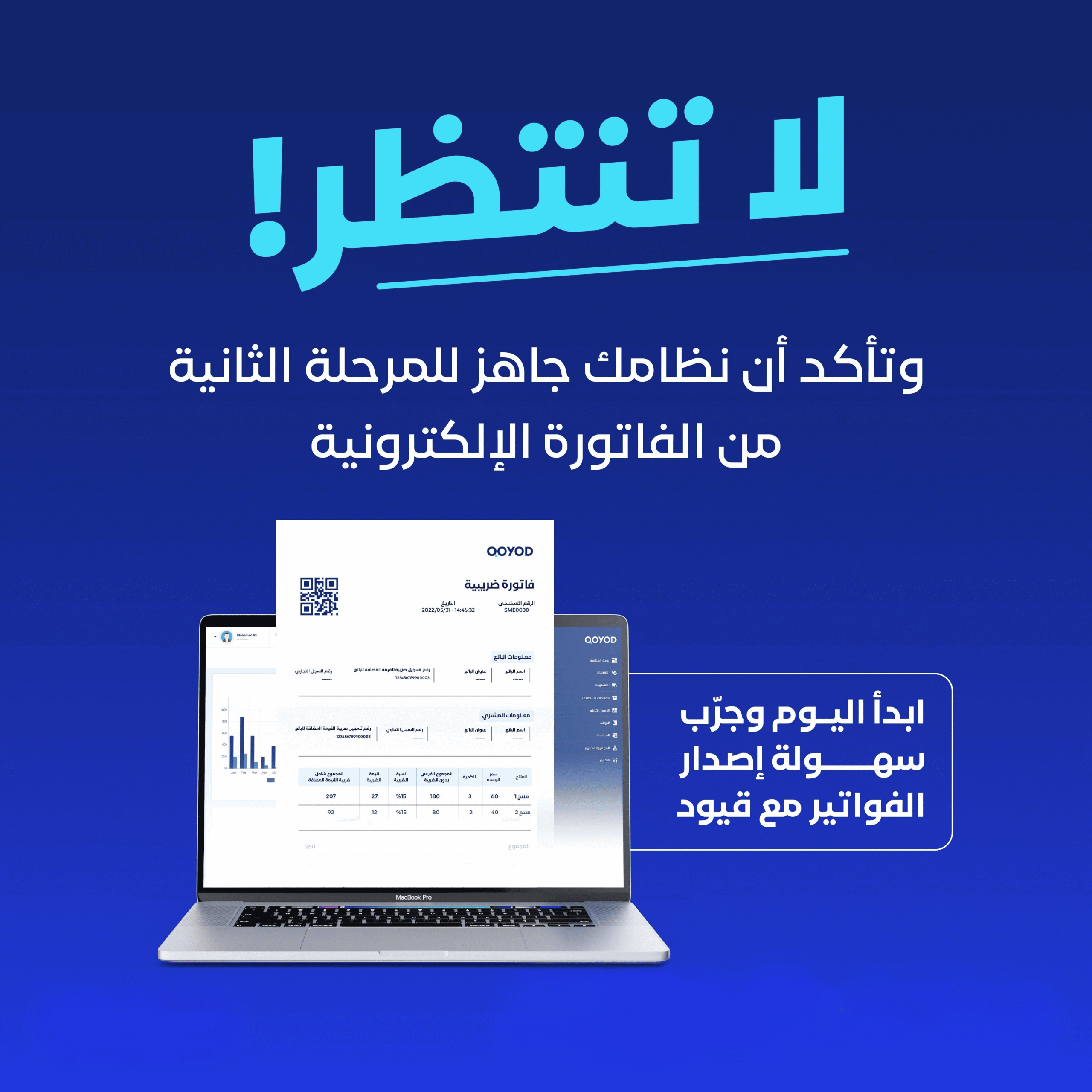
Phase two of ZATCA e-invoicing requires every finished-goods sale to be issued through a certified system connected to the Fatoora platform. Manufacturing businesses issue standard tax invoices for B2B sales through the Clearance flow, with per-line VAT on every finished-good shipped.
Every invoice must include the factory name and tax number, a sequential invoice number, the date and time, the buyer name and tax number on B2B invoices, an itemized list of finished goods with quantity and unit price, VAT at 15%, totals before and after VAT, and a QR code. A certified system generates the QR code, signs the invoice in XML, and transmits it to the Fatoora platform inside the Reporting or Clearance window.
How to evaluate a ZATCA-certified system for manufacturing
When evaluating any e-invoicing vendor for a manufacturing business, verify these six criteria:
- Official ZATCA phase-two certification with a verifiable approval number on the Authority’s portal.
- Both Reporting (simplified retail) and Clearance (B2B finished goods) flows in one system.
- Per-line VAT on multi-line finished-goods invoices.
- Tight integration between production orders, WIP, finished-goods inventory, and the general ledger.
- Long-term cloud storage of signed invoices for at least six years.
- Monthly input-VAT and output-VAT reports ready in time for the quarterly filing deadline.
Where Qoyod fits in specifically for production-cost accounting
Qoyod brings together, inside one account: cloud accounting with cost-center and product dimensions, multi-level bills of materials with standard costs, work-in-process by production order, labor and overhead absorption, variance analysis at order close, ZATCA-approved e-invoicing, payroll, and consolidated reports. Every material issue, labor allocation, overhead absorption, and finished-goods receipt lands an automatic journal entry inside the same ledger.
The platform handles multi-plant manufacturing groups under one account, with shared master data (item master, BOM library, work-center registry), role-based permissions per plant, and either consolidated or per-plant reports.
For factories opening new lines or migrating from spreadsheet costing, the setup service and the bookkeeping service are available as part of Qoyod Pro Services, alongside the app marketplace for connecting to ERP and shop-floor partners.
Frequently asked questions
Does Qoyod support multi-level bills of materials?+
How does Qoyod handle work-in-process?+
Does Qoyod absorb direct labor and factory overhead?+
Can Qoyod produce variance analysis?+
Does Qoyod work for multi-plant manufacturing groups?+
Is technical support available 24/7?+
Running production-cost accounting does not need a generic ledger, it needs an operating system that ties bills of materials, work-in-process, labor and overhead absorption, variance analysis, and ZATCA e-invoicing together inside one account. The factories that consistently grow are the ones that see variance and unit cost every week. That capability is what makes Qoyod the right fit for production-cost accounting in Saudi Arabia.