A gaming store in Saudi Arabia mixes three different revenue streams under one roof: retail sales of consoles, games, and accessories, hourly billing for in-store play areas, and trade-ins of used games and consoles. A single Riyadh store can stock 180 console SKUs, 1,400 game titles, 40 play stations billed by the hour, and run 60 trade-ins a week. Without per-channel inventory, hourly play-area tracking, trade-in valuation, and ZATCA e-invoicing, the store loses margin to mispriced trade-ins, uncounted play-area hours, and dead stock on last-generation consoles.
What makes gaming-store accounting different
A gaming store is a retail-and-service business at the same time. Consoles and games sell off the shelf, play stations bill by the hour or by package, and trade-ins create used inventory at a discounted cost basis. The same customer transaction can include a new console, a used trade-in, an hour of in-store play, and a snack bar bill. Generic POS tools cannot tie those four lines into one ticket.
Gaming-store accounting revolves around five connected pieces: console and game inventory by platform and title, hourly play-area billing with per-station tracking, accessory sales with attached margin, trade-in valuation against a reference price list, and ZATCA simplified tax invoice on every counter and play-area ticket.
Daily reality is dozens of postings per day: console sales, game-title sales by platform, hourly play tickets opened and closed by station, accessory attachment to console sales, trade-in receipts at a discounted cost basis, supplier payments for new releases, and the daily reconciliation of POS, play-area, and trade-in ledgers.
The most common accounting challenges in gaming stores
Every gaming store in Saudi Arabia runs into the same four recurring problems. They share the same gap: play-area hours live on a paper sheet at the counter, trade-ins get valued by guess, and last-generation consoles sit on the shelf for months without anyone noticing.
1. Play-area hours uncounted. A customer pays 30 SAR for an hour at station 7. The attendant writes the start time on a sticky note. Without a per-station timer tied to the POS, six to ten hours a week slip through unbilled per station, which on 40 stations is 240 to 400 unbilled hours a week.
2. Trade-ins mispriced. A customer brings a used PlayStation 4 to trade against a new PlayStation 5. The attendant offers 600 SAR off the bench without a reference list. Three weeks later the used unit sells for 550 SAR and the store loses 50 SAR on the trade with no record of the gap.
3. Last-generation dead stock. A new console generation drops and last-generation stock loses 25% of value in the first six weeks. Without per-platform aging, the store sits on 60 to 120 units worth 90,000 to 180,000 SAR at original cost with no clearance plan.
4. Accessory attachment missed. A new console sells with an average attach rate of 0.3 accessories. Stores that prompt for controllers, headsets, and extended warranties at the till lift attach to 0.8 and add 40 to 70 SAR margin per console. Without an attachment prompt at the POS, the margin is left on the table.
What a gaming store actually needs from its accounting software
A generic accounting tool was built for selling counted items, not for billing 40 play stations by the hour, valuing used trade-ins against a reference list, and tracking last-generation aging by platform. The gap is concrete:
| Task | Generic accounting tool | What a gaming store needs |
|---|---|---|
| Consoles | Generic SKU | Platform, generation, edition |
| Games | Generic SKU | Platform, title, condition |
| Play area | Not supported | Per-station hourly billing |
| Trade-ins | Manual entry | Reference price with margin |
| Accessories | Generic SKU | Attached to parent console |
| VAT | Flat 15% | Per-line on standard rated |
Beyond the table, a gaming store specifically needs three capabilities generic platforms do not deliver:
- Console and game inventory by platform, generation, and condition, so the store sees which platform is moving, which generation is dead stock, and which used titles still have margin.
- Per-station hourly billing with package rates, where every play station opens and closes its own ticket, peak-hour multipliers apply automatically, and packages (one hour free with five) consume on the right line.
- ZATCA-certified retail invoicing, where every counter sale, play-area ticket, and trade-in fires a simplified tax invoice with the correct VAT treatment on each line.
How to organize a gaming store’s books step by step
Moving a gaming store to integrated accounting takes around two to three weeks depending on play-station count and trade-in volume. This is the sequence Qoyod applies with every new gaming-store customer:
E-invoicing and ZATCA compliance for gaming stores
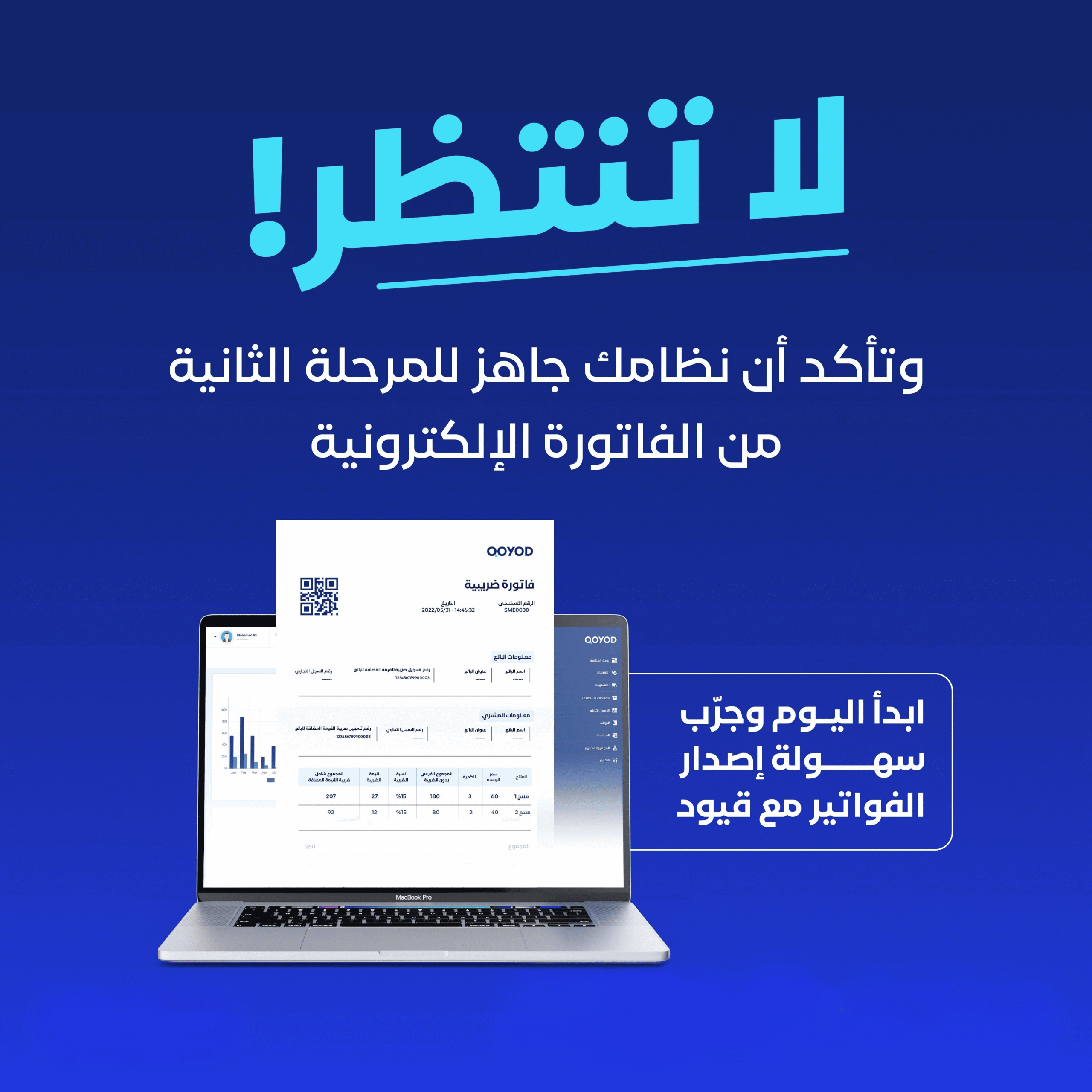
Phase two of ZATCA e-invoicing requires every counter sale, play-area ticket, and trade-in to be issued through a certified system connected to the Fatoora platform. Gaming stores issue simplified tax invoices at the counter and on play-area tickets under the Reporting flow.
Every invoice must include the store name and tax number, a sequential invoice number, the date and time, an itemized list with consoles, games, accessories, play-area hours, and trade-in credits, VAT at 15%, totals before and after VAT, and a QR code. A certified system generates the QR code, signs the invoice in XML, and transmits it to the Fatoora platform inside the Reporting window.
How to evaluate a ZATCA-certified system for a gaming store
When evaluating any e-invoicing vendor for a gaming store, verify these six criteria:
- Official ZATCA phase-two certification with a verifiable approval number on the Authority’s portal.
- Reporting flow live on every counter and play-area ticket without manual intervention.
- Per-line VAT on multi-line tickets that combine retail, play hours, and trade-in credits.
- Trade-in credits preserved as a negative line, not a discount, so VAT calculates correctly.
- Long-term cloud storage of signed invoices for at least six years.
- Monthly input-VAT and output-VAT reports ready in time for the quarterly filing deadline.
Where Qoyod fits in specifically for gaming stores
Qoyod brings together, inside one account: cloud accounting with channel dimensions, console and game inventory by platform and edition, per-station hourly play-area billing, trade-in valuation against a reference list, accessory attachment prompts at the till, ZATCA-approved e-invoicing, payroll, and consolidated reports. Every counter sale, play-area ticket, trade-in, and supplier payment lands an automatic journal entry inside the same ledger.
The platform handles multi-branch gaming chains under one account, with shared master data (console catalog, trade-in reference list, accessory cross-reference), role-based permissions per branch, and either consolidated or per-branch reports.
For stores opening new branches or migrating from paper play-area sheets, the setup service and the bookkeeping service are available as part of Qoyod Pro Services, alongside the app marketplace for connecting to POS hardware and payment gateways.
Frequently asked questions
Does Qoyod handle hourly play-area billing?+
How does Qoyod track trade-ins?+
Can Qoyod price consoles by platform and generation?+
Does Qoyod support accessory attachment prompts?+
Does Qoyod work for multi-branch gaming chains?+
Is technical support available 24/7?+
Running a gaming store does not need a generic POS, it needs an operating ledger that ties console and game inventory, hourly play-area billing, trade-in valuation, and ZATCA e-invoicing together inside one account. The stores that consistently grow are the ones that see play-area utilization and platform aging every day. That capability is what makes Qoyod the right fit for gaming stores in Saudi Arabia.