A customs clearance office in Saudi Arabia carries shipment files, not products. Every file starts at Jeddah, Dammam, Riyadh dry port, or a land border crossing, moves through Fasah declaration, Saber conformity, and ZATCA duty payment, and closes with a final disbursement statement to the importer. A single Jeddah broker can handle 60 shipment files at once, advance 1.2 million SAR in port disbursements per month, work with 18 shipping lines, and chase 90-day receivables from importers. Without shipment-file accounting, port-disbursement advances, broker-fee billing, and ZATCA e-invoicing, the office loses margin to advances it never recovers and to fees it never bills.
What makes customs clearance accounting different
A customs clearance office is a project-by-shipment business. Every file is its own profit center, with its own duty advances, port fees, transport costs, and broker fee. The same importer can have 30 open files at once at different stages: declaration submitted, duty paid, container released, trucked to warehouse, billed, collected. Generic accounting tools cannot model the per-file advances-and-disbursements ledger that brokers actually run.
Customs clearance accounting revolves around five connected pieces: per-shipment file accounting with advances and disbursements, broker fee structures by HS code or container, port-and-line disbursement tracking, importer credit control with file-level aging, and ZATCA standard tax invoice on broker fees with reimbursable disbursements passed through at cost.
Daily reality is dozens of postings per day: duty payments to ZATCA, port handling charges, shipping line release fees, inland trucking, Saber conformity fees, broker fee accrual at file close, importer invoicing on file completion, and collection follow-up on aging files.
The most common accounting challenges in customs clearance offices
Every customs clearance office in Saudi Arabia runs into the same four recurring problems. They share the same gap: cash leaves the office in advance for duty, port fees, and trucking, and the office never matches the recovery against the original file.
1. Disbursement advances lost. A broker advances 84,000 SAR in customs duty on a container for an importer. The container clears, the importer never sees a clean line-by-line disbursement, and 6,000 SAR in port fees never make it onto the invoice. Across 60 files a month the leakage compounds to a six-figure annual loss.
2. Broker fee under-billed. The office quotes a 1,200 SAR per-container clearance fee but absorbs an extra Saber conformity fee, a port storage charge, and a customs amendment fee on the side. Without a fee schedule that captures every chargeable line, the office bills 1,200 SAR and swallows 800 SAR in unrecovered fees.
3. Importer aging invisible. An importer with 12 closed files owes 340,000 SAR across 180-day aging. The office takes a 13th file, advances another 60,000 SAR in duty, and only discovers the receivables hole at quarter close. Without file-level aging by importer, the credit overrun never gets caught.
4. Port and line disbursements double-paid. A shipping line release fee gets paid by the office at the counter and again from petty cash because two staff handle the same file. Without a per-file disbursement ledger, the duplicate sits unreconciled until year-end audit.
What a customs clearance office actually needs from its accounting software
A generic accounting tool was built for selling counted items, not for opening 60 shipment files, advancing duty to ZATCA, paying port fees and trucking, and billing the importer six weeks later. The gap is concrete:
| Task | Generic accounting tool | What a customs office needs |
|---|---|---|
| Project | Generic project | Per-file shipment ledger |
| Disbursements | Expense account | Reimbursable per file |
| Fees | Single rate | Schedule by HS code or container |
| Importers | Generic customer | Credit limit with file aging |
| Ports | Not supported | Per-port and per-line tracking |
| VAT | Flat 15% | Standard on fee, zero on disbursement |
Beyond the table, a customs clearance office specifically needs three capabilities generic platforms do not deliver:
- Per-shipment-file accounting with advances and disbursements, where every duty payment, port fee, trucking charge, and Saber fee posts against the file and rolls into the final disbursement statement to the importer.
- Broker fee schedule by HS code or container with reimbursables pass-through, so every chargeable line lands on the invoice and disbursements pass through at cost without VAT confusion.
- ZATCA-certified B2B invoicing through the Clearance flow, where every importer invoice fires a standard tax invoice with disbursement lines, and the system handles the simplified tax invoice case on walk-in customs work.
How to organize a customs clearance office’s books step by step
Moving a customs clearance office to integrated accounting takes around two to three weeks depending on file volume and importer mix. This is the sequence Qoyod applies with every new customs-office customer:
E-invoicing and ZATCA compliance for customs clearance offices
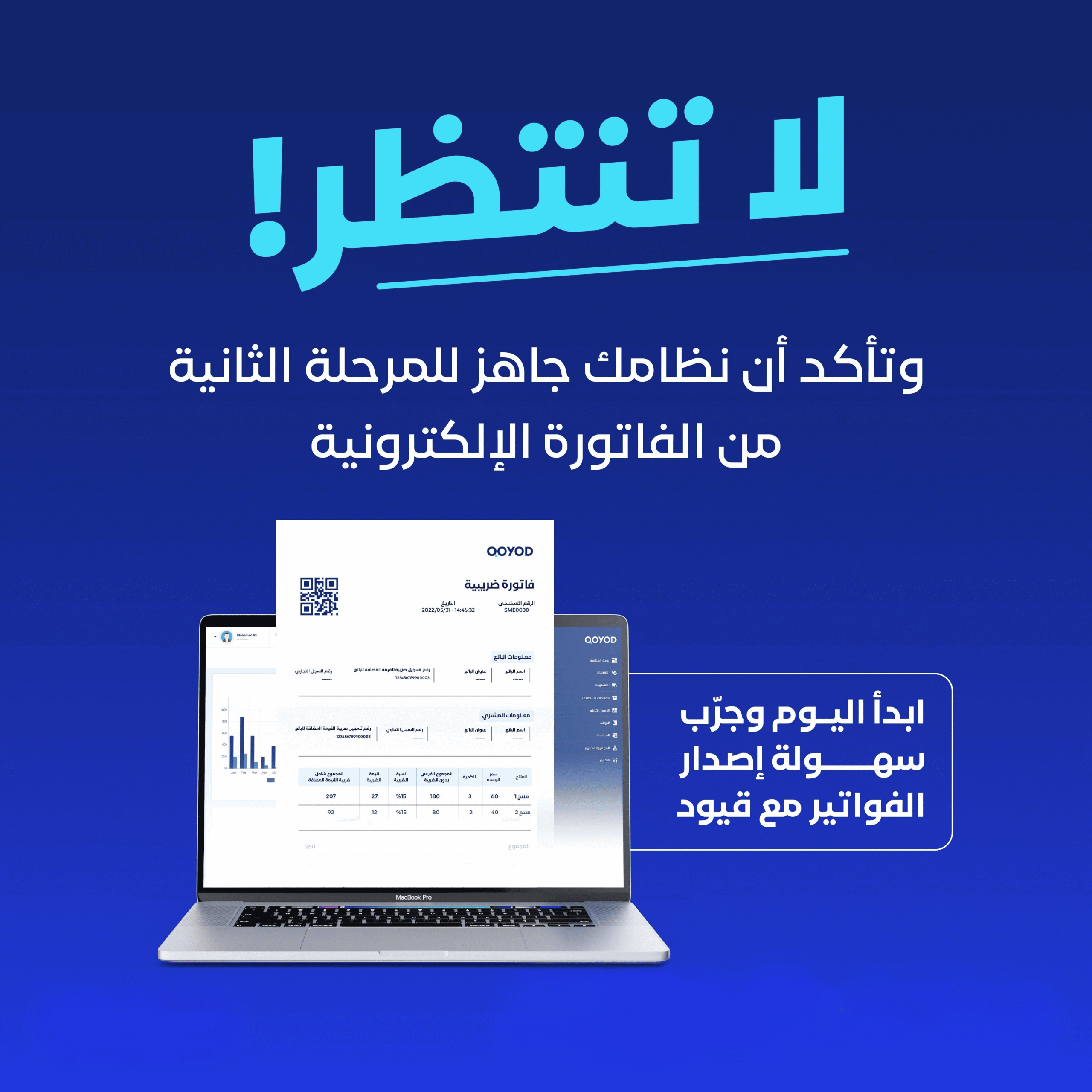
Phase two of ZATCA e-invoicing requires every broker invoice and importer billing to be issued through a certified system connected to the Fatoora platform. Customs clearance offices issue standard tax invoices for importers through the Clearance flow, with disbursement lines passed through at cost.
Every invoice must include the office name and tax number, a sequential invoice number, the date and time, the importer name and tax number, an itemized list with broker fee lines (VAT-able) and disbursement lines (pass-through), VAT at 15% on the fee portion only, totals before and after VAT, and a QR code. A certified system generates the QR code, signs the invoice in XML, and transmits it to the Fatoora platform inside the Clearance window for B2B invoices.
How to evaluate a ZATCA-certified system for a customs office
When evaluating any e-invoicing vendor for a customs clearance office, verify these six criteria:
- Official ZATCA phase-two certification with a verifiable approval number on the Authority’s portal.
- Clearance flow with B2B invoices and the ability to split fee lines from disbursement lines.
- Per-line VAT control so disbursements pass through at cost without VAT.
- File reference, Fasah declaration number, and Saber certificate visible on every invoice.
- Long-term cloud storage of signed invoices for at least six years.
- Monthly input-VAT and output-VAT reports ready in time for the quarterly filing deadline.
Where Qoyod fits in specifically for customs clearance offices
Qoyod brings together, inside one account: cloud accounting with file and importer dimensions, per-shipment-file accounting with advances and disbursements, broker fee schedules by HS code and container, importer credit control with file-level aging, ZATCA-approved e-invoicing with pass-through disbursements, payroll, and consolidated reports. Every duty advance, port fee, trucking charge, and importer billing lands an automatic journal entry inside the same ledger.
The platform handles multi-branch broker networks under one account, with shared master data (importer database, fee schedule, port and line registers), role-based permissions per branch, and either consolidated or per-branch reports.
For offices opening new branches or migrating from spreadsheet file logs, the setup service and the bookkeeping service are available as part of Qoyod Pro Services, alongside the app marketplace for connecting to logistics and CRM partners.
Frequently asked questions
Does Qoyod support per-shipment-file accounting?+
How does Qoyod track port and shipping line disbursements?+
Can Qoyod control importer credit?+
Does Qoyod separate VAT-able broker fees from pass-through disbursements?+
Does Qoyod work for multi-branch broker networks?+
Is technical support available 24/7?+
Running a customs clearance office does not need a generic accounting tool, it needs an operating ledger that ties shipment files, port disbursements, broker fees, importer credit, and ZATCA e-invoicing together inside one account. The offices that consistently grow are the ones that see file margin and importer aging every week. That capability is what makes Qoyod the right fit for customs clearance offices in Saudi Arabia.