A computer or IT shop in Saudi Arabia sells three things in one location: brand-new hardware with vendor warranties, repair and upgrade services on customer-owned machines, and B2B contracts for office equipment rollouts. A single Riyadh shop can stock 380 SKUs from laptops and printers to peripherals, run 60 active repair tickets a week, and ship 25 office orders a month to small-business customers. Without serial-number tracking on every device, vendor-warranty linkage, repair job cards, and ZATCA e-invoicing, the shop loses a meaningful slice of margin to wrong-warranty returns and parts-pull leakage.
What makes computer-shop accounting different
A computer shop is a serialized-inventory business. Every laptop, every monitor, every printer has a serial number, a vendor warranty period, and a customer history that follows the device for years. Generic POS tools treat a 4,200 SAR laptop the same as a 12 SAR USB cable, and at year-end the gap between system count and physical count buries serialized devices that quietly disappeared.
Computer-shop accounting revolves around five connected pieces: serial-tracked inventory with vendor-warranty linkage, repair job cards with parts and labor accrual, B2B office rollouts with multi-line orders, customer-loyalty tracking with device history, and ZATCA simplified tax invoice on every retail sale and standard tax invoice on every B2B order through the Clearance flow.
Daily reality is dozens of postings per day: hardware receipts with serial capture, retail sales with serial issuance, repair tickets opened with customer-device history pulled, parts pulled for repairs, warranty claims escalated to the vendor, B2B office orders shipped, and end-of-day cash and card reconciliation.
The most common accounting challenges in computer shops
Every computer shop in Saudi Arabia runs into the same four recurring problems. They share the same gap: serials live on stickers, warranties live in PDF, and repair tickets live in a paper book.
1. Serialized inventory drifts. A shop holds 380 SKUs of which 140 are serialized devices. Without barcode-and-serial issuance at sale, two devices a month walk out without ledger attribution. At 3,200 SAR average cost, that is roughly 76,000 SAR a year of unattributed loss.
2. Warranty claims miss the window. A laptop fails inside the vendor warranty window but the customer claim comes in without the serial linkage. The shop replaces the device at cost instead of recovering from the vendor, eating 4,800 SAR of margin.
3. Repair parts leak. A repair pulls 380 SAR of parts but the invoice bills only 320 SAR because the technician forgot a thermal paste and a screw kit. Across 60 weekly tickets the leakage adds up to 14,000 SAR a month.
4. B2B office orders shipped without margin check. A 25-laptop office rollout at 4,800 SAR per unit looks profitable but actual cost includes shipping, configuration labor, and a 1.5% damage allowance. Without per-order cost build-up, the shop quotes a 9% margin and lands a 4% margin.
What a computer shop actually needs from its accounting software
A generic accounting tool was built for selling fungible items, not for selling a serialized 4,200 SAR laptop with a 24-month vendor warranty. The gap is concrete:
| Task | Generic accounting tool | What a computer shop needs |
|---|---|---|
| Inventory | Generic SKU | Serial-tracked with warranty |
| Warranty | Not tracked | Vendor and customer windows linked |
| Repairs | Generic service | Job card with parts and labor |
| B2B orders | Generic invoice | Multi-line with per-order cost |
| Customer history | Not tracked | Device history with repair log |
| VAT | Flat 15% | Per-line on standard rated |
Beyond the table, a computer shop specifically needs three capabilities generic platforms do not deliver:
- Serial-tracked inventory with vendor warranty, so every laptop, monitor, and printer enters at receipt with a serial, a vendor reference, and a warranty period, and leaves at sale with the customer linkage.
- Repair job cards with parts and labor, where every repair opens a ticket against the device serial, parts pull against the ticket, technician labor logs against the ticket, and the invoice matches the ticket exactly.
- ZATCA-certified retail and B2B invoicing, where every retail device sale, every repair ticket, and every B2B office order fires a tax invoice with QR code in one flow.
How to organize a computer shop’s books step by step
Moving a computer shop to integrated accounting takes around two to three weeks depending on serial-tracked inventory size and B2B contract complexity. This is the sequence Qoyod applies with every new shop customer:
E-invoicing and ZATCA compliance for computer shops
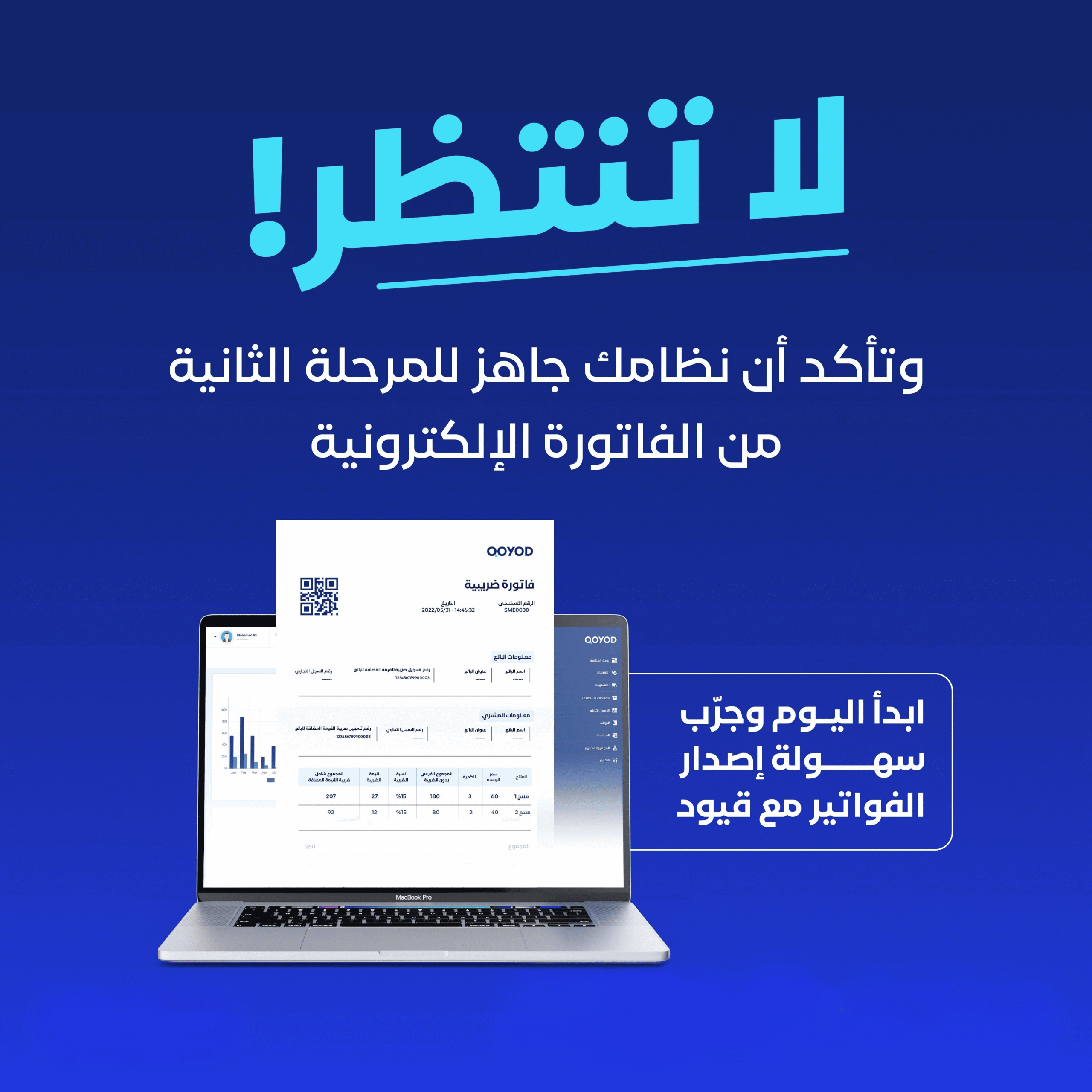
Phase two of ZATCA e-invoicing requires every retail device sale, every repair ticket, and every B2B office order to be issued through a certified system connected to the Fatoora platform. Computer shops issue both simplified tax invoices at the counter and standard tax invoices for B2B orders through the Clearance flow.
Every invoice must include the shop name and tax number, a sequential invoice number, the date and time, the buyer name on B2B invoices, an itemized list of devices, parts, and labor lines with serials where applicable, VAT at 15%, totals before and after VAT, and a QR code. A certified system generates the QR code, signs the invoice in XML, and transmits it to the Fatoora platform inside the Reporting or Clearance window.
How to evaluate a ZATCA-certified system for a computer shop
When evaluating any e-invoicing vendor for a computer shop, verify these six criteria:
- Official ZATCA phase-two certification with a verifiable approval number on the Authority’s portal.
- Both Reporting (retail simplified) and Clearance (B2B office orders) flows in one system.
- Per-line VAT on multi-line invoices with serial print on device lines.
- Serial-number capture and warranty linkage preserved at sale.
- Long-term cloud storage of signed invoices for at least six years.
- Monthly input-VAT and output-VAT reports ready in time for the quarterly filing deadline.
Where Qoyod fits in specifically for computer shops
Qoyod brings together, inside one account: cloud accounting with channel and warranty dimensions, serialized inventory with vendor warranty, repair job cards, B2B office order processing with per-order cost build-up, customer device history, ZATCA-approved e-invoicing, payroll, and consolidated reports. Every device receipt, retail sale, repair ticket, and B2B order lands an automatic journal entry inside the same ledger.
The platform handles multi-branch computer-shop networks under one account, with shared master data (serialized inventory, technician rates, customer history), role-based permissions per branch, and either consolidated or per-branch reports.
For shops opening new branches or migrating from a legacy POS, the setup service and the bookkeeping service are available as part of Qoyod Pro Services, alongside the app marketplace for connecting to e-commerce and CRM partners.
Frequently asked questions
Does Qoyod track serialized inventory?+
How does Qoyod handle vendor warranties?+
Can Qoyod handle repair job cards?+
Does Qoyod handle B2B office rollouts?+
Does Qoyod work for multi-branch computer-shop networks?+
Is technical support available 24/7?+
Running a computer shop does not need a generic POS, it needs an operating ledger that ties serialized inventory, warranty, repair tickets, B2B orders, and ZATCA e-invoicing together inside one account. The shops that consistently grow are the ones that see serial variance and repair margin every week. That capability is what makes Qoyod the right fit for computer and IT shops in Saudi Arabia.