Financial budgeting is the backbone of a healthy small or medium business. Without a clear plan, cash flow turns into guesswork. Spending drifts. A slow quarter arrives with no cushion to absorb it. Most SME owners end up asking the same thing. How do we move past simple bookkeeping and start managing money on purpose? And how do we stay on top of tax compliance in every market we sell in?
The answer is a simple plan you can repeat, backed by the right software. This guide covers what a budget is, the main budget types (capital, operating, flexible), and the steps to build one. You will also see how Qoyod Accounting Software handles the forecasting for you. Budgeting then stops being a yearly chore. It becomes a tool you actually use.
Definition of the Budget
A budget is a detailed financial plan. It shows where your money comes from and where it goes over a set period. A company can build one. So can a household, a single project, or a whole country. The idea is simple: plan the money before you spend it, and tie each amount to a goal.
Types of Budgeting
Budgets are grouped in a few ways. It depends on who uses them and what they track. Here are the main types.
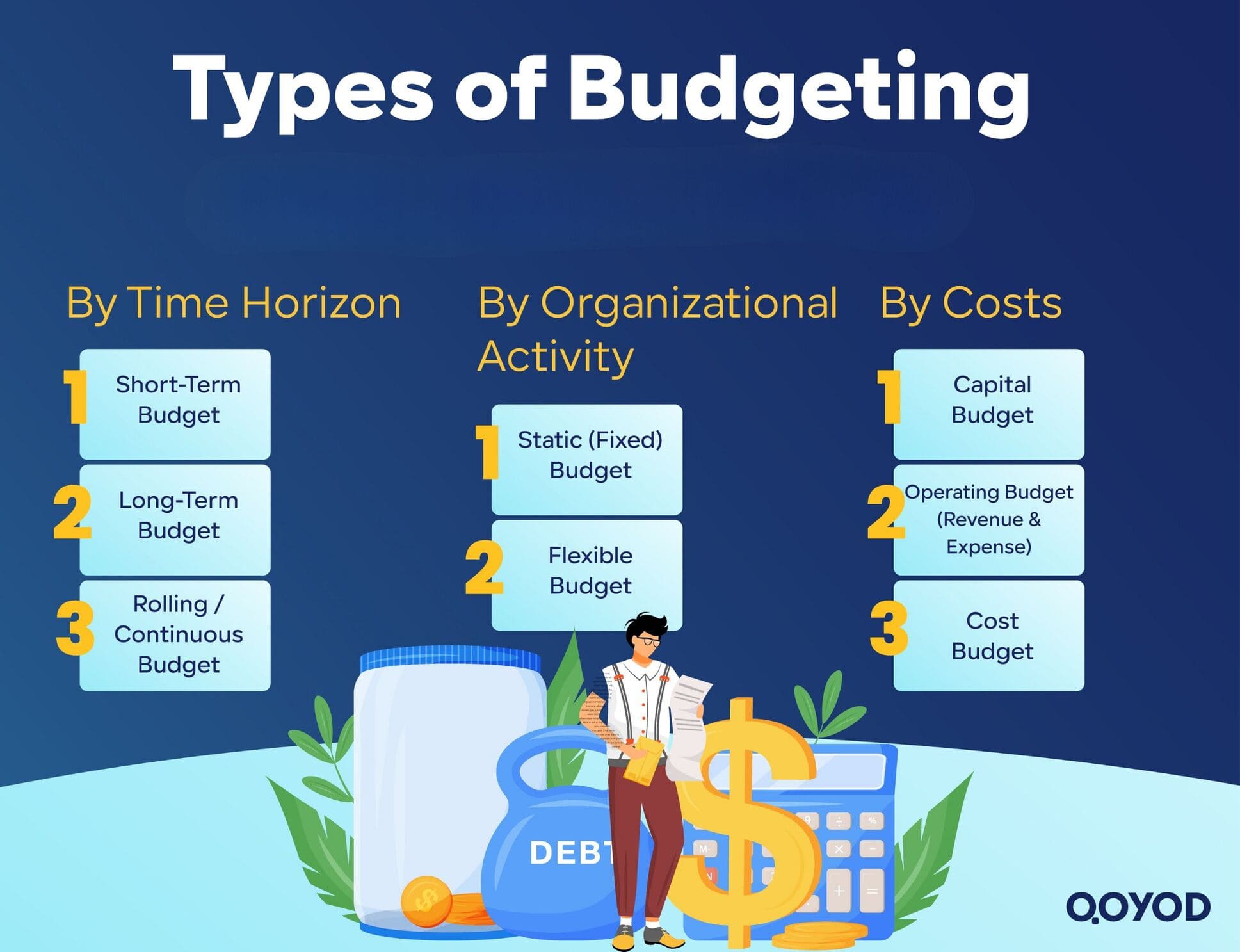
Types of Budgeting by Time Horizon
These types are sorted by the period they cover.
- Short-Term Budget: Covers one year or less. You set the goals first. Then you plan the daily numbers that get you there.
- Long-Term Budget: Covers three to five years. It suits big projects, investments, and growth plans.
- Rolling/Continuous Budget: Updated as you go, month by month or quarter by quarter. That keeps the numbers fresh and makes decisions easier.
Types of Budgeting by Organizational Activity
These budgets track how busy the business is. In short, how much it makes and how much it sells.
- Static (Fixed) Budget: Built on one activity level, then left alone. It does not move, even when output goes up or down.
- Flexible Budget: Built to move with activity. When output changes, the numbers change too. That makes it far better for tracking real performance.
Types of Budgeting by Costs
These budgets follow where the money goes. They cover spending channels, profit, and the assets you own.
- Capital Budget: Forecasts the cost of large, strategic projects. It checks that revenue can keep funding the work until it is done.
- Operating Budget: Comes in two halves. A revenue budget for what you expect to earn, and an expense budget for what you expect to pay.
- Cost Budget: Estimates material costs for a set period, so your money goes further.
Learn More About : Financial Analysis in Saudi Arabia: Qoyod’s Free Template
Objectives and Importance of Financial Budgeting
Companies and governments alike put real work into financial budgeting. These are the goals behind it.
- Sound Financial Planning: Keep transactions orderly and stop money from leaking out. That alone moves a company closer to its goals.
- Monitoring Expenditure: Track what gets spent, sort it into cost groups, and tighten the channels that waste money.
- Preventing Losses: Unplanned costs sink companies. A budget keeps spending and revenue in balance.
- Informed Decision-Making: Choices match what the business can afford. No asset stripping, and no slide toward insolvency.
- Focus on Core Objectives: Attention stays on the main goals, and growth plans stay grounded.
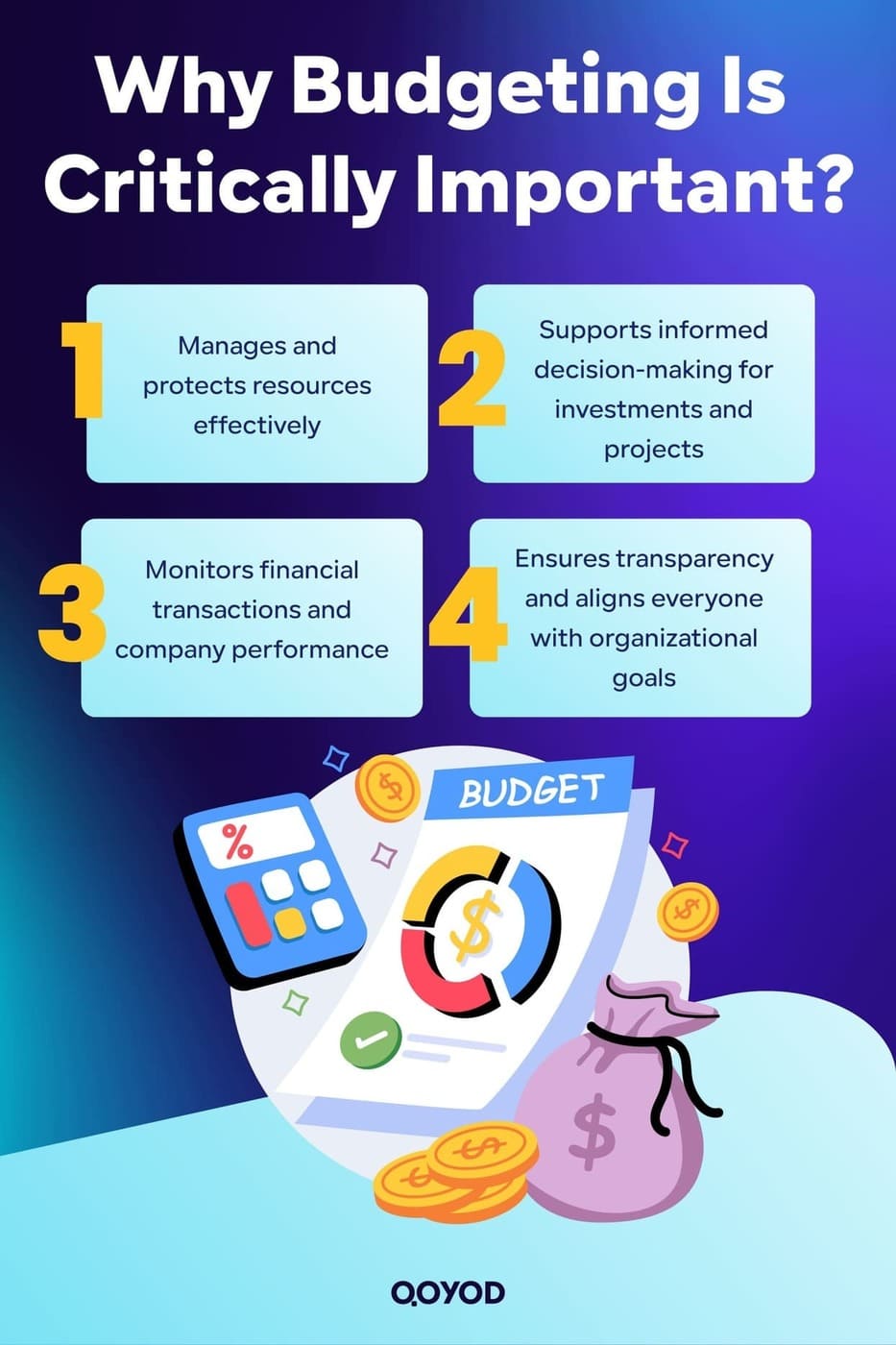
The Critical Importance of Budgeting
A few reasons make this work worth the effort.
Managing Resources in the Entity
A budget shows every source of income and every resource that feeds profit. Once you can see them, you can steer them. Waste has nowhere left to hide.
Making Better Decisions
Say a new project lands on the table. The budget works like a lens. It shows the costs, the resources you need, and the return you can expect. The choice gets much clearer.
Monitoring Financial Transactions and Company Performance
You price out each step of production and spot the weak points. Those may sit in production, in marketing, or somewhere else. Once you can name them, you can fix what is holding sales back.
Maintaining Transparency
The budget spells out the goals and who owns each one. Everyone knows their part. Surprise costs and quiet overspending get much harder.
Key Elements of the Financial Budget
These parts are the frame a company builds its plan on. They set the goals, map revenue and spending, and measure performance. The mix shifts from one industry to the next. Still, most budgets share the same core pieces.
Projected Revenues
- Sales of Products or Services: Expected sales. Split them into local and export revenue if that fits your business.
- Investment Income: Returns from stocks, bonds, or property.
- Other Income: One-off income, such as rent or the sale of old assets.
Cost of Sales
- Raw Material Costs: What you pay for primary materials, shipping included.
- Direct Labor Costs: Wages for the people who make the product.
- Other Variable Costs: Packing and delivery for finished goods. These rise and fall with output.
Operating Expenses
- Salaries and Wages: Pay for staff and managers outside production, plus taxes and allowances.
- Rent and Utilities: Rent, power, water, and internet.
- Administrative and Marketing Expenses: Marketing, ads, legal fees, and general admin costs.
- Maintenance of Equipment and Assets: What it costs to keep your assets running well.
Fixed and Variable Costs
- Fixed Costs: Costs that hold steady whatever you produce, such as rent, core salaries, and insurance.
- Variable Costs: Costs that move with output, such as raw materials and shipping.
Capital Expenditures
- Purchase of Fixed Assets: New equipment, new sites, or added production capacity.
- Maintenance and Development of Assets: Upgrades to the equipment and tech you already own.
- Infrastructure Investments: Systems and infrastructure that support the business long term.
Available Cash
- Cash Inflows: Every source of cash, from cash sales to investment income.
- Cash Outflows: Everything paid out: debt, running costs, and asset purchases.
- Remaining Cash: What is left once outflows are gone. It tells you whether you need extra funding.
Liabilities
- Creditors/Accounts Payable: What you owe suppliers and other parties.
- Loans and Financing: Bank loans and other funding you have to repay.
- Accrued Expenses: Costs you have run up but not yet paid, such as taxes and deferred wages.
- Raw Materials: What production needs to run.
- Finished Goods: Products that are ready to sell.
- Work-in-Progress: Items still moving through production.
Expected Profits and Losses
- Net Profit: Projected revenue minus total costs.
- Expected Losses: What you stand to lose if costs run past revenue.
Contingency and Reserve Funds
- Cash Reserve: Money set aside for emergencies and lean months.
- Emergency Backup Plans: Fallback options for costs and funding if revenue drops.
Return on Investment (ROI)
- Returns Analysis: Measures the return you expect from each investment in the budget.
- Analytical Indicators for Return: Compares projects and assets, so you can back the strongest ones.
Together these pieces give you a full picture. You can see where the money sits, steer it well, and make choices that hold up over time.
Stages of General Budget Preparation
Any organization can run a budget. A country runs a General Budget. It plans national revenue and spending, and it carries legal weight. It moves through four stages.
1- Preparation
The Executive Authorities draft the budget. They start from what the state achieved last year. From there they set the rise or fall in each revenue line. The draft is then built on the real figures the state collected.
2- Adoption (Approval)
Next comes the Legislative Authority. It receives the plan before the fiscal year starts, reviews it, and sends it to the parliamentary councils. Those councils can cut spending. They cannot add new spending of their own.
3- Execution (Implementation)
The budget is published in official sources. Every ministry and government body then applies it as written.
4- Evaluation
The Legislative Authority tracks how the budget performs. It checks the revenue collected and the projects the state has started. It also measures whether essential spending was covered as planned.
Rules of the General Budget
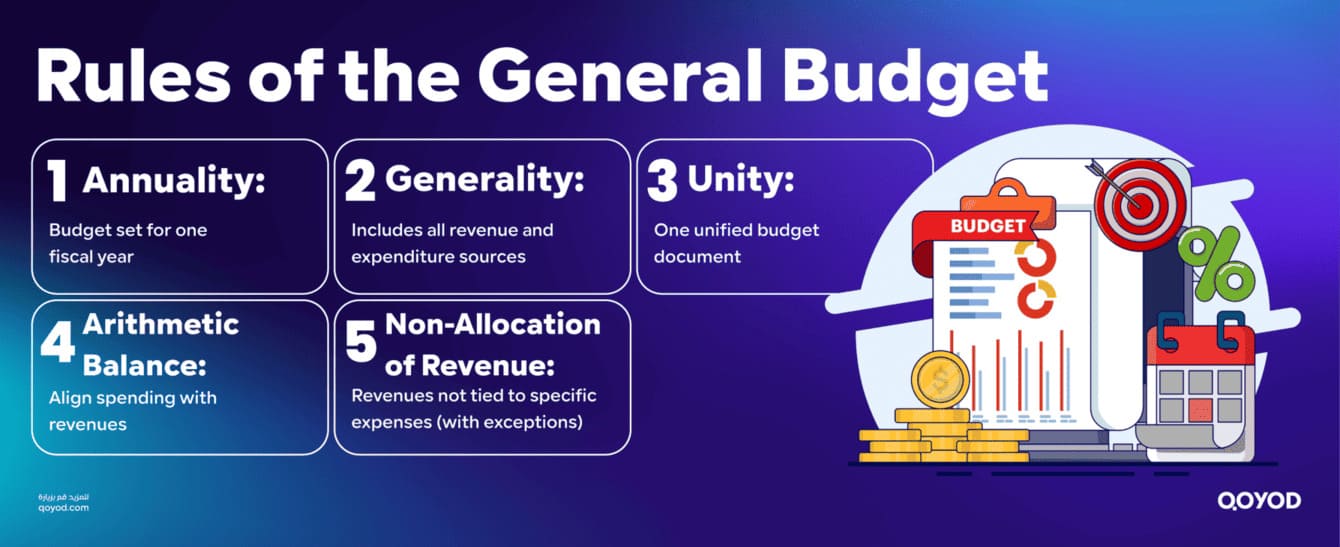
A few rules shape how a general budget is written.
- Annuality (Yearly Basis): The plan covers one fiscal year. It is rebuilt each year to match current needs.
- Generality (Comprehensiveness): It must cover every source of income and every area of spending.
- Unity: One document holds all the state’s revenue and all its costs.
- Arithmetic Balance: Spending is arranged to match revenue. That keeps the books clear of a deficit or an idle surplus.
- Non-Allocation of Revenue: No revenue line is tied to one spending line. All income covers all needs.
Note: All these rules have exceptions in special cases.
How to Prepare a Financial Budget?
A budget only works if it rests on facts. These steps get you there.
Historical Data
Start with your last two budgets. Long-term plans count as two periods as well. Read them for spending patterns and income sources you can trust.
Setting Forecasts
Use what you found to build new figures. Tie each one to a goal the new budget has to hit.
Identifying Factors Influencing the Budget
You need a clear read on the market and on how the business runs. That is how you spot the forces that can knock the plan off course, inside the company and outside it. Plan around them. Ask investors and owners too, since they often see openings the team misses.
Financial Allocation
Decide how much each activity gets. Study what each one really needs. Never set a figure without the analysis behind it.
Review and Analysis
Check that the figures behind your forecasts are correct. Then check that each one still points at the goal.
Implementing the Budget Plan
Share the plan with every department, watch how it is carried out, and track the results.
Example of Budget Preparation
Al-Rashidi Company trades paper products. Management asked for a budget plan for fiscal year 1446 (example year). Here is what the management accountant did.
- Listed every income source: sales, contributions, partnerships, and so on. Regular income came to 1,500,000 Riyals (example currency), plus 150,000 Riyals of irregular income during 1445.
- Recorded every cost: salaries, running costs, production costs, and the rest. That came to roughly 1,250,000 Riyals, plus 50,000 Riyals of irregular expenses in 1445.
- Built the 1446 budget as shown below (general percentages, and an example that works in any market).
| Income Statement | Income in 1445 (Actual) | Income in 1446 (Estimated) | Percentage Change |
| Total Revenues | 1,650,000 | 1,750,000 | ≈ 6.06% |
| Total Expenses | 1,300,000 | 1,000,000 | ≈ -23.08% |
| Gross Profit | 350,000 | 750,000 | ≈ 114.29% |
The accountant then set four goals to lift net profit.
- Switch to lower-cost marketing plans, digital first.
- Study competitors and shape products around what customers ask for.
- Reach new markets and push e-commerce harder.
- Build partnerships that make the company a better bet for investors.
Mistakes to Avoid When Preparing a Budget
A few mistakes sink budgets and waste company resources. Watch for these.
- No clear, realistic plan tied to real figures.
- No follow-up once the plan is live, and no changes when the business shifts.
- No money set aside for unexpected expenses, such as an emergency.
- Leaning on loans when the cash on hand would do.
- Skipping proper budget preparation methodologies.
- Lumping revenue and spending together instead of breaking them down.
Budget (Budget) vs. Balance Sheet (Mizaniya)
A Balance Sheet and a Budget both help you manage money well. They are not the same thing. This table shows where they differ.
| Point of Comparison | Balance Sheet | Budget |
| Responsibility | Falls under the responsibility of the Financial Accountant. | Falls under the responsibility of the Management Accountant. |
| Nature of the Plan | A financial plan based on actual figures derived from historical statistics. | A forecasting financial plan based on predictions that have not yet occurred. |
| Timing of Planning | Prepared at the end of the fiscal year. | Prepared at the beginning of the fiscal year. |
| Components | Assets, Liabilities, Equity (Net Assets). | Expected Revenues, Expected Expenses, Expected Net Profit. |
| Importance | Measuring historical financial performance. | Organizing future financial performance. |
| Goal | Clarifying the economic position and achieving financial transparency. | Forecasting the volume of future revenues. |
Challenges in Estimating the Budget
A few things can throw a budget off while you build it.
- Estimates built on unstable factors, or an event nobody saw coming.
- Lack of information, often because access is limited.
- Conflict of interests, with each department pushing for a bigger share.
- Shortage of staff, and too little experience among them.
FAQ: Financial Budgeting for Global Businesses
A budget is a provisional financial plan for a specific period that outlines expected revenue sources and planned expenditures, aiming to organize resources and achieve the goals of an organization or state with higher efficiency. It helps control expenses, avoid waste, and direct funds to priority activities, ensuring business sustainability and the ability to finance future expansion. The Budget is a predictive document prepared at the start of the financial period to estimate future revenues and expenditures for planning and control purposes. The Balance Sheet is a financial statement prepared at the end of the period to show the actual financial position of assets, liabilities, and equity, used to measure historical performance and show economic status with transparency. There is the Short-Term Budget (one year or less), focusing on daily operations and immediate goals, and the Long-Term Budget (three to five years), used for investment and expansion decisions. There is also the Rolling/Continuous Budget, which is regularly updated by adding a new period as a preceding one ends, providing flexibility to adapt to changes. There is the Static Budget, which is built on a fixed activity level and does not change even if production or sales volume changes, making it simpler but less accurate in volatile environments. In contrast, the Flexible Budget is prepared for different activity levels, allowing estimates to change automatically with the volume of work, providing a more accurate reading of actual performance. They include the Capital Budget, concerned with strategic projects and the purchase of fixed assets, and the Operating Budget, covering operating revenues and current expenses. Additionally, there is the Cost Budget, which focuses on estimating direct and indirect costs to improve the efficiency of resource use and reduce unit cost. The budget aims to achieve organized financial planning that prevents resource waste and links spending to priorities and strategic goals. It also seeks to control spending, reduce losses from uninformed decisions, support financial decision-making, and focus management on core objectives and expansion plans in a responsible and disciplined manner. The budget aggregates all available income and funding sources and links them to various uses, enabling management to allocate resources to the most profitable and impactful activities. This approach reduces unnecessary expenses, improves the entity's ability to utilize its assets, directs liquidity towards high-return projects, and maintains stable cash flow.What is a Financial Budget?
What is the difference between a Budget and a Balance Sheet?
What are the types of Budgets by Time Horizon?
What are the types of Budgets by Organizational Activity?
What are the types of Budgets by Costs?
What are the most important goals of Budget Preparation?
Why is the Budget an important tool for Resource Management in an Entity?
Budget Preparation Software
Qoyod Accounting Software is one of the best tools for building budgets of every kind. It is a smart program that plans ahead using the figures you hit in past years. So it manages revenue and spending for you, and it helps you set automated and auditable budgets. It also covers enough day-to-day accounting to make financial planning simple.
Try Qoyod Accounting Software now to make your business operations easier and more accurate with solutions designed for modern businesses.